
Paying with Foreign Credit Cards in Colombia: Cuotas, DCC Markups, and Datáfono Rules
A checkout script for foreign Visa and Mastercard holders in Colombia: answer the cuotas question, choose pesos on the datáfono, read the receipt, and know when a card surcharge is not allowed.
IDIOMA DEL ARTÍCULO
Showing original language
You tap your card at a corner café, and the cashier asks two things in quick succession: “¿A cuántas cuotas?” and then, when the terminal wakes up, “¿Pesos o dólares?” Neither question is a trick, but both are easy to answer wrongly when there is a line behind you.
Short answer: say “una” (one) to the cuotas question, and choose pesos (COP) on the currency screen unless you have read that terminal’s own rate and still prefer your home currency. The rest of this guide explains why, and what to do if a shop adds a surprise charge. For the broader question of which card to carry, see our credit cards guide for foreigners; this article is only about the moment at the datáfono.
What DCC is on a Colombian datáfono
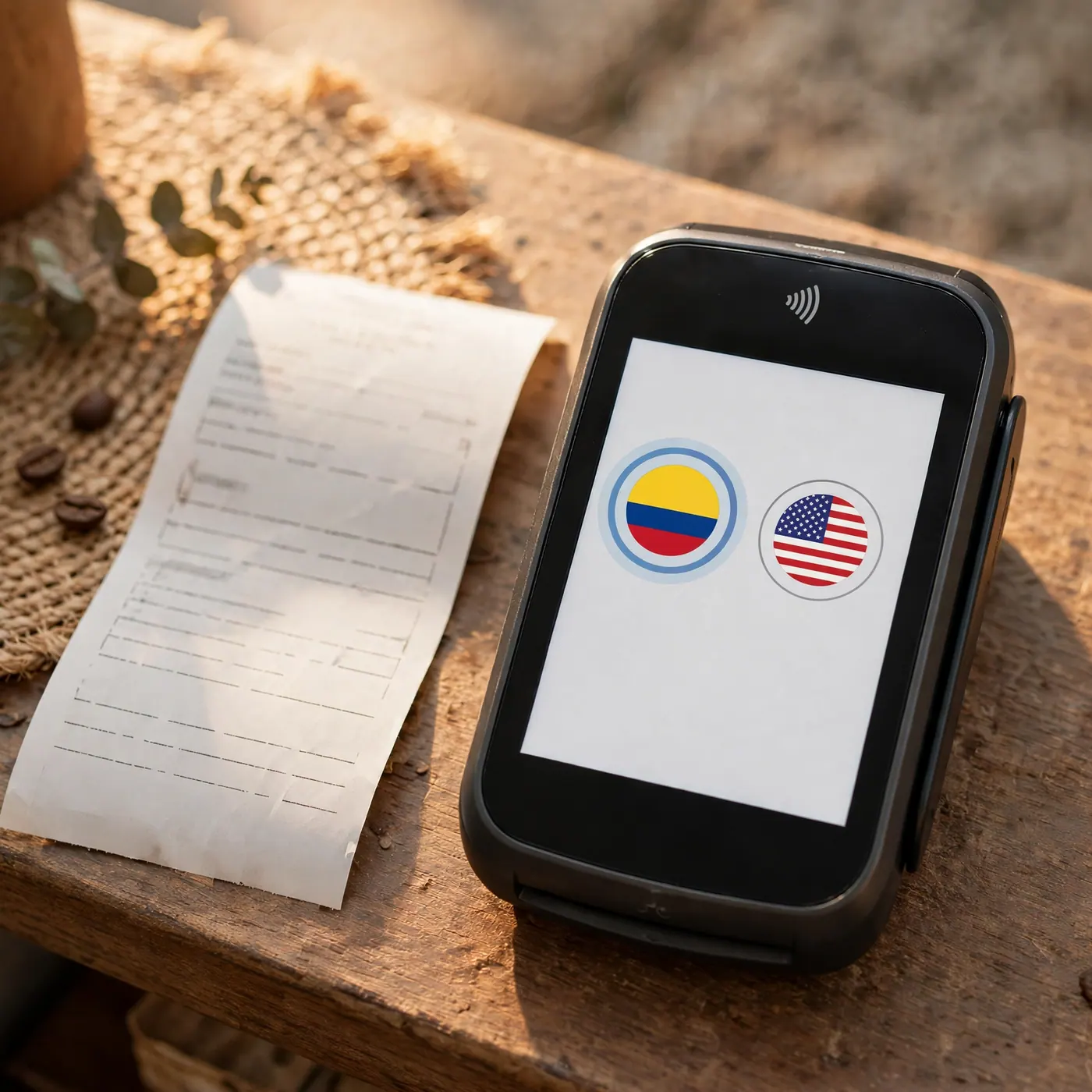
The “pay in your currency” screen is Dynamic Currency Conversion (DCC). It looks like a courtesy, but it is a product sold to merchants. Redeban brands its version “Paga en tu moneda”: the cardholder selects the card’s home currency on the terminal, and the merchant is still paid in pesos. Redeban says the service works with Visa and Mastercard, and its pages mention up to 150 currencies on the merchant page and more than 140 on the financial-institution page. Credibanco and Bold sell DCC as well.
Here is the detail most guides skip. Redeban says the merchant receives an extra 1% of the DCC purchase, credited monthly in pesos. Credibanco describes a 1% merchant incentive per DCC purchase on international Visa cards, and Bold says international-card datáfono sales get a 1% commission discount for the merchant. That 1% is the merchant’s incentive, not the fee on your statement. What you actually pay is the exchange rate printed on that terminal, plus whatever your own issuer charges. I could not find any operator publishing a national cardholder markup, so be suspicious of anyone quoting one as fact.
Coverage also changes. Bold’s product note dated 19 September 2025 described a USD-or-COP choice, Mastercard on its Smart Pro, Smart and Neo datáfonos, and Visa plus Mastercard on online payment links, and said more currencies and terminal brands were coming. Treat the terminal in front of you as the final word. ATM screens make the same kind of offer; that is covered in our ATM fees guide.
How to answer “¿A cuántas cuotas?”
Cuotas are installments. Colombian cardholders routinely split purchases over several months, and cashiers ask by reflex. With a foreign card, answer “una” or “1” and watch the screen.
To be clear about what the law does and does not say: I found no Superfinanciera order requiring cashiers to key foreign cards as one installment, so do not argue that at the counter. The practical reality is that multi-cuota plans normally run between a local acquirer and a Colombian issuer, and a foreign card often cannot enter one. If the terminal rejects anything other than a single payment, ask the cashier to run a new charge as one payment.
You may see Ley 1480 de 2011, article 45, parágrafo 2, quoted online. It says that on consumer credit covered by that article, the number of installments must be agreed with the consumer and a contract may not force a minimum number. That protects borrowers from seller or lender financing; it is not a foreign-card rule.
What the screen and receipt must show
If the terminal offers a currency choice, the process is supposed to be transparent. Visa says a DCC offer must show both amounts and currency symbols, the exchange rate, and any markup or extra fee, on the screen and on the receipt. The merchant must not choose for you or steer you with font size or colour, and accepting or declining should not affect your ability to buy. Mastercard’s 2025 merchant guide goes further: no conversion method may be the default, automatic DCC is not allowed, and without your explicit choice the sale must be processed in local currency. Both are card-network standards, not Colombian statutes with a peso penalty.
Redeban’s AndroidPRO manual, dated 26 December 2024, shows the flow: amount, an optional tip prompt, then a currency screen with an exchange rate, and a confirm key. Other terminal brands may differ.
- Hold the terminal (or watch it) while you pay.
- Select COP yourself; do not let the cashier tap for you.
- Read the receipt before leaving: the currency and amount should match what you chose.
My honest take: the pesos option is boring and usually right, because your issuer then converts under your own card terms, which you can check in advance. The downside is that you cannot see the final home-currency figure until the statement arrives. If a terminal opens with your home currency preselected, ask for pesos. If the cashier refuses to redo it, Visa’s advice is to decline the sale and tell your issuer.
Card surcharge versus cash discount
This is where shops overstep. Under Ley 1480 de 2011, article 26, the provider must show the public price in Colombian pesos, including taxes and additional costs, and the consumer only has to pay the announced price; any extra cost must state its reason and amount. The SIC’s price guidance adds that an extra sum for paying by credit card, not included in the announced price, cannot be collected. The announced price is the maximum.
A real cash discount is a different thing. A lower price for cash is allowed only when that condition is disclosed clearly and completely. A higher card price that was never the announced price does not qualify. So “plus 5% for the datáfono” at the register, after a shelf price with no such note, is not something you have to pay.
One restaurant aside: tips are voluntary under the SIC’s explanation. A suggested propina is not a card surcharge, and you can refuse it or change the amount. It still should not be added silently before you confirm the card amount. If you need to escalate a surcharge, our SIC complaint guide shows the filing path.
If the charge is wrong
- Photograph the announced price (shelf, menu or sign) before you leave.
- Keep the receipt that shows the currency and amount.
- Ask for a void and a new charge in the same currency as the original; Mastercard’s rules require refunds in the original currency.
- If the shop will not fix it, file with the SIC. Filing a consumer complaint on its portal carries no fee.
Set expectations honestly: a denuncia seeks an administrative investigation and a possible fine in the collective interest, while getting one charge reversed is a separate individual claim. I cannot promise a refund timeline or a fine amount. Also check your issuer’s own foreign-transaction schedule, since that varies by card.
If a merchant has no terminal you trust, a Bre-B QR is a different payment rail altogether; our WanderWallet checkout guide covers it.
Frequently Asked Questions
❓ Should I choose dollars or pesos on the datáfono?
Choose pesos unless you have read that terminal’s rate and still want the home-currency option. The merchant may be paid to offer DCC, while your issuer converts a peso charge under your own card terms, so compare before choosing otherwise.
❓ What do I say when they ask how many cuotas?
Say “una”, meaning one. The question is about the local installment plan, not a Superfinanciera order for foreign cards, and a foreign card often cannot be split. If the terminal rejects more than one payment, ask for a fresh single charge.
❓ Can the shop add a percentage because I paid by card?
Not on top of the price they already announced. Under Ley 1480 de 2011, article 26, and the SIC price page checked 13 October 2026, the announced peso price is what you must pay. A cash discount that was clearly disclosed in advance is a different practice.
❓ Is the 1% the fee I pay for DCC?
No. Redeban and Credibanco describe 1% as money the merchant receives on a DCC sale, and Bold describes a 1% commission discount for the merchant. Your own gap is the rate on the screen plus your issuer’s charges, and no national tariff is published.
❓ Does Bold work the same as Redeban?
Not on the documents checked on 12 October 2026. Bold’s 19 September 2025 note covered USD versus COP, Mastercard on three datáfono models, and Visa plus Mastercard online, and said more coverage was coming. The terminal in front of you decides.
❓ If I reject the dollar amount, can they refuse my card?
Visa says choosing or rejecting DCC should not stop the purchase, on its consumer page checked 13 October 2026. If the cashier will not rerun the charge in pesos, keep the receipt and use the SIC complaint path rather than arguing about a fine amount.
❓ Is a suggested restaurant tip a card surcharge?
No, and you can refuse it or change the amount. The SIC treats tips at food and drink places as voluntary. It still should not be added in silence before you confirm the card amount.
Sources
- SIC, Inconvenientes con el precio
- Ley 1480 de 2011, artículo 26 (SISJUR)
- Ley 1480 de 2011, artículo 45 (WIPO Lex)
- Redeban, Paga en tu moneda (comercios)
- Redeban, Paga en tu moneda (entidades financieras)
- Credibanco, DCC
- Bold, DCC note, 19 September 2025
- Visa, Dynamic Currency Conversion
- Mastercard, DCC Performance Guide 2025 (merchant version)
- Redeban, AndroidPRO user manual, 26 December 2024
- SIC Sede Electrónica, denuncia de protección al consumidor
- SIC, formulario de denuncia del consumidor
- SIC, Denuncias y demandas en materia de protección al consumidor



Comments
Loading comments...
Checking sign-in status...