
Mandatory Highway Safety Kit in Colombia: Law 769 Items, the C.11 Fine and Highway Stops
The nine items Article 30 of Law 769 requires in every car, what the C.11 fine means, and how a highway stop works, written for foreign drivers, renters and used-car buyers.
IDIOMA DEL ARTÍCULO
Showing original language
Quick answer: before any highway drive, your car needs the nine items listed in Article 30 of Law 769 of 2002. If one is missing, the infraction is code C.11, fined at 15 current legal daily minimum wages (15 SMLDV). The C.11 line does not say the car will be immobilized or impounded, whatever you read in forum threads.
I check the trunk before every road trip, usually at a gas station where I can lay everything out on the ground. It takes five minutes, and it is the cheapest insurance against a roadside argument you do not want. The law calls it the equipo de prevención y seguridad; everyone else says equipo de carretera. It is a separate matter from your license (see our guide to foreign license rules for tourists), SOAT and the vehicle inspection.
The nine items Article 30 requires
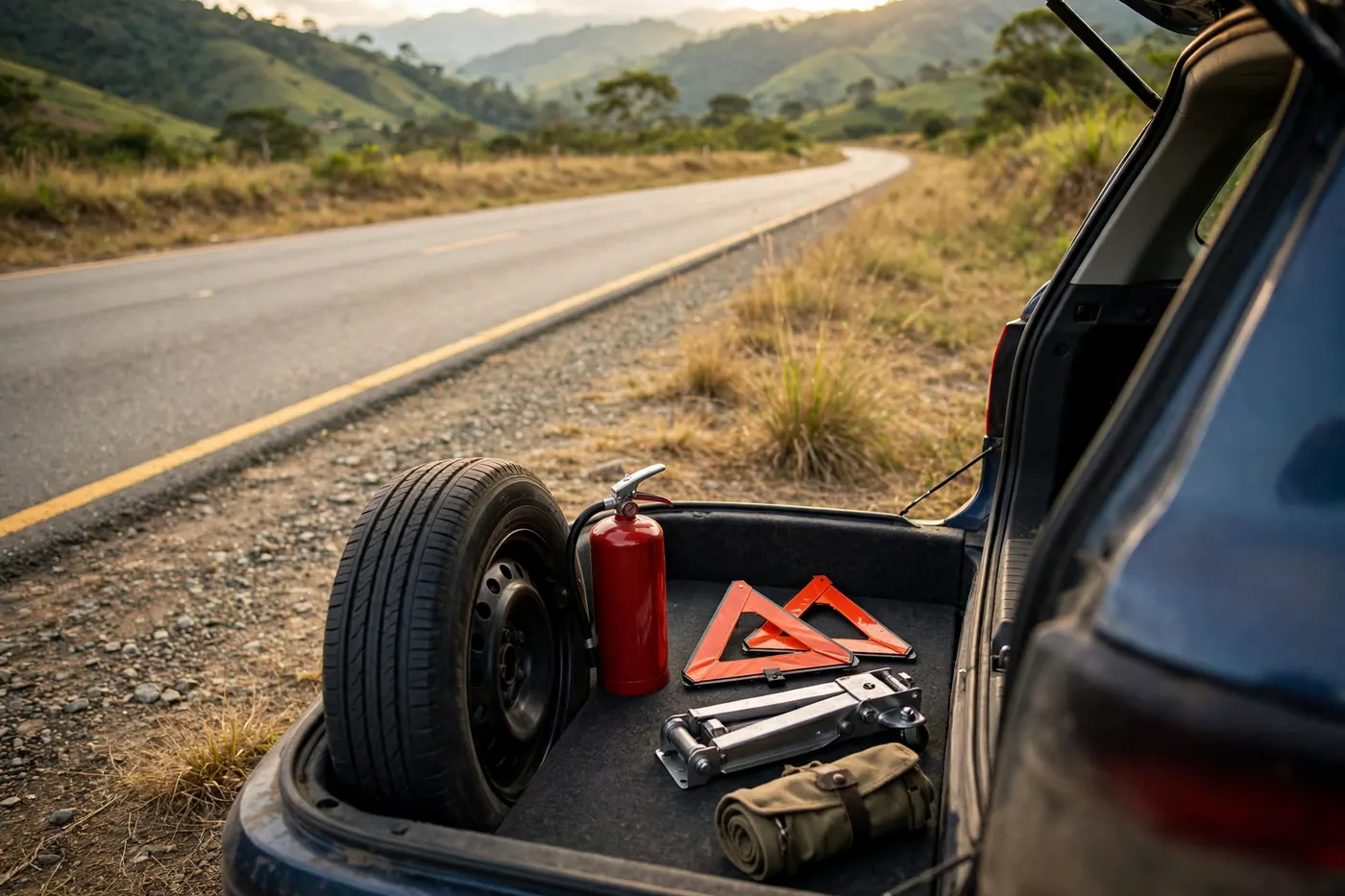
Article 30 says no vehicle may use national roads without, at minimum, the following. Here they are in the statute's order, each with the check I actually do.
- A jack able to lift the vehicle. Do not just see it, use it. Plenty of rental cars carry a jack that is the wrong one or seized with rust.
- A lug wrench (cruceta). Make sure it fits your wheel nuts, including any anti-theft lock nut.
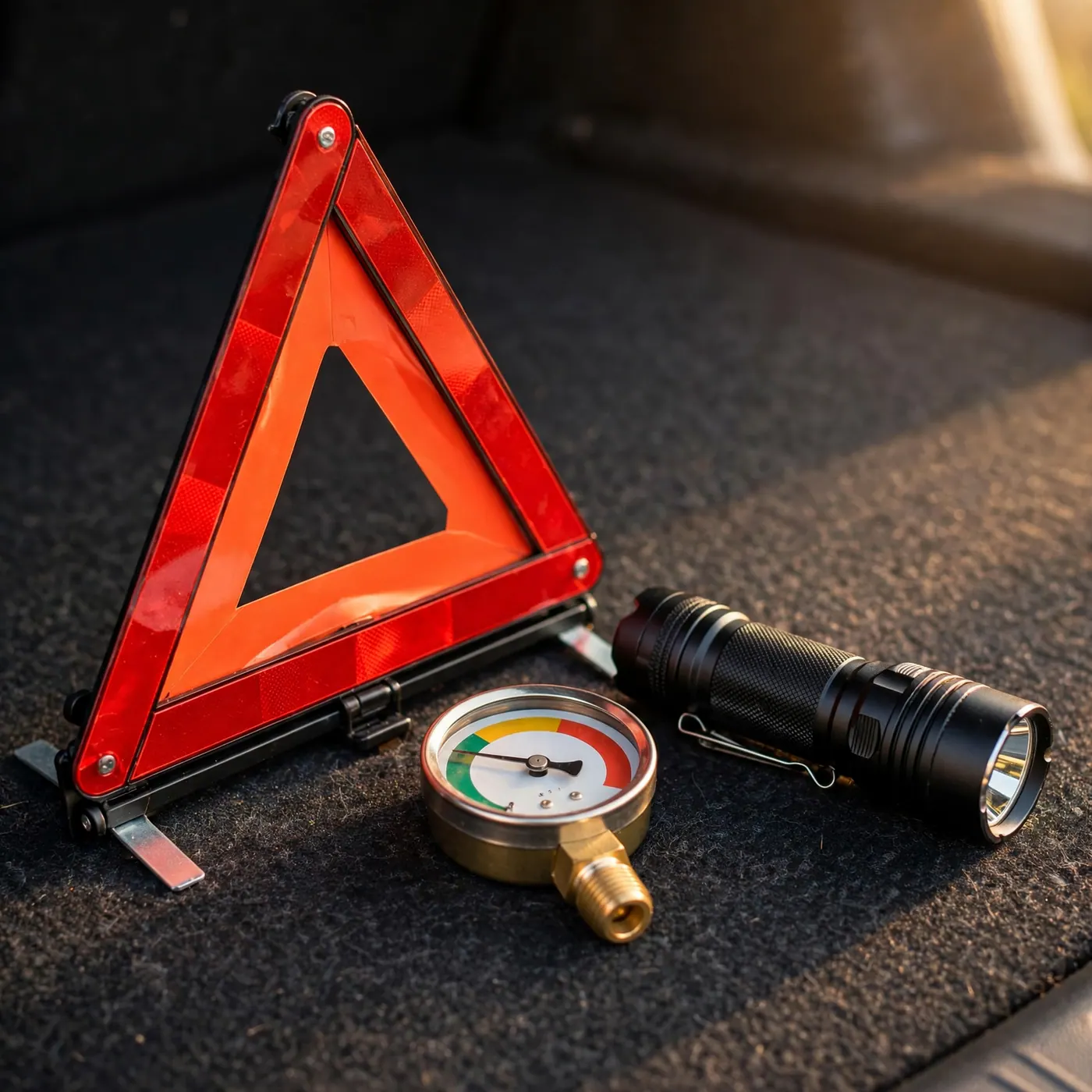
- Two reflective triangle signals with supports for vertical placement, or amber flashing/strobe lamps. Unfold them and confirm they stand upright. If you use lamps, test the batteries.
- A first-aid kit. It must be in the car. Opening it and finding it is full of dust is a good reason to restock.
- A fire extinguisher. Look at the gauge and the date. A discharged extinguisher is useless in an emergency.
- Two wheel chocks (tacos). They are small wedges, easy to forget, and often missing from used cars.
- A basic tool box with pliers, screwdrivers, an adjustable wrench and fixed wrenches. Count the categories against that list.
- A spare tire. Press it. A flat spare is the same as no spare when you are on the shoulder.
- A flashlight. Put in fresh batteries and test it.
That is the full list. Honest downside: nothing in the statute tells you how much of each item is enough, so a check at a stop can feel subjective. Having everything present, clean and working is the best answer to that.
What the statute does not say
A lot of online lists add things the law does not. The statutory C.11 kit has nine items, and a reflective vest is not a tenth one. I still carry one, because it is sensible when you walk back to place a triangle, but it is not what the fine is based on. The same goes for cones, flares and a specific list of medicines.
The transit rules also do not set out what goes inside the first-aid kit. In a legal opinion dated 31 October 2024, the Ministry of Transport said an expired item such as saline is not, by itself, a typed C.11 offense. That opinion is non-binding under Article 28 of the CPACA, so an officer may see it differently, and you would contest the ticket at a hearing. But the kit itself still has to be in the vehicle.
Extinguishers work the same way. A 20 November 2025 ministry opinion says the code sets no capacity class, size, location or mounting rule, and recommends the technical standards NTC 3808 and NTC 2885. It also says there is no separate lithium-battery extinguisher rule. Again, this is non-binding. Practically, buy a charged, in-date extinguisher sized sensibly for the vehicle and mount it where you can reach it.
Who can stop you, and how the stop works
On national highways outside the urban perimeter, the Policía de Carreteras applies the transit code. After Law 1310 of 2009, the Consejo de Estado (Concepto 2034 of 2011) reads municipal and district rural perimeters as belonging to local transit authorities. Inside town, expect local transit agents instead. If you are moving household goods by road, a different set of questions applies, covered in our intercity moving guide; this article stays on private cars.
Highway checks are common on weekend trips, so know the procedure. Under Article 22 of Law 1383 of 2010:
- The officer orders the vehicle to stop and, for a contravention, issues a written comparendo.
- The comparendo orders you to appear within five business days, and you are given a copy.
- If the driver will not sign or will not show the license, a witness signs. That witness must be identified with a cédula or passport, plus address and phone if any.
- For highway police, their copy is delivered through the route commander or service commander.
Paying less, or contesting
If you accept the infraction, Article 136 allows payment of 50% within five days, or 75% within twenty days, but only if you also take the mandatory transit-norms course at a transit agency, driving school or integral attention center registered in RUNT. If you miss those windows, the statute requires 100% plus late interest. If you reject the charge, the case goes to a hearing.
Do not argue with the officer, and do not treat a ministry concept as a paper that cancels a ticket on the spot. Take your copy and deal with it through the proper channel. Tickets are paid through the transit authority or its official payment channel. Nobody needs a private "kit certification" fee, and no payment speeds up a transit procedure.
I will not print a peso figure for C.11. It is 15 SMLDV, so the amount changes whenever the minimum wage changes. Check the current number with the transit authority that issued the ticket.
Cars with no spare, and motorcycles
Article 30 still lists a spare tire. A 30 May 2025 ministry concept quotes Circular 20174000431181 of 17 October 2017: vehicles that, by technical design, have no spare and can keep moving should not receive a comparendo for that reason. The circular does not repeal Article 30 and the concept is non-binding. If your car came with a sealant kit or run-flat tires, keep the original documentation and any manufacturer information handy.
Motorcycles are not exempt by statute. A 29 July 2024 ministry opinion says demanding the full Article 30 kit on a motorcycle is not reasonable because the bike cannot physically carry it. That opinion does not bind an officer. If you ride, carry what you reasonably can, such as a flashlight, basic tools and a tire repair kit.
Rentals and used cars: check the trunk first
The fine can name the driver and/or the owner. A rental agreement is not an exemption, and a clause in the contract is not a defense at the shoulder. So before you drive off the lot, open the trunk and go through the nine items. Photograph anything missing and ask the agency to add it before you leave.
Same logic for buying a used car. Missing wheel chocks or a dead extinguisher are cheap fixes, but they also tell you how the previous owner treated the car. Do the trunk check alongside the paperwork steps in our used-car paperwork and RUNT inspection guide.
What the kit does not replace
The carried kit is separate from your driver's license, SOAT and the técnico-mecánica inspection. For inspection validity and tariffs, see our técnico-mecánica guide. For city driving restrictions, read the pico y placa guide for foreigners. Have a question about driving rules? Ask in the Colombia Move community.
Preguntas frecuentes
❓ What has to be in a Colombia highway kit?
Article 30 of Law 769 requires nine items: a jack, lug wrench, two reflective triangles, first-aid kit, fire extinguisher, two wheel chocks, basic tool box, spare tire and flashlight. Amber flashing or strobe lamps may replace the triangles. (verifica en la fuente oficial)
❓ What is the fine if something is missing?
Missing the kit is code C.11, fined at 15 current legal daily minimum wages, against the driver and/or owner. The C.11 line does not order immobilization or impoundment. The peso amount changes with the minimum wage, so confirm it with the issuing transit authority. (verify with the official source, as accessed)
❓ Can I be fined for an expired item in the first-aid kit?
The kit itself must be in the car. The Ministry of Transport's non-binding opinion of 31 October 2024 says transit rules do not specify contents, so an expired item is not by itself a typed C.11 offense. You can contest at the hearing. (verify with the official source, as accessed)
❓ Does the extinguisher need a specific size?
It must be carried, and it should be charged and in date. A non-binding ministry opinion of 20 November 2025 says the transit code sets no capacity class, size or mounting rule, and recommends standards NTC 3808 and NTC 2885. (verify with the official source, as accessed)
❓ Do motorcycles need the same kit?
Article 30 is written for vehicles generally. A non-binding ministry opinion of 29 July 2024 says demanding the full car kit on a motorcycle is not reasonable, but it does not bind an officer, so carry what you sensibly can. (verify with the official source, as accessed)
❓ My car has a tire-repair kit and no spare. Is that a ticket?
Article 30 still lists a spare. A 2017 circular, quoted in a May 2025 ministry concept, says cars designed without one that can keep moving should not be ticketed for that. The reading is non-binding, so keep your manufacturer documentation. (verify with the official source, as accessed)
❓ What should I do at the stop, and can I pay less?
Take your copy of the comparendo and appear within five business days. If you will not sign, a witness with a cédula or passport signs. You may pay 50% within five days or 75% within twenty only if you accept the charge and take the RUNT-registered course. (verifica en la fuente oficial)


Comments
Loading comments...
Checking sign-in status...