
How to Pay Your Domestic Worker's Social Security on MiPlanilla (PILA) in Colombia
A practical walkthrough for expat household employers: register on a PILA operator, choose cotizante 2 or 51, use UGPP's 2026 contribution tables and pay on time.
IDIOMA DEL ARTÍCULO
Showing original language
You hired someone to clean your apartment, you know you owe health, pension, ARL and caja contributions, and now you are staring at a payment portal wondering which box to tick. That is the exact point where most foreign employers stall. This guide covers the payment side only: registering on an operator, picking the right planilla, using the 2026 tables and paying on time.
Quick answer: household work is an employment relationship, so contributions are paid monthly through a PILA operator such as MiPlanilla, after the worker is affiliated to EPS, pension fund, ARL and a caja de compensación. Full-time (30 days in the month) uses Planilla S with cotizante 2. Under 30 days uses Planilla E with cotizante 51.
Why this is a PILA job and not an invoice
UGPP is clear that a household domestic relationship is a contrato de trabajo, not a contrato de prestación de servicios. Full-time means 30 days in the month. Medio tiempo or por días means periods under 30 days, and each employer signs a separate contract with the worker. Calling the arrangement "freelance" does not move it out of the system.
For the broader picture of when you count as an employer and which benefits exist, read our legal guide to hiring a domestic worker. This article starts after you have decided to hire and need to pay correctly.
One thing to know up front: MiPlanilla is one operator, not the only one. UGPP lists Aportes en Línea, Arus, Asopagos, Mi Planilla, Simple and SOI. Pick one and stay with it, because corrections to a planilla stay with the operator that processed it.
Register as the employer on MiPlanilla
MiPlanilla offers a "Servicio doméstico" path in its independent registration. It lets you pay the worker's health, pension, ARL and caja without paying contributions of your own as an independent. One independent login can add the domestic worker and generate that planilla separately. The portal can also be used from outside Colombia.
Honest warning: the worker record asks for a document type. The live form lists foreign options such as cédula de extranjería and pasaporte for the worker, but I would not assume that a passport-only employer login will pass every check. Use the document type the live form accepts for you, and if it rejects you, sort out your own ID status before the deadline, not on it.

Affiliate first, pay second
You cannot pay a planilla for someone who is not affiliated. The worker chooses the EPS (for full-time work), the pension fund (AFP), the ARL and the caja. You, as employer, file each affiliation form. Only then does the monthly planilla make sense.
Caja affiliation is mandatory for natural-person domestic employers, and caja is paid through PILA. For a full month, the caja base cannot be below one SMMLV. UGPP's domestic tables list health, pension, ARL and caja only. There is no SENA 2% or ICBF 3% line, so do not add one.
Cotizante 2 or cotizante 51: choose the right planilla
This is where the legal risk sits, so read it twice.
- Full-time (30 days): Planilla S, cotizante 2. MiPlanilla labels it "Servicio doméstico".
- Medio tiempo or por días (under 30 days): Planilla E, cotizante 51. MiPlanilla labels it "Tiempo parcial".
On MiPlanilla, cotizante 51 requires fewer than 30 days in the month, pay under one SMMLV, an employment contract, and subsidized health or contributory-beneficiary status. Part-time ARL is reported on 30 days at one SMMLV.
Pay in kind has a ceiling: food and housing cannot exceed 30% of the minimum wage. Half-time pay may be half a minimum, and a day rate is referenced to the minimum and may legally be higher.

The 2026 numbers: full-time on one minimum wage
Decreto 1469 de 2025 sets the 2026 monthly minimum at COP 1,750,905 from 1 January 2026. A nullity case exists against it, and a provisional suspension issued in February 2026 was later revoked. UGPP is publishing tables based on that figure, so use them, but recheck the UGPP ABC page if a court changes the minimum.
UGPP's 2026 full-time table on one minimum wage:
| Subsystem | Employer | Worker (withheld) | Total |
|---|---|---|---|
| Health (8.5% / 4% / 12.5%) | COP 148,827 | COP 70,036 | COP 218,863 |
| Pension (12% / 4% / 16%) | COP 210,109 | COP 70,036 | COP 280,145 |
| ARL (0.522%) | COP 9,140 | - | Employer only |
| Caja (4%) | COP 70,036 | - | Employer only |
You withhold the worker's 4% health and 4% pension shares from their pay. ARL and caja are on you. The operator's PDF controls the final amounts to the peso, so treat this table as a sanity check, not a substitute. Do not use the 2025 figures still shown on UGPP's sister page.
Day and part-time workers: the weekly bands
For workers under a full month, pension and caja follow weekly bands. Days worked for you in the month decide the band:
| Days in month | Pension (total cotización) | ARL | Caja |
|---|---|---|---|
| 1-7 | COP 70,036 | COP 9,140 | COP 17,509 |
| 8-14 | COP 140,072 | COP 9,140 | COP 35,018 |
| 15-21 | COP 210,108 | COP 9,140 | COP 52,527 |
| More than 21 | COP 280,145 | COP 9,140 | COP 70,036 |
The pension column is the full 16% cotización, not the employer-only 12%, so remember to withhold the worker's 4% share. Many guides get this wrong. If the worker is in the subsidized health regime or is a beneficiary in the contributory regime, there is no health contribution from you. More than 21 days but less than a full month, with pay under one minimum, still means full pension and caja and no health line in that situation.
I will not give you one "half-time costs exactly X" number, because UGPP both places medio tiempo on cotizante 51 and prints a full-minimum table for "tiempo completo o medio tiempo". Enter the real salary and let the operator apply the minimum-base and cotizante 51 health rules. Our day-worker social security post is a companion, but follow the total-cotización column above.
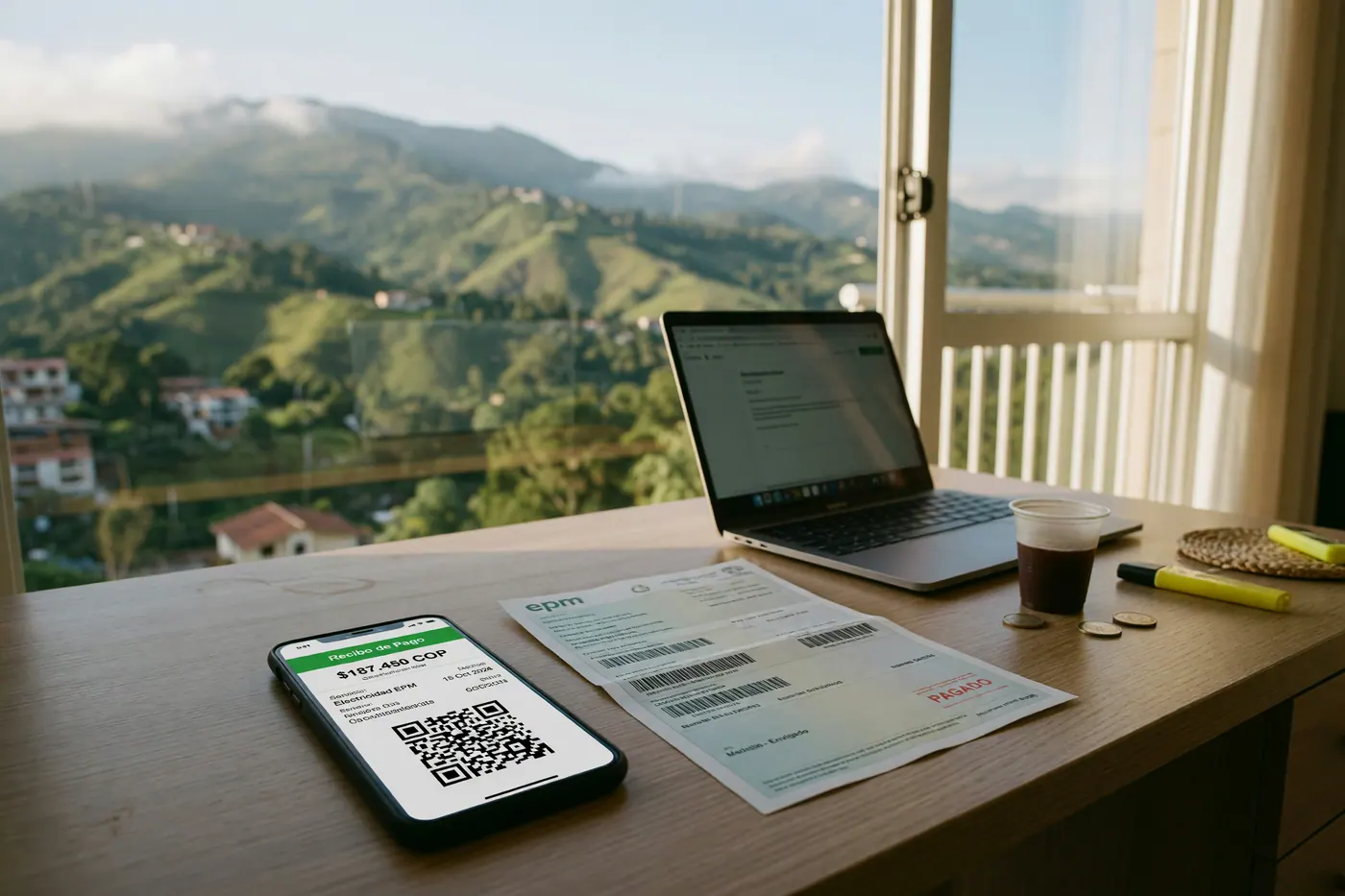
Generate the planilla and pay it
The operator manual describes this logged-in sequence for full-time: Empleados, then type 2 Servicio Doméstico, then Generar Planilla with the domestic S option, and pay only after the PDF shows the PAGUE AQUÍ step. Button labels move around, so treat them as operator interface, not law.
Deadlines follow Decreto 923 de 2017: the business day depends on the last two digits of your NIT or ID, starting on the 2nd business day for digits 00-07 and ending on the 16th for 94-99. I am not printing a calendar date because holidays shift it. Households with one or two cotizantes may use electronic or assisted payment.
- PSE: needs a Colombian bank account. Do not count on a foreign Visa or Mastercard working.
- Pago asistido: pay in person with the planilla number.
The certificate is immediate after PSE, or within 24 business hours after an in-person payment. Late payment adds mora interest, calculated by the operator. Check the administradoras listed on the PDF before you pay.
Pension reform: nothing extra for you to split
Since 1 August 2025 the PILA operator disperses pension contributions under Ley 2381 de 2024. You do not change payroll fields or file a second planilla. A worker who meets the weeks test (as of 1 July 2025: 750 for women, 900 for men) with a base at or below 2.3 SMMLV has the pension contribution routed to Colpensiones. Otherwise it follows their chosen fund. That is the operator's job, not yours.
What PILA does not cover
Prima de servicios is a separate labor payment: 30 days of salary per year, half by 30 June and half in the first 20 days of December, proportional to time worked, and it includes domestic and day workers. Cesantías, their interest, dotación and vacaciones also sit outside the planilla. For formulas, use our labor law guide for expats and the Spanish-language guide on paying interest on cesantías.
Or skip being the employer
If monthly planillas, withholding and prima dates sound like too much, a cleaning service is a different relationship: the business handles its own staff. Our guide to hiring a maid or cleaning service compares both routes. A genuine outside business is not the same as relabeling your own worker. According to active listings on Colombia Move (October 2026), the limpieza category has 3 active service listings.
Mistakes I see most often
- Using cotizante 2 for someone who works two days a week.
- Charging a health line to a cotizante 51 who is a beneficiary or subsidized.
- Inventing SENA or ICBF lines. They are not in UGPP's domestic tables.
- Reusing a 2025 table, or the old example pesos on operator help pages.
- Paying before affiliation is complete.
- Trying to correct a planilla on a different operator than the one that processed it.
If you skip or get a month wrong, UGPP can flag the omission or wrong base and expect a correction on a planilla N, and an official assessment can follow. Fix errors early.
Frequently Asked Questions
❓ Do I use cotizante 51 if someone cleans only a few days a week?
Usually yes, if they work fewer than 30 days in the month, earn under one minimum wage, have an employment contract and already have subsidized or beneficiary health. Full-time 30-day work is cotizante 2 on Planilla S. Enter the real salary and let the operator apply the rules (verifica en la fuente oficial).
❓ Who pays the 4% health and 4% pension?
The worker bears those shares, and you withhold them from wages on a full-time planilla. ARL and caja in UGPP's domestic table are paid by the employer. A cotizante 51 generally has no health line when the worker is subsidized or a beneficiary. Confirm the amounts on the operator's PDF (verifica en la fuente oficial).
❓ Do I also pay SENA and ICBF?
No SENA or ICBF line appears in UGPP's domestic contribution tables. The household pays health, pension, ARL and caja through PILA, and caja affiliation is mandatory for natural-person domestic employers. Do not add percentages you have seen for companies (verifica en la fuente oficial).
❓ What if I am abroad or have no Colombian bank account?
The portal can be used from outside Colombia. PSE needs a Colombian bank path, so without one use pago asistido with your planilla number. Do not assume a foreign credit card will work, and check the payment options on the operator before the deadline (verifica en la fuente oficial).
❓ What happens if I skip a month?
The operator can add mora interest, and UGPP can ask you to correct an omission or a wrong base through a planilla N. An official assessment can follow if it is not fixed. Correct it on the same operator as soon as you notice (verifica en la fuente oficial).
❓ Does the August 2025 pension reform mean two pension planillas?
No. Since 1 August 2025 the operator disperses pension contributions under Ley 2381 de 2024, so you file one planilla. A worker who meets the weeks test and has a base at or below 2.3 SMMLV has the contribution routed to Colpensiones (verifica en la fuente oficial).
❓ Can I avoid PILA by calling it a prestación de servicios?
No. UGPP treats household domestic work as an employment contract, whatever label you use. Hiring a genuine outside cleaning business is a different relationship, but relabeling your own worker does not change your obligations (verifica en la fuente oficial).


Comments
Loading comments...
Checking sign-in status...