
How to Register and Sell a Lot in a Horizontal Property or Country Condominium
Learn how to sell a lot or plot within a country condominium in Colombia: Law 675 regulations, fees on unbuilt land, and notarial procedures.
IDIOMA DEL ARTÍCULO
Showing original language
Selling a plot within a gated country residential development or condominium does not work the same way as selling a traditional rural plot or an urban house. Many owners assume that because it is simply an undeveloped green plot, it is enough to agree on a price between private parties and sign a promise of sale. However, when the land is part of a co-ownership subject to the horizontal property regime in Colombia, specific legal obligations come into play that can halt the closing of the deal or lead to costly disputes if not managed in time.
From the mandatory collection of administration fees for plots where not a single brick has been laid, to the restrictions on facades, heights, and setbacks imposed by internal architectural manuals, today's buyer demands document clarity before disbursing funds. Anyone who has their papers in order, knows their duties under the law, and presents the property with transparency manages to close the deal faster and without giving away unnecessary commissions on intermediation.
The legal nature of the plot in horizontal property (Law 675 of 2001)
The starting point for selling with legal certainty is to understand under which legal framework the development is constituted. In Colombia, the horizontal property regime is regulated by Law 675 of 2001. When a developer builds a legal country condominium, they submit the plot of land to this regime through a public deed notarized and duly registered at the Office of Public Instrument Registration (ORIP).
This means that each resulting plot is a private unit of exclusive ownership and has its own individual real estate registration folio. It is not a partial share or an undivided percentage. In this regard, it is advisable to review how the general regulations of Law 675 on horizontal property operate to understand the scope of rights over common areas versus the private area.
In the rural real estate market, there are abundant irregular offers of so-called "pirate plots," where buyers are sold a false promise regarding a percentage of a larger farm without subdivision or development license. Facing that reality, having a plot duly registered under the horizontal property regime represents a decisive competitive advantage. The buyer obtains the certainty that they are acquiring a legally viable property, transferable in a formal manner by public deed and protected by urban planning licenses compliant with Decree 1077 of 2015.
Why must an unbuilt plot pay an administration fee?
One of the most recurring doubts among those who own country plots is whether a piece of land without a house built on it has the obligation to assume monthly common expenses. It is common to hear complaints like "I don't consume water, I don't use the pool, and I barely visit the plot once a year". However, Colombian legislation is categorical on this point.
Paragraph 2 of Article 29 of Law 675 of 2001 expressly determines that the obligation to contribute timely to necessary common expenses exists even when the owner does not occupy their private property or the plot is undeveloped. The ordinary administration fee does not only compensate for services consumed individually, but for the permanent maintenance of the co-ownership: security at the entrance, perimeter fencing, maintenance of internal paved or gravel roads, utility networks, communal lighting, and environmental conservation.
To delve deeper into the calculation of these obligations and the collection mechanism, you can consult our guide on how to charge and pay the administration fee in horizontal property. The fee is calculated by applying the co-ownership coefficient assigned to each private unit in the original regulation, which is usually calculated based on the area of the plot relative to the total private areas of the condominium.
The administration clearance certificate and its impact on the notary
At the time of formalizing the public deed of sale, the notary is required by law to demand the administration clearance certificate (paz y salvo de administración) issued by the administrator or legal representative of the co-ownership. This document certifies that the property is up to date with all its financial obligations to the condominium up to the date of signing.
If the seller presents pending balances or past-due fees and does not provide the clearance, the deed cannot be granted regularly unless the provisions of Article 29 of Law 675 are applied: that the request for the certificate is noted in the instrument and that the new buyer contractually assumes the joint and several liability for existing debts to the co-ownership. In practice, almost no buyer or financial institution agrees to sign while assuming someone else's debts.
If you need to structure this requirement well in advance of the signing date, check the detailed steps for processing the administration clearance certificate to sell or rent properties. Clearing the balance with the administration before setting the notary date avoids forced extensions of the promise of sale or the collection of penalty clauses for non-compliance.

What the buyer will demand of you: Architectural manual and condominium licenses
Whoever buys a country plot seeks to realize a project for rest, permanent living, or investment. For that reason, their main concerns will revolve around what they can and cannot build on the land. In a country co-ownership, the rules of the game are defined on two complementary fronts:
- The internal regulation and architectural design manual: Establishes mandatory setbacks from neighboring boundaries and communal roads, the maximum percentage of land occupancy (footprint area allowed for the house), maximum heights in floors or meters, accepted materials and facade colors, and whether hard wall enclosures are allowed or only live green fences.
- The Territorial Ordering Plan (POT, PBOT, or EOT) and the environmental authority (CAR): Municipal and environmental regulations set housing densities in rural or suburban expansion land, protection zones for water sources or stream buffers, and the requirements for processing the construction license before the urban curator or local planning office.
Providing a digital copy of the coexistence manual and architectural regulations to an interested buyer eliminates objections immediately. Likewise, demonstrating the actual availability of essential public utilities (legalized electrical connection and verified potable water point or local aqueduct connection) gives your lot a tangible value far superior to rustic plots without basic infrastructure.
Documentary step-by-step to close a direct sale and formalize the deed
To manage the sale of your country lot in an orderly fashion and avoid setbacks at the notary, consolidate a complete documentary folder before starting in-person visits with interested parties:
- Updated Certificate of Tradition and Freedom: Issued by the ORIP with a validity of no more than 30 days, verifying that the title does not record liens, uncancelled active mortgages, or limitations on ownership.
- Copy of the previous public deed: The title through which you acquired the property, including the original registration notes.
- Municipal property tax clearance certificate (Paz y salvo): Issued by the treasury or finance department of the local entity where the lot is located, certifying payment for the current fiscal year.
- Valorization clearance certificate: In those local entities where the contribution for public benefit works applies.
- Condominium administration clearance certificate: Issued by the legal representative of the co-ownership, indicating the status as of the signing date.
- Topographic plan of the lot: With a coordinate table, exact boundaries, and physical markers visible on the land.
Regarding closing costs, notary expenses, ORIP registration fees, and the departmental registration tax (fiscal receipt) are determined based on the amount set in the contract and the official current rates issued by the Superintendence of Notary and Registry and the corresponding governor's office. The practical recommendation is to request an official written settlement directly at the chosen notary office prior to the signing date.
Where and how to promote your country lot to find serious buyers
Promoting a lot in a condominium requires highlighting attributes different from those of a finished urban home. Simply posting a photo of a green pasture without references does not spark interest. Qualified buyers analyze:
- The actual topography of the land (flat, gently sloping, with slope usable for terraces).
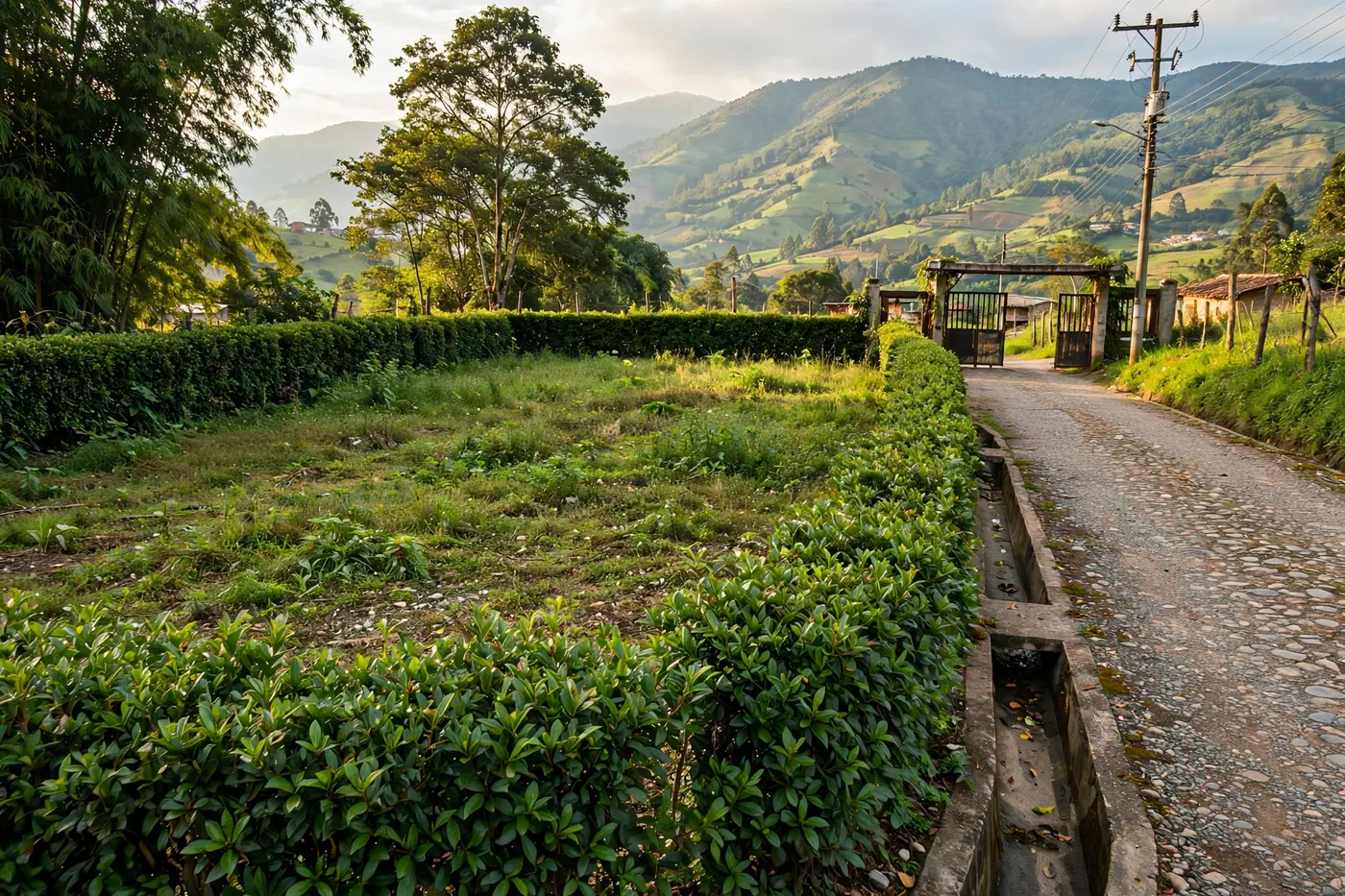
- The state of internal roads within the condominium (tire tracks/paved strips, cobblestone, or compacted gravel) and the distance to the main paved road.
- The operational common areas that add value to the development (24-hour security gate, ecological trails, social hall, or sports courts).
- The cleared legal status: independent title and current administration payments.
While social media or generic groups receive traffic, they often attract unqualified users, informal intermediaries, or exchange offers that do not meet your expectations. You can check the current supply in the country estates and lots category to compare how properties in your area are positioned. According to active listings on Colombia Move (September 2026), there are 16 lot ads and 24 estate ads, with 2,345 and 5,897 views respectively.
Frequently asked questions
❓ Is a lot without a built house inside a condominium obligated to pay administration fees?
Yes: Paragraph 2 of Article 29 of Law 675 of 2001, in effect in 2026, mandates paying expenses even if the lot is vacant. This fee sustains the security gate, internal roads, communal networks, and the maintenance that increases the value of the entire co-ownership.
❓ What happens if a lot is sold with outstanding administration fees?
The notary notes if the clearance certificate is missing, and the buyer becomes jointly liable for the debt to the co-ownership. In 2026, it is advisable to pay the balance or deduct it from the price before signing, so the deal does not fall through.
❓ How do I avoid being scammed by an irregular undivided interest or illegal lot development?
Ask for the Certificate of Tradition and Freedom from the ORIP, valid in 2026, with an individual title for your private unit. That title originates from the subdivision in the horizontal property deed, with a subdivision license, not from an informal percentage.
❓ Can the new owner build a home of any style and size they wish?
No: the project must follow the architectural manual, the co-ownership regulations, and the local POT (Land Use Plan). The buyer submits plans to the internal committee before requesting a building permit, according to the rules in effect in 2026.
❓ How much money do the notary and registration expenses of a lot represent?
The cost depends on the deeded price, the current notary rate, and the departmental registration tax. In 2026, do not use a generic percentage: ask for a written settlement at the notary office where you will formalize the deed.
❓ Where can I post my condominium lot to sell it without commission?
You can post it in direct classifieds, without real estate brokerage. Describe regulations, topography, and updated paperwork, and handle interested parties via WhatsApp or phone call. Avoid open groups that fill your chat with curious onlookers.

Comments
Loading comments...
Checking sign-in status...