
How to Demand the Refund of Rent for Early Delivery of a Leased Property (Law 820)
How to settle advance rent and indemnities under Law 820 of 2003 when returning a property ahead of schedule.

IDIOMA DEL ARTÍCULO
Showing original language
Having to vacate an apartment or house before the lease contract expires is a common situation in Colombia. A job transfer or a drop in income often forces tenants to pack up sooner than agreed. That is when a financial clash arises: what happens to the rent for the month you already paid if you return the keys halfway through the period? Does the landlord have the right to keep all the money or charge you for the months remaining until the end of the year?
Under the urban housing regime in Colombia, the rules do not depend on the landlord's arbitrary will or informal verbal agreements. The Law 820 of 2003 strictly regulates how an early termination is settled, when there is an obligation to compensate, and in what cases the tenant has the indisputable right to demand the return of balances paid in advance. According to active listings on Colombia Move (September 2026), there are 152 active housing listings and only 2 in the temporary rental section today.
Quick answer: when do you get the rent paid in advance back?
The landlord must return the money corresponding to the days or months of rent paid in advance if the early handover was made by mutual agreement or if the contract ended for a just cause attributable to the landlord. Since the rent payment covers the actual enjoyment of the property, retaining payment for periods not inhabited without legal basis constitutes unjust enrichment under the Colombian Civil Code. Conversely, if you leave unilaterally and without just cause before the expiration date, the law requires you to indemnify the landlord with exactly three monthly rent payments, but the landlord can never charge you for that compensation and the remaining months of the contract simultaneously.
When is the refund of unearned rent appropriate?
To determine if you have a positive balance after returning the property, it is essential to distinguish between a period already accrued and an advance payment not enjoyed:
- Rent paid in advance: If you paid for the full month on the first calendar day and, following a formal agreement or a proven cause of force majeure or breach of contract, you hand over the keys on the tenth day with a signed record, the rent for the remaining twenty days was not accrued. You are entitled to a proportional settlement and a refund of that balance.
- Prohibition of double charging: Some landlords attempt to retain the rent for the current month, demand payment for the remaining months of the year, and also claim contractual penalties. In urban housing, this is illegal. Once the property is physically returned and the termination is formalized, the landlord recovers possession and cannot profit by charging rent for a vacant space.
- Accrued periods: Every day that you had material and effective possession of the property must be paid. The refund only applies to days or months after the official date set in the handover record.

Early handover by mutual agreement (Article 21 of Law 820)
The fastest and most economical route is termination by mutual agreement, provided for in Article 21 of Law 820 of 2003. When parties negotiate, mandatory sanctions do not apply.
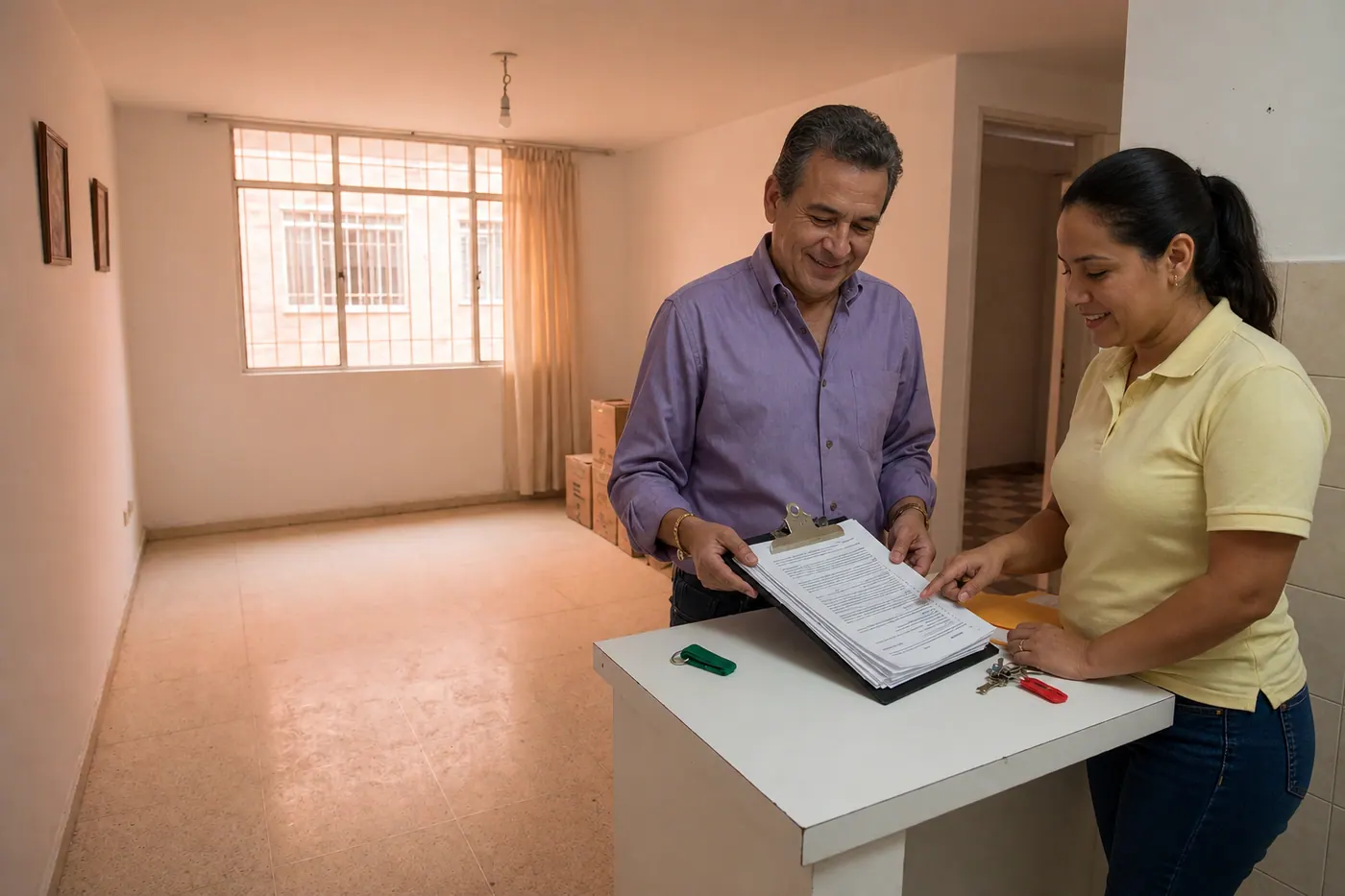
In these cases, parties can freely agree that there will be no compensation whatsoever or agree on a symbolic sum to cover the days it will take the owner to re-list the property. To secure this process, always draft an addendum or termination record stating:
- The exact date on which the physical handover of keys will take place.
- The express statement that both parties are clear and settled regarding rent payments.
- The exact amount the landlord will return to the tenant for days paid but not inhabited, along with the agreed date and method of payment.
- The formal reconciliation of public utility service accounts.
If you need to structure a formal document without ambiguity, use the guidelines in our Law 820 lease agreement template to verify how handover and inventory clauses should be formulated.
Unilateral exit without just cause: postal notice and 3-month compensation
If the landlord does not accept an agreed handover and you decide to terminate the contract before the expiration of the initial term or its extensions for personal reasons, you must strictly apply paragraph 4 of Article 24 of Law 820 of 2003.
The regulation requires fulfilling two simultaneous conditions:
- Written notice via authorized postal mail: You must notify the landlord at least three (3) months in advance, indicating the exact date you will surrender the property.
- Legal assessed compensation: You must pay compensation equivalent to three (3) months of rent in effect on the date of notification.
Keep in mind: This 3-month compensation is the maximum cap set by law for urban housing. Any contractual clause that attempts to charge you the full value of the months remaining to complete the year or higher penalties is considered ineffective under Colombian law.
The consignment procedure before the Banco Agrario (Article 25)
A common problem occurs when the tenant expresses a desire to return the property early by paying the compensation, but the landlord refuses to accept the money or the apartment to delay the process and continue charging monthly rent. To neutralize this conduct, Article 25 of Law 820 established a mandatory mechanism:
- Consign the legal compensation at the Banco Agrario de Colombia in favor of the landlord and at the order of the competent local authority (such as the Housing Control Sub-directorate or the respective municipal secretariat in cities like Bogotá, Medellín, or Cali).
- Keep the receipt issued by the bank.
- Send an authentic copy of the consignment to the landlord via authorized postal service, informing them of the exact day and time set for the handover of the property.
If the landlord does not appear to receive the property on the agreed day, the tenant may go to the municipal authority or the public prosecutor's office (personería) so that a commissioned inspector can receive the keys and certify the delivery, releasing the tenant from any subsequent financial obligation.
Exit with just cause: immediate return and zero compensation
A penalty does not always have to be paid when a property is vacated ahead of schedule. Article 24 (paragraphs 1 to 3) empowers the tenant to terminate the contract immediately and without paying compensation when the landlord commits serious breaches:
- Recurrent suspension of public utility services: This occurs when the landlord is responsible for paying the bills (or extraordinary fees affecting connections) and the service is cut off due to their exclusive default.
- Serious interference with the enjoyment of the property: Hidden construction defects, severe leaks, structural cracks, or chronic dampness that render the home uninhabitable or threaten ruin, without the landlord carrying out the essential repairs within a reasonable time.
- Direct interference by the landlord: Acts that disregard or prevent the peaceful use of the rented property.
Under these grounds, the tenant is not only exempt from paying a three-month penalty, but also has the legal right to demand the immediate refund of any amount paid in advance for the days they could no longer occupy the property. It is essential to gather solid evidence: dated photographs, videos, records of written requests, and copies of utility bills.
Illegal deposits vs. Utility guarantees
When handing over a property, another financial dispute often arises: the arbitrary retention of alleged "deposits." Regarding this, the regulatory framework is clear:
Article 16 of Law 820 of 2003 expressly prohibits the requirement of cash deposits, real guarantees, guarantee checks, or blank promissory notes to secure obligations derived from urban residential lease contracts. If a cash deposit was required at the beginning of the contract, its retention is completely improper and you can demand its full refund immediately, just as we detail in our guide on the refund of security deposits in leases in Colombia.
The only legal guarantee authorized by Article 15 of the law is the one that secures the final payment of residential public utility services, through policies, bonds, or specific bank deposits calculated based on the average consumption of recent periods. Consult the conditions for this mechanism in our article on utility service guarantees in lease contracts to learn how accounts must be settled when the final bills arrive.
| Termination Type | Prior Notification | Applicable Indemnity | Right to Rent Refund |
|---|---|---|---|
| Mutual agreement (Art. 21) | Freely agreed | Does not apply (or as agreed) | Yes, for unlived days already paid |
| Expiration of the term (Art. 24 num. 5) | Minimum 3 months by postal mail | $0 COP | Does not apply (handed over at cutoff) |
| Unilateral without just cause (Art. 24 num. 4) | Minimum 3 months by postal mail | 3 months of current rent | No (offsetting with indemnity applies) |
| Unilateral with just cause (Art. 24 num. 1-3) | Immediate by written notification | $0 COP | Yes, reimbursement for unused days |
Step-by-step to formally claim your money
If you have already vacated the apartment, signed the handover certificate, and the landlord or real estate agency refuses to return the credit balances or insists on charging you for future months, follow this legal route:
- Send a formal written request: Send a communication via certified mail or with electronic delivery proof. Include the date of key handover, the signed inventory, a copy of the contract, the proof of paid utility bills, and the exact calculation of the days paid in excess that you are requesting to be transferred to you.
- Request an extrajudicial conciliation hearing: If there is no favorable response within a reasonable time (usually between 8 and 15 business days), file a conciliation request with the Municipal Personería, Casas de Justicia, an authorized conciliation center, or university legal clinics in your city (such as Bogotá, Medellín, or Cali). Conciliation is a free or low-cost procedural requirement; the final act is legally enforceable.
- Administrative complaint to the Mayor's office or Housing Secretariat: Municipal governments have departments responsible for overseeing compliance with Law 820 of 2003. If the landlord retained cash deposits prohibited by Article 16 or refuses to formalize the legal termination, you can file an administrative complaint that may lead to monetary fines for the owner or real estate agency.
When planning your move, don't forget to timely arrange moving permits with the building management and verify the authorized times according to the internal regulations and Law 675 on horizontal property in Colombia. Keep in mind that moving your belongings and the costs of the moving service are subject to private contract and are the tenant's responsibility, unless there is a judicial ruling due to the landlord's exclusive fault.
Frequently asked questions
❓ What happens to the rent I already paid if I return the apartment before the end of the month?
You have the right to a proportional refund for the days not enjoyed if the early handover was done by mutual agreement or for a just cause attributable to the landlord. The rent covers the effective use of the property; retaining fees for unlived days after handing over the keys has no legal basis. Source: Civil Code and Law 820 of 2003, in effect in 2026.
❓ Can the landlord charge me for all the months remaining in the contract?
No, Law 820 of 2003 prohibits charging for the remaining months of the contract once the housing has been returned. If the exit is unilateral without just cause, the maximum indemnity is three months of rent (Art. 24, num. 4). Source: Law 820 of 2003, in effect in 2026.
❓ How is the legal deposit made if the owner refuses to accept the indemnity or the property?
You must deposit the three months of indemnity at the Banco Agrario de Colombia in favor of the landlord and at the order of the municipal housing authority. Then, send the copy via authorized postal mail with the date and time of delivery. Source: Art. 25 of Law 820 of 2003, in effect in 2026.
❓ How much time does the owner or real estate agency have to return credit balances after the handover?
There is no fixed legal deadline in days; custom and conciliation usually agree on between 15 and 30 calendar days after the handover act. That margin covers the final utility bills. Source: conciliation practice, consulted in 2026.
❓ Is it legal for them to deduct paint or minor repairs from the money to be returned?
It is not legal to deduct for paint or natural wear and tear from use. Ordinary deterioration is assumed by the landlord; deductions are only allowed for attributable damages, verified in the initial inventory. Source: Civil Code and Law 820 of 2003, in effect in 2026.
❓ Where can I list a property for rent in Colombia safely and directly?
You can list your property or search for a home in the Colombia Move housing section, from owner to tenant and without intermediary commissions. Source: Colombia Move marketplace, updated in 2026.

Comments
Loading comments...
Checking sign-in status...