
Abusive clauses in lease agreements in Colombia: what Law 820 prohibits
Before signing a lease agreement in Colombia, identify the illegal or abusive clauses that Law 820 of 2003 expressly prohibits to protect tenants and landlords.
IDIOMA DEL ARTÍCULO
Showing original language
Signing a residential lease agreement in Colombia should be a transparent process for both parties. However, in practice, it is very common to encounter templates drafted by real estate agencies or landlords that include abusive clauses or terms that are openly contrary to national legislation. Accepting them due to urgency or a lack of knowledge often results in unjustified charges, loss of money, and exhausting conflicts when handing over the property.
In Colombia, the regulation governing residential leases is Law 820 of 2003. This law establishes minimum non-waivable rights for the tenant and clear limits for the landlord. Any provision that contradicts these rules can be contested before the competent authority or a judge; the specific effect must be reviewed on a case-by-case basis. Below, we review, point by point, the most common illegal clauses and how to protect yourself before and after signing.
1. The explicit prohibition of cash deposits
One of the most frequent abuses in the country is demanding a "cash security deposit" equivalent to one or two months' rent to cover potential future damages or utility payments. Article 16 of Law 820 of 2003 explicitly establishes that in residential lease contracts, no money deposits or real guarantees may be required to secure the fulfillment of the tenant's obligations.
This means that the landlord cannot retain cash sums under the heading of a "delivery guarantee." The only legally regulated exception relates to guarantees for the payment of household utility services (governed by Decree 3130 of 2003 and Law 820), which are handled through specific mechanisms or bonds with the service providers, and not through the deposit of money directly into the landlord's pocket.
2. Rent increases exceeding the IPC and before the due date
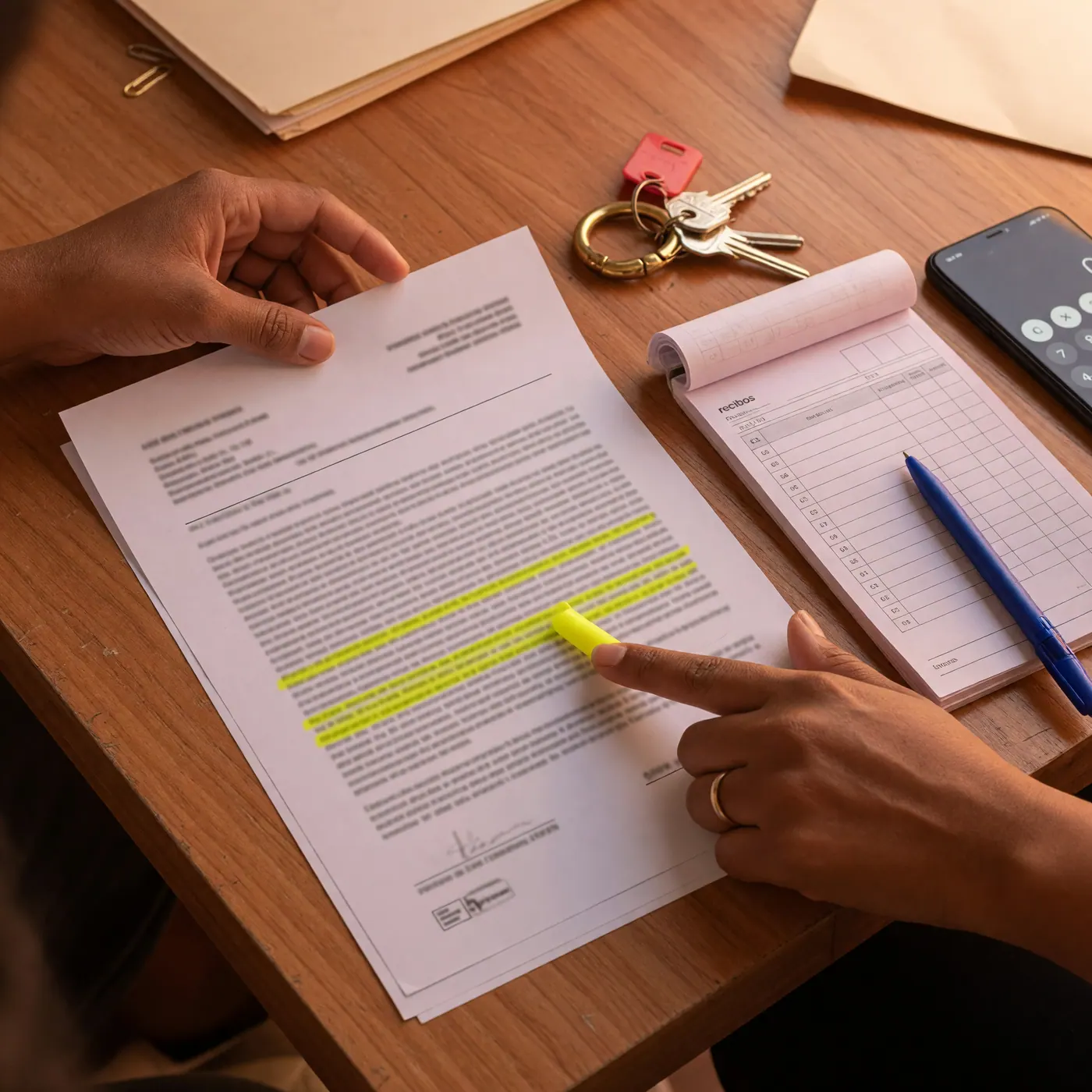
Another area where serious irregularities are committed is in the adjustment of the monthly rent amount. Colombian law sets two unbreakable limits for increases in residential housing:
- Timing: The rent can only be increased every 12 months of contract execution at the same price, never before.
- Maximum cap: The adjustment cannot exceed the percentage of the Consumer Price Index (IPC) for the immediately preceding calendar year. For increases applied during the year 2026, the maximum legal cap is 5.10% (corresponding to the annual inflation for 2025 reported by DANE).
Any clause that agrees to semi-annual increases, adjustments tied to the minimum wage, or arbitrary fixed percentages (such as 10% annually) contradicts the adjustment limits provided for residential housing. Additionally, Article 18 of Law 820 states that the monthly rent cannot exceed 1% of the commercial value of the property or the rented portion, a cap that must also be respected.
For a deeper look into the exact calculation of annual adjustments, you can review our detailed explanation in rules for rent increases in Colombia under Law 820.
3. Failure to deliver a copy of the contract and payment receipts
The formal contract is not a document exclusive to the landlord. Law 820 mandates that when the contract is executed in writing, the landlord has the obligation to provide the tenant (and co-debtors, if any) with a copy of the contract with original signatures within a maximum period of 10 days from its execution.
Similarly, whoever receives the rent payment is required by law to issue a written receipt stating the date, the amount, and the period paid. If the landlord refuses to deliver a copy of the contract or issue the corresponding receipts, the tenant is empowered to request the intervention of local inspection, surveillance, and control authorities.
4. Subletting clauses, use of the property, and disturbance of peace
Regarding subletting rooms or the entire property, the rule is clear: the tenant does not have the authority to assign or sublet to third parties unless there is express and unequivocal authorization from the landlord. If you sublet a room without the owner's written consent, they may terminate the contract with just cause.
On the other hand, abuses occur when the owner attempts to conduct "surprise inspection visits" without prior notice. While the landlord has the right to verify the condition of the property for necessary minor repairs, it is advisable to agree upon and coordinate visits in advance. Unauthorized entry can constitute a disturbance of enjoyment and contradict the landlord's obligation to guarantee the tenant quiet enjoyment of the property (Article 1982 of the Colombian Civil Code).
5. Where to report and seek conflict resolution
When you face an abusive clause or an improper charge, the first step should always be to send a formal written communication (via certified mail or email with a read receipt) citing the corresponding article of Law 820 of 2003.
If an agreement is not reached, Colombian law assigns the function of inspection, surveillance, and control of leases to municipal and district mayoralties. For example, in Bogotá, this function is exercised by the Undersecretariat of Inspection, Surveillance and Control of the District Secretariat of Habitat, an entity in charge of evaluating whether contracts comply with the law and sanctioning abuses. In other cities, consult the municipal or district mayor's office to identify the competent authority; you can also seek guidance or conciliation depending on the specific case.
According to listing data from the Colombia Move market (August 2026), the housing section recorded 106 active posts for apartments, houses, and rooms for rent. Dealing directly and transparently requires that both parties know their legal duties and rights from the very first day.
Frequently asked questions
❓ Which clauses in a rental contract are illegal in Colombia?
Clauses requiring cash deposits, setting rent increases above the annual CPI, restricting the right to receive a signed copy of the contract, or imposing disproportionate penalties exceeding the limits of Law 820 of 2003 are illegal.
❓ Can they charge me a cash deposit to rent a home?
No. Article 16 of Law 820 of 2003 expressly prohibits requiring cash deposits or real security to guarantee obligations in urban housing lease contracts.
❓ What is the maximum the rent can increase in 2026?
The maximum the rent for urban housing can increase in 2026 is 5.10%, corresponding to the 2025 CPI. The adjustment only applies when 12 continuous months of execution under the same rate have been completed.
❓ Can the landlord enter the property without my authorization?
The landlord must respect the quiet enjoyment of the property. The contract should regulate access and visits should be coordinated in advance; unauthorized entry may constitute a disturbance, but each specific case requires review.
❓ Can I sublet a room if I already pay the full rent?
Only if you have the express, written authorization of the landlord. Subletting without this permission is grounds for unilateral termination of the lease agreement.
❓ Where can I report a lease contract with abusive clauses?
You can go to your city's municipal mayor's office or the Secretariat of Habitat (in the case of Bogotá) to request a review and intervention regarding the lease contract.


Comments
Loading comments...
Checking sign-in status...