
Colombia Rent Increase Rules (2026): Law 820, IPC Caps, and Tenant Protections
Learn the exact mathematical limits for 2026 rent increases in Colombia under Law 820. Discover how to calculate the 5.10% IPC cap and defend against illegal hikes.
IDIOMA DEL ARTÍCULO
Showing original language
If you're renting an apartment or an office in Colombia, lease renewal time can be stressful. I've seen plenty of foreign renters face arbitrary rent hike demands from landlords who assume expats don't know the local laws. But renting in Colombia is actually highly secure if you understand the legal boundaries.
Before you sign a renewal or agree to a price bump, you need to know exactly what the government allows. For a broader overview on lease renewals, I highly recommend checking out our general Colombia rent increase rules checklist. But if you're looking for the exact mathematical caps and legal protections for 2026, you're in the right place. If you want to see real-world options right now, you can browse apartments and houses on Colombia Move — posting is completely free.
Quick Answer:
- 2026 Maximum Increase: 5.10% for residential leases (strictly tied to the 2025 IPC).
- Timing: Landlords can only raise rent after a full 12-month lease cycle completes, never automatically on January 1st.
- Commercial Leases: Offices and retail spaces have no legal percentage cap; increases are dictated entirely by your contract.
The Core Legal Framework: Law 820 of 2003
In Colombia, urban residential leases are heavily regulated by Law 820 of 2003 (Ley 820 de 2003). This law is designed to protect tenants from predatory pricing and arbitrary evictions. The most critical piece of this legislation for your wallet is Article 20, which dictates exactly when and by how much your rent can go up.
Under Article 20, your landlord can only increase your rent once every 12 months, specifically on the anniversary of your contract signing. A common tactic is for landlords to demand a rent increase on January 1st, claiming the new year triggers a new rate. Honestly, refuse it unless your lease genuinely started on January 1st. Rent adjustments are strictly tied to the 12-month cycle of your specific lease.
Furthermore, Article 18 of Law 820 caps the maximum monthly rent at 1.0% of the property's commercial value. In turn, that commercial value cannot exceed twice its official cadastral appraisal (avalúo catastral). If your landlord is trying to double your rent to match "market rates," they are likely violating this hard legal ceiling.
The 2026 Math: Real COP Calculation Examples
For residential contracts renewing in 2026, the absolute maximum legal rent increase is 5.10%. This figure isn't random; it is the cumulative Consumer Price Index (IPC) inflation rate for 2025, which the government statistics agency (DANE) officially certified on January 8, 2026.
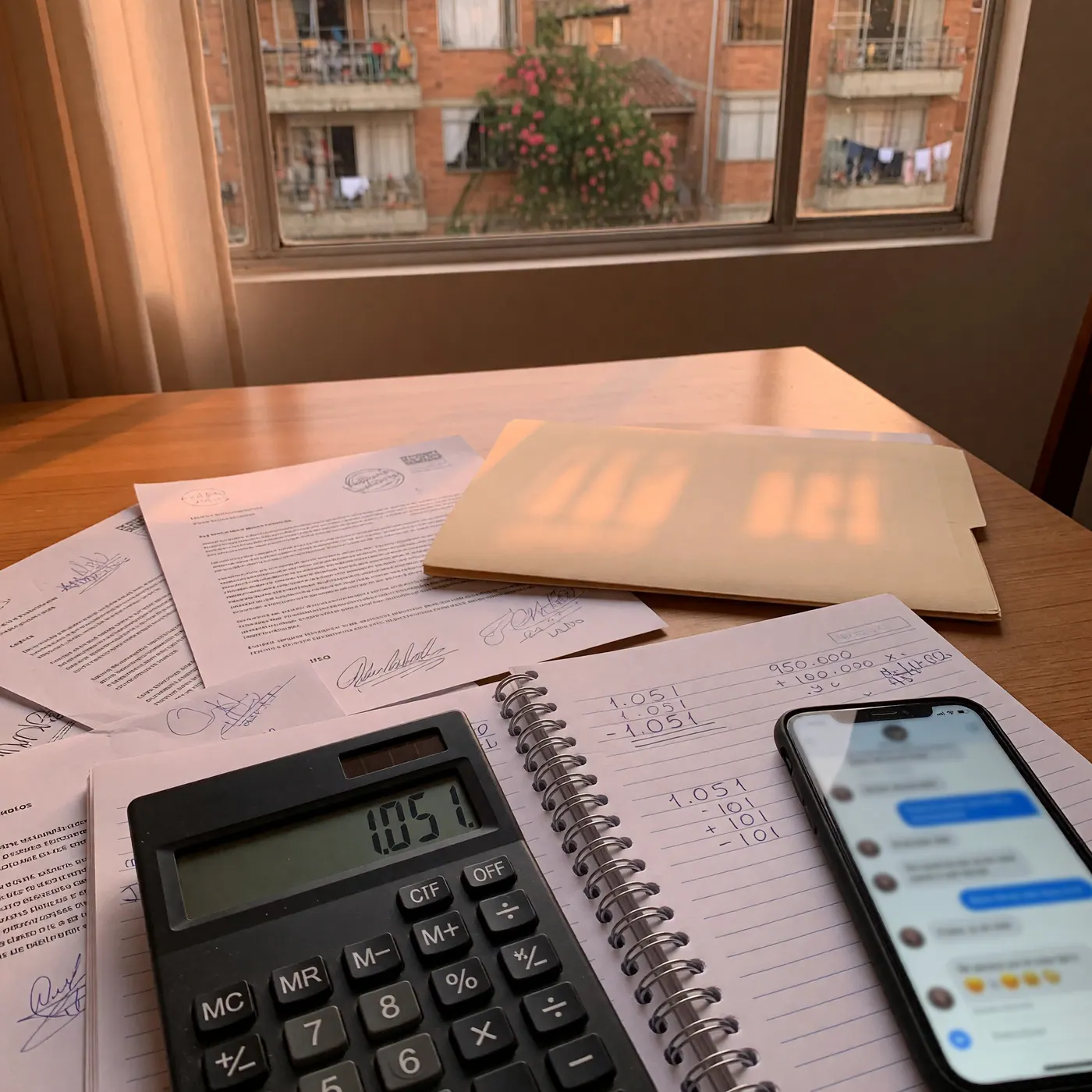
Some landlords might try to argue that because the 2026 Colombian minimum wage (SMMLV) increased to COP 1,750,905 (plus the COP 249,095 transportation allowance, totaling COP 2,000,000), your rent should go up by the same massive percentage. Do not fall for this. Minimum wage hikes do not legally dictate residential rent increases. The law strictly limits residential hikes to the previous year's IPC.
Here is how the 5.10% cap looks in practice:
- Current Rent: COP 1,200,000 → Maximum 2026 Increase: COP 61,200 → New Rent: COP 1,261,200
- Current Rent: COP 2,500,000 → Maximum 2026 Increase: COP 127,500 → New Rent: COP 2,627,500
If your landlord's math results in a number higher than your current rent multiplied by 1.051, the increase is illegal.
Residential vs. Commercial Leases (Offices and Business Spaces)
If you are a foreign entrepreneur renting an office or a commercial storefront, throw everything you just read about Law 820 out the window. Law 820 does not apply to commercial properties. Instead, commercial leases are governed by the Colombian Commercial Code (Articles 518 to 524).
The most important distinction is that commercial leases have no legal percentage cap for rent increases. The increase is dictated entirely by the principle of autonomía de la voluntad (freedom of contract). If your contract says rent goes up by 15% annually, you are legally bound to that 15%.
According to active listings on Colombia Move (July 2026), there are currently only 4 active office listings and 4 commercial spaces available on the platform, highlighting a tight supply gap for foreign entrepreneurs. Because commercial space is highly competitive, landlords often write aggressive increase clauses into contracts.
| Feature | Residential (Law 820) | Commercial (Commercial Code) |
|---|---|---|
| 2026 Rent Cap | 5.10% (Fixed by 2025 IPC) | No legal cap (Dictated by contract) |
| Security Deposits | Strictly Illegal | Legal and standard practice |
| Dispute Resolution | Regulated by Law 820 | Verbal procedure with peritos (Art. 519) |
Another massive difference involves cash security deposits. If you are renting an apartment, cash security deposits are strictly illegal under Law 820. However, for commercial leases, cash deposits are completely legal and standard practice.
What happens if your commercial lease is silent on rent hikes and you can't agree with your landlord at renewal time? Under Article 519 of the Commercial Code, the dispute must be settled through a judicial "verbal procedure" where court-appointed experts (peritos) determine a fair market rate.
How to Dispute an Illegal Rent Increase: Step-by-Step for Tenants
If your residential landlord demands a 10% or 20% increase in 2026, don't panic. The law is firmly on your side. Here is exactly how to handle it:
- Ask for written justification: Landlords must notify you in writing of any rent increase before the lease completes its 12-month cycle. Verbal demands mean nothing.
- Draft a formal response: Reply in writing citing Article 20 of Law 820 of 2003. Explicitly state that DANE certified the 2025 IPC at 5.10%, and therefore you will only accept an increase up to that legal limit.
- Keep paying the legal rate: This is crucial. Never stop paying your rent entirely, even if you are in a dispute. Withholding rent constitutes a breach of contract and gives the landlord legal grounds to evict you. Calculate your current rent plus the 5.10% increase, and pay that exact amount on time.
Frequently Asked Questions
❓ What is the maximum rent increase allowed in Colombia for 2026?
The maximum legal rent increase for urban residential leases in 2026 is strictly capped at 5.10%. This rate is determined by the cumulative 2025 consumer price index (IPC) inflation officially certified by DANE on January 8, 2026. Landlords cannot charge a peso more than this limit.
❓ Can my landlord increase my rent in January 2026?
No, unless January is the exact anniversary of your lease agreement. Rent can only be adjusted once every 12 months, starting from the month the contract was signed or the month of the last legal adjustment.
❓ Does the 5.10% cap apply to commercial leases or offices in Colombia?
No, the 5.10% IPC cap applies exclusively to urban residential leases under Law 820 of 2003. Commercial leases (offices, warehouses, retail locales) have no legal limit and are governed entirely by the terms agreed upon in the contract.
❓ Is it legal for a landlord to ask for a security deposit in Colombia?
No, cash security deposits are strictly illegal for residential leases under Law 820 of 2003. However, security deposits are completely legal and standard practice for commercial leases governed by the Commercial Code.
❓ What happens if a commercial lease is silent on rent increases and we disagree?
If the contract does not specify a renewal rate and you cannot reach an agreement, Article 519 of the Commercial Code dictates that the dispute must be settled in court through a verbal procedure with the aid of neutral peritos (expert appraisers).
❓ Should I stop paying rent if my landlord demands an illegal increase?
No, you must never stop paying rent entirely, as this constitutes a breach of contract that allows your landlord to evict you. Instead, calculate the legal 5.10% increase, pay that exact amount, and send a formal written notice citing Article 20 of Law 820.





Comments
Loading comments...
Checking sign-in status...