
Unifianza and El Libertador Rental Guarantees: How Foreign Renters Qualify Without a Codeudor
Navigating long-term apartment rentals in Colombia often hits a wall when agencies demand a local co-signer with real estate. Here is how foreign renters pass underwriting with Unifianza and El Libertador.

IDIOMA DEL ARTÍCULO
Showing original language
Finding an unfurnished, long-term apartment in Colombia is one of the most rewarding milestones for any expat, digital nomad, or remote professional relocating here. You browse listings in leafy neighborhoods, find a bright space with mountain views, contact the real estate agency (inmobiliaria), and then run straight into the traditional Colombian rental brick wall: “Necesita un codeudor con finca raíz.”
For decades, traditional Colombian leasing has relied on having one or two local co-signers who earn double the monthly rent and hold title to unencumbered Colombian real estate (finca raíz libre de gravámenes). As an international resident, your cousin in Chicago or your mom in Manchester cannot serve as that guarantor. But that does not mean you are forced into overpriced tourist platforms. Commercial rental guarantee entities—chiefly El Libertador and Unifianza—provide modern institutional pathways for foreign tenants to qualify entirely on their own verifiable income.
The Codeudor Barrier and Ley 820: What Foreigners Need to Know
To understand why Colombian property managers cling to co-signers, you have to look at statutory tenancy law. Under Article 16 of Ley 820 de 2003, Colombian residential landlords are strictly prohibited from demanding cash damage deposits (depósitos en dinero efectivo) or collateral bonds (cauciones reales). Any lease clause asking you to deposit two or three months of cash into an owner’s personal account as a damage bond is legally void.
Because owners cannot legally hold cash security deposits against default or property damage, the entire Colombian real estate industry leans on legal guarantees to back residential contracts. If an agency cannot require a cash deposit, it must protect the property owner against unpaid rent, unpaid administration fees, and prolonged eviction procedures. While finding alternatives to a Colombian codeudor used to mean informal handshakes or paying inflated Airbnb rates, underwriting companies now bridge that gap using formal risk models.
That bottleneck is not a shortage of apartments. According to active listings on Colombia Move (September 2026), the housing section currently shows 166 live ads, including 56 apartments (31 listed as renting). The hard part for foreigners is still passing Unifianza or El Libertador without a local property-owning co-signer.
Póliza vs. Fianza: How El Libertador and Unifianza Differ
When you apply for a long-term lease through an agency, your paperwork will be processed through one of two distinct legal structures: an insurance policy (póliza de arrendamiento) or a commercial surety guarantee (fianza de arrendamiento).
El Libertador (Seguros Bolívar)
Investigaciones y Cobranzas El Libertador S.A. operates in alliance with Seguros Bolívar, an insurance institution regulated by the Superintendencia Financiera de Colombia (SFC). When you undergo an estudio digital with El Libertador, the underwriter evaluates your risk profile to issue a collective lease insurance policy that indemnifies the property owner for up to 36 months of unpaid rent, building administration fees, and legal defense costs during eviction proceedings.
Unifianza S.A.
Unifianza is a specialized commercial surety company (afianzadora) governed under the Colombian Commercial Code. Rather than issuing a standard insurance policy, Unifianza signs an individual surety contract (contrato de fianza). If a tenant defaults, Unifianza pays the monthly rent and administration fees directly to the owner and legally subrogates (derecho de repetición y recobro por ministerio de la ley) to recover the full debt directly from the tenant through judicial collection.

Underwriting Criteria: What Underwriters Actually Look For
Both entities have modernized their risk models, enabling foreigners with valid visas or foreign earnings to submit their files online. However, passing their automated risk engines requires meeting clear quantitative thresholds.
- Net Income Ratio: You must demonstrate verifiable liquid monthly income equal to approximately 2.5 to 3 times the monthly rent plus the condominium administration fee (administración). If an apartment rents for COP 3,500,000 and the administration fee is COP 500,000, your verifiable net monthly income must sit between COP 10,000,000 and COP 12,000,000 (roughly USD 3,225 to USD 3,870 at about COP 3,100 per USD as of 16 September 2026).
- Documented Identity: While having a Colombian Cédula de Extranjería (CE) streamlines digital identity checks, underwriters frequently accept a valid foreign passport paired with an approved Colombian visa (such as a Digital Nomad Visa, Migrant Visa, or Work Visa).
- Bank Statements (Extractos Bancarios): You will need to provide certified, complete bank statements from the past three to six months. Incomplete summary sheets, mobile app screenshots, or uncertified balances are routinely rejected.
- Employment and Remote Invoices: If you work remotely for an overseas employer, submit an official employment verification letter (translated into Spanish) detailing your title, start date, compensation, and contract duration, accompanied by matching wire deposits.
Comparative Underwriting Guide
| Feature | El Libertador (Seguros Bolívar) | Unifianza S.A. |
|---|---|---|
| Legal Mechanism | Póliza de Arrendamiento (Insurance) | Fianza de Arrendamiento (Surety) |
| Regulatory Scope | Superintendencia Financiera | Colombian Commercial Code |
| Underwriting Fee | ~5% of monthly rent + IVA (non-refundable; confirm the live PSE quote) | Same study-fee class, with a possible minimum on modest rents |
| Foreign Passports | Passport plus valid visa and certified statements | Same foreign-document packet, including Cédula de Extranjería when available |
| Turnaround Time | Often 24 to 48 business hours digitally | Usually a next-business-day file once biometrics clear |
Overcoming the Lack of Local Credit History
Because international credit scores from Equifax or Experian do not link directly into the Colombian Datacrédito credit bureau, underwriters scrutinize incoming liquidity and stability. If your application falls just short of the algorithmic requirements, three strategies can push your file across the finish line:
1. Pledging a Bank Term Deposit (CDT Pignorado)
If your foreign remote earnings are variable or self-employed invoices raise questions, you can propose a CDT pignorado (a pledged Certificate of Term Deposit). You open a fixed-term deposit at a Colombian commercial bank covering approximately 3 to 6 months of the lease value, and legally pledge it to the insurer or agency as collateral. You retain ownership and continue earning interest on the underlying funds, but the deposit cannot be liquidated until the lease finishes and all utility bills are settled. Acceptance is discretionary: pre-clear the CDT with both the agency and the guarantor before you pay the non-refundable study fee.
2. Adding a Joint Co-Applicant
If you live with a partner or roommate, you can combine your income onto a single application. Both applicants pay a nominal additional background fee, but their combined net earnings are evaluated together against the 2.5x to 3x income ratio.
3. Offering Advance Rent (Cánones Anticipados)
While Article 16 of Ley 820 makes cash damage deposits illegal, it does not prevent a tenant from voluntarily paying several months of rent in advance. If an agency agrees, you can contractually pay 6 or 12 months upfront into an escrow or directly to the landlord. Ensure your contract specifies that these funds represent prepayment of designated calendar months, not an open-ended damage reserve.
When budgeting your relocation and evaluating whether to commit to an annual unfurnished lease or explore long-term furnished apartment leasing, factor in exchange rate shifts. Smoothly transferring funds and managing currency conversion ahead of your lease start date prevents unexpected transaction delays when paying the underwriting fee or posting utility guarantees.
Step-by-Step: Submitting Your Digital Application
- Obtain the Inmobiliaria Property Code: Your real estate broker will supply a unique property identification code and their registered agency ID. You cannot start the study without this reference number.
- Complete the Online Underwriting Form: Visit the official tenant portal for either El Libertador or Unifianza. Select your applicant category (Empleado, Independiente, or Persona Natural Extranjera).
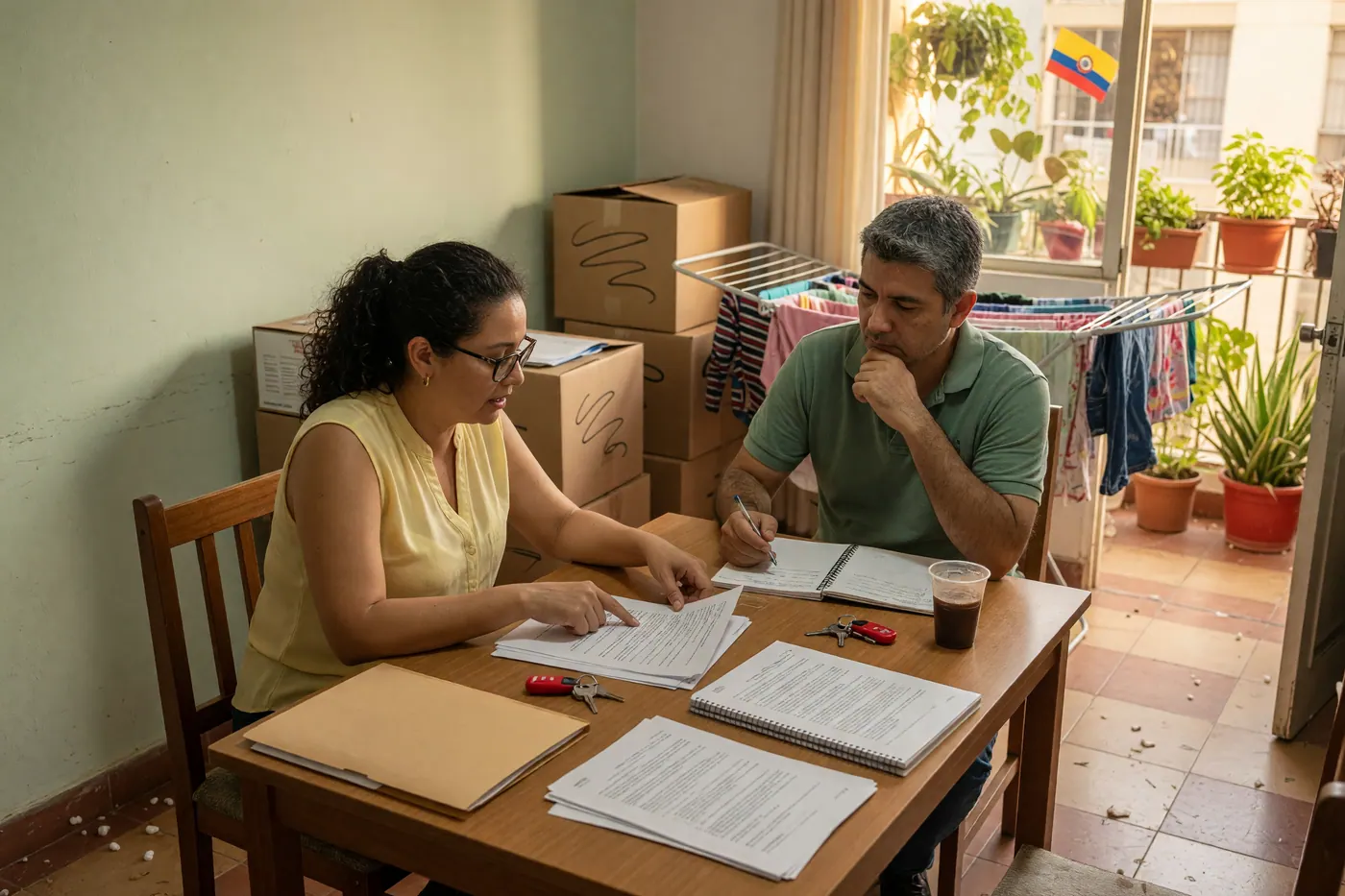
- Upload Verified PDF Documentation: Attach high-resolution scans of your passport, visa or Cédula de Extranjería, translated employment letters, and the last 3 to 6 months of official bank statements.
- Pay the Underwriting Fee (Estudio): Pay the screening fee via PSE or a Colombian debit card. The fee typically equates to roughly 5% of one month’s rent plus 19% IVA, with a minimum tier on modest rents. Keep the digital payment receipt for your records.
- Complete Biometric or Identity Validation: Underwriters will send an automated SMS or email containing a secure identity verification link to validate your facial biometrics or confirm identity details.
- Receive Underwriting Resolution: Approvals are delivered by email within 24 to 48 business hours. If approved, the system generates a formal certificate that greenlights your real estate agency to draw up the lease.
Frequently Asked Questions
❓ Can a Colombian landlord legally ask me for two months of cash security deposit?
No. Article 16 of Ley 820 de 2003, still in force in 2026, bans cash damage deposits and collateral bonds on urban residential leases. Informal owners still ask; those clauses are void. Licensed agencies use a póliza or fianza instead of holding your cash.
❓ What is the difference between El Libertador and Unifianza?
El Libertador underwrites through Seguros Bolívar under Superfinanciera insurance rules. Unifianza is a commercial surety company under the Commercial Code that signs a fianza and can recover paid claims from the tenant. Both protect the owner if you miss rent, but the legal vehicle is different as of 2026.
❓ How much monthly income do I need to prove to pass a rental study?
Underwriters typically want about 2.5 to 3 times rent plus administración in verifiable net monthly income. Combined applicants can pool earnings. Confirm the live matrix with the agency in 2026; a visa alone does not guarantee approval.
❓ Can I qualify using a foreign passport instead of a Cédula de Extranjería?
Yes. Major underwriters often accept a valid foreign passport plus a valid Colombian visa and certified bank statements. A Cédula de Extranjería still speeds identity checks in 2026, but it is not always mandatory if your visa and liquidity file is complete.
❓ How does a CDT work as an alternative to a Colombian co-signer?
A CDT pignorado is a Colombian bank term deposit pledged as collateral, often sized around 3 to 6 months of rent. You keep the interest, but you cannot cash it until the lease and utilities are clear. Agencies may refuse it, so pre-clear the option in 2026 before applying.
❓ Are rental underwriting fees refundable if my application is rejected?
No. The estudio de arrendamiento fee pays for screening and is non-refundable even if you are denied. In 2026 it is commonly around 5% of one month’s rent plus IVA, with a minimum on lower rents; check the exact PSE quote before you pay.


Comments
Loading comments...
Checking sign-in status...