
How to Convert USD to COP in Colombia: Foreign Cards, Bre-B & Wise Money Transfers
Learn how to convert USD to Colombian pesos without paying painful tourist exchange fees, from ATM strategies and Wise limits to using Bre-B instant payments.
IDIOMA DEL ARTÍCULO
Showing original language
When you step off a plane in Colombia, your US dollars don't automatically stretch as far as they should if you stumble into common tourist traps. Whether you are paying your monthly rent in Laureles, settling a dinner tab in Chapinero, or buying second-hand furniture for a long-term stay, converting USD to Colombian pesos (COP) efficiently can easily save you hundreds of dollars each month.
Quick Answer: The best way to convert USD to COP for day-to-day spending is using a foreign card with zero foreign transaction fees and always selecting "Decline Conversion" or "Charge in COP" at ATMs and payment terminals. For larger sums, digital remittance corridors like Wise provide near-market exchange rates directly into Colombian bank accounts up to $2,900 USD per transfer.
Understanding the Official Rate: The TRM Explained
Before you exchange a single dollar, you need to know the baseline: the Tasa Representativa del Mercado (TRM). The TRM is Colombia's official daily interbank exchange rate, regulated by the Banco de la República and calculated and certified every business day by the Superintendencia Financiera de Colombia (SFC). It reflects the real, volume-weighted average of currency transactions between financial institutions in the spot market.
As of 5 September 2026, the live TRM sat around COP 3,126 per USD. That number moves every business day, so treat it as a snapshot: check Superfinanciera or Banrep, or see today's dollar rate (TRM) and converter, instead of locking any peso figure in your head.
Every retail rate you encounter in daily life is measured against this certified benchmark. Street exchange kiosks (casas de cambio) at arrivals halls or heavy tourist corridors quote their own independent buy and sell rates. These booths bake in hefty spreads, often undercutting the official TRM by 5% to 15% to guarantee their own profit margin. Unless you land late at night without an operational debit card and urgently need cash for an official arrivals cab, skip the arrivals-hall exchange booths entirely.
Using Foreign Debit and Credit Cards: The ATM Playbook
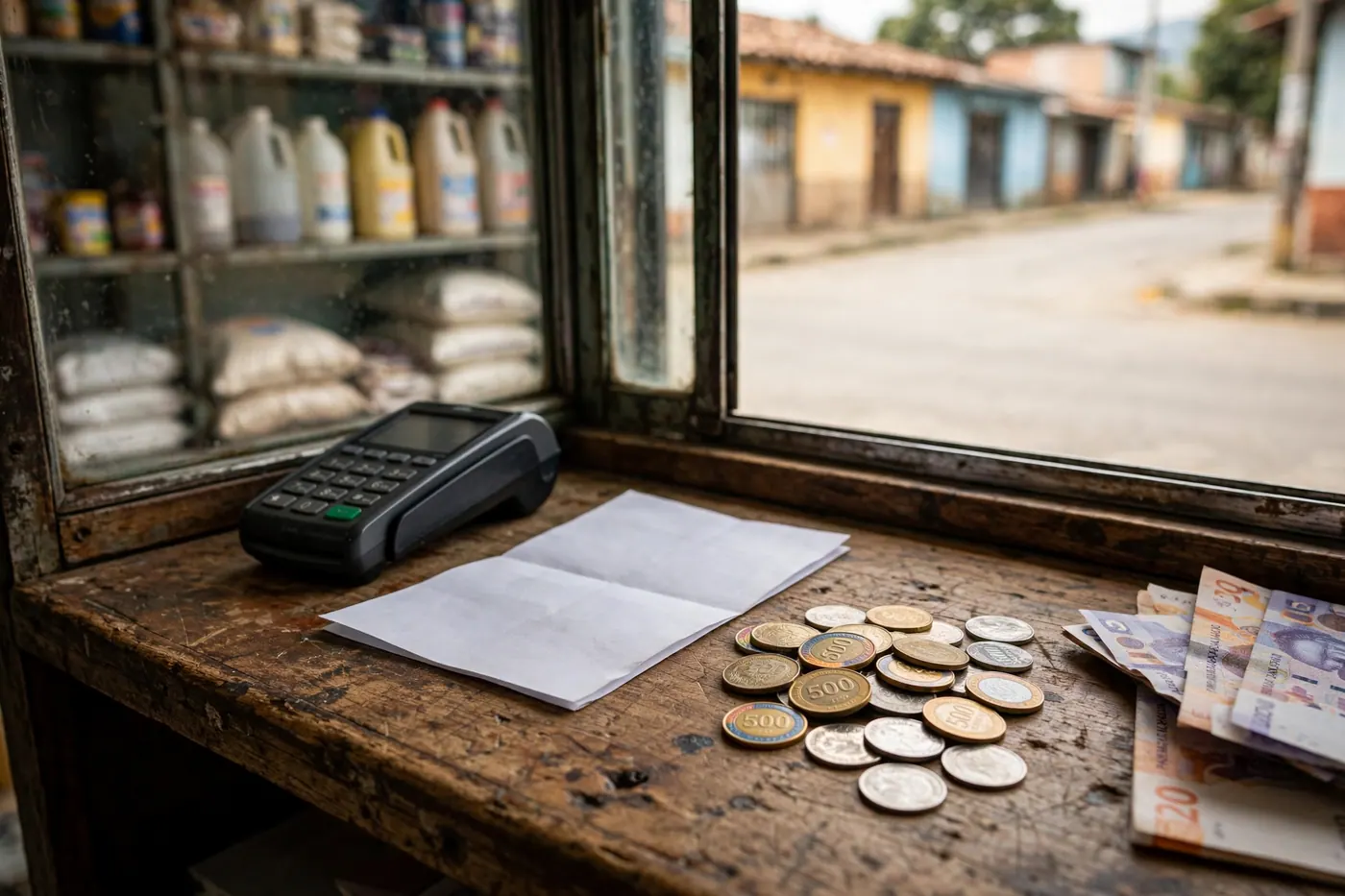
For most day-to-day purchases at restaurants, supermarkets, and established retail stores, your primary payment method should simply be a foreign credit card that charges zero foreign transaction fees. However, cash remains necessary in Colombia for street vendors, smaller neighborhood shops (tiendas), traditional yellow cabs, and private classified handoffs. When you need paper cash, automated teller machines (cajeros automáticos) are your cleanest route—if you follow the prompts correctly.
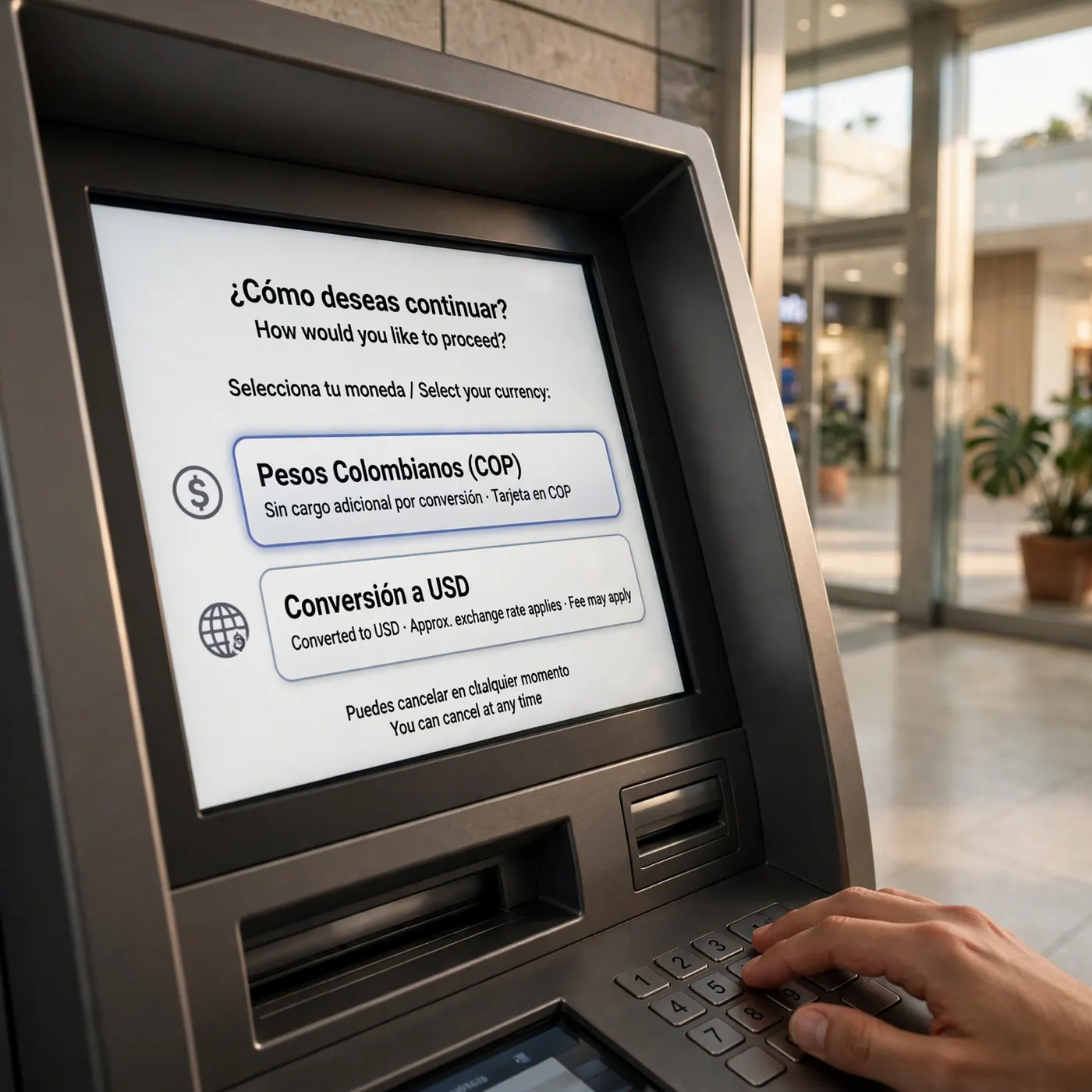
Every time you insert a foreign Visa or Mastercard into a Colombian ATM or hand it to a waiter using a portable card terminal (datáfono), the machine may attempt a tactic known as Dynamic Currency Conversion (DCC). The terminal asks whether you prefer to be billed in US dollars or Colombian pesos. Choosing USD feels reassuring, but it authorizes the Colombian ATM operator to set the exchange rate, slapping on an opaque markup that often runs between 5% and 12% above the true TRM.
Always press "Decline Conversion" or select "Charge in COP". When you decline, the transaction passes through your home bank or card network at standard wholesale interbank rates, preserving your spending power.
Beyond conversion markups, expect direct ATM operator surcharges. Most Colombian financial networks charge an out-of-network terminal fee that typically ranges between COP 15,000 and COP 30,000 per withdrawal, regardless of your withdrawal size. Single-transaction withdrawal limits also vary by bank, commonly capped between COP 600,000 and COP 2,000,000 per pull. To minimize the bite of fixed operator fees, pull the maximum permitted amount in a single transaction from a well-lit indoor machine located inside a shopping center or bank branch vestibule rather than on an exposed street corner. For a deeper breakdown of fee-free cards and payment acceptance, check out our guide to using credit cards in Colombia as a foreigner.
Sending Money via Wise & Digital Remittance: Step-by-Step
When you need to pay a landlord, settle utilities, or transfer larger sums into a local bank account, carrying stacks of physical banknotes is impractical and unsafe. Digital transfer services such as Wise, Remitly, or WorldRemit allow you to bridge your foreign accounts directly to Colombian institutions like Bancolombia, Davivienda, Nu Colombia, and digital wallets like Nequi.
Wise is particularly favored by remote workers because it applies the real mid-market exchange rate alongside an explicit, transparent fee. However, Colombian foreign exchange regulations impose specific guardrails:
- Per-Transaction Limit: Wise allows transfers of up to 2,900 USD equivalent in Colombian pesos per individual transfer into local personal accounts.
- Abono Automático (Automatic Deposit): Many local bank accounts—especially Bancolombia—require the receiving account holder to activate "abono automático" inside their online banking or mobile app portal. Without this setting enabled, incoming international wires will stall in a clearing hold.
- Declaración de Pago: If an international remittance is not settled automatically, the recipient must log into their bank portal and submit a digital exchange declaration form (Declaración de Pago) indicating the origin and nature of the funds (e.g., family assistance or professional services) before the funds release into COP.
Navigating Bre-B & Instant Local Payments
Colombia's domestic payment landscape is evolving rapidly. Banco de la República has rolled out Bre-B, the country's national interoperable instant payment infrastructure. Bre-B connects retail banks, financing companies, and digital wallets into a unified settlement rail, enabling instant, 24/7 transfers that clear within seconds.
Bre-B works via registered identifiers called "Llaves" (keys). A user registers an alias—such as their mobile phone number, email address, or national identification number—and associates it with their preferred account. Instead of typing out lengthy 11-digit bank account numbers or routing codes, senders simply enter the recipient's phone number or scan a Bre-B QR code at a checkout counter.
To understand the technological architecture and everyday merchant adoption, read our full breakdown on how the Bre-B instant payment system works for expats in Colombia.
For foreign nationals, access to Bre-B depends on your residency and banking status. Because registering an official bank-backed Bre-B key requires an active domestic bank account—which typically requires holding a valid Cédula de Extranjería (foreigner ID) and an active RUT tax registration—tourists cannot directly open a full traditional account. However, visiting travelers and newly arrived remote workers can navigate local micro-transactions using cash, international debit cards, or specialized expat wallet solutions. If you do not have a Colombian ID yet, discover alternatives in our article on how to pay with Bre-B without a Colombian bank account.
Large Sums, International Wires & Legal Compliance
If you are purchasing real estate, buying a vehicle, or investing capital in a Colombian business entity, digital remittance services capped at $2,900 USD per transfer will not suffice. Major capital movements require direct international SWIFT wire transfers into an account registered as an authorized foreign exchange market intermediary (Intermediario del Mercado Cambiario - IMC).
Large incoming foreign exchange must be declared to Banco de la República using official currency declaration forms, now handled via digital declarations through your receiving bank. This registration establishes an official paper trail, proving that your initial capital arrived legally through foreign exchange channels. This proof is critical whenever you sell the property later and wish to repatriate your USD capital without severe withholding tax penalties.
Keep in mind that continuous residency or foreign transfers into Colombian accounts can also trigger domestic tax reporting requirements. If you spend significant time in the country, consult our guide on DIAN Foreign Asset Reporting and Form 160 compliance to avoid steep fines. SWIFT wires can take 2 to 5 business days and may pick up intermediary correspondent fees, so they are not "instant" the way Wise's pre-verified corridor can be.
Everyday Payment Strategy for Settling In
Achieving financial efficiency in Colombia comes down to matching the right conversion mechanism to each everyday task:
- Groceries, Department Stores & Airbnbs: Tap a primary foreign credit card with zero foreign transaction fees. Always choose COP at the point of sale.
- Street Markets, Cafés & Small Retailers: Withdraw bulk cash (COP 1,000,000 to COP 2,000,000 per pull) from secure indoor bank ATMs. Decline dynamic conversion every time.
- Apartment Rent & Utility Bills: Send monthly COP directly from your home bank to the landlord's Bancolombia or Davivienda account using Wise, staying under the $2,900 USD transfer bracket.
- Furnishing a New Home & Buying Essentials: Once you have local cash or digital funds readily available, source pre-owned furniture, kitchen gear, and electronics directly from local residents. Buying second-hand from departing expats and locals avoids high department store markups.
According to active listings on Colombia Move (September 2026), there are 360 ads live sitewide and 141 housing listings drawing 27,926 views, plus 7 appliance ads. Once you have pesos, peer-to-peer furniture and home-setup buys are a practical way to stretch converted cash rather than paying retail markups.
Frequently Asked Questions
❓ What is the TRM, and how does it affect converting USD to Colombian pesos?
The TRM (Tasa Representativa del Mercado) is Colombia's official daily interbank exchange rate, calculated and certified by the Superintendencia Financiera de Colombia. It acts as the national benchmark against which all banks, card networks, and currency booths set their respective buying and selling spreads in 2026.
❓ Should I choose USD or COP when withdrawing cash at an ATM in Colombia?
Always choose COP (or press "Decline Conversion") when an ATM asks to charge you in USD or Colombian pesos. Choosing COP lets your home bank perform the conversion at standard interbank rates, avoiding dynamic currency conversion fees that often add hidden 5% to 12% markups in 2026.
❓ How much money can I send to a Colombian bank account using Wise?
Wise permits transfers of up to 2,900 USD equivalent in Colombian pesos per individual transaction into recipient personal accounts in Colombia. Senders needing to move larger sums in 2026 must either split their transfers across multiple transactions or initiate a formal SWIFT international wire.
❓ Why is my incoming bank transfer in Colombia on hold or pending?
Incoming international transfers usually stall because the recipient has not activated "abono automático" in their banking app or needs to complete a digital Declaración de Pago. Once the recipient authorizes automatic clearance or submits the exchange declaration form online in 2026, funds release in COP.
❓ Can a foreigner use Colombia's Bre-B payment system?
Foreigners with an active Colombian bank account or digital wallet and a valid Cédula de Extranjería can register their own Bre-B "Llave" to send and receive instant funds. Foreign tourists without local accounts cannot register directly on domestic bank rails in 2026, but can pay merchants via cash, cards, or compatible expat payment tools.
❓ Is it safe to exchange cash on the street in Colombia?
No, you should never exchange cash with street money changers (cambistas) due to severe risks of counterfeit bills and robbery. Instead, withdraw pesos directly from an indoor bank ATM inside a shopping mall or use an official, registered casa de cambio if you must convert physical notes in 2026.


Comments
Loading comments...
Checking sign-in status...