
DIAN Electronic POS Equivalent Document: Requirements and End of the 5 UVT Cap
The cash register receipt is no longer what it used to be. We explain what the electronic POS equivalent document is, who must issue it, what requirements it has, and why the 5 UVT cap does not apply to this electronic version.
IDIOMA DEL ARTÍCULO
Showing original language
You ring up the sale at the counter, the cash register prints the usual receipt slip, and the customer leaves. Until someone asks whether that slip can be used to deduct VAT or to book the expense as a cost, or whether you should already be transmitting everything to the DIAN. This guide answers based on the regulation at hand, without confusion and without figures that have not been verified.
Short answer: the electronic POS equivalent document has no 5 UVT cap. That figure belonged to the traditional POS receipt. And, according to the DIAN, the paper receipt is no longer the ordinary way to sell.
What the electronic POS equivalent document is and how it differs
Its official name is «Documento equivalente electrónico tiquete de máquina registradora con sistema P.O.S.». It is regulated by DIAN Resolution 000165 of 2023, dated November 1, 2023. It is generated with point-of-sale hardware and software, transmitted to the DIAN for prior validation, and is only considered issued when the DIAN validates it and it is delivered to the buyer (except in the event of a technological failure at the DIAN itself).
It is worth separating three figures that many people confuse:
- Traditional POS receipt (paper): the one in paragraph 2 of article 616-1 of the Estatuto Tributario. It does not give the buyer deductible VAT, costs or deductions.
- Electronic POS equivalent document: validated by the DIAN, with no value limit, and with tax benefits for an identified buyer.
- Electronic sales invoice: the alternative of issuing electronic invoices for 100% of sales.
Whoever already issued equivalent documents may not implement the electronic POS and instead issue electronic invoices for all their sales. If that is your route, start with the electronic invoicing guide for self-employed workers. The DIAN states that it offers free software to issue electronic invoices, but that software is the path for invoices, not a POS cash register.
The 5 UVT cap: what it said and what applies today
Paragraph 2 of article 616-1 allowed issuing the cash receipt only when the sale did not exceed five (5) UVT per document, excluding taxes. Even so, the buyer could demand a sales invoice.
Watch the nuance, because it is where almost every blog gets it wrong: no one repealed that sentence of the Estatuto. What happened is that the DIAN created a different document, the electronic one, and Resolution 165 says it may be issued «regardless of the value of the operation». DIAN press releases 009 and 013 of 2024 repeat this: the 5 UVT limit does not apply.
Additionally, in Concept 020900 of November 18, 2024, the DIAN maintains that the paper POS receipt has no requirements in the regulation of the invoicing system and that, because of that absence, it cannot be applied. Obligated parties must issue an electronic invoice or an electronic equivalent document. The paper or booklet invoice is only permitted in the case of the technological inconvenience in article 37 of Resolution 165.
When it benefits the buyer
The electronic POS supports deductible VAT, costs and deductions only if the purchaser is identified with name or company name and identification number or NIT. Without that data, this benefit is not granted. Do not confuse it with the acknowledgment of receipt for credit invoices either: that topic is separate and we explain it in this guide on acknowledgment of receipt and deductible costs.
Who is obligated and who may fall outside
Not every corner shop, bakery or pharmacy is obligated simply by being one. First, the test in articles 7 and 8 of Resolution 165 applies.
Obligated (article 7): VAT-responsible taxpayers, national consumption tax-responsible taxpayers, merchants and professionals subject to the legal exceptions, and those registered in the Simple Regime. The Simple Regime does not exempt you from invoicing for meeting the conditions of not being VAT-responsible; the DIAN has said those taxpayers must adopt electronic invoicing (confirm the specific deadline in article 915 of the Estatuto Tributario in force).
Not obligated (article 8), among other cases:
- Natural persons who are not responsible for VAT or consumption tax and who meet all the conditions of the cited regulations.
- Salaried employees and pensioners, for that income.
- Natural persons who only sell excluded goods or provide services not subject to VAT, if their gross income from those activities, in the previous year or in the current year, is less than 3,500 UVT, not counting salaries, pensions or occasional gains.
This list is not closed: article 8 has more numerals. And the 3,500 UVT are not a cap on the POS; they are an income test for a narrow group of natural persons. If you buy from someone who is not obligated to invoice, review the supporting document. When the situation depends on your case, confirm with an accountant.
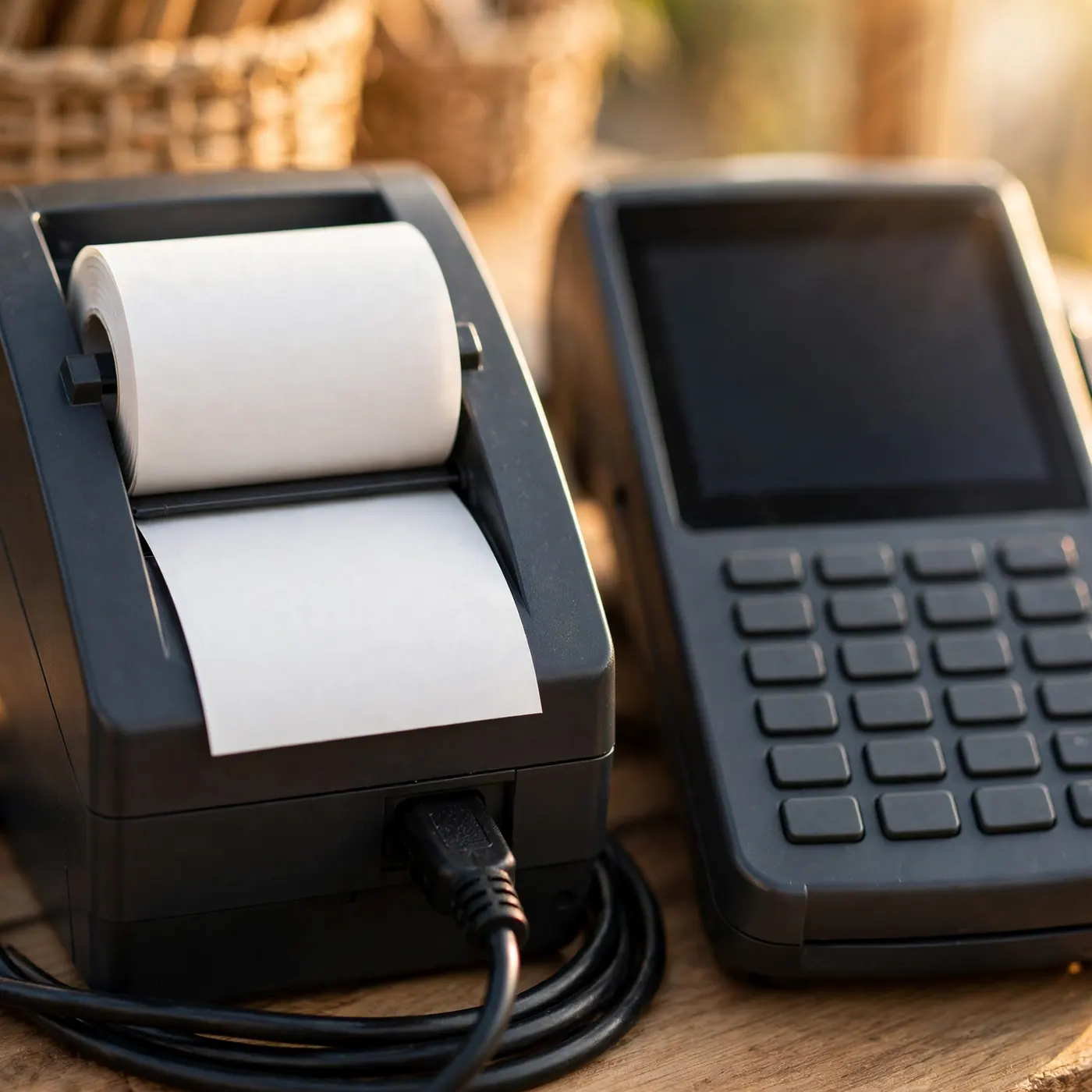
Timeline: the deadlines have already passed
Resolution 008 of January 31, 2024 amended article 23 of Resolution 165 and set three dates, all of which have passed:
| Group | Who | Date |
|---|---|---|
| 1 | Large taxpayers | May 1, 2024 |
| 2 | Income tax filers who are not large taxpayers | June 1, 2024 |
| 3 | Non-filers and those without those qualities | July 1, 2024 |
If any text tells you the deadline is February 3, 2024, it is outdated: that date from press release 009 was replaced by Resolution 008. Whoever opts for the POS after those dates must first register, under article 28. Resolution 227 of 2025 only compiled the regulations and relocated articles; it did not create new deadlines or caps.
Requirements for the electronic receipt
Compared with the paper receipt, the electronic one requires considerably more. According to the common requirements (article 19 of Resolution 165, now article 1.5.1.3.2.4 in the compilation), it must include:
- The designation «Documento equivalente electrónico tiquete de máquina registradora con sistema P.O.S.».
- Name or company name and NIT of the seller.
- Breakdown of VAT, consumption tax and any other taxes the law requires.
- Consecutive numbering and the number, range and validity authorized by the DIAN.
- Date and time of generation and of issuance.
- The CUDE (not to be confused with the CUFE, which is for invoices).
- The DIAN address for the QR code according to the technical annex.
- The issuer's digital signature.
The specific requirements (article 20) call for quantity, unit of measure, specific description and codes of the goods or services. The software must allow point-of-sale functions, identify the department or grouping and the VAT and consumption tax rate, and the item displayed must have a barcode or other internal identification.
And for the buyer to use it for VAT, costs and deductions, record their name or company name and their identification number or NIT, only when the customer asks for the document in their name.
How to implement it, step by step
- Confirm you are obligated under articles 7 and 8, and decide: electronic POS or electronic invoicing for 100% of sales.
- Become an enabled electronic invoicer. This is a prerequisite.
- Choose the operating mode: software from a technology provider or your own software, and associate it in the DIAN portal (Factura Electrónica, Habilitación, Documentos electrónicos, Documentos equivalentes).
- Pass the test set until the status is «Habilitado».
- Request the numbering authorization in the DIAN transactional portal.
We do not claim the menus will remain identical over time: the DIAN may change the screens. Verify the enablement status and the current numbering in the portal before continuing with the old receipt slip. Be wary of unofficial intermediaries who charge you for «procedures» you can do yourself in the portal; software provider costs vary and are not a DIAN fee.
Frequently asked questions
❓ Does the electronic POS have a 5 UVT cap?
No, the electronic POS equivalent document can be issued regardless of the value of the operation. The 5 UVT, excluding taxes, was the limit of the traditional POS receipt in paragraph 2 of article 616-1 of the Estatuto Tributario (verify at the official source).
❓ Does the paper receipt still work for costs and deductions?
Not in ordinary operations. In Concept 020900 of November 18, 2024, the DIAN says that this receipt is not applicable and that it does not give deductible VAT or costs. Paper is reserved for the technological inconvenience in article 37 of Resolution 165 (verify at the official source).
❓ What buyer data makes the electronic POS support VAT and costs?
Name or company name and identification number or NIT of the purchaser. Without that identification the benefit cannot be guaranteed, and the other requirements of tax legislation must also be met (verify at the official source).
❓ Must I implement the electronic POS or can I invoice everything electronically?
You can issue electronic invoices for 100% of your sales instead of implementing the equivalent document. The DIAN presents both routes as valid for those who already issued equivalent documents (verify at the official source).
❓ Since when has the DIAN required the electronic POS?
According to Resolution 008 of 2024, the dates were May 1, June 1 and July 1, 2024, depending on whether you are a large taxpayer, an income tax filer or another subject. Those deadlines have now passed, and whoever enters later must be enabled before issuing it (verify at the official source).
❓ Is a Simple Regime shop exempt from invoicing?
No. Those registered in the Simple Regime are among those obligated to invoice, and the DIAN's doctrine does not release them for meeting the conditions of not being VAT-responsible. Confirm your case with an accountant (verify at the official source).
❓ How is the system enabled with the DIAN?
You must be an electronic invoicer and associate the software of a provider or your own. Then you pass the test set until the Habilitado status and request the numbering authorization in the DIAN portal (verify at the official source).





Comments
Loading comments...
Checking sign-in status...