
How to pay the Industry and Commerce Tax (ICA) for freelancers in Colombia
Learn how to settle the Industry and Commerce Tax (ICA) if you work as a freelancer or have a small business in Colombia. Learn about the rules in Bogotá, Medellín, and Cali, the ReteICA calculation, and how to avoid sanctions from the Secretary of Finance.

IDIOMA DEL ARTÍCULO
Showing original language
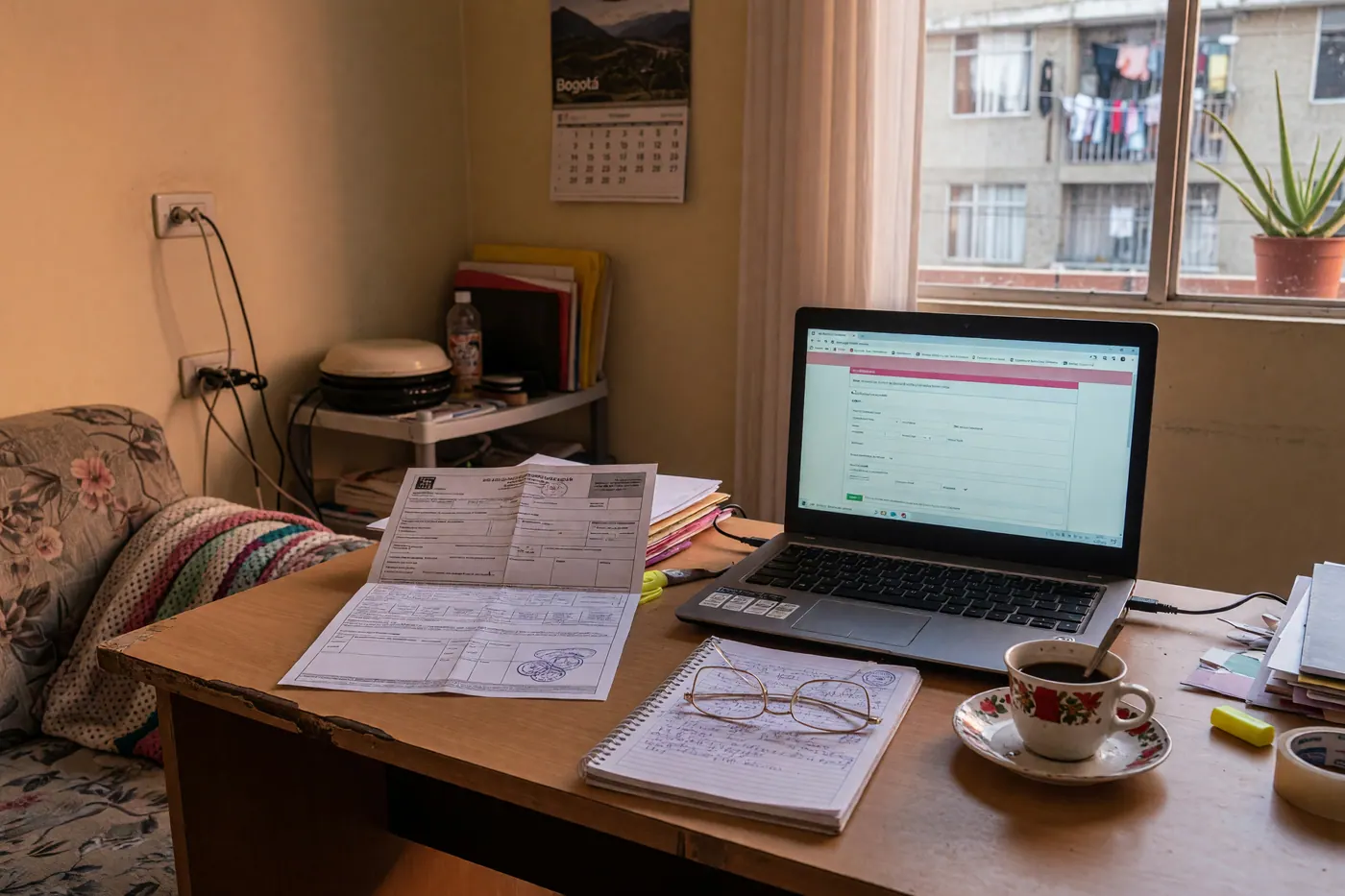
Many independent professionals and freelancers in Colombia focus solely on their annual income tax declaration to the DIAN. However, there is a municipal tax that frequently triggers requirements and penalties for late filing when overlooked: the Industry and Commerce Tax (ICA). Whether you are a designer, doctor, lawyer, consultant, or small business owner, if you provide services or sell goods independently, local Finance Secretariats expect your registration and tax settlement.
1. What is the Industry and Commerce Tax (ICA) and who is required to pay it?
The ICA is a territorial tax collected by city halls to fund local infrastructure and public services. Unlike national taxes administered by the DIAN, the ICA is collected directly by the Finance Secretariat of each municipality (such as the District Finance Secretariat in Bogota or the Revenue Subsecretariats in Medellin and Cali).
All individuals or legal entities that perform industrial, commercial, or service-related activities, with or without a commercial establishment open to the public, are required to register and pay the ICA. This includes service contract workers and those practicing liberal professions without a dependent employment relationship.
Income from salaries of employees under an employment contract and pension income are not subject to ICA. If you issue billing statements or electronic invoices to clients for fees or independent services, you must check the obligations of the municipality where you conduct the activity.
2. The principle of territoriality: in which municipality must you pay?

A constant dilemma for independent and remote workers is knowing which city hall they must pay if they live in one city but their client is based in another. Article 343 of Law 1819 of 2016 established the territoriality rules to avoid double municipal taxation:
- Physical and intellectual services: The ICA is accrued in the municipality where the work is physically executed or the contracted service is provided.
- Consulting and remote work: If you work from your home or private workshop, the activity is considered to be practiced in your municipality of residence or work office, regardless of where your client's offices are located.
When you formalize contracts with institutional clients, they often request tax documents. To keep your billing in order and avoid excessive withholdings, we recommend consulting our guide on the DIAN support document for non-invoice issuers.
3. How to calculate the ICA: rates per thousand and practical examples
The calculation of the ICA is not done through a direct percentage like VAT or income tax, but through a rate per thousand (expressed in units per every $1,000 of taxable gross income). The rates are set by each city's municipal council within ranges authorized by national law (between 2x1,000 and 14x1,000; for services and consulting, they are usually between 4.14 and 9.66 per thousand depending on the municipal CIIU code).
| City | Minimum ReteICA Base for Services (2026) | Exemption Cap/Non-obligated | Service rate |
|---|---|---|---|
| Bogota D.C. | 4 UVT ($209,496 COP) | 1,933 UVT ($101,238,942 COP) | Check district CIIU code |
| Medellin | 15 UVT ($785,610 COP) | According to local municipal statute | Check municipal CIIU code |
| Cali | 3 UVT ($157,122 COP) | According to district regulation | Check district CIIU code |
To understand the calculation using the official 2026 Tax Value Unit (UVT) set at $52,374 COP by the DIAN, let's look at an example: if you provide consulting services in Bogota and earned $50,000,000 COP gross in the year, you apply the service rate (9.66 x 1,000). You multiply $50,000,000 by 0.00966, which results in a gross tax of $483,000 COP. From this value, you subtract the ReteICA withholdings that your clients have applied to you during the year.
4. ReteICA in major cities: Bogota, Medellin, and Cali
ReteICA is the mechanism of withholding at source for ICA that your clients deduct from you at the moment they pay an invoice or billing statement. These withheld amounts are not a lost expense: they function as a credit balance that you subtract directly from your final tax declaration.
The rules vary significantly in each capital:
- Bogota D.C.: The District Finance Secretariat requires registration in the Tax Information Registry (RIT). The minimum base for applying ReteICA to services is 4 UVT ($209,496 COP in 2026), and for purchases of goods, it is 27 UVT ($1,414,098 COP in 2026). If you belong to the preferential regime with income below 1,933 UVT ($101,238,942 COP in 2026), the withholdings applied to you are considered final payment of the tax.
- Medellin: The minimum base for ICA withholding at source for services provided in the Antioquian capital is set at 15 UVT ($785,610 COP in 2026). You must keep your data updated with the Revenue Subsecretariat.
- Cali: The Municipal Finance Administrative Department sets one of the lowest withholding bases for service provision, starting from 3 UVT ($157,122 COP in 2026).
If, in addition to providing services, you are considering opening a physical location or store, review the legal details in our guide on renting a commercial space or office in Bogota and Medellin. Likewise, if you are moving from independent work to establishing a company, learn about the procedures in our article on how to register an SME or business at the Chamber of Commerce.
According to active ads on Colombia Move (August 2026), the services section had 107 active ads and accumulated 14,553 views. This is a snapshot of supply and demand within the platform, not an estimate of the Colombian labor market.
5. The Simple Taxation Regime (RST) and step-by-step payment
An increasingly popular alternative for small businesses and freelancers is to enroll in the DIAN's Simple Tax Regime (RST). Under this modality, the consolidated ICA is settled bimonthly using DIAN Form 2593. The main advantage is that the DIAN collects the municipal tax and distributes it to each mayor's office, saving you from filing multiple forms with different local Finance Secretariats.
If you choose the ordinary territorial regime, follow this procedure to pay online:
- Registration in the local registry: Register on your municipality's Finance Secretariat website within the timeframe established by the local tax statute.
- Collect your ReteICA certificates: Ask your clients for the withholding certificates stating the amounts withheld during the taxable year.
- Fill out the virtual form: Access your city's Virtual Finance Office (for example, the SHD Virtual Office in Bogotá).
- Calculate the amount to pay: Apply the rate according to your CIIU code, subtract the withholdings, and settle the net balance.
- Pay via PSE or bank: Generate the official receipt with a barcode or make an electronic payment using the PSE button.
Frequently Asked Questions
❓ What happens if I provide services as a freelancer and have never registered for ICA?
Your municipality's Finance Secretariat may issue summons and impose sanctions for non-registration or late filing. It is advisable to register voluntarily in the local registry and review pending declarations before receiving a formal notice; the effects and sanctions depend on the municipal statute, and it is best to confirm them with an accountant.
❓ If I work 100% remotely from my home for a company in another city, where do I pay ICA?
You must pay taxes in the municipality where you physically perform the work. According to Article 343 of Law 1819 of 2016, if your place of work is your home in Medellín or Cali, that is where the tax is incurred, regardless of whether your client's main office or NIT is registered in Bogotá or abroad.
❓ What is the minimum income amount to be required to declare ICA in Bogotá in 2026?
In Bogotá, individuals in the preferential regime whose taxable income from the previous year is less than 1,933 UVT ($101,238,942 COP in 2026) are not formally required to file an ICA declaration, provided that the ReteICA withholdings applied by their clients have covered the entire tax.
❓ How do I recover the money that companies withhold from me for ReteICA?
ReteICA is deducted as an advance payment on your annual or bimonthly ICA declaration. You must attach and keep the withholding certificates issued by your contractors to subtract that balance from the total tax settled; if there is a credit balance, check the applicable municipal procedure.
❓ If I am in the Simple Tax Regime (RST), do I have to pay ICA to my mayor's office?
You do not need to file individual declarations with the local Finance Secretariat for the consolidated ICA. By belonging to the RST, you integrate the ICA into your bimonthly advances with the DIAN using Form 2593, and the national entity distributes the funds to the corresponding municipalities.
❓ Does income from salaries under an employment contract pay ICA?
No. Income obtained from salaries and social benefits derived from an employment or legal and regulatory relationship does not constitute a taxable event for the Industry and Commerce Tax.



Comments
Loading comments...
Checking sign-in status...