
How to Request and Demand the Administrative Clearance Certificate in Horizontal Property
How to request the administrative clearance certificate in co-ownership: filing, 10-business-day deadline, and what to do at a notary office if they do not provide it.
IDIOMA DEL ARTÍCULO
Showing original language
| Point | What to apply |
|---|---|
| Who issues it | The administrator or legal representative (Art. 51 num. 13, Law 675 of 2001). |
| What the notary asks for | Proof of no debt for common expenses to transfer ownership (Art. 29). |
| Written deadline | Up to 10 business days for documents (Law 1755 of 2015, Art. 14). |
| If it does not arrive | Deed with record of the filing and joint liability of the buyer (Art. 29, para. 5). |
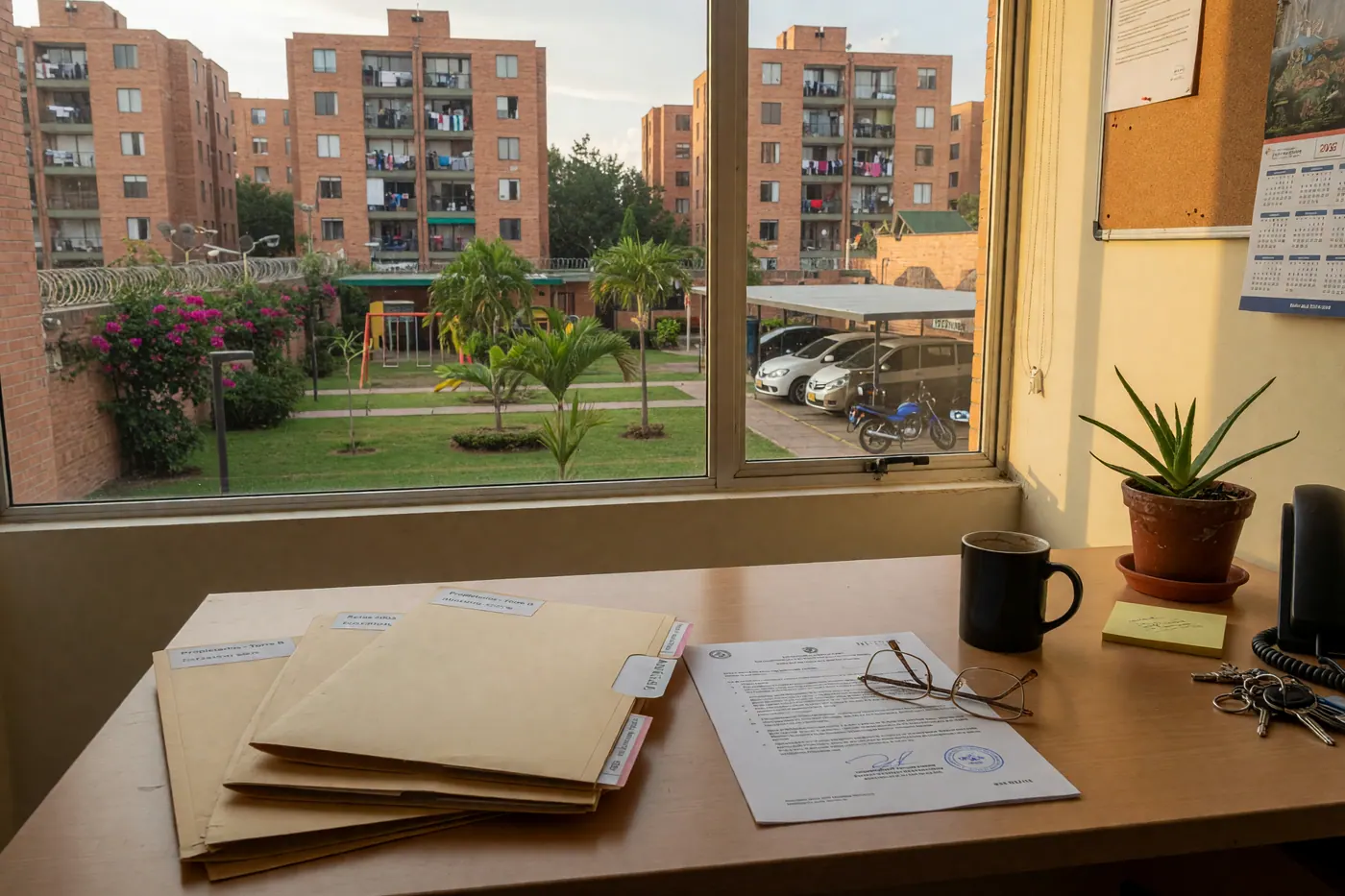
The last time I accompanied a friend to sign a deed, the hurdle wasn't the property tax. It was a WhatsApp message from the building management at 7:40 a.m.: “the proof of no debt will be out tomorrow.” The notary already had a scheduled time. That building management proof of no debt is what is required to sell a co-owned property. Leaving it for the last minute is the silliest way to lose the signing.
According to active listings on Colombia Move (September 2026), there are 44 apartment ads and 135 in the housing section: several of those deals get stalled exactly here. I would request it with a formal filing record, not an audio message.
What the proof of no debt certifies (and what shouldn't block it)
Article 29 of Law 675 of 2001 mandates that the notary require the proof of no debt for common expenses issued by the building's legal representative. It is not a certificate of “everything the management happens to think of.” It refers to ordinary and extraordinary dues already incurred.
The typical fight: they withhold the paper over a noise fine under dispute or a parking lot scratch. Those sanctions fall under the coexistence regulations. The notary certificate accounts for expenses. If the dues are up to date, I wouldn't accept them denying you the document “until you pay the fine.”
The same Article 29 creates joint liability between the seller and the buyer for uncovered expenses. That is why the serious buyer—and the bank, if there is a loan—refuse to sign blindly. The collection, the arrears, and who is responsible to the building association are in how to collect and pay the building management dues.
Don't confuse it with the proof of no debt for betterment taxes (valorización): that is issued by the territorial entity, not the administrator. The deed folder usually requires both. The municipal map is at how to request the proof of no debt for betterment taxes.
How to request it so there is a trail
Article 51, numeral 13, of Law 675 establishes the administrator's duty to issue the proof of no debt when the owner or holder changes. It is not a favor.
The channel I would use: official email or physical filing with a stamp and date. WhatsApp is good for hurrying things along, not for providing proof. If they later say they “never received it,” a loose chat won't save you at the notary.
- Tower, apartment, or house, and if a parking space and storage unit apply.
- Name and document of the owner or holder.
- Cut-off date (the month of the deed or the handover).
- Receipts for the last ordinary and extraordinary dues.
- That you are requesting the proof of no debt for expenses for a transfer of ownership or change of holder.
- Acknowledgment of receipt: filing number, date, and time.
Ask for a signed PDF. If they insist on paper, an original with the legal representative's signature. Notaries list it among the requirements for deed signing in horizontal property, valid for the month of issuance, not a certificate from the previous quarter.
Delivery deadlines and charges you shouldn't swallow
Law 675 did not set a “three-day” clock in this article. If the request is in writing, the right of petition before private legal entities applies (Law 1755 of 2015, arts. 14 and 32): up to 10 business days for documents and information. That is not “when the accountant returns from vacation.”
Validity, in practice, is marked by the monthly cut-off. A March certificate is useless for an April deed if the new due has already been charged. Request it for the month of the grant and update it if the signing is delayed.
Can they charge you an “issuance fee”? The law does not contemplate a discretionary rate: the administrator already collects a salary. A disproportionate surcharge that is not in the budget or the regulations is a toll. The only thing that might make sense is the cost of photocopies if you refuse the PDF. I would reject an invented charge and ask for the general assembly minutes or the regulation where it was approved.
Watch out for the administrator who only responds via WhatsApp, loses the filing record, and charges for printing a sheet of paper. An email with an acknowledgment of receipt is the clock you can later show the buyer or seller.

If they don't deliver: notary, petition, and tutela
The sale doesn't fall through just because the paper is missing on the day of signing. Article 29, paragraph 5, allows the notary to authorize the deed with a record of the submitted request and the fact that the buyer assumes joint liability for outstanding debts. The buyer inherits the liability. Banks and serious buyers prefer not to sign that way. Use this only when the administrator has hidden and the closing cannot wait.
If 10 business days have passed without a response, follow up with the filing record. If they remain silent, Constitutional Court Ruling T-333 of 2018 has protected the right of petition of co-owners against private management. A tutela (constitutional injunction) isn't the first message: it's what you use when they slam the door on you.
If the delay caused you to lose the sale, Article 50 establishes the civil liability of the administrator for malice or negligence. You need proof: promise, earnest money, filing record, and silence. Do this: file, keep the receipt, take a copy to the notary. Avoid this if you are the buyer: signing “without the proof of no debt, we'll see.” The joint liability of Article 29 is your debt the next day.
The proof of no debt when you surrender a lease
Returning the keys without a building management proof of no debt leaves the door open to retroactive charges. The administrator must also issue it when there is a change of holder. Attach it to the handover record: dues up to the cut-off, accrued extraordinary dues, and utility readings. Without that comparison, the return of the security deposit becomes a tug-of-war. The details of the deposit are in return of the lease deposit or guarantee.
If the property is left empty and you lease it again, publish it with photos, price, and management rules: in the housing section people are looking for co-owned apartments, not half-finished ads.
Frequently asked questions
❓ How much does it cost for the building management to issue the proof of no debt?
They should not charge you a fee for handling this: issuing it is an ordinary function already covered by your maintenance fees. The law does not contemplate discretionary rates; a surcharge would only make sense if approved in the budget or bylaws and is limited to the material cost of copies. Reject disproportionate charges without that basis (source: Law 675 of 2001, accessed 2026).
❓ Is it safe to sign like this?
The notary can notarize with proof of the filing and buyer's solidarity, according to Article 29 of Law 675 of 2001. The liability for expenses does not disappear: it is inherited by the buyer. Banks and serious buyers usually refuse this. Source consulted in 2026: Law 675, art. 29.
❓ Where to list the property once you have the 'paz y salvo' (clearance certificate)?
On owner listing sites and direct classifieds, with photos, HOA fee amount, and building rules. Avoid opaque groups where they ask for a commission to 'close' the deal. The certificate helps show that there is no hidden debt. Practical source updated in 2026: the same filing receipt you used at the notary.
❓ Is the administration clearance certificate ('paz y salvo') mandatory to sign the deed?
Yes: the notary must require it at the beginning, according to Article 29 of Law 675 of 2001. If the administrator does not deliver it, it can be notarized with proof of the filed request and with the buyer's solidarity. That does not annul the sale automatically. Source consulted in 2026: Law 675, art. 29.
❓ How much time does the administrator have to deliver the certificate?
Law 675 does not set a number of days for this certificate. If the request is a formal document petition, Law 1755 of 2015 gives up to 10 business days. A 'it will be out next week' via WhatsApp does not replace that timeframe. Source consulted in 2026: Law 1755, art. 14.
❓ Can they deny me the clearance certificate due to a contested coexistence fine?
They should not withhold the common expense clearance certificate if ordinary and extraordinary fees are up to date. The notarial certificate accounts for those expenses; non-finalized sanctions fall under the coexistence bylaws. Source consulted in 2026: Law 675 and doctrine on expenses.


Comments
Loading comments...
Checking sign-in status...