
Tourist Police & Emergency Medical Dispatch in Colombia: Expat Emergency Protocols
A practical guide for expats and travelers navigating Colombian emergency services, from bilingual dispatch tricks on Línea 123 to Tourist Police support and CRUE hospital protocols.
IDIOMA DEL ARTÍCULO
Showing original language
When unexpected crises hit in a foreign country, panic thrives on unfamiliar bureaucracy. Whether you have lost a passport in a taxi, encountered aggressive touts, or faced a sudden medical emergency in an apartment late at night, knowing the exact operational workflow of Colombian emergency response saves critical minutes. While evaluating neighborhood safety and realistic security practices in Colombia helps minimize everyday risks, understanding who to call and what to say during an acute crisis is mandatory.
This guide covers how to contact and leverage the Policía de Turismo (Tourist Police), how municipal Línea 123 dispatch operates, how to access emergency ambulances via public CRUE networks versus private providers, and how to secure formal police documentation for insurance and consular replacements.
Quick Answer: Colombia Emergency Numbers at a Glance
- Unified Emergency Dispatch (All services): 123 (Toll-free 24/7 on any mobile phone or landline, even without SIM credit).
- Policía de Turismo: Stationed at major airports, historical districts, and dedicated Attention Points (Puntos de Atención al Turista).
- Fire Department (Bomberos): 119 (or routed via 123).
- Anti-Extortion & Kidnapping (GAULA): 165.
- Official Crime Reporting: Online via the national ¡A Denunciar! portal or in-person at local CAI and URI stations.
- Emergency Medical Mandate: Under Ley 1438 de 2011, all public and private Colombian clinics must stabilize life-threatening emergencies regardless of insurance or upfront payment.
Colombia Emergency Line 123: How Dispatch Works & Language Barrier Strategies
In Colombia, Línea 123 functions as the unified emergency number across the entire national territory. It operates 24 hours a day, 7 days a week, and connects directly to municipal integrated command centers—such as the C4 (Centro de Comando, Control, Comunicaciones y Cómputo) in Bogotá or SIES-M in Medellín. Under Colombian telecommunications regulations, dialing 123 is completely toll-free on all mobile networks and landlines. You do not need airtime, data, or an active cellular balance to connect.
While travelers frequently ask if dialing 911 works, you should never rely on 911 in Colombia. While some international roaming providers reroute 911 calls to local dispatchers, others fail or encounter connection delays. Always dial 123 directly from your device.
Once connected, dispatchers triage calls into three operational branches: Policía Nacional, Bomberos (Fire/Rescue), or CRUE (Ambulance/Medical Dispatch). A critical hurdle for many expats is language. While dispatch centers in international hubs like Bogotá, Medellín, and Cartagena maintain some operators with conversational English, standard shifts are overwhelmingly Spanish-speaking. In high-adrenaline situations, relying on bilingual dispatchers creates risky delays.
Essential Spanish Emergency Phrases
If your Spanish is intermediate or conversational, speak slowly, state your emergency immediately, and give the operator these key cues:
- "Emergencia médica, necesito una ambulancia urgente." (Medical emergency, I need an urgent ambulance.)
- "Robo en proceso / Me acaban de robar." (Robbery in progress / I was just robbed.)
- "No hablo español fluido. ¿Tiene un operador que hable inglés?" (I don't speak fluent Spanish. Do you have an operator who speaks English?)
- "Hay una persona herida / inconsciente." (There is an injured / unconscious person.)
Mastering Colombian Address Nomenclature
A Colombian emergency operator cannot send help to a building name, a landmark, or a vague description. They require the exact administrative address formatted under the standard grid system. Practice spelling your residential address using Colombian terms:
- Calle (Cl. / Cll.): Streets running roughly east-west in standard municipal grids.
- Carrera (Cra. / Cra.): Avenues running roughly north-south.
- Transversal / Diagonal: Angled avenues cutting across the grid.
- Número (#): The intersecting street followed by building distance (e.g., Carrera 43A # 5A - 113).
- Interior / Apartamento: Tower, block, or apartment number inside gated complexes.
- Barrio & Ciudad: Your specific neighborhood and municipality (e.g., Barrio El Poblado, Medellín or Barrio Chapinero, Bogotá).
The Role of the Policía de Turismo: Where to Find Them & How They Help
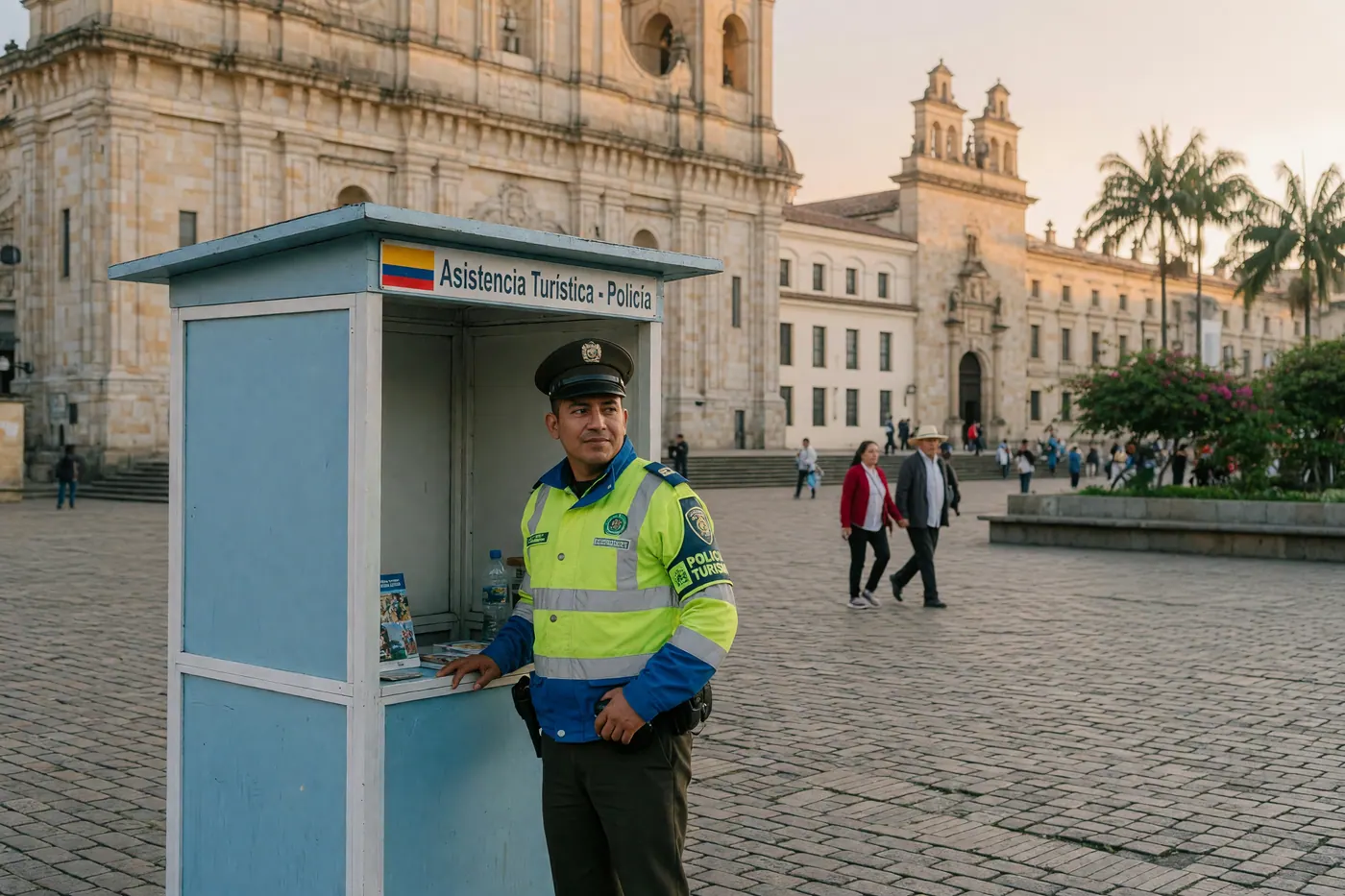
Foreigners encountering non-violent security problems, vendor extortion, or regulatory disputes in tourist zones often turn to standard street patrols and find limited support. Colombia established a dedicated division under Ley 300 de 1996 (General Tourism Law): the Grupo de Protección al Turismo y Patrimonio Nacional, commonly referred to as the Policía de Turismo.
Unlike standard urban patrol officers who focus primarily on general public order, Tourist Police officers receive specialized instruction in foreign languages, cultural diplomacy, consumer rights, and cultural heritage preservation. You can easily recognize them by their distinctive uniforms, which typically include high-visibility yellow-green vests bearing the official Policía de Turismo insignia and armbands.
Primary Functions and Jurisdictions
The Tourist Police operate within strategic corridors where international and domestic visitors congregate:
- Fixed Kiosks & Points of Attention (Puntos de Atención al Turista): Stationed in historic centers (such as La Candelaria in Bogotá, the Walled City and Getsemaní in Cartagena, and Comuna 13 or Parque Lleras in Medellín).
- Transit Gateways: Permanent presence inside international airport arrival halls (El Dorado, José María Córdova, Rafael Núñez) and intercity bus terminals.
- Consumer & Tour Dispute Resolution: Intervening when unlicensed tour operators, informal taxi dispatchers, or venues impose fraudulent overcharges or fail to provide legally binding services.
- Victim Guidance: Assisting foreign crime victims through the formal complaint process and linking them with consular or translation resources.
Important boundary: Tourist Police do not serve as private bodyguards or private transport escorts. Their authority is regulatory, orientational, and preventive within designated tourist zones. When navigating traffic stops outside tourist corridors, review our guide on handling police checkpoints and roadside documentation to ensure your interactions with standard transit authorities remain smooth.
Emergency Medical Dispatch (CRUE) vs. Private Ambulance Services
Medical emergencies introduce unique logistical challenges in Colombia. When you call 123 for a medical issue, the call is transferred to the Centro Regulador de Urgencias y Emergencias (CRUE), an operational division of the local health secretariat. CRUE acts as the central air traffic controller for public medical resources, assessing patient condition and dispatching public ambulances from the Sistema de Emergencias Médicas (SEM).
However, expat expectations regarding ambulance response times often clash with metropolitan reality. Peak-hour traffic in cities like Bogotá or Medellín, combined with municipal ambulance supply constraints, can result in variable response times for conditions classified as non-immediately fatal. Understanding your options—and knowing when to hail a taxi or rideshare directly to a clinic—is critical.
Emergency Medical Service Options Compared
| Service Type | Primary Providers | Dispatch Protocol | Best For |
|---|---|---|---|
| Public 123 / CRUE Dispatch | Municipal Red de Salud | Call 123 → CRUE medical triage evaluation | Major roadside trauma, multi-casualty incidents, acute life-threatening situations where bystanders call help. |
| Private Prepaid Ambulance Plans | Emermédica, Grupo EMI, Coomeva Emergencias Médicas | Direct private dispatch hotline via dedicated app or phone line | At-home emergencies, sudden severe illness, rapid doctor-to-home triage, stabilized transport to private clinics. |
| Private Taxis / Rideshare (Direct Transit) | Local yellow taxis, Uber, Cabify | Direct transit to nearest high-complexity ER (Clínica / Hospital) | Conscious patients, stable fractures, localized cuts, situations where traffic delays make waiting for an ambulance risky. |
Your Legal Emergency Rights: Ley 1438 de 2011
A foundational principle of Colombian healthcare law that every expat must understand is codified in Article 67 of Ley 1438 de 2011. Under this statute, every public and private hospital or clinic in Colombia is legally bound to provide Atención Inicial de Urgencias (Initial Emergency Care) to any human being present in national territory.
This means that in an acute, life-threatening emergency (e.g., severe trauma, myocardial infarction, acute anaphylaxis), an emergency room cannot refuse to treat or stabilize you on the grounds that you lack Colombian EPS health insurance, carry a foreign passport, or do not have an active credit card ready. Once initial medical stabilization is complete, the hospital administration will process insurance coverage, invoice the patient, or arrange an orderly transfer. For a deeper breakdown of triage color codes and ER admission procedures, read our full walkthrough on understanding medical emergency triage and hospital admission protocols.
Stolen Passports & Crime Reporting: Navigating ¡A Denunciar! and CAI Stations
If you fall victim to theft (hurto) or lose vital documents, obtaining an official police report—known as a denuncia—is the legally required first step for filing insurance claims, obtaining an emergency passport at your embassy, and clearing exit migration with Migración Colombia.
In Colombian neighborhoods, you will frequently see small octagonal police stations called Centros de Atención Inmediata (CAI). While CAI officers can take immediate field reports, dispatch neighborhood patrols, and help coordinate immediate searches, they generally direct victims of theft to formal legal reporting platforms for official certified documents.
Step-by-Step Reporting Channels
- Online Portal (¡A Denunciar!): The quickest and most efficient route is the official national reporting platform operated jointly by the Policía Nacional and the Fiscalía General de la Nación (accessible via policia.gov.co). You can complete the incident report in 15 to 20 minutes from any phone or computer. Once submitted, the system generates a formal incident tracking number and a downloadable, digitally signed PDF certifying the crime. Embassies, airlines, and insurers treat this PDF as official legal proof.
- Unidades de Reacción Inmediata (URI): If the incident involved severe physical violence, weapons, or immediate suspect apprehension, reporting must take place in person at a regional URI office of the Fiscalía. In these locations, a prosecutor (fiscal) and judicial investigators (CTI) take formal sworn depositions.
- Migración Colombia Reporting: If your foreign passport and Cédula de Extranjería are stolen, submit your online denuncia immediately, then notify Migración Colombia online or at their service centers before scheduling your emergency embassy appointment.
Consular Support: What Your Embassy Can (and Cannot) Do in an Emergency
Expatriates and international tourists frequently misjudge the scope of consular assistance during crises. Foreign embassies maintain 24-hour duty officers for citizen emergencies, but their powers are clearly delineated by international treaties and domestic laws.
What Consular Citizen Services Provide:
- Emergency Passports: Expedited issuance of limited-validity temporary passports to enable urgent international travel or travel back to your home country.
- Welfare Checks: Coordinating with local police and detention centers if a foreign citizen is reported missing, injured, or arrested.
- Medical & Legal Directories: Providing lists of verified English-speaking medical facilities, accredited translators, and criminal defense attorneys.
- Next-of-Kin Notification: Formally notifying family members abroad in the event of severe injury, medical incapacitation, or death, and assisting with repatriation of remains.
What Embassies Cannot Do:
- Embassies cannot act as personal legal counsel, post bail, or intervene to overturn Colombian judicial proceedings.
- Consulates cannot pay private hospital invoices, settle medical bills, or fund private air ambulances. Medical costs remain solely the patient's responsibility.
- Consular staff cannot provide armed physical protection or conduct sovereign criminal investigations on Colombian soil.
According to active listings on Colombia Move (September 2026), vivienda had 134 live housing ads and 25,624 views, so verify the address grid before you sign.
Frequently Asked Questions
❓ Does dialing 911 work in Colombia, or must I dial 123?
You must dial 123, which is Colombia's sole official unified emergency dispatch number for police, medical, and fire emergencies. While certain foreign mobile carriers occasionally route 911 calls across international partner towers, this rerouting is inconsistent as of 2026. Always dial 123 directly from any mobile phone or landline without adding area codes.
❓ Do Colombian emergency 123 operators speak English?
Most emergency dispatch operators in Colombia speak only Spanish, although municipal control centers in major cities like Bogotá and Medellín have limited bilingual staff on duty. In a crisis as of 2026, clearly state your location (Carrera, Calle, Número, and Barrio) and use concise Spanish phrases such as "emergencia médica" or "necesito ayuda policial" to initiate triage without translation delays.
❓ How is the Tourist Police (Policía de Turismo) different from regular police?
The Tourist Police is a specialized national police division established under Ley 300 de 1996 to protect cultural heritage, monitor tourist corridors, and resolve consumer disputes affecting foreign visitors. As of 2026, officers are still positioned at airports, historical squares, and transit terminals, with training in visitor assistance, foreign languages, and tourism regulations.
❓ Can a private hospital in Colombia refuse to treat me in a life-threatening emergency?
No, private and public hospitals in Colombia are legally prohibited from refusing life-stabilizing care during acute emergencies under Article 67 of Ley 1438 de 2011. As of 2026, any clinic with an emergency room must still deliver initial triage and stabilization regardless of nationality, residency status, or upfront ability to pay, though long-term inpatient care will require insurance authorization or private payment.
❓ How do I report a stolen phone or passport to Colombian authorities?
You can report stolen belongings or identity documents online through the national ¡A Denunciar! virtual system operated jointly by the Policía Nacional and Fiscalía General de la Nación. As of 2026, completing the online form still generates an official, certified incident report (denuncia) that is accepted by foreign embassies for emergency passport replacement and by travel insurance providers for claims.
❓ Can my home country's embassy pay for an emergency medical evacuation from Colombia?
No, foreign embassies and consulates do not cover medical bills, ambulance transport fees, or international medical evacuation flights for their citizens. As of 2026, consular officers can still facilitate communication with family members and provide lists of local medical providers, but all evacuation and treatment costs must be covered by comprehensive private travel or international expat health insurance.



Comments
Loading comments...
Checking sign-in status...