
Colombia Emergency Number 123: Official Guide to Police, Ambulance & Fire Dispatch
Calling 123 in Colombia connects you to unified police, medical, and fire dispatch. Here is how the system works, how to navigate language barriers, and what to expect.
IDIOMA DEL ARTÍCULO
Showing original language
When an unexpected crisis strikes while living or traveling abroad, knowing who to call and what happens after you dial can prevent panic from turning into disaster. In Colombia, the single universal emergency number is 123. Functioning similarly to 911 in North America or 112 across the European Union, 123 serves as the national gateway for police intervention, medical rescue, structural firefighting, and civil protection.
Yet many newcomers assume dialing 123 works exactly like emergency systems back home. In practice, Colombia’s emergency coordination combines civilian call intake, specialized police quadrant dispatch, and a municipal medical regulatory body known as CRUE. Furthermore, while the country welcomes millions of international visitors and remote workers each year, the vast majority of dispatch operators handle calls strictly in Spanish.
How Colombia's 123 Dispatch Architecture Works
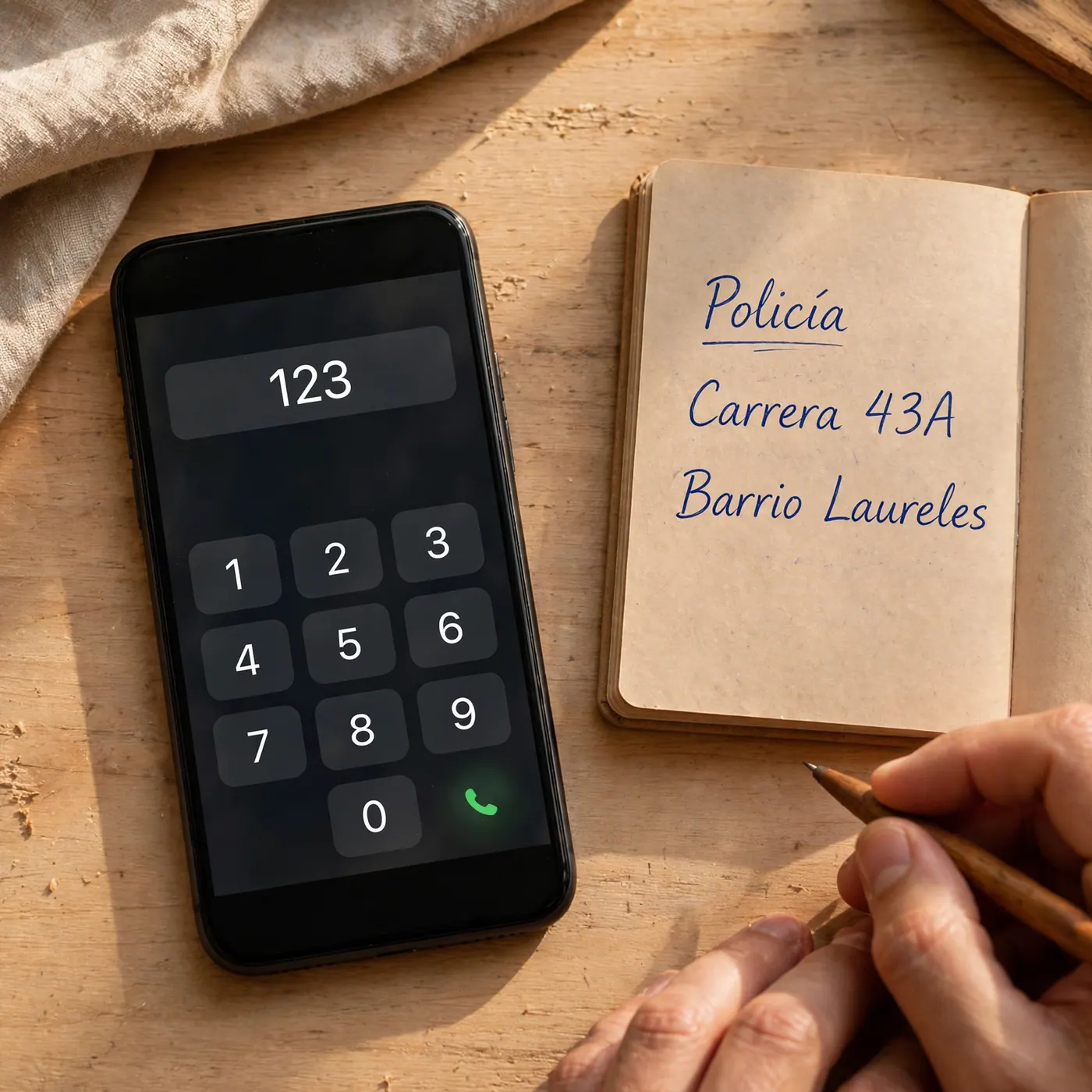
In Colombia, dialing 123 connects to the nationwide emergency number, which routes callers to municipal dispatch centers. In Bogotá, calls enter the NUSE (Número Único de Seguridad y Emergencias) managed by the C4 (Centro de Comando, Control, Comunicaciones y Cómputo), while other metropolitan areas operate through systems such as Medellín's SIES-M or Cali's SIES. When you place a call, you are not speaking directly to a patrolling officer or a paramedic in the back of an ambulance. Instead, you connect to a centralized dispatch facility where a trained intake operator screens your situation within seconds.
During an active call, the intake operator performs initial triage by categorizing the incident into one of three primary response branches:
- Policía Nacional: Active crimes in progress, physical assaults, armed robberies, disturbances of the peace, traffic collisions involving aggressive disputes, or urgent perimeter protection.
- CRUE (Centro Regulador de Urgencias y Emergencias): Life-threatening physical trauma, severe respiratory failure, unconsciousness, heart attacks, or major traffic injuries requiring municipal ambulance mobilization.
- Cuerpo Oficial de Bomberos & Disaster Management: Structural or forest fires, natural gas leaks, structural collapses, electrical hazards, and flood extractions (coordinated alongside entities such as IDIGER in the capital).
Once your incident category is confirmed, the intake operator logs your coordinates and patches the incident ticket directly to the agency dispatcher overseeing your specific urban sector.
City-by-City Emergency Dispatch Infrastructure
While 123 is a single nationwide number, operations are managed regionally by municipal secretariats of security. Understanding how your metropolitan area processes emergency calls helps you set realistic expectations during a crisis.
Bogotá: The C4 Operations Center
In Bogotá, Línea 123 is handled as NUSE (Número Único de Seguridad y Emergencias) by the Secretaría Distrital de Seguridad, Convivencia y Justicia inside the C4 facility (Centro de Comando, Control, Comunicaciones y Cómputo). The center brings together the Policía Metropolitana de Bogotá (MEBOG), the capital's CRUE health desk, the Cuerpo Oficial de Bomberos, mobility wardens, and the Secretaría de la Mujer under one operational roof. The Bogotá 123 platform also supports technical enhancements, including silent web-chat links and emergency video calls sent via SMS or messaging apps when a caller is unable to speak safely out loud.
Medellín: Centralized Coordination at SIES-M
In Medellín, emergency communications are run through SIES-M (Sistema Integrado de Emergencias y Seguridad Metropolitano). The nerve center is headquartered at Centro Administrativo La Alpujarra, Calle 44 # 52-165, La Candelaria, Medellín. The system coordinates emergency units across the entire Aburrá Valley, dispatching the Policía Metropolitana del Valle de Aburrá (MEVAL), Bomberos Medellín, and the municipal SEM/CRUE emergency medical routing team.
Cali: The SIES Urban Hub
In Santiago de Cali, the Secretaría de Seguridad y Justicia manages dispatch via the local SIES center. This unified command coordinates responses between the Policía Metropolitana de Santiago de Cali (MECAL), the municipal CRUE ambulance triage desk, and Bomberos de Cali.
Calling an Ambulance: The Reality of CRUE and Hospital Care
One of the most common surprises for foreign residents is that dialing 123 does not automatically send an ambulance to your doorstep. Unlike private emergency response subscriptions, Colombia’s public medical response is heavily triaged to manage finite municipal healthcare resources.
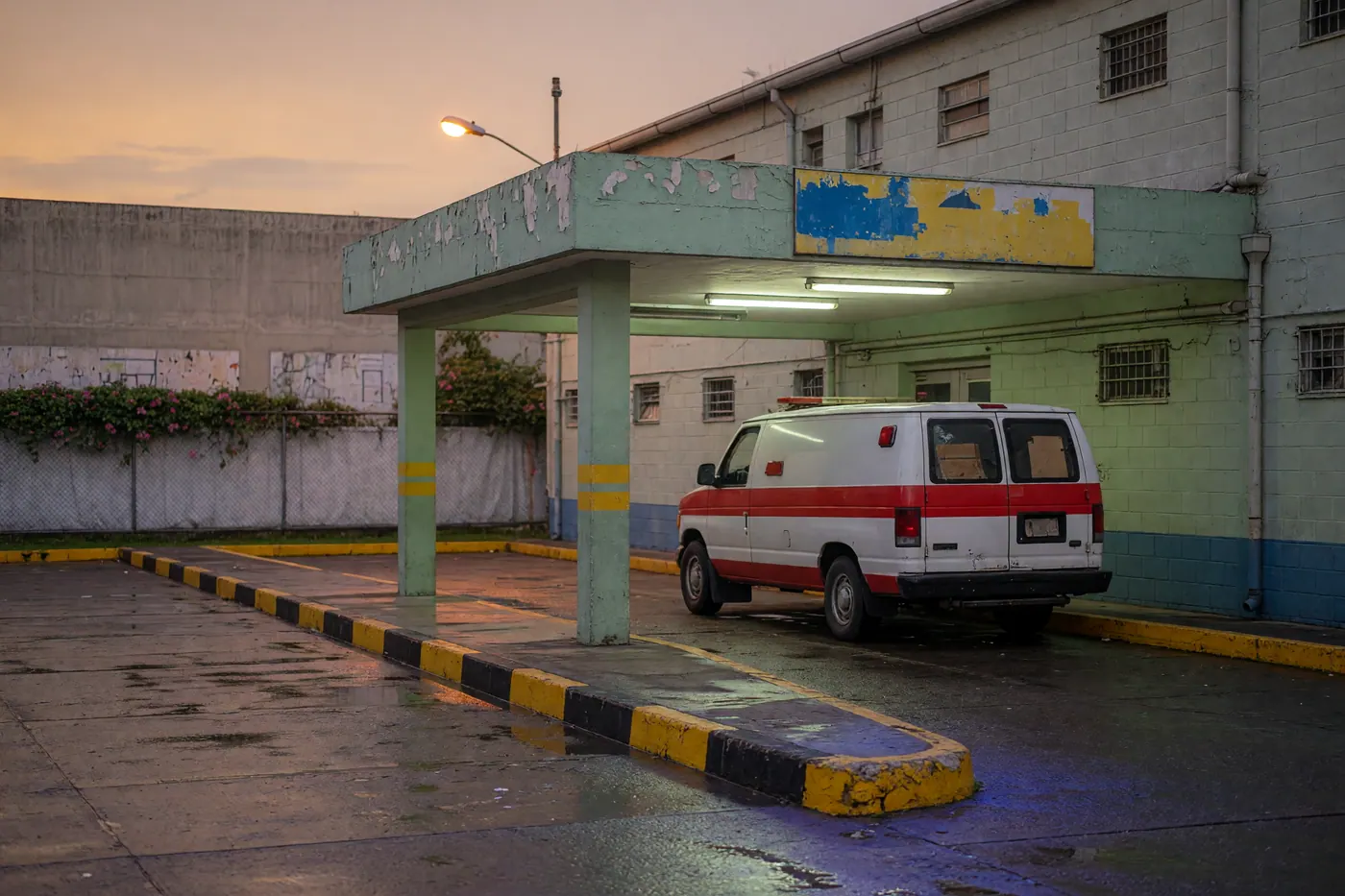
When you request medical help on 123, you are transferred to a CRUE physician or specialized paramedic. The coordinator will ask targeted diagnostic questions: Is the patient conscious? Are they breathing? Is there uncontrolled arterial bleeding? If the situation qualifies as an immediate threat to life (Triage 1 or critical Triage 2), CRUE authorizes the dispatch of a public or contracted municipal ambulance.
If the medical evaluator determines that the condition is non-critical—such as a sprained ankle, moderate fever, or stable minor cut—they will instruct you to arrange private transport or a private car to the nearest clinical urgent care center (urgencias). For non-critical emergencies, foreigners often rely on private pre-hospital medical networks such as EMI or Emermédica, which operate independently from the public CRUE 123 channel.
Related Reading: To understand hospital intake tiers, triage rankings, and how private clinics handle deposits and international health policies, read our guide to medical emergency procedures and ER triage for expats in Colombia.
Mandatory Emergency Treatment Under Ley 1438 de 2011
If you or someone in your care suffers a catastrophic medical event, Colombian law provides vital protection. Under Article 67 of Ley 1438 de 2011, every public and private clinic, hospital, and healthcare facility nationwide is legally obligated to admit and stabilize any patient suffering a life-threatening medical emergency (known legally as atención inicial de urgencias). A hospital cannot demand upfront payment, credit card deposits, or proof of an EPS or travel insurance policy before providing vital stabilization care.
Overcoming the Language Barrier: Exact Spanish Scripts
Can you speak English when calling 123? While operators in major metropolitan centers occasionally have bilingual staff available, you should never assume you will reach an English speaker. If you speak only English, dispatchers may struggle to record your location, losing critical minutes.
If you need an English speaker, your opening phrase should be: "¿Tiene un operador que hable inglés, por favor? Es una emergencia." If none is immediately available, speak slowly, remain calm, and use the structured transmission formula below.
The Essential Transmission Formula
Emergency operators require four fundamental pieces of information in a specific sequence:
- City and Neighborhood (Ciudad y Barrio): In Colombia, identical street numbers exist across different municipalities. Always open with your city and neighborhood first.
- Exact Address (Dirección Exacta): Use standard Colombian address notation (e.g., Carrera con Calle, building name, apartment number).
- Nature of Crisis (Tipo de Emergencia): Police, medical, or fire.
- Number of People at Risk: Mention if weapons are present or if individuals are unconscious.
Key Phonetic Phrases for Critical Situations
| Situation | Spanish Phrase | Pronunciation Guide |
|---|---|---|
| Immediate Police Needed | "Necesito a la policía de inmediato, hay un robo en curso." | Neh-seh-SEE-toe ah lah po-lee-SEE-ah deh een-meh-dee-AH-toe, eye oon RO-bo en KOOR-so. |
| Medical / Ambulance Needed | "Necesito una ambulancia urgente, una persona está inconsciente." | Neh-seh-SEE-toe OO-nah ahm-boo-LAHN-see-ah oor-HEN-teh, OO-nah per-SO-nah es-TAH een-kohn-see-EN-teh. |
| Fire / Gas Hazard | "Hay un incendio y olor a gas en este edificio." | Eye oon een-SEN-dee-oh ee oh-LOR ah gahs en ES-teh eh-dee-FEE-see-oh. |
| Exact Location Hand-off | "Estoy en [Ciudad], Barrio [Nombre], Carrera [Número] con Calle [Número]." | Es-TOY en [City], BAR-ree-oh [Neighborhood], Cah-RREH-rah [X] kohn KAH-yeh [Y]. |
Tourist Police & Non-Emergency Crime Reporting
Not every stressful situation requires a siren-blazing response from Línea 123. Misusing emergency lines creates severe bottlenecks for frontline responders. Under Ley 1801 of 2016 and Ley 2197 of 2022, placing prank, obscene, or false calls to 123 is classified as a behavior contrary to coexistence, penalized with a Multa General Tipo 4 (16 SMDLV). In addition to the fine, police inspectors can order the suspension of the telephone line and may require the violator to participate in a pedagogical course on civic coexistence.
When to Call the Tourist Police
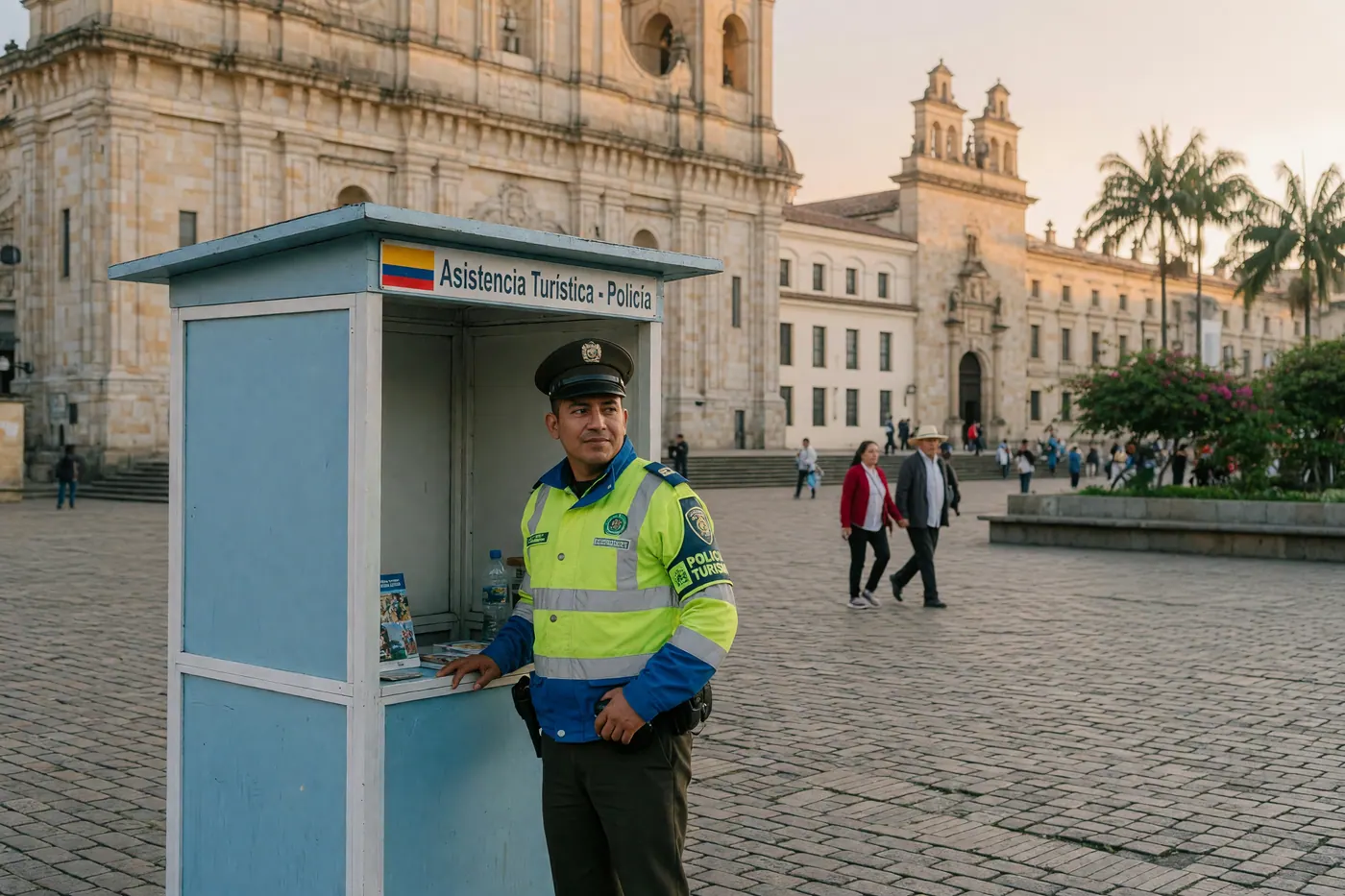
If you are navigating consumer fraud, vendor disputes, language problems at a historic terminal, or petty street concerns in a major tourist corridor, you can ask 123 to route you to the specialized Policía de Turismo (a division of DIPRO). Tourist police units are stationed at Attention Points (Puntos de Atención al Turista) across major historic centers and passenger terminals to assist foreign travelers.
Related Reading: Learn more about specialized bilingual patrol units, historic sector presence, and safety kiosks in our detailed overview of the Colombian Tourist Police and travel safety protocols.
Reporting Minor Thefts: The "¡A Denunciar!" System
If your mobile phone or bag was stolen while unattended, or you were pickpocketed in a crowded market and the suspect is already gone, do not tie up 123 operators. Instead, file an official penal report (denuncia) using the joint online portal operated by the Policía Nacional and Fiscalía General de la Nación: ¡A Denunciar! (adenunciar.policia.gov.co). The digital filing generates an official criminal report certificate (constancia de denuncia) that international travel insurance providers require for stolen property claims.
For specialized secondary crisis lines—such as GAULA anti-extortion (dial 165) or municipal mental health helplines—refer to our broader directory of crisis lines and emergency phone numbers across Colombia. For Código Dorado medical-dispatch codes used alongside 123, see the Colombia emergency numbers and Código Dorado guide.
Frequently Asked Questions
❓ Does Colombia's 123 emergency number support English?
While some operators in major metropolitan centers like Bogotá and Medellín speak English, you should not rely on it; call intake is conducted overwhelmingly in Spanish. In an urgent crisis, state your city, neighborhood, and address using basic Spanish scripts or have a bilingual contact speak on your behalf.
❓ Can I dial 911 from my mobile phone in Colombia?
You should never rely on dialing 911 in Colombia; always dial 123 directly from your mobile device or landline. While some international carrier roaming configurations automatically forward 911 to 123, relying on this on local prepaid SIM cards can fail or cause fatal dispatch delays.
❓ Will an ambulance arrive immediately if I call 123 for a medical issue?
An ambulance is only dispatched if the CRUE medical coordinator determines an immediate, life-threatening situation under emergency clinical triage. Non-critical medical conditions are referred to taxis, ride-hailing apps, or private pre-hospital medical networks such as EMI or Emermédica.
❓ What are the legal penalties for making prank or fraudulent calls to 123?
Fraudulent or non-emergency calls to Colombia's 123 emergency line violate the National Police Code and carry a Multa General Tipo 4 penalty of 16 SMDLV under Ley 2197 of 2022. In addition to monetary fines, police authorities can impose line suspension and can order offenders to attend pedagogical coexistence courses.
❓ Does calling 123 cost money or require mobile phone credit?
Calling 123 is completely toll-free from any mobile phone or landline in Colombia, even if your prepaid SIM card has zero balance. As of 2026, mobile carriers must still route 123 traffic regardless of airtime or data balances (fuente: S1/S2).
❓ What should I do if I am the victim of a minor theft where the suspect has fled?
For non-urgent incidents where life is not in immediate danger, do not tie up 123; file a formal report online through the national "¡A Denunciar!" portal or visit the nearest CAI police station. This provides an official police filing certificate without burdening frontline dispatchers handling active emergencies.


Comments
Loading comments...
Checking sign-in status...