
Dental Tourism in Colombia: Costs, Clinics & What to Expect
Colombia is one of the world's top dental tourism destinations — here's what major procedures actually cost, how to find a trustworthy clinic, and what the experience is really like.
IDIOMA DEL ARTÍCULO
Showing original language
The first person I met who came to Medellín specifically for dental work was a retired teacher from Arizona. She was staying at a boutique hotel in Laureles for three weeks, splitting her time between appointments at a clinic near El Poblado and weekend trips to Guatapé and the Jardín Botánico. She'd had two implants placed, a set of porcelain veneers fitted, and a full cleaning — total cost including flights and hotel: roughly what a single implant would have cost her back home without insurance.
"I've been putting this off for five years," she told me over breakfast. "I just assumed dental work abroad meant sketchy clinics and bad outcomes. But these clinics are nicer than anything I've seen in Phoenix."
She's not a fluke. Colombia — Medellín especially, but also Bogotá, Cali, and Cartagena — has become a legitimate destination for serious dental work. The quality is real, the savings are significant, and for anyone already planning time in Colombia, adding a dental appointment (or three) to the itinerary makes a lot of financial sense. This guide covers what you actually need to know — costs, how to find a trustworthy clinic, what the experience is like, and the honest downsides.
What to know first
- Colombia costs 50–70% less than the US for implants, veneers, crowns, and root canals
- Best cities: Medellín and Bogotá have the most English-speaking clinics and international patient experience
- You don't need to be a resident — any tourist can book and pay out of pocket
- Major implant work requires a 2–4 week stay, often with a follow-up trip months later
- Bring X-rays from home if you have them — saves time at the diagnostic consultation
- Most travel insurance does not cover elective dental procedures — budget the full cost out of pocket
Why the Savings Are Real (Not Just Marketing)
The price gap between Colombian dentistry and North American dentistry isn't explained by lower quality. It's explained by lower overhead: lower malpractice insurance premiums, competitive pricing on materials, and dentist salaries that are generous in Colombian terms but a fraction of what US dentists earn. A Colombian dentist making $4,000–6,000 USD per month is doing very well. Their US counterpart needs $20,000+ to cover student loans and office costs.
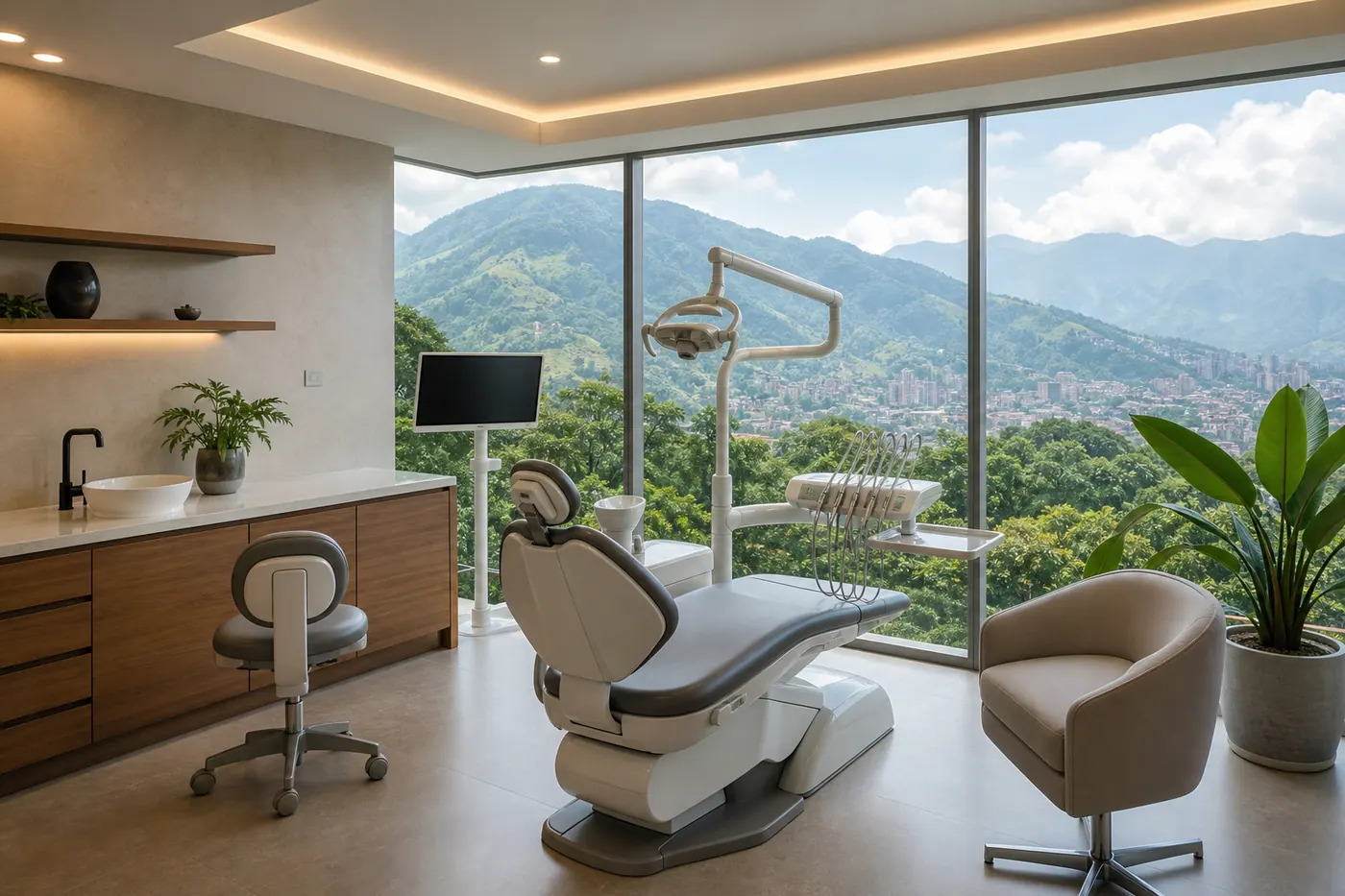
Colombian dental education is rigorous — 5-year undergraduate programs at universities like CES, Universidad de Antioquia, Pontificia Universidad Javeriana, and UNAL. Specialists add 2–3 years of post-graduate training. Many of the top implantologists and prosthodontists working in Medellín and Bogotá did part of that training in the US, Spain, or Brazil. The private clinics catering to international patients have invested accordingly: 3D cone beam CT scanners for implant planning, CAD/CAM milling for same-day crowns, digital X-ray systems.
The honest caveat: quality variation is wider in Colombia than in a heavily licensed US market. The range from excellent to poor is real, and the consequences of choosing badly — a poorly placed implant, a veneer that cracks in six months — are painful to fix from abroad. That gap is what most of this guide is about.
Cost Comparison: Colombia vs. US, Canada, and UK
Here's what you can realistically expect at a reputable clinic in Medellín or Bogotá. Prices in Cali and Barranquilla tend to run 10–15% lower; clinics in touristy areas like El Poblado charge a premium over local-market clinics in the same city.
| Procedure | USA | Colombia | Savings |
|---|---|---|---|
| Dental implant (single) | $3,000–5,000 | $800–1,500 | 65–75% |
| Porcelain crown | $1,200–2,000 | $200–450 | 70–80% |
| Porcelain veneer (per tooth) | $1,500–2,500 | $300–600 | 65–80% |
| Root canal (molar) | $1,000–2,000 | $150–350 | 75–85% |
| Full arch implants (All-on-4) | $25,000–40,000 | $7,000–14,000 | 60–75% |
| Clear aligners (full treatment) | $4,000–8,000 | $1,200–3,500 | 50–65% |
| Teeth whitening | $500–1,000 | $80–200 | 75–85% |
A note on the top-tier dental tourism clinics: the ones that actively market in English, have a dedicated patient coordinator, and have appeared in travel publications charge more than neighborhood dentists. Still 50–65% below US prices — but don't walk in expecting the lowest possible number just because you saw this table.
Which Procedures Make the Most Sense
Not everything is equally worth traveling for. Here's a practical breakdown:
✅ Best reasons to come to Colombia for dental work
- Implants — single implants, full arch (All-on-4/6), implant-supported bridges. This is the core case for dental tourism here.
- Veneers and crowns — Colombian labs produce quality porcelain; top clinics have in-house labs for same-day or same-week work.
- Root canals — routine, fast, dramatically cheaper.
- Full mouth rehabilitation — high savings on major work, but requires careful planning and likely 2 trips.
⚠️ Worth doing while here, but not worth flying for alone
- Cleanings and checkups — affordable, but savings alone don't justify a flight.
- Whitening — add it to any trip where you're getting other work done.
- Clear aligners — only makes sense if you're staying in Colombia long enough for follow-ups.
How to Find a Dentist You Can Trust
This is where people go wrong. A "best dentist in Medellín" recommendation from a Facebook group might be genuinely excellent — or it might be someone who paid for placement in a WhatsApp guide. Do your own due diligence.
What to look for in a reputable clinic: the dentist's degree should be from a recognized Colombian university (CES, Universidad de Antioquia, Pontificia Universidad Javeriana, UNAL). Specialists — implantologists, prosthodontists, orthodontists — should hold a post-graduate title. Ask for it if it's not displayed.
Clinics with an in-house lab or a tightly partnered local lab give you better quality control and faster turnaround on crowns and veneers. Ask whether your work will be fabricated domestically or outsourced internationally — some clinics import cheaper zirconia blanks from China to cut costs, which may or may not be fine depending on the supplier.
The single most important thing: get a written, itemized treatment plan before you commit. A consulta diagnóstica (diagnostic consultation) should produce a specific document listing each procedure with individual pricing. If they quote you a package total without line items, or pressure you into paying before the consultation, walk out.
For finding candidates: search expat Facebook groups for Medellín and Bogotá — look for threads with detailed procedure descriptions and long-term outcomes, not just "I loved Dr. X." The Colombia Move community at colombiamove.com/comunidad is another useful resource where questions tend to get practical, un-incentivized answers. If you can, schedule a virtual consultation before booking flights — most serious dental tourism clinics offer this now, and you can share X-rays and get a preliminary quote remotely.
📖 Keep Reading
Planning a longer stay? Medicina Prepagada in Colombia — if you're here for several months, private health insurance may cover some dental work beyond the basics.
What to Expect at a Colombian Dental Clinic
Walk-in culture doesn't work for dental tourism — book ahead, especially at clinics popular with international patients. Occupancy is high from January through March and June through August (peak expat travel seasons). If you're planning around specific dates, reach out 4–8 weeks in advance.
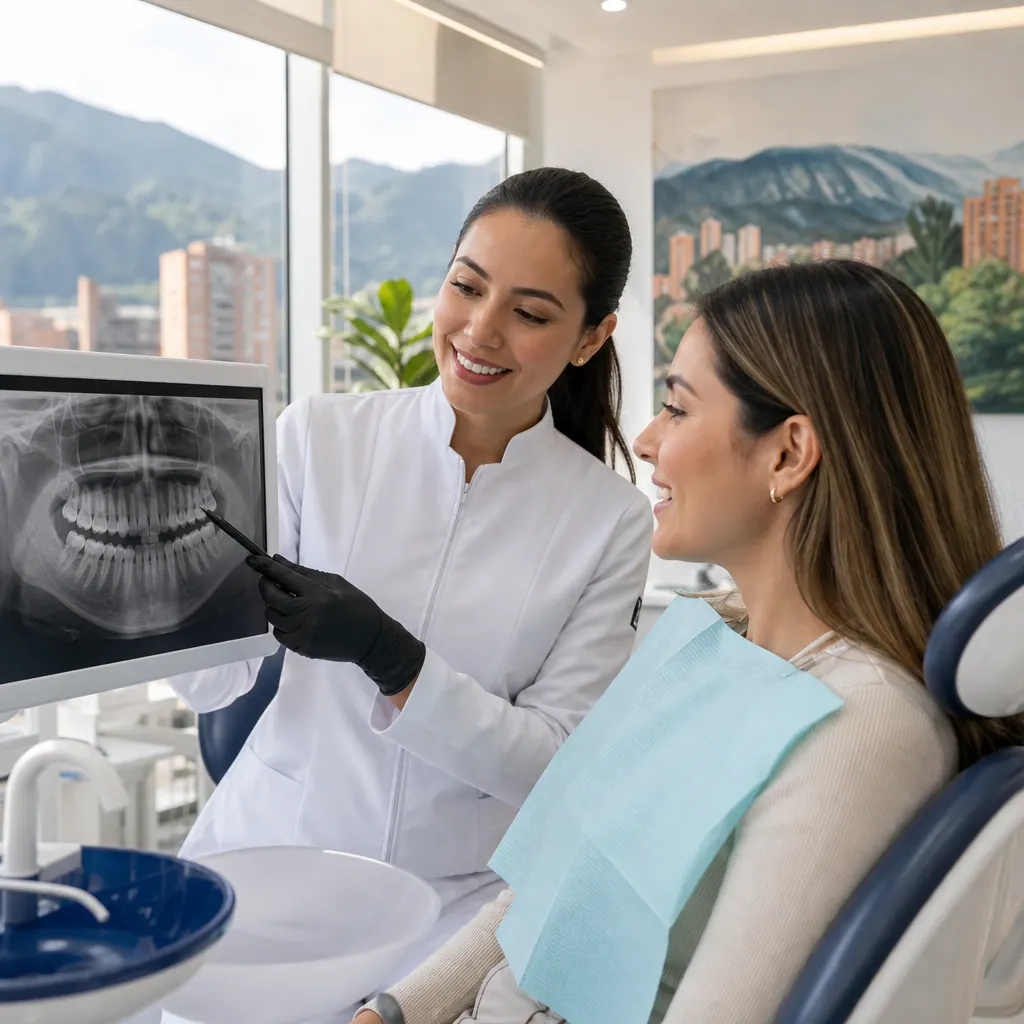
Your first appointment is a diagnostic consultation: panoramic X-ray, sometimes a 3D CBCT scan for implant cases, full examination, and the written treatment plan. Budget 90 minutes. Cost is usually 0–80,000 COP depending on the clinic, and sometimes free at clinics actively seeking international patients.
For implants: the standard process is placement first (extraction if needed), then a 3–6 month osseointegration period, then the crown fitting. Most patients handle this across two trips — come for the placement, heal at home, return for the crown. Some clinics offer immediate-loading protocols that compress the timeline, but not every case qualifies. Ask explicitly if you're hoping to get everything done in one trip.
Pain management is identical to what you'd experience at home — local anesthesia, standard drugs. Post-op care instructions are provided in Spanish and usually in English at tourist-facing clinics. One practical note: after any significant procedure, ask someone to accompany you back to your accommodation. You won't be in a state to process metro directions.
Before you leave the country, ask your clinic for a full digital copy of your X-rays and treatment records. This is your right as a patient, and you'll need them if anything requires follow-up care from a dentist at home.
Planning Your Stay Around Dental Work
For veneers, crowns, and root canals, a 1–2 week stay is usually enough. For implant placement, add buffer — healing can slow things, and you don't want to be on a 10-hour flight 48 hours after a complex extraction. For full-arch rehabilitation, plan for two trips, each 2–3 weeks.
Where to base yourself: most dental tourism in Medellín happens near El Poblado and Laureles, where the majority of reputable clinics are concentrated. A short-term apartment rental works better than a hotel for longer stays — you want a kitchen for soft-food cooking post-procedure. For Bogotá patients, Chapinero and Zona Rosa are the main clinic clusters.
On insurance: most travel insurance doesn't cover elective dental procedures. SafetyWing covers emergency dental (a cracked tooth, an abscess that develops unexpectedly) but not planned implants or veneers. Budget the full procedure cost out of pocket, plus a contingency buffer for unplanned follow-up work.
If you're traveling specifically for dental work, consider nomad health insurance as a backup for anything that goes sideways during recovery. SafetyWing offers short-term coverage that works well for multi-week dental stays.
📖 Keep Reading
Not sure about insurance while in Colombia? Travel Insurance for Colombia breaks down what actually covers what — and what most people assume is covered but isn't.
Red Flags to Watch For
A few things should make you pause before committing to a clinic:
- Quotes given verbally without a written, itemized treatment plan — this is non-negotiable before you pay anything.
- Unusually low prices. If a single implant is quoted at $350 and everything else is at market rate, ask exactly what brand of implant and what material. Colombian pricing is low; suspiciously low pricing usually means a cut somewhere.
- Pressure to prepay in full before your diagnostic consultation is complete.
- No specialist credential for specialty work. A general dentist can and does place implants in Colombia, but if you're getting complex work done, ask about their specific post-graduate training.
- No digital X-ray system. Clinics using old film-based X-rays in 2026 aren't investing in their diagnostic capability.
- Guarantees that sound too good. 'Lifetime warranty' on implants placed overseas is hard to enforce — ask specifically what the warranty covers and what the process is if something fails.
For context on how Colombian private healthcare works more broadly, the guide to EPS health insurance for foreigners explains the system that local residents use — useful background even if you're just visiting for procedures.
Frequently Asked Questions
❓ Is dental work in Colombia safe?
Yes, at reputable, accredited clinics. Colombia has legitimate dental education standards and well-regulated private practice. The risk comes from choosing poorly — unverified providers, suspiciously cheap quotes, no written treatment plan — not from the country itself. The same due diligence you'd apply to any significant medical procedure applies here.
❓ How much can I realistically save on implants in Colombia?
A single implant that costs $4,000–5,000 in the US typically runs $900–1,400 at a reputable Medellín or Bogotá clinic. For a full arch (All-on-4), a $30,000+ US procedure might cost $8,000–14,000 in Colombia — savings that comfortably cover flights, accommodation, and several weeks of living expenses.
❓ Do I need to speak Spanish to see a Colombian dentist?
Not at most dental tourism clinics. Major practices in El Poblado, Chapinero, and other expat-heavy areas have English-speaking patient coordinators and dentists. If you prefer a local clinic (typically a bit cheaper), basic Spanish helps but isn't essential — dental appointment vocabulary is limited and learnable in an afternoon.
❓ Can I do a virtual consultation before flying to Colombia?
Yes, and you should. Most reputable dental tourism clinics offer virtual consultations — share your X-rays and photos, describe your situation, and get a preliminary quote and treatment plan before committing to travel. This eliminates surprises when you arrive and lets you compare clinics without being physically present.
❓ What if something goes wrong after I return home?
This is the real risk of dental tourism. If a crown cracks or an implant fails weeks after you're home, you'll need a local dentist willing to work on someone else's procedure — most will, but it adds cost and complexity. For major work like full-arch implants, ask your Colombian clinic about their international warranty policy. Some have partner clinics abroad; others offer remote consultation support. Get this in writing before you commit.
📖 Keep Reading
Planning to stay longer? Read the full Moving to Medellín relocation guide and the honest breakdown of Medellín neighborhoods by budget and lifestyle.
Have a question about dental tourism in Colombia or want to share your experience? Ask the community at colombiamove.com/comunidad — there are expats who've done this and can give you real, unsponsored answers.

Comments
Loading comments...
Checking sign-in status...