
Drinking Water Filters in Colombia: Tap Water Quality, Carbon vs Ozone Units for Renters
Colombian city tap water is treated, but building tanks and old pipes can spoil it. Here is how carbon, ozone, ceramic and RO filters compare for renters, and what to install without risking your deposit.
IDIOMA DEL ARTÍCULO
Showing original language
Quick answer: the water leaving Bogotá's and Medellín's treatment plants is generally safe. The weak link is usually your building: the rooftop or underground tank and the old pipes. For a rental, a faucet-mounted carbon block unit (with an optional ozone stage) is the cheapest, reversible fix. Skip anything that needs drilling.
You move into a nice apartment, pour a glass from the kitchen tap, and it tastes faintly of pool. A week later your stomach is unhappy and a neighbor tells you to "just buy botellones." Before you start hauling 20-kilogram jugs up the stairs, it helps to understand where the problem actually starts.
The Colombian Tap Water Paradox
Here is the part that surprises newcomers: municipal water in the big metros is treated to potable standards. Colombia tracks this with the IRCA (Índice de Riesgo de la Calidad del Agua para Consumo Humano), calculated through the national SIVICAP system run by the Instituto Nacional de Salud. A score of 0–5% falls in the "Sin Riesgo" tier, and the networks serving Bogotá (EAAB) and Medellín (EPM) typically sit there (INS SIVICAP).
So why do so many people get sick or see cloudy water? Because utilities answer for quality up to the building's meter. After that, the water passes through your building's storage tank and internal plumbing, which belong to the copropiedad (the building administration), not the utility.
I would not tell anyone that Colombian tap water "will make you sick." It won't, in most big cities. But I also wouldn't drink it unfiltered in an old building where nobody can show me a tank-cleaning certificate.
The Legal Standard: Decreto 1575 and Your Building Tank
Under Decreto 1575 de 2007 (Art. 10), horizontal property administrations must wash and disinfect their potable water storage tanks (tanques de reserva) at least once every six months. That is a concrete thing you can ask for. When you tour an apartment, ask the administrator when the tank was last cleaned and request the certificate. A vague answer tells you what you need to know.
If your building also loses supply during maintenance cuts, tanks matter even more; our guide to handling water and internet outages in Colombian apartments covers how reserve tanks behave during rationing.
For the source text, see Decreto 1575 de 2007. As a tenant you cannot force a cleaning yourself, but you can put the request in writing to the administration.
Carbon vs Ozone: What Each Filter Actually Does
Ozone filters (filtros de ozono) are everywhere in Colombia, and it is easy to see why: they are cheap, compact and they disinfect. A small generator creates O3 by corona discharge and bubbles it through the water, killing bacteria and neutralizing odors. A 2025 chapter on household filters in Cartagena found ozone units were the most common type in sampled homes, at 65% (IntechOpen).
The catch, and I'll be blunt: ozone is a disinfectant, not a strainer. It does not remove sand, rust, pipe scale or dissolved heavy metals. El Tiempo's reporting on household systems makes the same point: ozone disinfects but does not remove heavy metals or chemicals (El Tiempo).
Activated carbon block filters (roughly 0.5 to 5 microns) do the physical job. They trap sediment, cysts, chlorine taste and volatile organic compounds, and they need no electricity.
| Feature | Carbon block | Countertop ozone | Ceramic gravity | Under-sink RO |
|---|---|---|---|---|
| Removes sediment | Yes | No | Yes | Yes |
| Kills bacteria | Partly (depends on cartridge) | Yes | Yes (with good ceramic) | Yes |
| Needs power | No | Yes, sink-side outlet | No | Often a pump |
| Drilling needed | No | No | No | Usually |
| Renter-friendly | High | High | High | Low |
Ozone units need an electrical outlet near the sink for the generator (typically 25W at 110V). Gravity and direct-faucet carbon units work purely mechanically. My pick for most renters: a carbon block unit first, with ozone as an add-on only if your building's tank is questionable.
Ceramic Gravity Filters and Reverse Osmosis
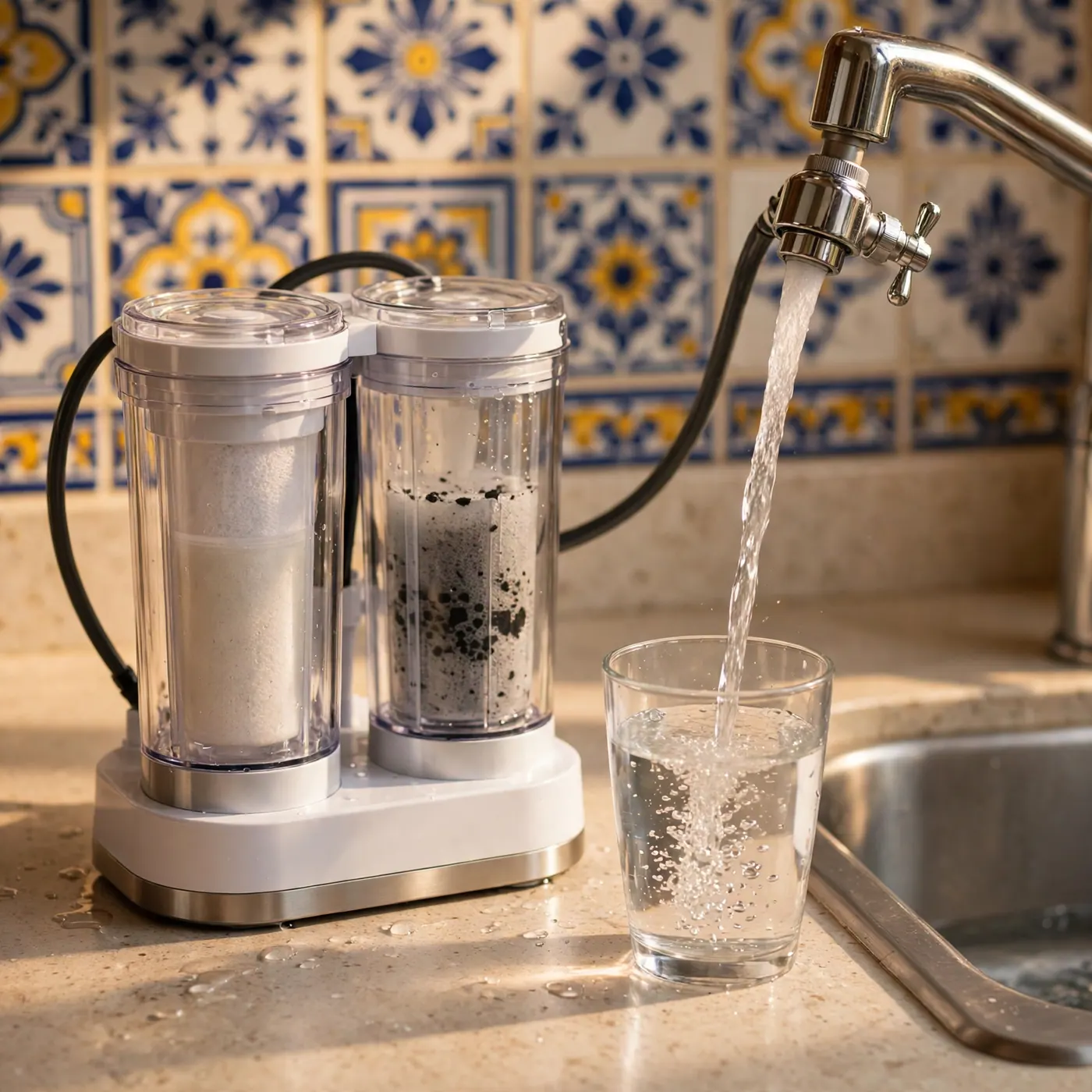
Ceramic gravity filters (the countertop "tower" style, often with a carbon core) are slow but reliable, silent, and completely non-invasive. The downside is counter space and the need to refill the top chamber by hand. They suit one or two people.
Reverse osmosis is the strongest option on paper, and it is what you may want in a place where water chemistry is poor. For a renter it is usually the wrong tool. A permanent under-sink RO system typically means drilling a second hole in a granite counter or tapping the drain pipe, and either can lead to a security deposit deduction. If you truly want RO, ask the landlord for written permission first, or choose a countertop unit that connects with a diverter and removes cleanly when you leave.
City Realities: Metros vs Coast
Not every municipality looks like Bogotá or Medellín. In coastal or smaller provincial towns, IRCA risk levels often exceed zero, and in those places multi-stage ceramic or RO filtration is the sensible baseline if you plan to drink from the tap. Parts of Santa Marta are a typical example. Check the latest local IRCA report through your municipality or the national SIVICAP data before assuming anything.
In the big metros, a carbon filter handles taste and sediment, and the main question is building hygiene rather than treatment quality.
November Rainy Season and Turbidity
Right now, in the heavier rain months, mountain runoff can raise suspended sediment in raw water intakes. Maintenance flushes can also knock loose mineral deposits in older lines and building tanks, so you might see tap water turn brown or yellowish for a while. It is usually harmless to look at but unpleasant to drink.
That is when a sediment pre-filter earns its keep. A cheap 5-micron sediment stage in front of carbon extends the life of the finer cartridge, and it is far kinder to an ozone unit, which will not remove that mud on its own. If water runs discolored, let the tap flow until it clears before filling anything.
Renter Installation Rules
Think reversible. A faucet-diverter unit screws onto the aerator, sends water through the filter and can be unscrewed in two minutes when you leave. It needs no tools beyond maybe a small wrench, and it leaves no marks. Keep the original aerator in a labeled bag.
- Faucet diverter or countertop unit: fine under almost any lease.
- Drilling granite or marble, or cutting under-sink pipes: ask in writing, expect a deduction otherwise.
- Ozone units: confirm there is a grounded outlet within reach of the sink.
When you negotiate a lease, mention filtration up front, especially in furnished rentals. Browse apartment rentals in the vivienda section and ask the owner about the building tank cleaning schedule before signing. If a filter install turns into a repair argument, see who pays for repairs, landlord or tenant. If you are still furnishing the kitchen, our IKEA Colombia furniture and delivery guide helps with countertop organization.
Maintenance, Costs and Where to Buy
Retail prices vary with brand and housing material, but countertop carbon and combination ozone units typically fall somewhere around COP 180,000 to COP 400,000 at national retailers like Homecenter or MercadoLibre, with replacement cartridges roughly COP 30,000 to COP 85,000 (Homecenter; verifica la cifra vigente). Most carbon and sediment cartridges need replacing every 6 to 12 months, sooner if flow drops.
Two scam notes. Door-to-door sellers often push proprietary cartridges at inflated prices. Choose units that take standard 10-inch or 7-inch cartridges you can buy at any hardware chain. And ozone units need cleaning too; a neglected one is worse than none.
Over a year, a filter usually beats buying botellones, though how much depends on your household. For the broader monthly picture, see our Bogotá monthly budget breakdown.
According to active listings on Colombia Move (October 2026), there are 36 active appliance listings and 57 apartments offered for rent.
Frequently Asked Questions
❓ Is tap water safe to drink in Bogotá and Medellín?
Municipal water in both cities is treated to national potable standards and typically scores in the "Sin Riesgo" IRCA tier. Problems usually arise in older building pipes or storage tanks, so filter if you do not know the tank's cleaning history. (verify with the official source, as accessed)
❓ How does a Colombian ozone water filter actually work?
A small electric generator produces ozone gas that bubbles through the water, neutralizing bacteria and odors. It does not remove sediment, rust or heavy metals, so pair it with a physical carbon or sediment filter for real protection. (verify with the official source, as accessed)
❓ Can my landlord forbid me from installing a water filter?
Check your lease, but a countertop filter that screws onto the faucet without modification is rarely a problem. A landlord can reasonably object to drilling granite or altering under-sink pipes and may deduct repair costs from your deposit. (verify with the official source, as accessed)
❓ How often should filter cartridges be replaced?
Most activated carbon and sediment cartridges should be changed every 6 to 12 months, or sooner if water flow noticeably drops. Follow the manufacturer's schedule, and replace faster during muddy rainy-season water. Prices vary, so verifica la cifra vigente at national retailers. (verify with the official source, as accessed)
❓ Why does tap water sometimes turn brown after heavy rain?
Heavy rain adds suspended mud to raw water sources, and maintenance flushes can dislodge settled mineral sediment in older pipes and building tanks. It usually clears after running the tap for a few minutes, but a sediment pre-filter helps. (verify with the official source, as accessed)
❓ Are botellones safer than a domestic filter?
Certified commercial 5-gallon botellones are safe to drink, but a domestic filter is generally cheaper over time and spares you from carrying heavy jugs upstairs. Make sure any jug supplier is reputable and the dispenser is kept clean. (verify with the official source, as accessed)

Comments
Loading comments...
Checking sign-in status...