
Water & Internet Outages in Colombia: Backup Power, Starlink & Landlord Rights
A practical guide for remote workers and renters in Colombia covering municipal water rationing, fiber internet blackouts, voltage surges, and lease rights under Colombian law.
IDIOMA DEL ARTÍCULO
Showing original language
If you work remotely from an apartment in Bogotá or Medellín, you will eventually face a sudden drop in water pressure during a team call or a sudden electrical blackout during an afternoon tropical storm. Between municipal water rationing cycles, frequent fiber-optic line cuts caused by street construction, and lightning transients rolling down Andean mountain ridges, utility disruptions are an unavoidable element of living in Colombia.
For digital nomads and foreign residents, waiting passively for utility providers to restore service is a recipe for missed deadlines and ruined hardware. Navigating life here requires understanding how communal apartment infrastructure operates, building inexpensive hardware redundancies, and knowing exactly what Colombian rental legislation requires from your landlord.
Water Outages & The Building Reserve Tank (Tanque de Reserva)
Unlike suburban detached homes in North America or Western Europe that rely strictly on direct municipal pressure, multi-family apartment buildings across Colombia operate on closed plumbing loops supported by a communal reserve tank (tanque de reserva) and an electric booster pump (bomba hidroneumática). When the municipal utility cuts water for scheduled pipeline maintenance or drought rationing, the building switches automatically to this underground or basement storage cistern.
How long your taps stay wet depends entirely on the building's physical capacity and occupancy volume. In modern mid-to-high-rise buildings, a properly engineered reserve tank typically provides between 12 and 24 hours of normal domestic water supply. However, in older walk-ups or retrofitted colonial houses, reserve capacity may be negligible, depleting within 3 to 5 hours once multiple apartments start running washing machines.
Furthermore, maintenance is governed by strict sanitary law. Under Colombian health regulations (specifically Decreto 1575 de 2007, Article 10) in conjunction with the horizontal property regime (Ley 675 de 2001), residential building administrations are legally required to drain, clean, and disinfect communal potable water tanks at least once every six months. If your building's water turns cloudy, sediment-heavy, or develops an odor after an outage, the administration has likely neglected this mandatory maintenance.
Power Surges & Hardware Protection in Andean Climates
Colombia runs on a standard 110–120V electrical system operating at 60Hz. While modern developments feature grounded three-prong receptacles and dedicated circuit panels, older buildings across urban centers frequently suffer from legacy wiring issues. In many older rental units, you will discover two-prong ungrounded outlets, unshielded neutral lines, or decorative third grounding holes that connect to absolutely nothing behind the faceplate.
This creates acute vulnerability during the Andean rainy seasons. High-frequency lightning strikes near overhead distribution lines produce sudden voltage spikes that easily destroy sensitive electronics, including high-end laptop power bricks, studio monitors, and external displays. Plugging your workstation directly into an ungrounded wall outlet or a basic COP 20,000 plastic multi-tap adapter offers zero true surge suppression, because surge protector Metal Oxide Varistors (MOVs) require a functional physical ground path to divert excess voltage away from your equipment.
| Device Category | Recommended Protection | Estimated Cost (COP) | Primary Function |
|---|---|---|---|
| Laptop & Monitors | Regulador de Voltaje (AVR) | $90,000 – $220,000 | Smooths sudden undervolt/overvolt sags and spikes without switching to battery. |
| Fiber Modem / Router | 12V DC Mini-UPS | $90,000 – $180,000 | Delivers continuous DC power for 4–8 hours without inverter loss. |
| Workstation PC / NAS | Line-Interactive UPS (800VA+) | $350,000 – $750,000 | Provides 15–20 minutes of runtime for clean operating system shutdown. |
Internet Continuity: The 3-Tier Remote Work Failover Setup
Maintaining continuous internet connectivity during a city outage does not require enterprise-grade infrastructure. Instead, remote professionals should assemble a practical, layered three-tier redundancy strategy.
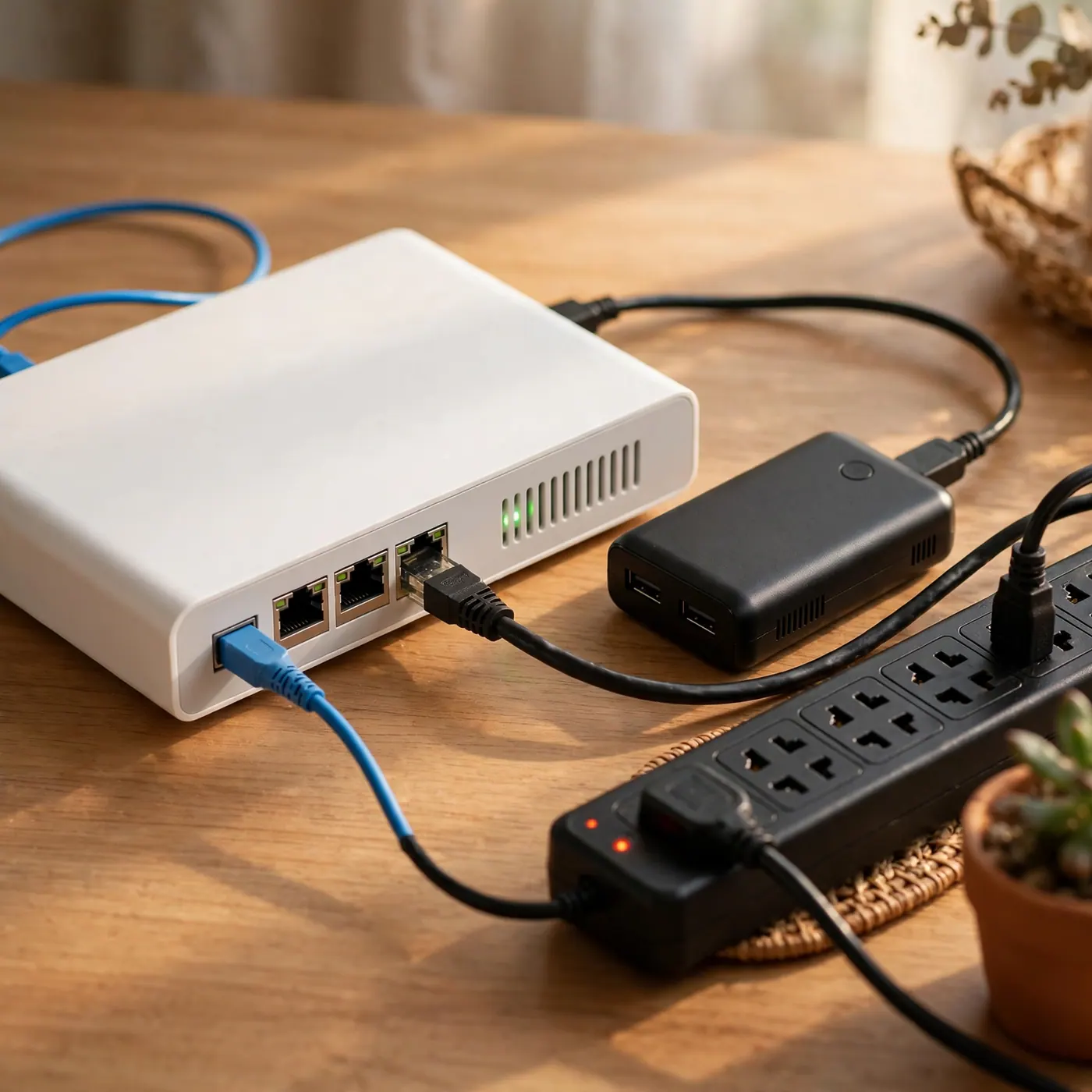
Tier 1: Dedicated 12V DC Mini-UPS for Fiber Modems
When neighborhood electricity cuts out, home fiber-optic cables often remain fully operational because the optical signal carrying your data requires no electrical current through the glass core. What dies is simply your apartment's optical network terminal (ONT) and Wi-Fi router. Standard computer battery backups (UPS units) are inefficient here because they invert battery DC voltage to AC wall voltage, only for the router's power supply to convert it back to 12V DC, burning off valuable energy as heat.
The solution is an inexpensive DC mini-UPS (10,000 to 14,000 mAh). These compact units plug directly between the wall outlet and your router's 12V barrel port. When main grid power drops, the mini-UPS transfers power with zero millisecond transfer delay, keeping your home Wi-Fi network online for 4 to 8 hours without interrupting an active video call.
Tier 2: Multi-Carrier Mobile Tethering
If a primary fiber trunk line is physically severed by municipal road crews or a fallen tree, local Wi-Fi drops completely regardless of router power. For quick failover, remote workers should maintain a dual-SIM smartphone or an unlocked 4G/5G mobile hotspot equipped with a secondary carrier (e.g., Claro primary and Tigo or Movistar secondary).
Keep in mind that during widespread electrical blackouts, cellular towers in dense residential sectors experience severe network congestion. When an entire neighborhood loses power, thousands of residential smartphones simultaneously abandon dead home Wi-Fi and flood nearby cell towers, degrading cellular download speeds to a crawl. In such events, toggling your handset network settings from 5G/4G to 3G can sometimes bypass saturated bands and route essential text, email, and low-bandwidth chat traffic through.
Tier 3: The Reality of Starlink in Colombian Apartments
SpaceX's Starlink operates across Colombia, but urban apartment dwellers must be realistic regarding installation constraints. Satellite internet requires an unobstructed upward view of the sky—roughly a 100-degree clear conical view free from building overhangs, eaves, or neighboring towers.
If you live on a lower floor with a covered balcony, Starlink will rarely establish or maintain a stable connection, suffering intermittent signal dropouts every few minutes as low-earth satellites cross blind spots behind concrete walls. Furthermore, mounting an external satellite dish on an exterior building facade or communal rooftop requires formal written authorization from the building's administrative council under horizontal property regulations (Ley 675 de 2001). For most urban apartment renters, Starlink is only practical if you rent a top-floor penthouse with private terrace rights, or a suburban detached house in surrounding valleys. Hardware kits typically retail between COP 800,000 and COP 1,600,000 depending on active regional promotional pricing, with monthly residential service plans ranging from approximately COP 150,000 to COP 270,000.
Landlord Responsibilities vs. Public Outages (Ley 820 de 2003)
When an apartment lacks running water or electrical continuity, foreign renters frequently ask whether they can legally withhold rent or cancel their lease agreement immediately. Colombian residential tenancy is strictly regulated under Ley 820 de 2003, which establishes a clear dividing line between landlord maintenance obligations and external public infrastructure disruptions.
Under Articles 8 and 9 of Ley 820, landlords are legally mandated to maintain the property in a state suitable for basic human habitation, ensuring that internal plumbing pipes, electrical distribution panels, and built-in hot water systems remain fully functional. If water loss is caused by a ruptured pipe inside your private walls, or if the building's water pump breaks because the owner's association failed to service it, the landlord is obligated to remedy the fault promptly.
Conversely, your landlord bears zero legal liability for municipal utility rationing, citywide power grid failures, or utility repair shutoffs executed by public service operators like EPM or Enel. Because public service rationing constitutes force majeure outside the lessor's control, tenants have no legal right to withhold monthly rent payments, demand arbitrary rent reductions, or unilaterally terminate the contract without penalty fees. If the cut is actually an unpaid invoice rather than a grid failure, pay through the official portals — see how to pay utility bills online in Colombia for EPM, Codensa, Air-e, and Vanti.
However, under Article 24 of Ley 820, a tenant can legally terminate a lease without paying the standard three-month contractual indemnity if the landlord actively causes utility cuts—such as failing to pay mandatory utility bills included in rent or refusing to repair documented structural wiring and plumbing failures after formal written notification.
If you are still hunting for a more resilient rental, Colombia Move marketplace counts are a useful snapshot: according to active listings on Colombia Move (September 2026), there are 54 apartment ads live, including 29 listed for rent, so you can compare buildings before you sign rather than guessing about reserve tanks and wiring.
Regulatory Rights & Telecom Outage Compensation
Colombian telecommunications law provides explicit statutory rights when fixed residential internet experiences recurring downtime. Under the regulatory framework established by the Comisión de Regulación de Comunicaciones (CRC Resoluciones 5050 de 2016 and 5111), fixed home internet providers are legally required to discount consumer bills when service interruptions surpass specific thresholds.
Specifically, if your fixed internet connection is down for more than 2.5 hours—accumulated continuously or across discontinuous drops within a single monthly billing cycle—the operator must apply an automatic, proportional credit to your next billing statement. To enforce this right effectively, follow these procedural steps:
- Record outage timestamps: Log the exact hour your router loses optical sync (red LOS indicator) and when connectivity is formally restored.
- Obtain a formal ticket (Radicado PQR): Contact your service provider via their customer service portal, telephone line, or app immediately. Request the official PQR tracking number (Número de Radicado). Under Colombian law, consumer complaints are tracked via this unique number.
- Demand contractual cancellation if chronic: If your internet provider demonstrates persistent, chronic service unavailability over extended periods and fails to restore contractually agreed bandwidth, the CRC regulations allow consumers to terminate residential telecommunication contracts without early termination penalties.
For detailed instructions on escalating persistent telecommunication failures to national oversight bodies, consult our complete guide on how to file fixed home internet complaints before the SIC and CRC in Colombia.
Frequently Asked Questions
❓ Can I break my Colombia apartment lease if the building constantly loses water or power?
Only if the disruption is caused by internal building defects or landlord negligence that the owner refuses to repair under Ley 820 de 2003. You cannot legally break a residential lease without financial penalties due to municipal utility rationing, neighborhood electrical failures, or public infrastructure repairs executed by municipal operators.
❓ How long does an apartment water reserve tank usually last during rationing?
In modern multi-family apartment towers, an engineered communal reserve tank typically maintains standard domestic water flow for 12 to 24 hours. Smaller or older walk-up residential buildings with limited cistern capacity frequently run completely dry within 3 to 6 hours once communal water levels drop.
❓ Does Starlink work reliably from an apartment balcony in Bogotá or Medellín?
Rarely, because the Starlink dish requires an unobstructed 100-degree field of view to track satellites without interference from exterior walls or upper floor overhangs. Unless you have exclusive access to an unobstructed rooftop terrace with administrative permission under Ley 675 de 2001, high-rise balconies rarely maintain continuous connections.
❓ How does a mini-UPS keep fiber internet working during a blackout?
A direct 12V DC mini-UPS connects between the wall adapter and the optical modem, providing uninterrupted battery power for 4 to 8 hours without conversion power loss. As long as your telecom operator's neighborhood fiber distribution cabinet remains energized on backup batteries, your home Wi-Fi stays live.
❓ Are Colombian internet providers legally required to refund me for outages?
Yes, under CRC Resolución 5050 de 2016, telecommunication operators in Colombia must credit users automatically on their billing statement whenever service downtime exceeds 2.5 hours in a single billing cycle. Retain your official service ticket number (radicado) to verify that the credit appears on your next invoice.
❓ Do I need a surge protector for electronics in Colombian apartments?
Yes, because voltage fluctuations and frequent lightning strikes along the Andean ranges can easily damage sensitive equipment, especially in older apartment buildings lacking properly grounded three-prong electrical installations. Use a dedicated automatic voltage regulator (AVR) for sensitive desktop hardware.

Comments
Loading comments...
Checking sign-in status...