
Colombia Rental Applications: How Foreigners and Remote Workers Prove Income
Securing a long-term lease in Colombia as a foreigner or remote worker can feel overwhelming. Here is how to prove foreign income, navigate local insurance screening, and protect your tenant rights.
IDIOMA DEL ARTÍCULO
Showing original language
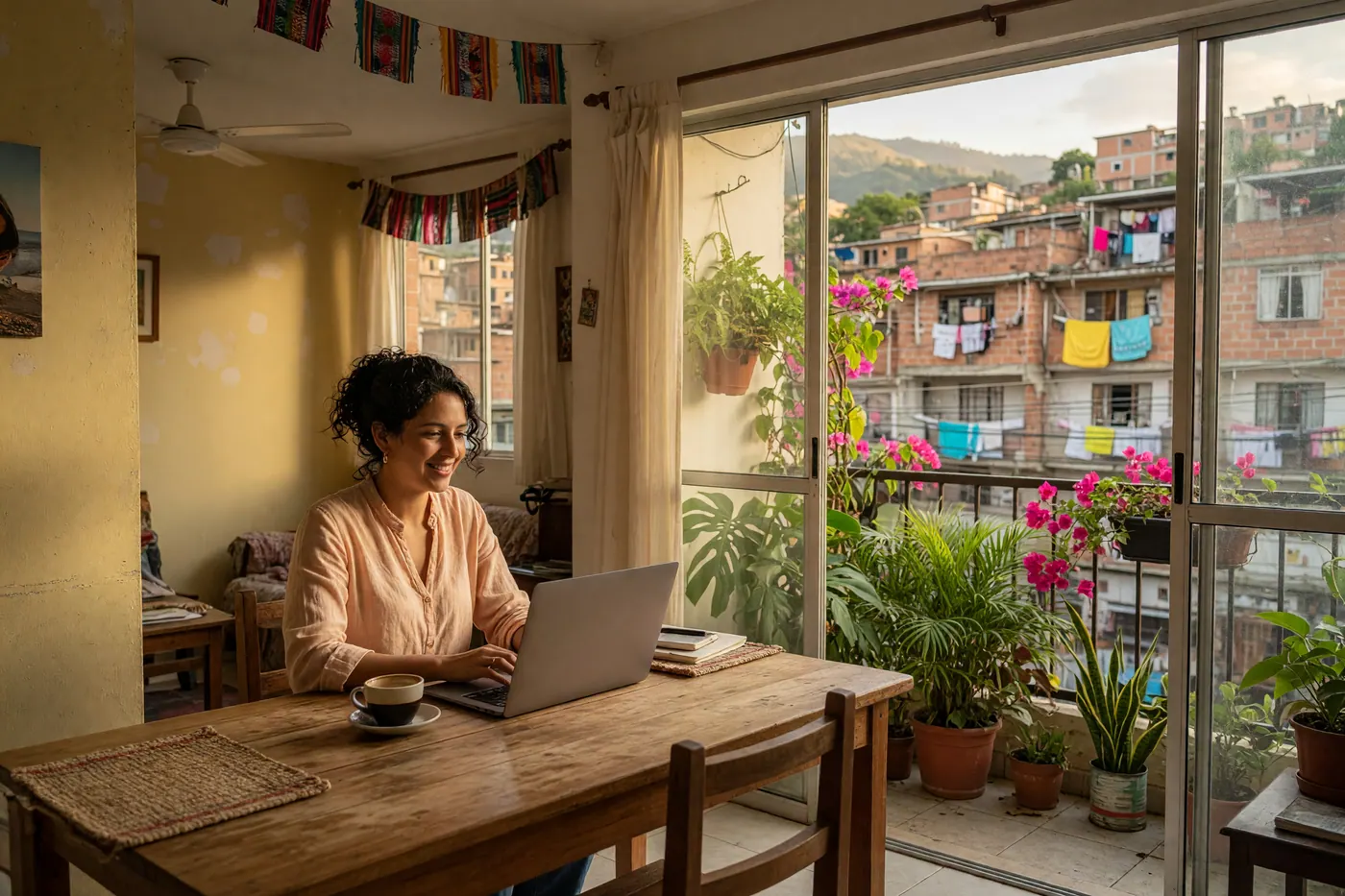
Moving to Colombia as a digital nomad, freelancer, or remote employee is an exciting step, but signing a long-term residential lease often presents a major hurdle: proving your income. Traditional Colombian real estate agencies (inmobiliarias) rely on rigid local screening procedures designed for local employees with local paystubs. If your income arrives in US dollars, euros, or cryptocurrency from client contracts or foreign companies, standard application processes can instantly stall.
Quick Answer: Foreigners and remote workers in Colombia can successfully prove income by providing 3 to 6 months of complete bank statements showing regular transfers, foreign employment contracts or client retainer agreements, and recent tax returns. While traditional agencies require local guarantors and 2x rent in proven income, dealing directly with property owners allows far greater flexibility—without paying illegal cash security deposits.
The Challenge of Proving Foreign Income in Colombia
When applying for a long-term rental in cities like Medellín, Bogotá, or Cali, property owners and real estate management companies evaluate candidate risk using local financial metrics. In Colombia, standard lease guarantees are underwritten by private insurance companies known as afianzadoras or aseguradoras (such as Seguros SURA or El Libertador). These companies assess whether an applicant earns at least double (2x) the monthly rent canon.
However, traditional insurers may be reluctant to underwrite foreign contracts that fall outside Colombian jurisdiction. If you do not possess a Colombian employment contract or local payroll vouchers (desprendibles de pago), traditional corporate agencies frequently decline the application unless you provide a local co-signer (codeudor). Fortunately, alternative approval routes exist for independent remote workers and expats.
Essential Document Checklist for Foreign Applicants
To build a compelling rental application package that satisfies direct landlords or progressive insurance underwriters, compile the following documentation before starting your apartment hunt:
- Valid Identification: A clear scan of your unexpired passport photo page and your Cédula de Extranjería, if you have one.
- Bank Statements (3 to 6 Months): Complete PDF statements from your primary checking or business accounts showing consistent monthly income deposits.
- Proof of Employment or Contracts: An official letter from your remote employer on company letterhead detailing your salary, position, and start date, or active client contracts if you operate as a freelancer.
- Tax Documentation: Your most recent annual tax return, such as a US Form 1040, W-2, UK P60, or international equivalent, establishing overall annual earning capacity.
- Proof of Current Local Address: Utility bills or temporary accommodation receipts establishing your local footprint. If you need clarity on obtaining local address documentation, review our guide on proof of address documents in Colombia.
How to Present Foreign Bank Statements Safely
Bank statements serve as the backbone of your application when local paystubs are unavailable. Property managers want to see consistent cash flow that clears the standard 2x rent threshold. For instance, if you are applying for a 3,500,000 COP (about $1,110 USD at the August 7, 2026 TRM) monthly apartment, an underwriter applying that rule would look for steady monthly deposits exceeding 7,000,000 COP (about $2,220 USD).

When submitting foreign financial records, privacy and security should be top priorities. Always redact sensitive identifiers before handing PDFs over to landlords or brokers. Black out your full Social Security Number, tax identification numbers, full credit card numbers, and internal bank account numbers—leaving only the last four digits visible alongside your name and monthly transfer summaries.
While formal agencies occasionally ask for certified Spanish translations (traducción oficial) of contracts or financial statements, many direct property owners accept standard English bank statements as long as the incoming totals and dates are clearly legible.
Agencies vs. Direct Owners (Dueño Directo)
Understanding the structure of Colombia's housing market saves weeks of frustration. Traditional agencies manage properties on behalf of local owners and strictly follow insurance rules. If your foreign income does not fit their automated checklist, your application may be rejected regardless of your net worth.
Direct property owners (dueño directo), on the other hand, hold more discretion over tenant selection and may evaluate foreign income documents individually. According to active listings in Colombia Move's housing section in August 2026, there were 98 housing ads across the marketplace—a concrete place to compare how owners describe their application requirements, not a guarantee that every owner accepts foreign documents.
Navigating Guarantors (Codeudores) vs. Digital Insurance
A traditional Colombian rental application may require a codeudor, sometimes one who can document Colombian property or local income. As a newcomer, finding that person is often the most frustrating part of the process.
Modern digital lease insurance provides another route. SURA advertises a digital residential lease-insurance option for rents up to 5,000,000 COP without a codeudor, subject to its income verification and approval process. If co-signer requirements are blocking you, read our breakdown of renting in Colombia without a codeudor.
Keep Reading: Compare the practical steps for finding monthly rentals in Medellín before sending an application.
Know Your Legal Rights: Security Deposit Rules Under Ley 820
One of the most frequent legal traps facing foreign renters in Colombia is a demand for a cash security deposit (depósito en efectivo). Article 16 of Ley 820 de 2003 prohibits landlords from requiring cash deposits or real guarantees to secure the general obligations of an urban residential lease.
Article 15 is narrower: a landlord may require a guarantee or deposit dedicated specifically to public-utility payments, capped at two consecutive billing periods and handled under the utility-service procedure. That is different from holding one or more months of rent as a general damage deposit. Review the legal rules on security deposits in Colombia before transferring money.
To strengthen your file without altering documents, add a one-page income summary in COP, label every supporting PDF clearly, show recurring client relationships, and provide a reference who can confirm your work. Never fabricate or edit financial records: false documents can expose you to fraud allegations and destroy your application.
Frequently Asked Questions
❓ Can I rent an apartment in Colombia using foreign income?
Yes, foreign income can support a Colombian rental application. Direct owners may be more flexible with foreign bank statements and remote contracts than traditional agencies, but acceptance depends on the owner or insurer's screening policy.
❓ Is a security deposit legal in Colombia?
No, a general cash security deposit is prohibited for urban residential leases under Article 16 of Ley 820 de 2003. Article 15 separately permits a utility-specific guarantee capped at two consecutive billing periods.
❓ What is the income requirement for a rental application in Colombia?
Major lease insurers commonly look for monthly income of at least twice the monthly rent. SURA and El Libertador describe this 2x standard, although approval still depends on the full application and current underwriting criteria.
❓ Do I need a local codeudor if I am a foreigner?
Not always. Some agencies require a local co-signer, but direct owners can assess other evidence and certain digital lease-insurance products may approve applicants without one after income and credit screening.
❓ Should I translate my bank statements into Spanish?
Not in every case. A formal agency may ask for an official Spanish translation, while a direct owner may accept clear English statements; ask before paying for translations.
❓ How can I safely share financial documents with a landlord?
Redact sensitive identifiers before sending files. Hide Social Security and tax numbers, full account and card numbers, and unrelated transactions while preserving your name, statement dates, balances, and relevant income deposits.
Comments
Loading comments...
Checking sign-in status...