
Buying Dehumidifiers and Inverter Air Conditioners for Colombia Rentals: Beating Mold and Salt Air
A renter's guide to choosing between a plug-in dehumidifier and a fixed inverter air conditioner in Colombia: humidity targets, estrato running costs, lease-safe drainage and buying checks.
IDIOMA DEL ARTÍCULO
Showing original language
Quick answer: if you rent, start with a cheap hygrometer and a plug-in dehumidifier. Move to a fixed inverter mini-split only when heat, not just dampness, is the problem, and only with written permission from your landlord.
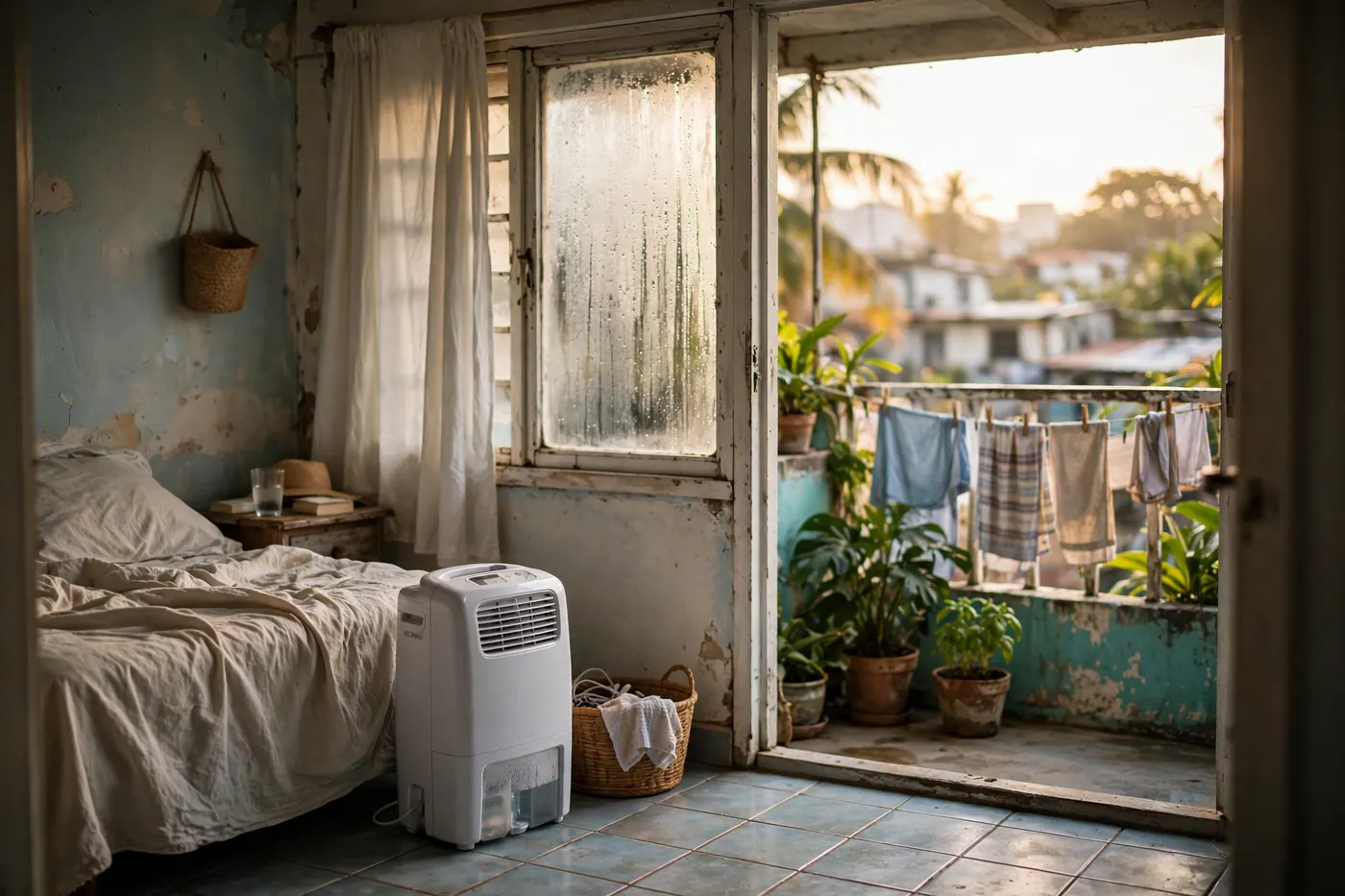
The decision looks different depending on where you live. On the Caribbean coast, in Cartagena or Santa Marta, you are fighting heat and moisture together, so drying and cooling are both on the table. In Bogotá or Medellín, the usual complaint is cool dampness: mildew in closets, a musty leather jacket, condensation on windows. There a dehumidifier often does the job, and a mini-split would just be a lease problem. Cartagena's environmental observatory publishes a historical outdoor series from Rafael Núñez (1943–2014, discontinuous) with monthly mean relative humidity mostly between 78% and 82%. That is old outdoor data, not your bedroom today, but it tells you the air never gets a real break.
What indoor humidity are you aiming for?
Colombia has no legal humidity limit for homes, so the useful benchmark is the US EPA's: keep indoor relative humidity below 60%, ideally between 30% and 50%, and dry wet materials within 24 to 48 hours. In a warm, humid climate, the EPA also notes that if indoor humidity stays above 60%, ventilation alone will not fix it, because outdoor air brings moisture in. You need dehumidification.
Before buying anything, spend a small amount on a digital hygrometer. Put it in the bedroom and in the closet for a few days, including nights with the windows shut. If the reading hovers at 55% you may not need a machine. If it sits at 70%, you do.
One honest limit: an appliance manages air moisture, it does not cure a leak. If water comes through a wall, a roof slab or a bathroom pipe, that is a building problem. Our guide on who pays for structural mold and dampness covers that track, so I will not repeat it here.
Portable dehumidifier vs fixed inverter mini-split
| Portable dehumidifier | Inverter mini-split | |
|---|---|---|
| What it does | Removes moisture from one room or closet | Cools and also pulls moisture out |
| Power | Plugs into a normal outlet | Often needs a dedicated circuit |
| Installation | None; tank or hose to an existing drain | Indoor unit, outdoor condenser, drain line |
| Lease impact | Low | High: permission, and often building approval |
| Best for | Closed bedroom, closet, damp but not very hot air | Hot coastal bedrooms where you need cooling |
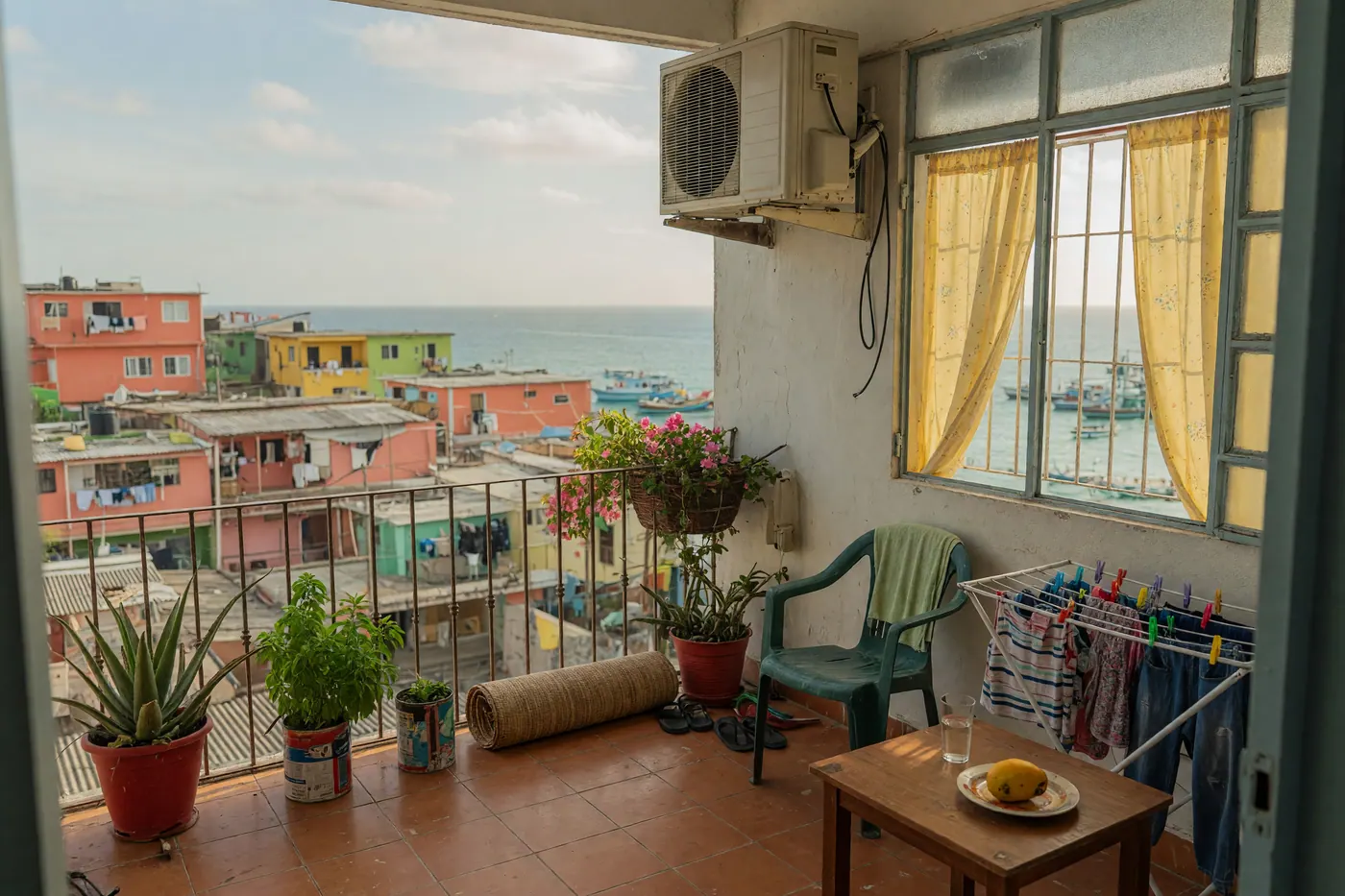
A dehumidifier is the lower-conflict choice. Be aware that it adds some heat to the room, so on the coast it can feel stuffy without cooling. A mini-split does both jobs, but it is a fixed thermal installation. Under Colombia's RETSIT regulation, design should account for temperature, humidity, outdoor climate, space for indoor and outdoor units, energy performance and mold prevention. This is not a DIY job; hire a qualified installer and do not let anyone improvise refrigerant work.
"Inverter" simply means the compressor can slow down instead of switching fully on and off. I would not trust any savings percentage a seller quotes. Fixed air conditioners up to 17,580 W of cooling capacity fall under the RETIQ energy-labelling rules, so compare the declared consumption on the label in front of you rather than a slogan.
How estrato 4, 5 and 6 change what it costs to run
Here is the method, and it works in any city. Take the nameplate watts, divide by 1,000, multiply by the hours you run it per month, then multiply by the CU (the unit cost per kWh) printed on your latest bill. I will not give you a "typical" monthly bill, because tariffs change monthly and depend on your retailer, who owns the network assets, and your estrato. If you need help reading the bill itself, see our guide to kWh, CU and estrato on coastal bills.
The estrato rules matter mostly at the edges:
- Subsistence band: 173 kWh per month where the municipal seat is below 1,000 m, and 130 kWh per month at or above 1,000 m (UPME Resolución 355 de 2004). Use the elevation of the municipal seat, not a neighborhood guess.
- Estratos 1, 2 and 3: subsidies of up to 60%, up to 50% and 15%, but only up to that subsistence amount. Every extra kWh from a dehumidifier or air conditioner is unsubsidized.
- Estrato 4: pays the unit cost, with no subsidy and no contribution.
- Estratos 5 and 6: pay a 20% contribution on the cost of service (Ministerio de Minas y Energía).
A dated example, strictly for illustration: EPM's September 2026 sheet for low-voltage residential users, where the network operator owns the assets, lists estrato 4 at 958.38 COP/kWh and estratos 5 and 6 at 1,150.06 COP/kWh for all consumption. That is a Medellín-area EPM figure, not a Bogotá or coastal rate. So a 300 W unit running 200 hours would use 60 kWh; at the estrato 4 EPM rate that is 60 × 958.38 COP. Swap in your own CU and the math works anywhere.
Santa Marta warning: if your bill is from Air-e, its efficient-use program started on 1 September 2026 for an initial six months, with charges on bills issued from 1 October 2026. It adds an extra charge only on kWh above 110% of your own target, 50% for estratos 4, 5 and 6, and can give a credit under 90% of the target. A new air conditioner can push a home across that line. Your target is on your bill, and CREG can change the program. Do not assume other utilities apply the same rule.
Drainage that does not breach your lease
This is where renters get into trouble. A dehumidifier collects water, and that water has to go somewhere.
- Empty the tank daily, or run the drain hose to a bathroom or laundry floor drain that already exists.
- Do not cut a new hole in a wall, facade or slab.
- Put any hardware change in writing with your landlord before you do it.
The legal logic is simple. Under Ley 820 de 2003, article 22, numeral 5, improvements, changes or expansions to an urban dwelling without the landlord's express authorization are a ground for ending the lease. Under Código Civil article 1994, a landlord does not have to repay useful improvements unless he agreed in advance to pay, though you may remove the materials if that does no damage. And under Ley 675 de 2001, facades and the roof slabs covering the building are essential common property, so an outdoor condenser on a facade needs building approval on top of your landlord's, not just your own decision. The statutes do not mention dehumidifiers by name, but a plug-in unit with a hose to an existing drain involves none of these changes. For who pays for what once something breaks, see landlord vs tenant repairs in Colombia.
Under RETSIT, a tenant in possession can be responsible for operating and maintaining a fixed air conditioner unless the contract says otherwise. Ask who owns it and who services it before you sign.

Buying new or used: the checks that matter
- Voltage and frequency. Colombia's standard low-voltage supply is 120 V phase-to-ground at 60 Hz, not 110 V. Equipment built for another voltage needs a special transformer and must be marked. A used 220 V or 50 Hz unit with no marked transformer is the wrong purchase.
- The label. A fixed air conditioner should carry its RETIQ energy label. No label, walk away.
- Coil condition. On the coast, look for corroded coils or a rusty casing. I would skip any unit with a "just needs gas" story.
- Drain included. Check the hose, tank and a working drain outlet.
- Move-out. Agree in writing who uninstalls a fixed unit and who keeps it.
For gas, voltage and used-appliance traps in general, read our used home appliances guide. Check current prices with retailers directly; I am not quoting any here.
What to ask before you rent a humid apartment
- Is there an independent electricity meter, and can I see the last few bills?
- Is air conditioning already installed, who owns it, and is it inverter or not?
- Where does the condensate drain?
- Is there any past dampness on walls, ceilings or closets?
- Which estrato is it, and which retailer serves the building?
According to active listings on Colombia Move (October 19, 2026), there are 203 active apartment listings, 48 of them rentals, and only 1 active temporary rental. A place that already states air conditioning and who pays electricity is easier than adding a mini-split the lease will not allow.
Frequently Asked Questions
❓ Do I need an air conditioner in Bogotá, or is a dehumidifier enough?
If the problem is cool dampness and closet mildew, start with a hygrometer and a portable dehumidifier rather than assuming a mini-split. Bogotá's subsistence band is the 130 kWh case only if the municipal seat is at or above 1,000 m, and a fixed install still needs permission.
❓ Will a dehumidifier stop mold in Cartagena?
It can hold indoor humidity down, which is what the EPA ties to mold control, but it will not fix a leak. A historical outdoor series at Rafael Núñez shows monthly means mostly 78–82%, so aim for indoor humidity under 60%.
❓ Can I mount a mini-split in a rental?
Not without the landlord's written permission, and not on a facade or roof unless the building's copropiedad allows it, since those are common property. A plug-in dehumidifier with a hose to an existing drain avoids these changes.
❓ How much more do estratos 5 and 6 pay to run it?
They pay a 20% contribution on the cost of service, while estrato 4 pays the plain unit cost and subsidies stop at 130 or 173 kWh. Use the CU on your own bill; EPM's September 2026 sheet is only a Medellín-area example.
❓ Does Santa Marta's Air-e bill punish a new air conditioner?
Only if the bill is Air-e and the new use goes above 110% of that home's own target. The extra 50% for estratos 4, 5 and 6 hits just those extra kWh on bills issued since 1 October 2026. The target is on your bill, not a citywide number.
❓ What voltage should a used unit be?
It should be 120 V and 60 Hz, marked on the nameplate. Avoid unmarked foreign-voltage equipment, and on a fixed air conditioner be wary of a missing RETIQ energy label.
❓ Is an inverter model worth it?
Compare the RETIQ declared consumption and the watts on the nameplate; there is no single savings percentage to promise. Runtime, direct sun and a setpoint that is too low affect your bill as much as the word inverter.



Comments
Loading comments...
Checking sign-in status...