
How to Register a Business in Colombia as a Foreigner
Colombia lets foreigners own 100% of a company — but the registration sequence has traps most guides skip. Here's how to get it right.

IDIOMA DEL ARTÍCULO
Showing original language
Colombian bureaucracy has a reputation — and honestly, some of it is earned. I've watched expats spend two weeks trying to fix a single DIAN error they made on step one of a four-step process. Starting a business here isn't that chaotic, but it does have a very specific sequence, and skipping any step tends to create problems that take months to sort out.
The good news: Colombia has genuinely made this easier over the past decade. The SAS (Sociedad por Acciones Simplificada) was designed as a lightweight structure for small businesses, and foreigners can own 100% of one — no Colombian partner required, no notary for a single-shareholder setup, and the whole thing can be done in a few business days once your documents are ready.
Most English-language resources on registering a Colombian company are either outdated or written by law firms who assume you already know what a matrícula mercantil is. This guide is the practical version — costs, exact sequence, and what to actually watch out for.
🏢 What to know first
- A foreigner can own 100% of a Colombian SAS — no local partner required
- You need a valid cédula de extranjería and a Colombian address to register
- Cámara de Comercio registration takes 1–3 business days once documents are ready
- Your NIT/RUT with DIAN is free and often same-day
- Budget COP 500,000–1,500,000 for fees (not counting an accountant or lawyer)
Why Register Formally Instead of Just Freelancing?
Most expats start by freelancing — invoicing clients informally, receiving payments abroad, keeping things simple. That works fine for a while. At some point, though, a Colombian client asks for a formal invoice. Or you want a business bank account. Or you're moving real money through Colombia and want a clean paper trail for DIAN before they ask questions.
Registration starts making sense when:
- You need to issue facturas electrónicas to Colombian companies for them to deduct your services as an expense
- You're hiring employees or paying local contractors formally
- You're building something to sell — a restaurant, a tech product, a real estate operation — and need legal separation between the business and your personal assets
- Your turnover is high enough that tax authorities will notice the informal arrangements
If you're pulling in $1,000–2,000/month from foreign clients and keeping expenses lean, persona natural status (registered freelancer) probably covers you. Once the business is real and you want the protections of a separate legal entity, the SAS is the move.
The Three Main Company Structures
Here's how the three options stack up:
| Structure | Best for | Key notes |
|---|---|---|
| Persona Natural | Solo freelancers, low revenue | No separate legal entity; full personal liability |
| SAS | Small-to-medium businesses, startups | Most flexible; 1 shareholder minimum; no notary needed for single-person SAS |
| Sociedad Limitada (Ltda) | Partnerships, regulated industries | Requires notary; largely outdated — SAS covers most use cases with less friction |
For 95% of foreigners starting something in Colombia, the SAS is right. The Sociedad Limitada is mostly a legacy structure — the SAS covers everything it does with less paperwork and no notary requirement for small setups. If a lawyer pushes you toward an Ltda without a strong reason, ask why.
Step-by-Step: How to Register an SAS
Here's the exact sequence. Don't skip ahead — each step gates the next.
Step 1: Get your cédula de extranjería
This is the first real blocker. You need a valid cédula (not just your passport) to register as the legal representative of the company with Cámara de Comercio. If you're on a tourist permit, you can't do this — you'll need a visa that entitles you to a cédula from Migración Colombia first. Get that sorted before everything else.
Step 2: Draft your estatutos (company statutes)
For a single-person SAS, the estatutos can be a simple private document — no notary. This document covers: company name and purpose, initial capital amount, who the legal representative is, and the registered Colombian address. You can find templates online, but generic versions have gaps. A local contador (accountant) can draft solid estatutos for COP 300,000–600,000, which is genuinely worth it to avoid rejected submissions.
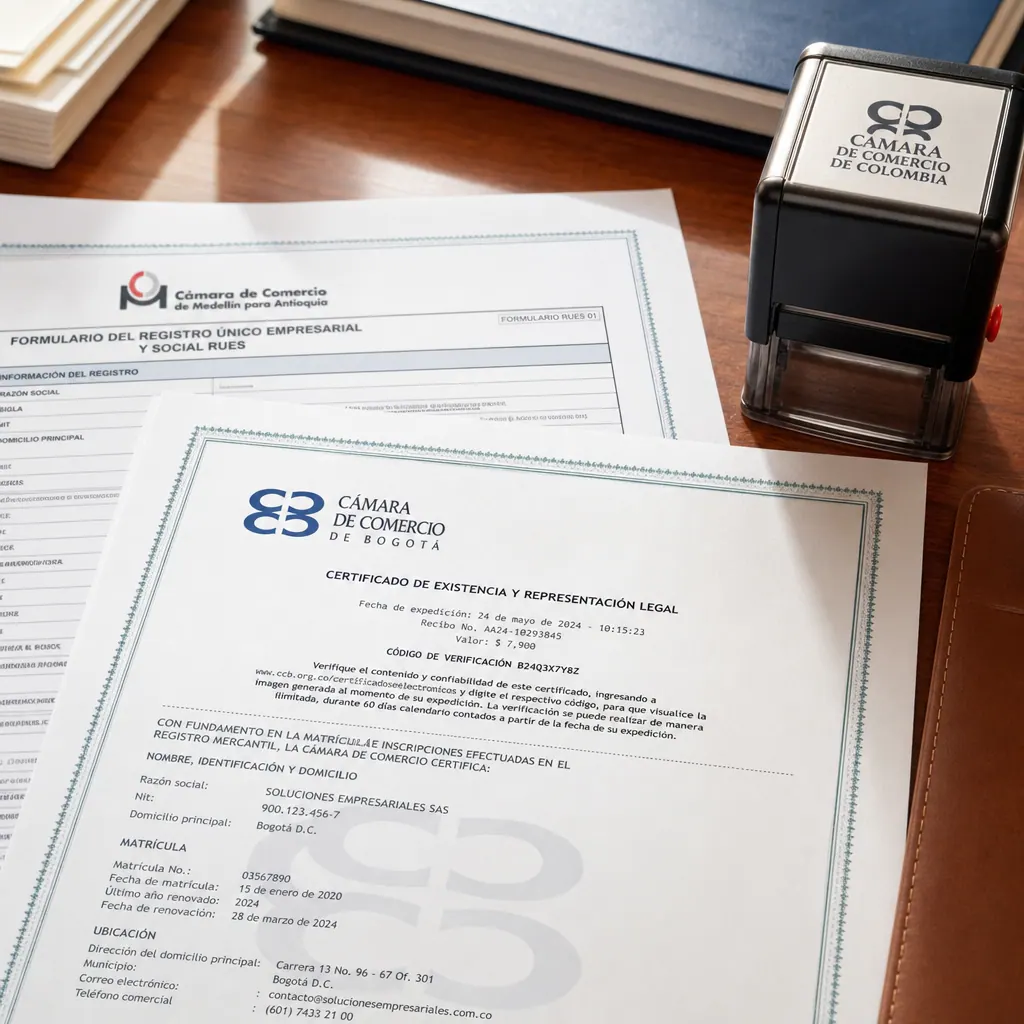
Step 3: Register with Cámara de Comercio
Bring your estatutos (2 copies), your cédula de extranjería (original + copy), your company's registered Colombian address, and payment for the registration fees. The Cámara de Comercio checks your company name against existing registrations and issues your matrícula mercantil. Typically takes 1–3 business days.
Step 4: Get your NIT/RUT from DIAN
Your NIT (Número de Identificación Tributaria) is your company's tax ID. Once you have the matrícula mercantil number, go to DIAN online or in person, register the new company, and get your RUT issued. This is free and often same-day. With your RUT active, you can then set up facturación electrónica — mandatory if you'll invoice Colombian clients.
Step 5: Open a business bank account
Most Colombian banks require: matrícula mercantil, RUT/NIT, estatutos, and the legal representative's cédula. Bancolombia and Banco Bogotá tend to have the least friction for foreign-owned companies. Nequi and Daviplata don't work here — you need a full cuenta corriente. Expect the bank visit to take a half-day; branch staff aren't always familiar with foreign-owned companies and may need to escalate.
What Does It Actually Cost?
The Cámara de Comercio registration fee is calculated as a percentage of your stated initial capital — roughly 0.7% plus a flat fee. For a small business with COP 5,000,000 in initial capital, you're looking at:
💰 Realistic cost breakdown
- Cámara de Comercio registration: COP 350,000–500,000 (depends on stated capital)
- Annual renewal (due every March): COP 300,000–450,000
- RUT/NIT at DIAN: Free
- Estatutos drafted by an accountant: COP 300,000–600,000
- Law firm if you need hand-holding: COP 1,000,000–2,500,000
- Business bank account: Usually free to open; monthly fees vary
The only thing that genuinely catches people off guard: the annual renovación is mandatory every year before March 31 — miss it and your company goes inactive and you get fined. Put it in your calendar now.
Which Visa Do You Need?
Here's the part most guides skip: owning a company in Colombia doesn't automatically mean you can legally work in it.
If you're the owner on paper — collecting dividends, not physically performing services — many visa types technically allow this, including a digital nomad visa or even a tourist permit in some interpretations. But gray areas are risky.
If you're the active legal representative physically running operations and drawing a Colombian salary, you need a work visa (Visa M - trabajador) or an investor visa (Visa M - inversionista). The investor visa requires roughly USD 28,500 equivalent invested in the company, but it's the cleanest path to residency for a serious business owner.
The line between 'owner' and 'employee of your own company' can be blurry under Colombian law. If you're unsure where you fall, check with a Colombian immigration lawyer before registering — it's easier than fixing it after. For the full breakdown on which visa lets you do what, see Colombian Work Permits: Which Visa Lets You Work Legally.
📖 Keep Reading
When It's Worth It — and When It's Not
Worth registering formally if:
- You're regularly invoicing Colombian companies who need facturas for their accounting
- You have local employees or contractors you want to pay through a legal entity
- You're building toward something you'll eventually sell or pass on
- You need a business bank account and a clean audit trail
Might not be worth it yet if:
- All your clients are abroad and you're paid in foreign currency
- Colombia-based revenue is small enough that informal invoicing covers your needs
- You're planning to leave within 12 months — you'll still owe the March annual renewal
One thing I'd genuinely recommend: talk to a Colombian contador before you start the process, not after. A 30-minute consultation (usually free or low cost) can save you from registering under the wrong structure or at the wrong capital level for your actual situation.
Getting Your Business Visible After Registration
Once you're registered, one of the fastest ways to get early clients is listing your services on Colombia Move. It's free, bilingual, and your listing gets indexed on Google — which matters more than most people expect for service businesses. You also get a seller storefront page (colombiamove.com/tienda/your-username) that you can share directly with potential clients before your own website is ready.
Service categories on the platform range from cleaning and plumbing to consulting and design. If you're targeting both Colombian locals and expats, having a presence there is genuinely useful.
Frequently Asked Questions
❓ Can a foreigner own 100% of a Colombian company?
Yes. Colombian law places no restriction on foreign ownership of an SAS. You don't need a Colombian partner, shareholder, or co-founder — 100% foreign ownership is fully legal and common.
❓ Do I need to be in Colombia in person to register?
Yes, for the standard process. The Cámara de Comercio requires in-person submission, and you need a Colombian cédula de extranjería which requires physical presence. Remote formation via power of attorney is technically possible but considerably more complicated and expensive.
❓ How long does the full process take?
Cámara de Comercio approval: 1–3 business days. RUT/NIT from DIAN: same day to 3 days. Business bank account: 1–5 days depending on the bank. In total, allow 2 weeks from having all your documents ready to having an operational business account.
❓ What's the difference between a NIT and a RUT?
They refer to the same number. The RUT (Registro Único Tributario) is the physical or digital document issued by DIAN. The NIT (Número de Identificación Tributaria) is the tax identification number that appears on the RUT. When a client asks for your NIT, give them the number from your RUT.
❓ Do I need to hire an accountant to run a Colombian company?
Not legally required, but practically yes. Colombian tax filings, ICA declarations, and facturación electrónica are complex enough that most small businesses work with a contador. Expect to pay COP 300,000–700,000 per month for basic bookkeeping and compliance — it's worth it to avoid DIAN penalties.


Comments
Loading comments...
Checking sign-in status...