
Colombia Rental Contract Red Flags: Key Terms and What to Watch Before You Sign
Before you sign a rental contract in Colombia: the key legal terms that define your rights — canon, deposito, codeudor, poliza, estrato — plus 12 red flags to catch before you sign.

IDIOMA DEL ARTÍCULO
Showing original language
A friend of mine rented an apartment in Laureles and lost her entire $800 deposit when she moved out. The landlord claimed she'd damaged the kitchen countertop — even though the crack had been there since she arrived. But there was no move-in inventory to prove it. Buried in the contract was a paragraph where she had "accepted the property in perfect condition." She called it the most expensive thing she never read.
Colombian rental law is actually solid — the Ley 820 de 2003 gives tenants real protections. But those protections only work if your contract respects them. Plenty don't. Some landlords include clauses that flat-out violate the law, betting you won't notice or won't fight. Others leave out things that should be there — like an inventory — which is almost worse than an abusive clause because it's an absence you can't point to at signing. If you want to see real-world options right now, you can browse apartments and houses on Colombia Move — posting is completely free.
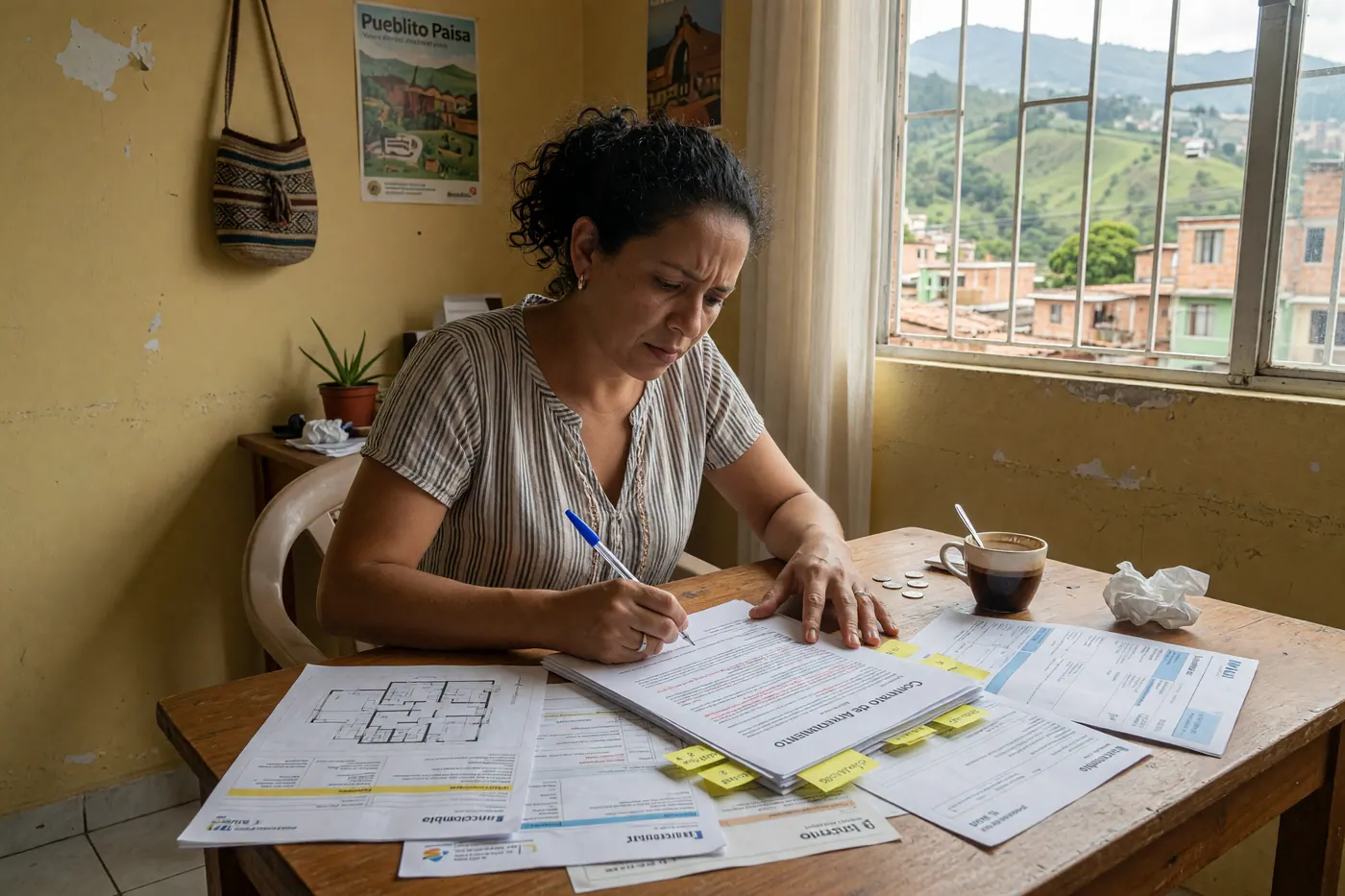
Here are the red flags I'd look for before putting pen to paper, plus a few things to check before the contract even shows up. Note: this is educational — not legal advice. For complex situations, consult a Colombian abogado.
5 rental contract red flags to know first
- Any cash deposit for housing rent or damages — illegal under Article 16, Ley 820
- No move-in inventory (acta de entrega) attached to the contract
- Rent increase clause not tied to the IPC — can be challenged or voided
- Early-exit penalty above 3 months — exceeds legal limits
- Agent can't show power of attorney from the owner — potential fraud risk
Key Colombian Rental Terms (and What They Really Mean)
Before you can spot a red flag, you need to understand what the contract is actually saying. These terms have specific legal and financial definitions in Colombia — getting them wrong can cost you real money. Here's the glossary I wish I'd had when I first started renting here.
Canon de arrendamiento is your base monthly rent — the number that goes to the landlord. Under Ley 820 of 2003, the annual increase is capped at the previous year's IPC (Consumer Price Index) and can only happen once per year, after 12 months of contract. Any clause allowing arbitrary raises is unenforceable.
Cuota de administracion (often just called administracion) is the monthly building management fee, paid to the copropiedad — not to your landlord. Always ask whether a listing price is administracion incluida (all-in) or separate. On a typical apartment, this adds COP 100,000–400,000+ to your actual monthly cost. → How administracion fees are calculated.
Deposito: Under Article 16 of Ley 820 of 2003, a cash security deposit to cover rent or property damage is outright illegal for urban residential leases — not capped, prohibited. A deposit specifically for utility bills is allowed under Article 15; deposits also remain legal for commercial leases. If a housing contract demands a deposito de arrendamiento or deposito de garantia, that clause is unenforceable.
Codeudor solidario: A co-signer who shares equal liability with you. If you default, the landlord or insurer can collect the full overdue amount from the codeudor immediately — without first pursuing you. This is why Colombians are careful about signing as a codeudor for someone else.
Fiador: A guarantor with subsidiary liability under Article 2383 of the Civil Code (beneficio de excusion). The landlord must first exhaust legal collection against the tenant's assets before pursuing the fiador. Harder to enforce, so many landlords now require a codeudor or a poliza instead.
Poliza de arrendamiento: A rental insurance policy from companies like SURA, Seguros Bolivar, or Seguros Mundial. It guarantees the landlord payment of rent, administracion, and utilities if the tenant defaults. Modern digital policies allow qualified tenants to rent without a local codeudor — worth exploring if you are an expat without a Colombian co-signer.
Estrato: Colombia classifies residential properties from 1 to 6 under Ley 142 de 1994, and this determines your utility rates. Estratos 1–3 receive government subsidies; estrato 4 pays cost-recovery rates; estratos 5–6 pay a surcharge that funds lower-tier subsidies. Estrato does not legally dictate your rent, but it significantly affects your actual monthly costs. As of July 2026, Colombia Move has over 100 active housing listings in the vivienda section — estrato is listed on each one, making it straightforward to compare the real cost between two apartments at different tiers.
Inventario de inmueble / Acta de entrega: The room-by-room condition checklist signed at move-in. Without it, there is no agreed baseline to compare against at move-out. See the Missing Inventory section below — this document is quietly behind most deposit disputes.
Entrega: The formal handover — at move-in (entrega de llaves) and at move-out (entrega de inmueble). You are legally obligated to return the property in the same condition you received it, minus normal wear and tear (deterioro normal de uso). No signed inventory at move-in means no agreed baseline for what that looks like.

Contract Clauses That Should Stop You Cold
The deposito clause is the most common illegal rewrite I see. Under Article 16 of Ley 820 of 2003, a cash security deposit to cover rent or property damage is outright prohibited in a residential housing contract — not capped at two months, prohibited entirely. If a contract includes a deposito de arrendamiento or deposito de garantia, that clause is unenforceable and you should demand its removal before signing. Landlords can legally require a utility-bill guarantee (Article 15) or a poliza de arrendamiento. The moment someone calls it a housing deposit, it is a red flag by definition.
Rent increases are another area where landlords sometimes write their own rules. Under Ley 820, annual increases for urban housing can't exceed the previous year's IPC (Colombia's Consumer Price Index). Any clause allowing the landlord to raise rent by any amount at any time is invalid — but having it in writing creates confusion you don't need. Push for language that explicitly references IPC.
The early-termination penalty is where I see the most aggressive rewrites. The law limits this to three months' rent for a tenant-initiated exit before the contract term ends. Some contracts push for six months, or require you to find a replacement tenant yourself. If the penalty clause seems excessive, ask them to revise it to match what Ley 820 actually permits. Most landlords will, once they realize you know the law.
One more to watch for: clauses where the tenant "waives" rights — the landlord's unilateral right to assess damage, or language saying you accept the property "in the condition described herein" when no condition report is attached. These clauses are generally unenforceable under Colombian law, but challenging them after you've already signed means you're fighting both the landlord and the legal ambiguity. Catch them before.
The Missing Inventory: The Quiet Way Deposits Disappear
The move-in inventory — called an *acta de entrega* or *inventario de inmueble* — is a room-by-room record of the property's condition when you take possession. What appliances work, what marks are on the walls, which faucets drip, what furniture is included. Without it, when you move out, the landlord can claim almost anything.
Ideally this is a signed document, attached to the contract, with photos agreed upon by both parties. Some landlords provide one automatically. Many don't, unless you ask directly. If a landlord says 'there's nothing to note, the apartment is perfect' — that's exactly when you need it in writing. Walk around with your phone, photograph every room, note every scuff and scratch, send the photos via WhatsApp and ask the landlord to reply 'confirmado.' That thread is admissible evidence.
A related document worth asking for: the *certificado de libertad y tradición*, which confirms who legally owns the property and whether it has any liens or legal proceedings attached. If you're renting through an agent, ask to see either this certificate or the agent's *poder notarial* (power of attorney from the owner). Standard, reasonable ask. If they balk, that's your answer.

Red Flags Before the Paper Even Shows Up
Some warning signs appear well before a contract arrives. The owner can't — or won't — tell you their name or show any ownership documentation. The agent can't produce a *poder notarial* from the owner. The listing was on WhatsApp, the photos don't match the apartment you visited, and the price dropped $200 the moment you showed up in person. Individually these might be nothing. Together, they're a pattern.
The other classic: pressure to sign today. 'There's another family interested this afternoon.' Some urgency is real — Medellín's Laureles and Bogotá's Chapinero move fast, and good apartments do get taken. But a legitimate landlord won't refuse you 24 hours to read a contract. If they won't let you take the document home, or they keep steering you away from specific sections, trust the instinct that reaction is giving you.
Before you sign: 5-point checklist
- Contract states exact monthly rent (canon) and ties annual increases to IPC
- No cash deposit clause for housing rent or damages — a deposito de arrendamiento is illegal (Article 16, Ley 820 of 2003)
- Move-in inventory is attached — or scheduled within 3 days of handover — and both parties sign it
- Landlord can show ownership documentation or certificado de libertad y tradicion
- Early-exit penalty is three months' rent or less
What to Do When You Spot a Red Flag
Not every red flag is a dealbreaker — some are fixable before signing. An abusive penalty clause can usually be negotiated: point to the specific Ley 820 article, explain that the clause is unenforceable anyway, and ask them to replace it with legal language. Most landlords acting in good faith will agree. The ones who refuse to change an illegal clause are telling you something.
A missing inventory is always fixable before you take the keys. Write one yourself if you have to. Photograph everything, note every issue in a WhatsApp message to the landlord's number, and get a written confirmation back. If the landlord won't engage, ask a witness to be present on move-in day and document it together.
If you're still searching, Colombia Move's rental listings include apartments posted directly by owners — no agency, no added fee, and direct WhatsApp contact so you can ask about inventory and paperwork before you visit.
Already in a dispute? The SIC (Superintendencia de Industria y Comercio) handles rental complaints in Colombia. The process is slow, but filing a complaint often prompts a landlord to settle. Keep every document, message, and photo. Courts will ask for them.
Keep Reading
Reading Spanish? The clause-by-clause guide — Como Revisar un Contrato de Arriendo Antes de Firmar — goes deeper into each legal requirement. And if you're figuring out whether you need a codeudor, fiador, or rental insurance policy, this guide on rental guarantees in Colombia explains what each one actually means.
Frequently Asked Questions
Is a cash security deposit (*deposito*) legal for residential rentals in Colombia?
No. Under Article 16 of Ley 820 of 2003, cash deposits to cover rent or property damage are strictly illegal for urban residential leases. You can refuse or demand the clause be removed before signing. A deposit specifically for utility bills (servicios publicos) is allowed under Article 15 — that is separate and legal. Deposits are also legal for commercial leases.
Can a landlord legally withhold money from my deposit at move-out?
For a utility deposit (the only legal form for housing), yes — but only for documented unpaid utility bills. If the landlord demanded a rent/damage deposit (illegal under Ley 820), the entire clause is unenforceable. For actual property damage beyond normal wear and tear, the landlord's remedy is civil action, not unilateral withholding. A signed acta de entrega is your main protection: without one, there is no agreed baseline.
If a clause is illegal, does that void the whole contract?
No. Under Colombian law, an illegal clause is generally considered unenforceable while the rest of the contract stands. But contesting it usually requires going to SIC or a court, which takes time. Better to catch it before signing than to fight it from inside the lease.
What is the difference between a codeudor and a fiador in Colombia?
A codeudor solidario (co-debtor) shares equal liability with the tenant — the landlord can collect the full overdue amount from the codeudor immediately upon default, without first pursuing the tenant. A fiador (guarantor), under Article 2383 of the Civil Code, has subsidiary liability: the landlord must first exhaust legal collection against the tenant before going after the fiador (the beneficio de excusion). Most landlords now require a codeudor or a digital poliza de arrendamiento because fiadores are harder to enforce.
What should I do if I already signed a contract with a bad clause?
Talk to the landlord first — sometimes they don't realize a clause is unenforceable and will amend the contract. If they won't, the illegal clause is likely void under Ley 820 even without a formal amendment. For disputes involving deposits or significant penalties, the Defensoría del Consumidor or SIC are your first stops.
How does the estrato of an apartment affect my monthly expenses?
Estrato determines your utility rates, not your rent. Under Ley 142 de 1994, properties are classified 1 to 6: estratos 1–3 receive government subsidies on water, gas, and electricity; estrato 4 pays cost-recovery rates; estratos 5–6 pay a surcharge that funds the lower tiers. A one-bedroom in estrato 2 can have utility bills 40–60 percent lower than a similar apartment in estrato 5, so always add expected utility costs to the canon when comparing listings.
🏠 Looking for rentals listed directly by owners?
Browse apartments, houses, and rooms on Colombia Move — no agency, no commission, bilingual listings, direct WhatsApp contact. Ask about inventory and paperwork before you visit.
Browse Rentals →

Comments
Loading comments...
Checking sign-in status...