
Deep well in Colombia: studies, permits, costs and how to hire
The complete route to evaluate groundwater on a farm: what a geoelectric study can tell you, what permits to review, how to demand a comparable quote and what tests should remain after drilling.
IDIOMA DEL ARTÍCULO
Showing original language
"The property has water" is not a sufficient answer. Before buying rural land, you need to know how much water it delivers, how it behaves in summer, whether there is a right to use it, what quality it has and how much it costs to bring it to the house, crops or animalsA weak spring, a seasonal cistern, and a legalized deep well are not the same asset.
If the property doesn't have reliable water supply, a well can be part of the solution, but drilling first and asking questions later is the most expensive way to learn. This guide organizes the complete project for someone evaluating a farm: preliminary study, environmental authority, drilling, pump testing, water analysis, pumping system and maintenance.
Colombia Move has just opened the category of Engineering and Technical Services. Its first two services address precisely this need: one focuses on geoelectric studies and tomographies to locate drilling targets; the other offers drilling and maintenance of deep wells from Ibagué. Below we review them with technical criteria and with a concrete list to request a comparable quote.
Before buying a farm: audit the water as a system
The guide to buying a farm in Colombia covers titles, access and land use. For water, an additional folder is needed. If a well already exists, request the resolution or environmental file, construction report, lithological profile, depth, diameter, filter location, pumping test, recent analysis and maintenance records. If the person offering the property does not have those documents, do not assume that they can be reconstructed at no cost or that the water intake is legal just because it has been operating for years.
- Availability: ask about the operational flow rate and its behavior at the end of the dry season, not just the water level on the day of the visit.
- Demand: separates human consumption, housing, irrigation, drinking troughs, washing and a fire prevention reserve. "Water for the farm" is not a design figure.
- Quality: request laboratory results and confirm that they correspond to the well, date and intended use. Clear water does not equal drinking water.
- Energy and storage: check electrical power, panel, pump, piping, tank, elevation difference and distance. A good well with a poorly sized system is still poor water supply.
- Access: A drilling rig needs width, height, terrain capacity, maneuverability, and space for mud or debris. A nice road for automobiles may not work for the equipment.
- Nearby risks: identifies septic tanks, corrals, fuels, agrochemicals, dumps and other intakes that may affect quality or cause interference.
Geology changes by valley, hillside, and formation, even within the same municipality. That's why experience on a neighboring farm helps, but it doesn't allow you to copy depth, flow rate, or budget. This matters just as much when buy a hot land farm near Bogotá like when comparing regions with the guide to municipalities for buying a farm in Antioquia.
What a geoelectric study does and what it cannot promise
Electrical resistivity tomography places electrodes in the ground, injects a controlled current, and measures potential differences. With this data, an interpreted image of electrical contrasts in the subsurface is constructed. These contrasts can help identify material changes, rock depth, fractured zones, or areas compatible with saturation and guide where to investigate or drill.
But resistivity also changes due to the type of rock, clay, porosity, salinity, minerals, surface moisture, and study geometry. A technical case of the United States Geological Survey (USGS) explains precisely that ambiguity and the need to restrict interpretation with lithology, water levels, or other data. The useful conclusion for whoever manages a farm is simple: tomography is a decision-making tool, not a magic wand that sees an underground river.
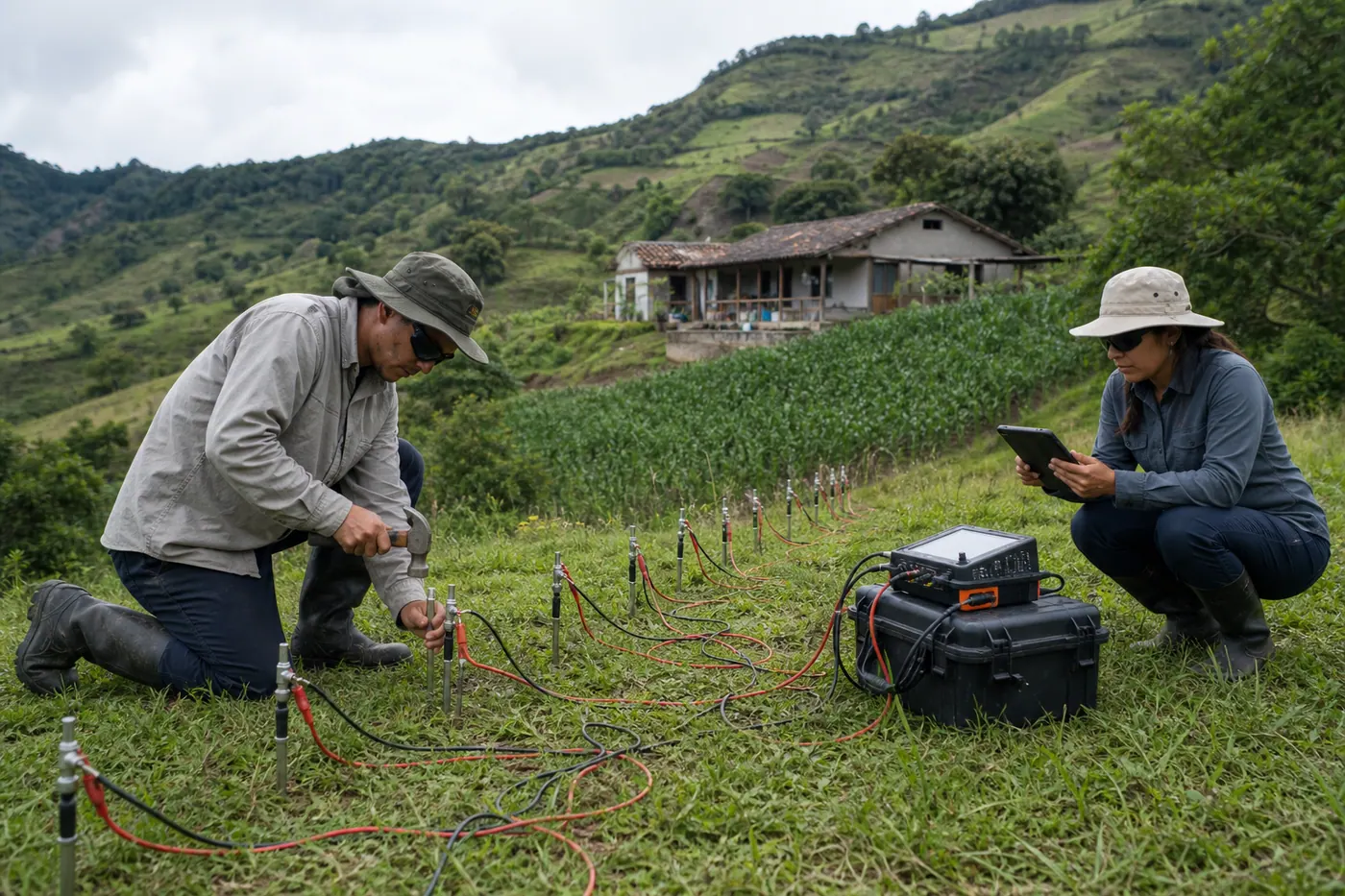
Before hiring, request that the proposal indicate the length and number of transects, electrode spacing, expected investigation depth, equipment, inversion method, interpreter experience, and deliverables. The report should show location, profiles, assumptions, limitations, and recommended points with priorities; a color capture without scale, coordinates, or explanation is not sufficient.
As a regional preselection, the Colombian Geological Service published in May 2026 a viewer with 14,177 groundwater points. It serves to understand what information exists in the surrounding area, but it does not demonstrate that a farm coordinate has an exploitable aquifer.
Permission to explore is not the same as the right to use water
The exact route depends on the jurisdiction and the characteristics of the project. As a working rule, the Ministry of Environment presents two procedures for the use of groundwater: prospecting and exploration, and concession before the competent environmental authority, with the exceptions established by the regulation. In other words, owning the land does not automatically convert groundwater into a freely extractable resource.
Authority changes with location. In the jurisdiction of the CAR of Cundinamarca, the entity indicates that the concession requires prior prospecting and exploration permission. For a farm in Tolima, the reference is the process of CORTOLIMABogotá Distrito Capital and other regions may have different authorities: confirm the municipality, coordinates, and jurisdiction before paying or mobilizing machinery.
The ANLA technical sheet summarize what a well-documented exploration leaves behind: location, method and depth, drilling description, stratigraphic profile, geophysical studies when they exist, pumping test and physical-chemical analysis, among other elements. Ask the contractor to clearly separate which procedure they manage, which technical signature they deliver, which fees the client pays, and what falls outside the scope.
From drilling to a system that actually works
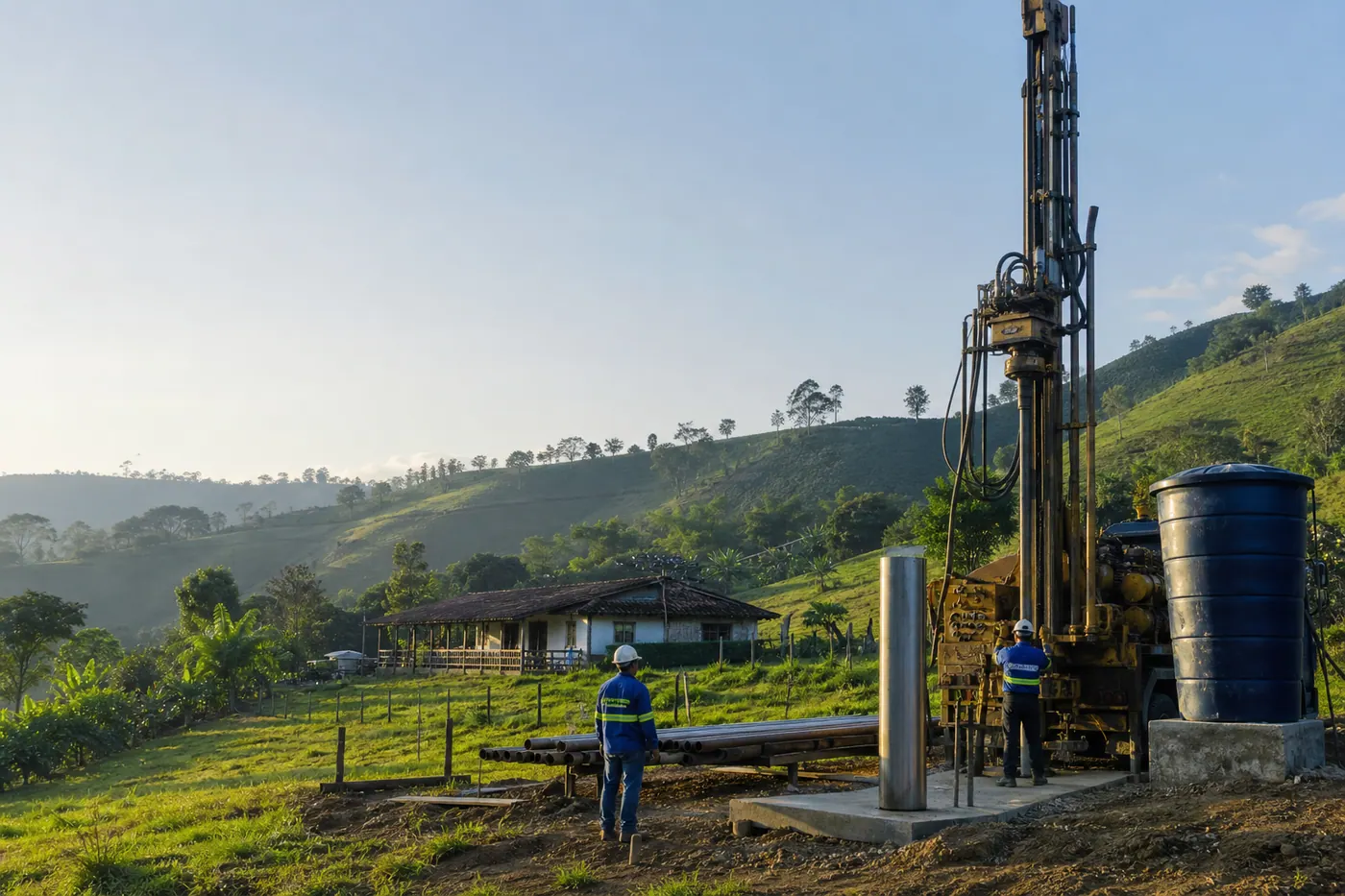
Drilling is a phase, not the final product. During construction, the materials traversed are recorded and the well design is adjusted: diameter, casing pipe, filters, gravel pack, and sanitary seal according to the conditions found. Afterwards, the intake is developed and cleaned to remove fines and debris. Only then does it make sense to measure its hydraulic response.
The CORNARE guide on pumping tests explains that the test allows estimating the advisable flow rate, operating conditions, aquifer parameters, and the proper location of the pump. It asks who designs the test, how long it lasts, how flow and level are measured, whether recovery is observed, and which authority should supervise it.
Then comes quality. The Resolution 2115 of 2007 establishes characteristics and instruments for control and surveillance of water for human consumption. The laboratory and parameters must correspond to the use and local risk. If a result requires filtration, disinfection, iron removal, or other treatment, that system, its spare parts, and its operation belong to the real cost of water.
How much it costs: compare scope, not a single figure
There is no serious national price that works for all farms. Depth is only one variable: mobilization, access, geology, diameter, drilling method, casing and filters, consumables, mud management, development, tests, laboratory, wellhead, pump, electricity, discharge pipe, tank, and procedures also matter. A low figure may be only the advance payment, a minimum depth, or the price per meter without completion.
Require that each quote answer the same matrix:
| Item | What must be written |
|---|---|
| Study and location | Information reviewed, field work, deliverable, coordinates, and limitations; clarify if charged separately. |
| Mobilization and access | Municipality/village included, equipment, roads, platform preparation, construction water, and demobilization. |
| Drilling | Method, diameters, billing unit, depth range, meter-by-meter record, and change management. |
| Construction | Material, diameter and thickness of pipe; filters, pack, seals, wellhead, and manufacturing warranty. |
| Completion | Development/cleaning, pumping test, recovery, sampling, laboratory, and final report. |
| Use system | Pump, cable, control panel, protections, pipe, tank, installation, and startup. |
| Legal and commercial | Procedure included, technical responsible party, fees excluded, taxes, payment method, and what happens if the result is not productive. |
Three alerts justify a pause: absolute guarantee of finding water, refusal to deliver drilling record and pumping test, or a "total quote" without materials, diameters, or exclusions. Compare at least several independent quotes and talk to customers whose wells have operated during a dry season, not just newly inaugurated works.
Two services already available in the new category
These cards are points of contact, not a Colombia Move certification of the technical result. Verify experience, professional responsible party, references, instruments, scope, documentation, and contractual conditions before hiring.
Geoelectric studies and tomographies for water search
The geoelectric studies and tomographies service, based in Chapinero, Bogotá, declares capacity to locate groundwater, support well planning, and advise on legalization procedures, with coverage in several regions. This is the right conversation if there is not yet a technically defensible drilling point. Request a proposal with measurement transects, expected investigation depth, signed report, coordinates, limitations, and how to coordinate the study with the driller.
Drilling, maintenance, and geoelectric studies from Ibagué
The deep well drilling and maintenance service offers drilling, maintenance, and geoelectric studies from Ibagué. The price appears as negotiable, which is more honest than simulating a total without knowing the property. Use it to request a visit or itemized quote with the previous matrix and confirm whether the scope integrates study, procedure, construction, test, laboratory, pump, and maintenance, or if each phase is contracted separately.
The category of Engineering and Technical Services will be gathering these specialties. While it grows, remember that two cards do not mean two independent quotes if they belong to the same contact or team: review their information and get external comparables when the investment is material.
The right decision for a farm without water
If I were evaluating a farm I loved but it had no reliable water, I would not rule out the property or drill on impulse. First, I would put in writing the demand, the legal situation, the regional evidence, machinery access, and the cost of the complete system. Then I would pay to reduce uncertainty in stages, with deliverables that another professional can review.
The best result is not simply "water came out." It is a documented well, operated at a sustainable flow rate, with known quality, clear use rights, protected pump, sufficient reserve, and a maintenance plan. That combination can indeed turn an isolated farm into a habitable and productive place.
Frequently asked questions about deep wells
Does a geoelectric study guarantee that I will find water?
No. The study reduces uncertainty and helps select targets, but drilling, geological record, and pumping test confirm whether a productive intake exists. It must also separate the possibility of water from its flow rate and quality.
Do I need permission to drill a well on a farm?
According to the MinAmbiente framework consulted on July 15, 2026, normally a prospecting and exploration permit is processed before test drilling. The authority, requirements, and possible exceptions depend on jurisdiction and project; confirm the farm's coordinates with the competent environmental authority.
Does the drilling permit already allow me to use the water?
Not necessarily. In the official framework consulted on July 15, 2026, exploration allows investigating and documenting the intake; use normally continues with the groundwater concession and conditions imposed by the authority.
How much does a deep well cost in Colombia?
There is no responsible national figure as of July 2026 without knowing depth, geology, access, diameter, materials, tests, pumping, and procedures. Request itemized quotes with the same line items so you do not compare a price per meter with a finished system.
How do I know how much water the well can produce?
With a correctly designed and interpreted pumping test. The test observes flow, drawdown, and recovery to recommend operating conditions; finding water during drilling does not replace that test.
Can water from a deep well be drunk?
Only when an appropriate laboratory analysis confirms the quality and, if necessary, the indicated treatment is installed and maintained. Clear, cold, or odorless water does not prove that it is suitable for human consumption.
Comments
Loading comments...
Checking sign-in status...