
Rent Payment Receipts in Colombia: How Tenants Prove Every Payment
Protect yourself from illegal deposit claims and eviction threats. Here is exactly how to legally document and prove your rent payments under Colombian law.
IDIOMA DEL ARTÍCULO
Showing original language
Handing over millions of pesos in rent every month without a solid paper trail is one of the easiest ways to land in legal trouble as a foreigner in Colombia. Whether you are dealing with a property management agency or renting directly from an owner, documenting your payments isn't just good practice—it is a strict legal requirement that protects both you and the landlord.
Quick Answer: Under Colombian law (Ley 820 de 2003), your landlord is legally obligated to provide a written receipt for every rent payment. Cash security deposits are strictly illegal for residential leases. If you pay via bank transfer, always include a specific reference (e.g., "Canon Apto 402 - Julio 2026") to ensure the transaction serves as valid legal proof.
I frequently see expats panic when a landlord threatens eviction over an allegedly "missed" payment, or when an agency tries to withhold an illegal cash deposit. Honestly, skip the stress. By understanding how rent receipts work in Colombia, you can bulletproof your tenancy and avoid common disputes. If you want to see real-world options right now, you can browse apartments and houses on Colombia Move — posting is completely free.
The Legal Standard: Your Right to a Receipt
In Colombia, the rules governing residential leases are laid out in Ley 820 de 2003. Article 11 of this law is your best friend as a tenant: it explicitly states that the landlord (or their authorized representative) must issue a written receipt for every payment made.
This isn't just bureaucratic red tape. Proving that you are paying rent establishes what Colombian law calls mera tenencia (mere tenancy). This legally acknowledges that you are renting the property, which actually protects the landlord by blocking any attempt by a rogue tenant to claim ownership through a proceso de pertenencia (adverse possession). Because it protects both parties, a legitimate landlord should never hesitate to give you a receipt.
What a Valid Colombian Rent Receipt Must Contain
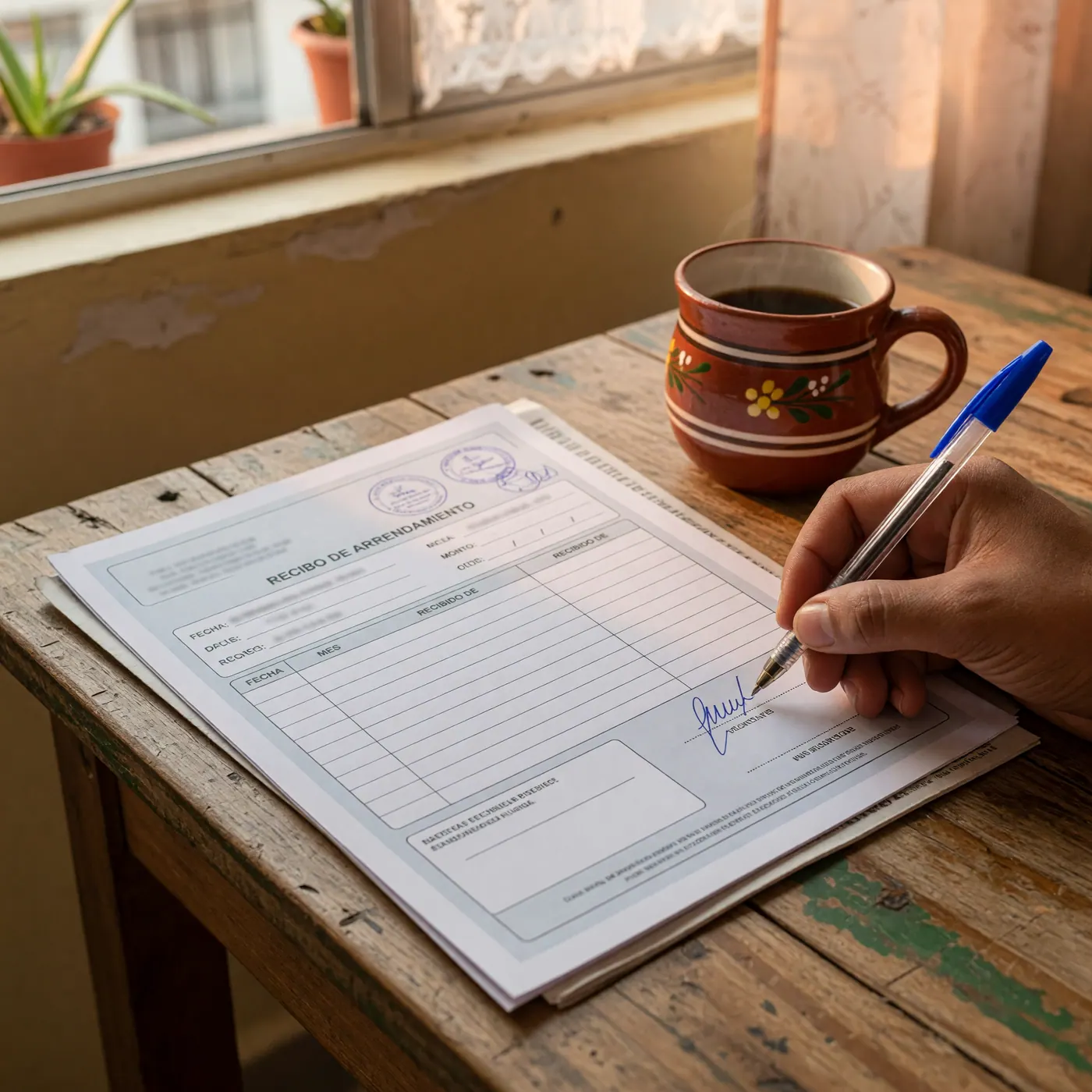
A simple piece of paper that says "Paid" won't hold up if a dispute escalates. Whether physical or digital (digital receipts and electronic signatures are fully valid under Ley 527 de 1999), a valid Colombian rent receipt needs six essential elements:
- Date of payment: The exact day the money was handed over or transferred.
- Amount: Written in numbers and ideally spelled out in words (e.g., $2.500.000 COP).
- Period covered: The specific month or date range the payment applies to (e.g., July 1 - July 31, 2026).
- Concept: What the money is actually for. Is it the base rent (canon), the building administration fee (administración), or utilities?
- Property ID: The exact address and apartment number.
- Signature and ID: The signature and cédula (or NIT for agencies) of the person receiving the payment.
Bank Transfers vs. Cash Payments
Direct bank transfers (via Bancolombia, Nequi, or Daviplata) are the most common and secure way to pay rent today. A bank transfer is strong legal proof of payment, but a raw screenshot is not 100% sufficient on its own. You must use the transaction reference or description field to specify exactly what you are paying (e.g., "Canon Arriendo Apto 402 - Julio 2026"). Furthermore, the destination bank account must match the one explicitly named in your lease agreement.
While you might be used to reading our guide to PSE payments for foreigners to handle your internet and utility bills, direct bank-to-bank transfers are much more standard for rent unless you are dealing with a massive corporate real estate agency.
The Danger of Cash: If your landlord insists on cash, you are stepping into a high-risk zone. Never hand over a stack of bills without receiving an immediate, physically signed receipt in exchange. Furthermore, if a landlord asks for a cash security deposit (depósito de arrendamiento) before moving in, walk away. Under Article 16 of Ley 820 de 2003, cash security deposits or real guarantees are strictly illegal for urban residential leases in Colombia. The only legal guarantees are those set up directly with utility companies.
Separating Rent, Administration, and Utilities
One of the most common mistakes foreigners make is lumping the base rent (canon), building HOA fees (administración), and utilities into a single undocumented transfer. If your lease requires you to pay the administration fee directly to the landlord rather than the building management, ensure your receipt itemizes it separately.
According to active marketplace signals on Colombia Move (July 2026), the housing section (vivienda) recorded 23,194 views across 110 active listings. With landlords processing applications and turning over properties this quickly, you cannot rely on verbal agreements. Clear documentation of separate fees from day one prevents disputes when moving out, much like having a pristine furnished rental inventory.
What to Do If Your Landlord Refuses Payment
Occasionally, a landlord might refuse to accept your rent payment or dodge your calls. This is a classic tactic used to force a tenant into default (mora), giving the landlord legal grounds to evict you or charge exorbitant penalty fees.
Colombian law anticipates this. Under Article 10 of Ley 820 de 2003, you have a strict legal mechanism to protect yourself called consignación extrajudicial. Here is the step-by-step procedure:
- Deposit the money: Within five (5) business days of your rent due date, go to a Banco Agrario branch and deposit the exact rent amount into the official account designated for extrajudicial rent payments. You will need the landlord's name and ID number.
- Notify the landlord: Within five (5) business days of making the deposit, you must send a formal notification to the landlord via certified mail (using a Servicio Postal Autorizado like Servientrega or Inter Rapidísimo). Include a copy of the Banco Agrario receipt.
- Keep the evidence: The certified mail receipt and the bank deposit slip legally prove you fulfilled your obligation, entirely neutralizing any claim that you defaulted on the rent.
Organizing Your Monthly Evidence Folder
I highly recommend creating a dedicated digital folder for your lease. Every month, save the PDF of your bank transfer or a scanned copy of the physical receipt. If you are redacting bank statements to show proof of income for future rentals, you can safely black out your total balance, but leave the specific rent transaction visible.
Having this organized folder is also a lifesaver when annual lease renewals roll around. If you need to verify whether the landlord is applying the legal maximum hike, you can easily reference your historical payments against our Colombia rent increase rules guide.
Frequently Asked Questions
❓ Is a landlord in Colombia legally required to give me a rent receipt?
Yes, under Article 11 of Ley 820 de 2003, the landlord or their authorized representative must issue a written receipt for every payment made. This serves as legal proof of your tenancy and protects both parties.
❓ Can a bank transfer receipt serve as a legal rent receipt?
Yes, bank transfers are strong legal proof of payment, but they should include a clear reference (e.g., "Canon Julio 2026") in the description. The transfer must also be sent to the specific bank account outlined in your rental contract.
❓ What should I do if my landlord refuses to accept my rent payment?
You must deposit the rent via consignación extrajudicial at Banco Agrario within 5 business days of the due date. Afterward, you must notify the landlord via certified mail within 5 business days to avoid being legally declared in default.
❓ Are security deposits legal in Colombia for residential leases?
No, cash security deposits are strictly illegal for urban residential leases under Article 16 of Ley 820 de 2003. The only legally permitted guarantees are deposits made directly to utility companies to cover potential unpaid bills.
❓ How do I handle administration fees (administración) on my receipts?
Always ensure administration fees are listed as a separate line item on the receipt or paid via a separate bank transfer. This prevents the building fees from being confused with your core rent payment (canon).


Comments
Loading comments...
Checking sign-in status...