
How to Start a Fumigation and Pest Control Company in Colombia: Health Requirements and Licenses
Learn the legal, environmental, and health requirements to establish your pest control company in Colombia and capture recurring B2B contracts.
IDIOMA DEL ARTÍCULO
Showing original language
Quick answer: To set up an urban fumigation and pest control company in Colombia, you need to incorporate your commercial entity, have an appropriate commercial premises with permitted land use, hire a professional technical assistant (minimum 40 hours per month according to Decree 1843 of 1991), and request an Inspection, Surveillance, and Control (IVC) visit from your municipal Health Secretariat to obtain the favorable sanitary certificate. Unlike in previous years, a 5-year operating license is no longer processed, but rather a sanitary certificate, for which the inspection visit is free of charge according to MinSalud guidelines (consulted in August 2026).
1. Legal framework: Urban pest control vs. Agricultural registry
One of the most common mistakes when starting a pest control service in Colombia is confusing the agricultural plant health regime with pest control in urban areas. If you are going to fumigate crops or grains on a farm, the procedure is handled by the Colombian Agricultural Institute (ICA) and requires the direction of an agronomist engineer.
However, when your service is focused on buildings, restaurants, hotels, warehouses, transport vehicles, and public areas, the Colombian technical standard that governs is Decree 1843 of 1991 under the surveillance of municipal and district Health Secretariats. Under this legal framework, the company provides an environmental hygiene and public health service, using exclusively authorized pesticides with a current sanitary registration issued by INVIMA.
2. Business and infrastructure requirements
Before requesting any sanitary inspection, you must structure the legal and physical basis of your company. Law 9 of 1979 and Decree Law 2150 of 1995 require that every commercial establishment comply with the basic requirements for commercial operation before providing services.
- Company incorporation: Register at the Chamber of Commerce of your city as a natural person with an establishment or as a company (for example, a S.A.S.). To see the exact steps to register your business, check our guide for registering an SME with the Chamber of Commerce in Colombia. In the RUT and mercantile certificate, several secretariats (for example, Santander) request CIIU 8129 (Other building and industrial cleaning activities); confirm the code with your Chamber and local secretariat, do not assume a single national code.
- Compatible land use: The company premises cannot be located in exclusively residential areas or within family homes (Art. 105 of Decree 1843). You need a land use certificate issued by the Municipal Planning office or Urban Curatorship that authorizes the storage of chemical supplies.
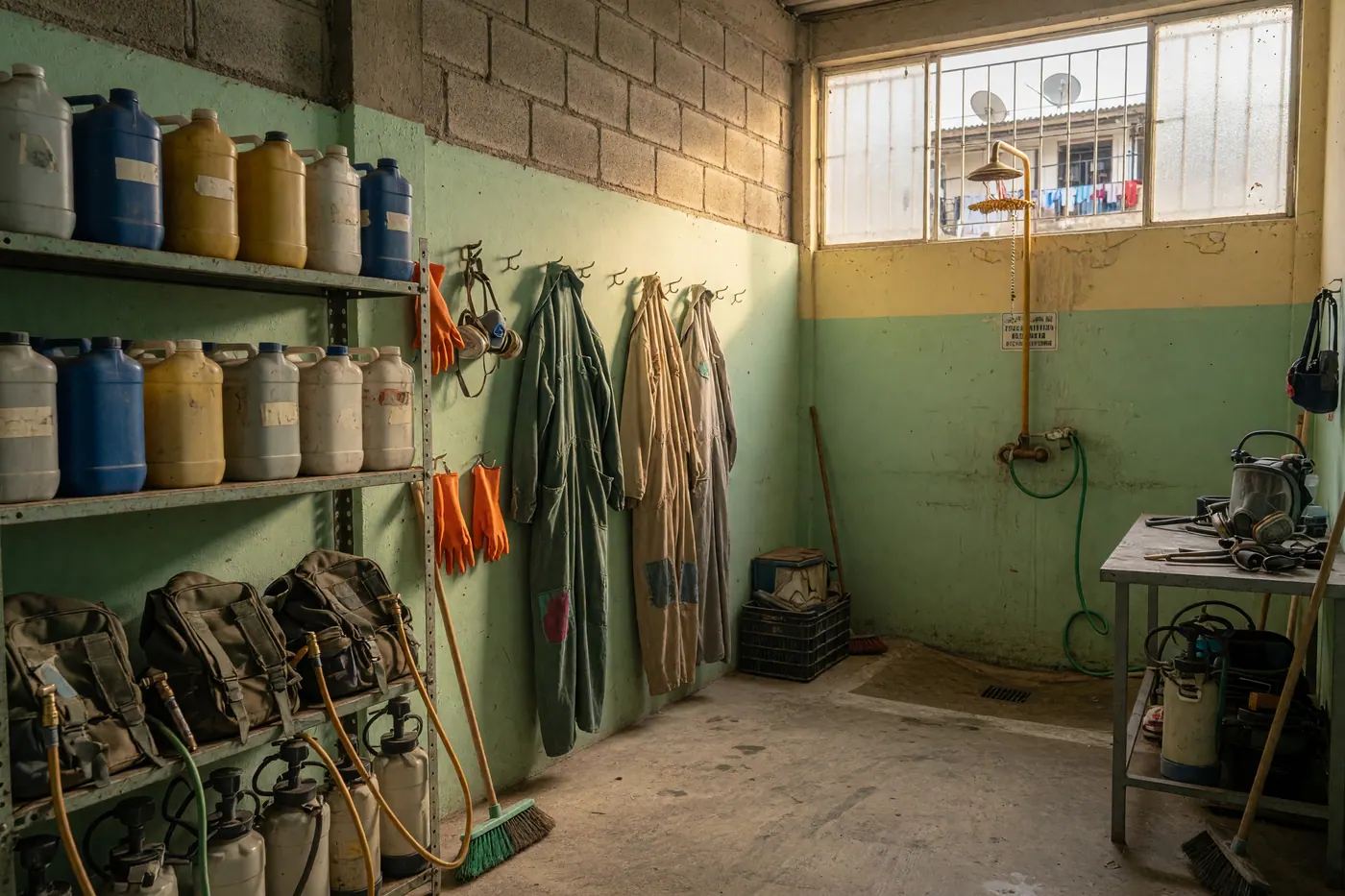
- Technical infrastructure of the premises: The space must have an administrative area separate from the pesticide storage, adequate ventilation, washable floors and facilities, an emergency shower, eyewash station, fire extinguishers, and a secure, locked area for weighing and preparing products.
- Local tax structure: When formalizing your business, you must register for the Industry and Commerce tax in your municipality. If you provide services independently or as a small business, consult how to pay the ICA tax in Colombia, or consider joining the Simple Taxation Regime (RST) to unify your tax obligations.
3. Technical personnel: Technical assistant and certified operators
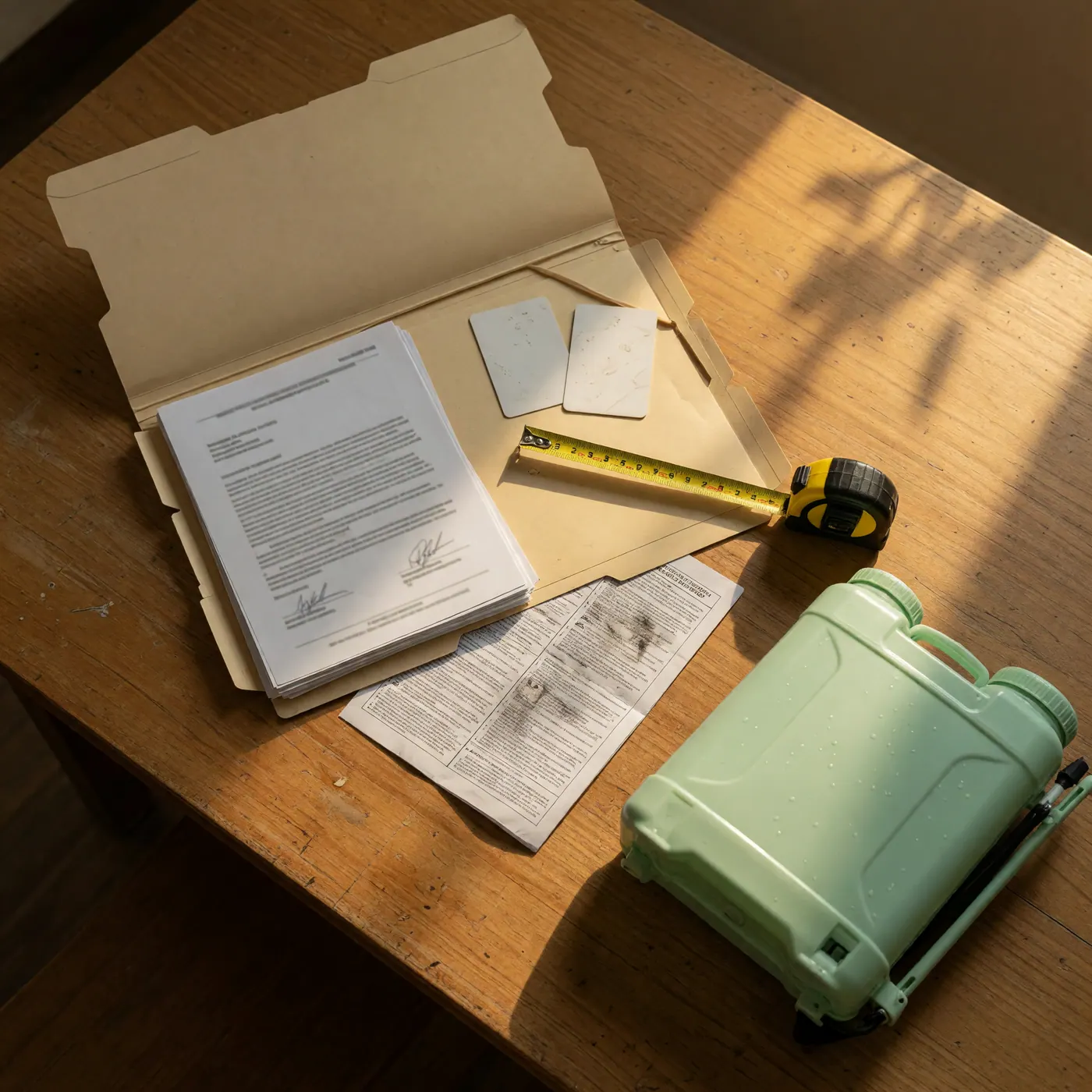
Decree 1843 establishes strict requirements regarding personnel who handle chemical substances. It is not legal to operate a fumigation business as an empirical worker without professional backing and certified technical aptitude.
Key hiring fact: Decree 1843 of 1991 (Art. 108) requires every urban application company to have the advice of a technical assistant with a university degree, specific training, and registration with the health authority, through a formal technical assistance contract for no less than 40 hours per month.
For their part, field operators applying the products must meet the following requirements:
- 60-hour training: Must have passed a theoretical-practical course on safe pesticide handling and integrated vector control with a minimum intensity of 60 cumulative hours, taught by an entity authorized by the health authority.
- Applicator ID card: Possess the certification or ID card issued or endorsed by the Health Secretariat of the jurisdiction where the services are provided.
- Occupational health exams: Periodic occupational medical evaluations and complete personal protective equipment (PPE): respirators with organic vapor filters, waterproof overalls, nitrile gloves, and safety goggles.
4. How to process the Sanitary Certificate with the Health Secretariat
Historically, Decree 1843 mentioned a "5-year sanitary operating license." However, by virtue of Decree Law 2150 of 1995 and Resolution 1229 of 2013 from the Ministry of Health, previous licenses were abolished to give way to the model of Inspection, Surveillance, and Control (IVC) based on the sanitary certificate.
According to the Ministry of Health's IVC ABC (consulted in August 2026), sanitary inspection visits have no official cost and the certificate granted does not have a fixed duration in years, but rather depends on the follow-up visits periodically conducted by the local authority.
| Process Step | Process Description | Key Required Documents |
|---|---|---|
| 1. Territorial registration | Registration of the establishment on the Health Secretariat platform (e.g., Healthy Businesses in Bogotá). | RUT, Chamber of Commerce (CIIU 8129 if your secretariat requires it), legal representative's ID. |
| 2. Filing of the request | Formal petition for a sanitary inspection visit for a pesticide application company. | Technical assistant contract (≥40 h/month), professional degrees, and personnel certificates. |
| 3. On-site audit and inspection | A sanitary inspector evaluates facilities, Safety Data Sheets (SDS), PPE, and the hazardous waste protocol. | Integrated Pest Management (IPM) plan, waste container disposal contracts (RESPEL). |
| 4. Issuance of the Visit Report | The authority issues the official sanitary certificate after reviewing the headquarters and equipment. | Favorable, Favorable with Requirements o Unfavorable. |
In Bogotá, the process is handled through the District Health Secretariat (Carrera 32 # 12-81) or via the institution's virtual platform. In other departments, such as Santander, Sectional Secretariats may require additional documents like extra-contractual liability insurance or an environmental contingency plan. Always verify the specific checklist at your city's mayor's office or governor's office. The Santander checklist (updated November 18, 2025) is a territorial example, not a national fee or requirement.
5. Authorized products and Integrated Pest Management (IPM)
Professional fumigation companies in Colombia do not apply agricultural-use substances in enclosed spaces. Decree 1843 and Ministry of Health guidelines mandate the use of only those pesticides formulated for public health or domestic environment use that have an active sanitary registration with INVIMA.
Except for very specific technical cases (such as rodenticides in protected bait stations, wood treatments, or fumigation of grains stored in silos), urban application companies are prohibited from using products classified in toxicological categories I and II (extremely and highly hazardous) in areas where people or domestic animals circulate.
Additionally, to sell your services to food companies, hospitals, or shopping centers, you must design a program for Integrated Pest Management (IPM). Chemical control is only the last resort; the plan must prioritize physical control (mesh screens, sealing cracks, mechanical traps) and client education on storage and hygiene.
6. Capturing B2B clients and how to publish your service
The residential market generates daily income, but the financial stability of a pest control company comes from recurring B2B contracts with residential complexes, restaurants, schools, industries, and offices. To compete in this segment, your commercial proposal must reflect technical rigor and full legal compliance.
Every time you provide a B2B service, you must deliver a Fumigation and Disinfection Certificate or Report signed by the technical assistant. This document must include the service date, the pesticides applied, their INVIMA registration numbers, dosages used, the re-entry period for the area, and the housekeeping and sanitation recommendations given to the client.
According to active ads on Colombia Move (August 2026), there is currently 1 active ad and 1 recent ad in the cleaning category, with 68 views: the supply of hygiene services is thin compared to the goal of 5 ads. To connect directly with horizontal property administrators and operations managers without paying intermediary commissions, you can structure your business profile on the platform.
When publishing your ad in the services section of Colombia Move, highlight your legal differentiators: valid favorable sanitary concept, staff applicator IDs, geographic coverage, and availability of electronic invoicing. This clarity builds immediate trust with institutional buyers.
Frequently Asked Questions
❓ Do I still need to request a 5-year sanitary license under Decree 1843?
Not as a currently valid sectional procedure. Today, the authority issues a sanitary concept of IVC (Ministry of Health/ABC, consulted August 2026), not the old five-year license. Decree 1843 remains the technical standard for the premises, personnel, and products.
❓ How much does the visit to obtain the sanitary concept cost?
The Ministry of Health indicates that the visit and the concept have no cost (guideline consulted August 2026). Other local policies or certificates may charge; the Santander example is not a national fee. You must budget for the Chamber of Commerce, warehouse adaptation, and occupational exams.
❓ Which professional can serve as a technical assistant?
The decree requires a university professional with training and registration in health and a contract of at least 40 hours per month. The lists of degrees are set by each secretariat; do not assume a national list.
❓ Can I use chemicals bought at rural agricultural supply stores?
Not for urban services. Only pesticides with an INVIMA registration for domestic or public health use, with the restrictions of Article 114 (Ministry of Health/INVIMA, 2026). Unauthorized agricultural input used indoors exposes you to measures under Law 9, depending on the case.
❓ How can I avoid being seen as an informal or unsafe fumigator?
Show the report or concept, IDs, product data sheet, and PPE (Decree 1843, consulted 2026). Do not apply with people, pets, or food in the area; attach your Chamber of Commerce, ARL, and the report template for each visit.
❓ Where can I advertise my fumigation services to capture B2B clients?
In service classifieds, for example, the cleaning category, with the area, starting prices, and documents visible (August 2026). Real photos of the team with PPE and an up-to-date concept help with corporate prospects.
❓ Does the CIIU code have to be 8129?
Several secretariats (for example, Santander) require it on the Chamber of Commerce registration and tax ID (RUT). Confirm the code with your local Chamber of Commerce and secretariat; do not assume a single national code.



Comments
Loading comments...
Checking sign-in status...