
How Much to Charge per Square Meter for Painting and Drywall Work in Colombia
A guide for painters, handymen, and property owners: indicative ranges per square meter for labor, how to measure, how much paint to buy, and how to agree on payments without arguing.
IDIOMA DEL ARTÍCULO
Showing original language
Almost every dispute over paint starts the same way: the owner asks for "a price to paint the apartment" and the painter answers with a number that explains nothing. When pricing is done per square meter (m²), both sides speak the same language. This guide gives you reference rates for labor, how to measure, and how to pay. Note: in Colombia there is no official rate for painting. Everything you see here is an indicative market range that changes with the technical visit.
Quick answer: For basic interior painting in vinyl, two coats, on sound walls and labor only, the reference is roughly between $8.000 and $15.000 COP per m². If the quote is "all-in" (including materials), the total rises to an approximate range of $18.000 to $30.000 COP per m², depending on the vinyl brand.
What drives the price per square meter
You don't paint the same thing in a room with smooth walls as in an apartment with peeling paint and damp. These are the factors that actually change the number:
- Type of paint: Type 1 vinyl is washable and highly resistant, ideal for living rooms, bedrooms and hallways. Type 2 resists washing less, and Type 3 is used mostly on ceilings and bases. Enamels and high-end washable paints are priced differently.
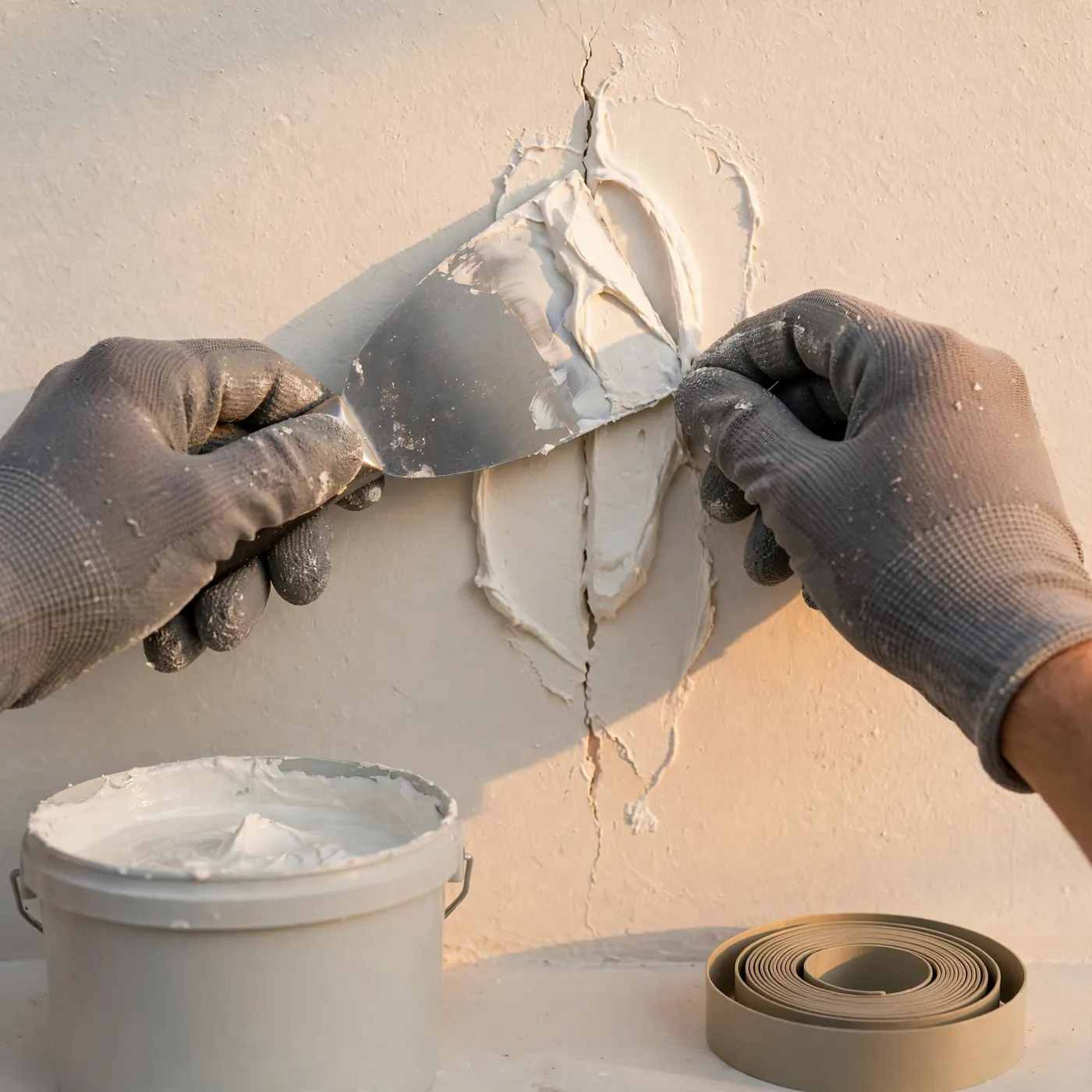
- Wall condition: A sound wall can be painted almost directly. If there is peeling paint, cracks or poorly filled plug holes, it must be scraped, patched and sometimes skim-coated.
- Height and complexity: Ceilings, drywall ceilings, moldings and walls over 1.5 meters that require a stepladder or scaffolding justify an adjustment for safety and time.
- Volume: The more continuous meters, the fewer pesos per m². Painting 40 m² does not cost the same per unit as painting 250 m².
- Location: In the large capitals, base rates are usually somewhat higher due to cost of living and travel than in intermediate municipalities. There is no single national table.
Reference rate table
These ranges come from market price lists consulted in October 2026 and vary depending on who quotes. Use them as a starting point, not as absolute truth.
| Job | Indicative reference |
|---|---|
| Interior wall in vinyl, two coats, labor only | $8.000 – $15.000 COP/m² |
| High-end washable, enamel on walls or ceilings | Approximate surcharge of 20% to 35% over the standard wall |
| Scraping blistered paint, deep patching or prior skim coat | Between $8.000 and $14.000 COP additional per m² |
| All-in (labor + putty, sandpaper, tape, plastic and paint) | $18.000 – $30.000 COP/m² depending on brand |
Note: other sources publish higher or lower ranges, for example depending on whether they include the benefits factor or whether the charge is per painter's hand. That's why you should always ask what the number includes: how many coats, what preparation, and whether the painter brings an assistant.
What is usually not included in the standard rate: moving heavy furniture, removing lamps and fixing deep dampness. That is quoted separately, and it's best to put it in writing.

How to measure and how much paint to buy
Measuring wrong is the fastest way to give away work or overpay. The method is simple:
- Measure the perimeter of each space and multiply it by the wall height. That is the vertical area.
- Add the ceiling area if it will also be painted.
- Subtract doors and windows only when they exceed 2 to 3 m².
- Add everything up and that is your paintable area.
Use that number to calculate the paint. One gallon of Type 1 vinyl covers approximately 35 to 45 m² in one coat, or 18 to 22 m² in two coats, depending on wall porosity. A cuñete (5 gallons) then covers about 90 to 110 m² in two coats. With that you'll know whether to buy a cuñete or loose gallons, and avoid costly leftovers.
As for the painter's output: on smooth interior walls, a common benchmark is 30 to 45 m² per workday in two coats. If someone charges you five days for an 80 m² apartment with sound walls, do the math before saying yes.
Labor only or all-in: what suits each party
If you are a painter, charging labor only protects you from the risk of vinyl prices rising and lets you focus on the work. The problem: the client sometimes buys poorly, or asks for cheap paint and then blames the finish. With "all-in" you control material quality and earn a margin, but you advance money and take on the waste.
If you are a property owner, "all-in" is more convenient because you get a fixed price. Labor only usually comes out cheaper if you know how to buy and want to choose the brand. My honest advice: if you don't know how much paint is needed, don't buy it yourself; let the painter calculate and check their math with the formula above.
For small, scattered jobs (touching up one wall here, replacing an outlet there), a handyman's day rate is usually better. In this guide to hiring a handyman we explain when it's better to pay by the day than by m².
November and year-end: when to schedule
In the final stretch of the year, demand for interior maintenance usually rises due to rental property handovers and renovations before December. The November long weekends, such as the All Saints' holiday, are good for painting with the house empty. My suggestion: book several weeks in advance, because good painters fill up first. If it's rainy season, keep in mind that walls with damp shouldn't be painted until the cause is fixed.
Contracts, advances and ARL
On small residential jobs, the usual arrangement is a civil works or service contract, where the contractor provides their own tools and social security coverage (ARL and health as an independent worker) when the job runs long. For details on what may be considered an employment relationship, check the Ministry of Labor and, if in doubt, consult a labor lawyer. If your project needs crews, see how to post construction jobs.
Watch out for work at height: a ladder fall without ARL becomes a serious problem for both sides. Require coverage when scaffolding or special ladders are involved.
A payment scheme that protects both parties:
- 30% at the start (or an advance only for materials, against an invoice).
- 40% against verified progress.
- 30% on delivery, holding back 10% to 15% until the finish has been reviewed carefully.
Write into the quote the agreed m², how many coats, what preparation is included and what is charged separately. That way you avoid improper deductions for "waste" and advances that vanish. For other home repairs, see how to hire maintenance and repair services. According to active listings on Colombia Move (October 2026), the repairs category has 7 active listings and 1,618 views, with 0 new listings in the last 30 days: people look at more than what gets posted.
Frequently asked questions
❓ How much does painting labor cost per square meter on average in Colombia?
As a reference, between $8.000 and $15.000 COP per m² for basic interior painting in vinyl, two coats, on sound walls and without materials. Ceilings, enamels, patching and large cities can raise the value, so confirm with a technical visit (verify with the official source).
❓ What is the difference between Type 1 and Type 2 vinyl for interiors?
Type 1 is washable and highly resistant, ideal for living rooms, bedrooms and hallways. Type 2 resists rubbing and washing less, so it degrades faster. For high-traffic areas, Type 1 is usually worth the difference (verify with the official source).
❓ Does the price per m² include patching holes and cracks?
Normally it includes minor preparation, such as filling three or four plug holes. Large patch jobs, peeling paint or general skim coating are charged separately per m². Ask for it in writing in the quote to avoid arguments later (verify with the official source).
❓ Is it better to charge by the day or by the square meter?
By square meter is usually more transparent and protects against delays, since you pay for the result. The day rate suits scattered touch-ups or small handyman tasks, where measuring every corner makes no sense.
❓ How far does a cuñete of vinyl go in a house or apartment?
A 5-gallon cuñete of Type 1 vinyl covers about 90 to 110 m² in two coats, or between 175 and 225 m² in one coat, depending on wall porosity. Measure first with the perimeter times height formula.
❓ How do I charge for changing from dark to light color?
One coat is not enough: a minimum of two or three coats of Type 1 vinyl or a white primer sealer is required. That's why it's best to quote it as work with more coats and not at the standard wall rate (verify with the official source).

Comments
Loading comments...
Checking sign-in status...