
RETIE Inspection Report in Colombia: Requirements, When It Is Mandatory, and How to Hire an Inspector
Learn what RETIE requires in Colombia, when you need an ONAC-accredited inspection report to connect your meter, and how to avoid fraud.
IDIOMA DEL ARTÍCULO
Showing original language
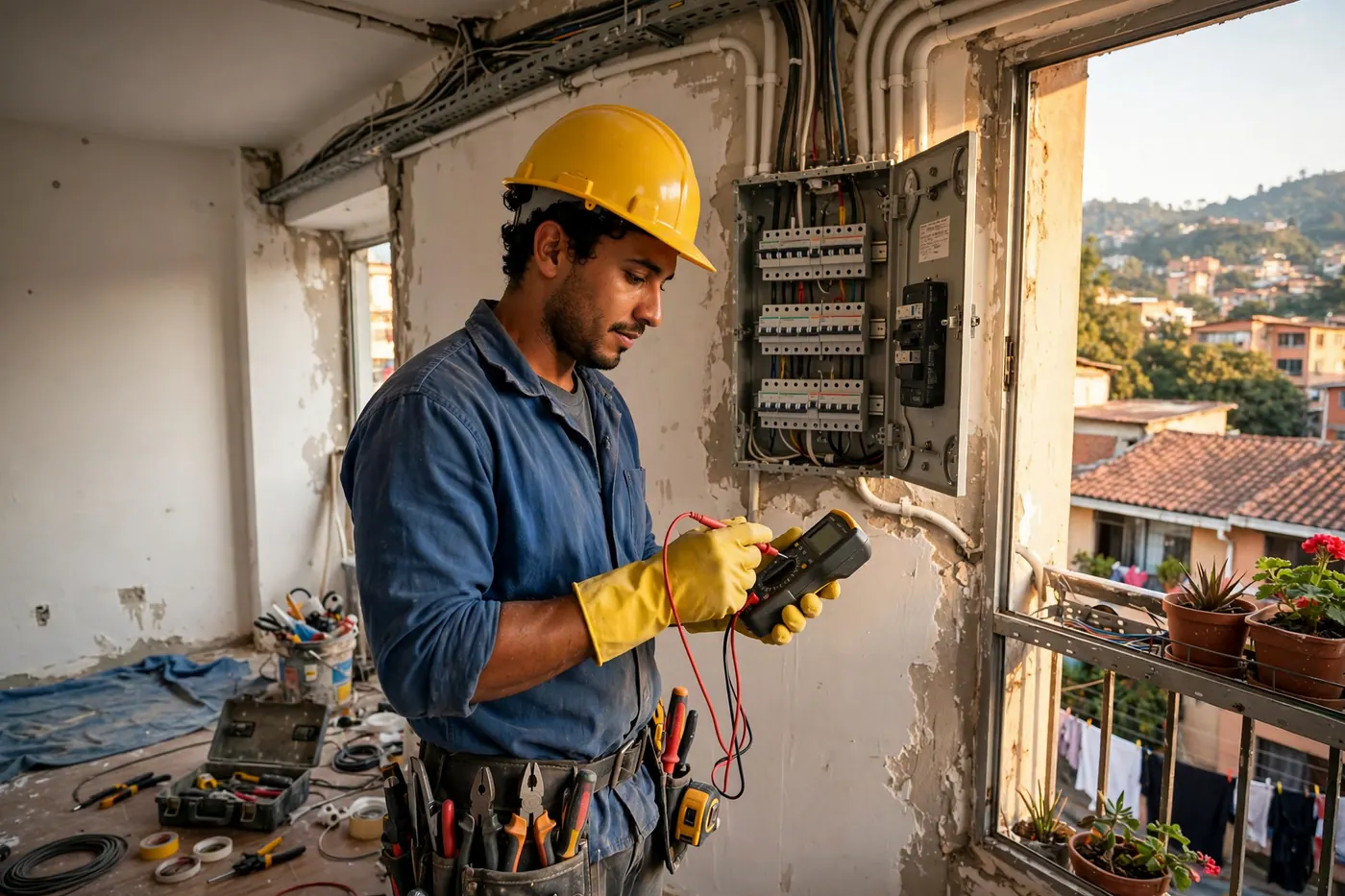
Finishing a remodel or building a structure in Colombia and encountering a refusal from the network operator to energize the property is a frequent headache. Whether you are dealing with Enel, EPM, Afinia, Celsia, or Air-e, the technical response is usually categorical: without compliance with RETIE, no official will authorize the installation or the sealing of the electricity meter.
The Technical Regulation for Electrical Installations (RETIE), comprehensively updated by the Ministry of Mines and Energy through Resolution 40117 of 2024 (organized into four technical books: Generalities, Products, Installations, and Conformity Assessment), is not a simple bureaucratic procedure. Its purpose is to guarantee human safety, prevent fires, and protect property from electrical risks. However, in the day-to-day life of Colombian construction sites, there is a lot of misinformation about who issues each document and when a formal third-party inspection is required.
- Declaration of Compliance: Signed under oath by the construction electrician (CONTE technician or COPNIA engineer).
- Inspection Report: Issued exclusively by an Accredited Inspection Body (OIN) endorsed by ONAC.
- Mandatory status: The report is essential for residential networks of 10 kVA or more, buildings or complexes with 5 or more electricity meters, common areas, solar panels, and vehicle chargers.
- Cost: There is no official rate set by law; each organization quotes freely based on power, circuits, and distance.
Declaration of Compliance vs. Inspection Report: Two Different Roles
One of the most expensive mistakes in renovations is believing that the electrician who wired the house can issue the "RETIE certificate" on their own. In Colombian legislation, there are two perfectly differentiated legal and technical concepts that make up the so-called Full Certification:
- The constructor's Declaration of Compliance: This is a document issued under oath by the competent professional who designed or built the electrical network. This professional must have a current professional license: electrical technicians endorsed by the National Council of Electrical Technicians (CONTE), technologists before CONALTEL or COPNIA, or electrical engineers registered with the National Professional Council of Engineering (COPNIA). In this official format, the technician declares that the installation complies with the regulation and assumes civil and disciplinary responsibility for their work.
- The Inspection Report: This is the document issued by an Accredited Inspection Body (OIN) supervised by the National Accreditation Body of Colombia (ONAC). The inspector performs an on-site, independent audit using calibrated instruments to verify that what has been built matches the design and technical standard.
By the ethical and legal mandate of RETIE, it is strictly prohibited for the person who designed or executed the installation to act as an inspector. The person who built it cannot evaluate themselves. Beware of any contractor who offers to "hand over the signed report" without the presence of a duly accredited independent auditing body.
When is the Accredited Inspection Report Mandatory?
Not every electrical intervention requires hiring a third-party inspection. RETIE precisely establishes the thresholds where Full Certification (Declaration of Compliance + ONAC Inspection Report) is strictly required for the utility company to authorize the connection:
| Type of Installation | Capacity / Scope | RETIE Requirement |
|---|---|---|
| Isolated single-family home | Less than 10 kVA | Declaration of Compliance (unless otherwise provided by the operator) |
| New home or commercial premises | Equal to or greater than 10 kVA | Declaration + ONAC Inspection Report |
| Multi-family or commercial projects | 5 or more energy meters (same license) | Mandatory report for each meter and common areas |
| Industrial installations | Equal to or greater than 20 kVA | Declaration + ONAC Inspection Report |
| Expansions or renovations | Expansion greater than 10 kVA, or more than 50% only if the intervened part exceeds 10 kVA | Inspection Report on the modified part |
| Renewable energy and mobility | Photovoltaic solar systems and EV chargers | Declaration + ONAC Inspection Report |
For a small individual house whose connection does not exceed 10 kVA, the general rule only requires the Declaration of Compliance signed by a technician registered with CONTE. However, the local network operator may reserve the technical power to request a report if it detects construction anomalies or variations in the connection. Conversely, in a residential building where each apartment demands less than 10 kVA, the mere fact of sharing a license with 5 or more meters makes an ONAC inspector's report mandatory for each unit and for the general substation or connection.
Construction Requirements to Pass Inspection Without Issues
For the inspector not to reject your installation, the work must be planned from the first day according to the standards of Resolution 40117 of 2024. The most rigorous control points during the technical visit include:
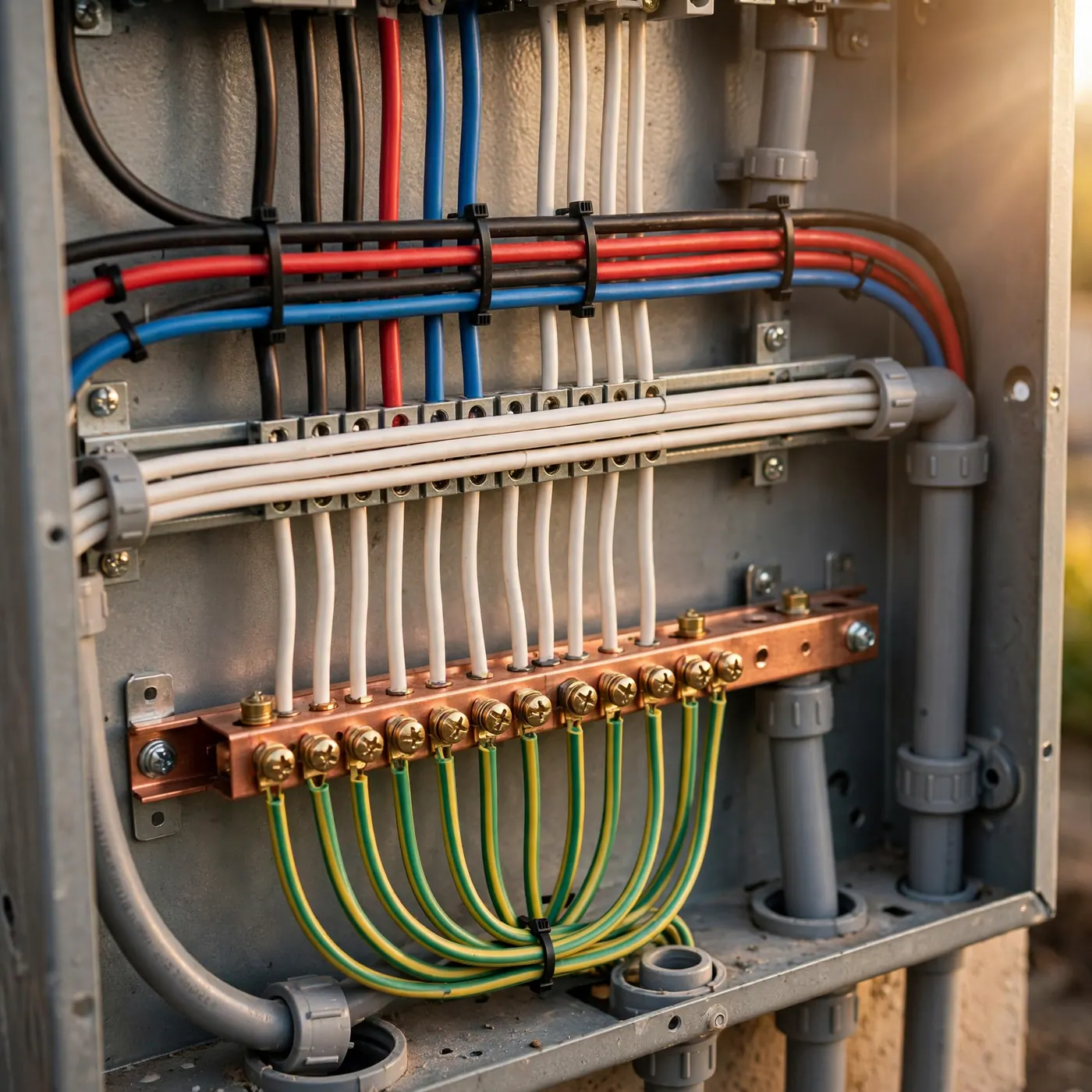
- Grounding System (SPT): This is the heart of electrical safety. The grounding rod, electrode, connector, and bare or insulated copper cable must comply with the regulated dimensions and materials. The inspector will measure the grounding resistance with a calibrated earth tester (tellurometer).
- Mandatory color code: In standard single-phase networks in Colombia, conductors must respect the regulatory convention: phase in black (or brown/red in specific systems), neutral in white, and protective earth in green or green with a yellow stripe. Using a single cable color throughout the entire conduit represents an immediate rejection.
- Materials with Product Conformity Certificate: Each breaker (thermomagnetic circuit breaker), residual current device (GFCI), outlet, panel, and cable section must have its RETIE product certificate issued by a certification body. Always keep the technical data sheets and legal purchase invoices.
- Labeling and diagrams: The distribution board must have the single-line diagram visible and each circuit properly marked (e.g., living room lighting, kitchen outlets, air conditioning).
How to Verify and Hire an Inspection Body (OIN)
The electrical certification market has formal companies, but also intermediaries who issue documents with no legal validity. To protect your investment before paying an advance, follow this verification procedure:
- Check the official ONAC directory: Go to the official ONAC portal (onac.org.co) and access the "Accredited Directory" module. Select the organism type "Inspection Bodies (OIN)" and filter by the RETIE sector.
- Validate the accreditation code: Every authorized body has an identification with the official alphanumeric format (for example, XX-OIN-XXX). Check that the body's status is listed as "Accredited" and that it is not suspended or withdrawn.
- Verify the technical scope: Check that the body has specific accreditation for the type of installation you need to certify (residential/commercial end-use networks, distribution, or generation).
- Registration in the SICERCO system: Once the inspection is approved, the body generates the official report, which must be registered with its sequential number in the Certificate of Conformity Information System (SICERCO) of the Superintendency of Industry and Commerce.
How Much Does a RETIE Report Cost?
A common question from property owners is the fee for this process. It is essential to understand that RETIE inspection fees are not fixed by decree or regulated by the State. They are governed by professional technical free-market prices.
The final value quoted by the Inspection Body will vary according to:
- The total installable power measured in kVA.
- The number of panels, meters, and branch circuits to be audited.
- The property type (single-family home, apartment tower, or industrial warehouse).
- The geographic distance and travel expenses required for the inspector to reach the property.
Always request itemized quotes from at least two accredited bodies and be wary of suspiciously low charges that promise to issue the report without carrying out a physical verification visit.
Watch out for the price of that visit: there is no official rate in pesos. According to active ads on Colombia Move (September 2026), there are 14 active electricity service ads and 761 views in that category. The buyer who is remodeling compares registration and zone; if you offer the service, the contact is direct and without an intermediary commission. You can also check the services section to see who is already posting electrical jobs.
The Most Frequent Mistakes That Fail Certification
When an inspector issues a "Non-Conforming" report, energization stops, and correcting the defects usually costs twice as much time and money. The most recurrent reasons for rejection in Colombian inspections are:
- Lack of GFCI outlets in wet areas: In bathrooms, kitchens, laundry rooms, and outdoors, it is mandatory to install ground-fault circuit interrupters to protect human life against discharges due to humidity.
- Overcrowded junction boxes and conduits: Exceeding the allowed occupation percentage inside the conduit causes overheating in the conductors.
- Incongruity between plans and built work: Modifying the location of the main panel or increasing circuits without updating the calculation reports and the plan delivered to the inspector.
- Lack of technical registration of the installer: If the professional who signed the Declaration of Compliance has an expired professional card with CONTE or COPNIA, the process is immediately invalidated.
Frequently asked questions
❓ What is the difference between the Declaration of Compliance and the RETIE Report?
The Declaration of Compliance is signed under oath by the technician or engineer who executed the installation, assuming responsibility for the work. The Inspection Report is issued by an independent Inspection Body accredited by ONAC after performing a technical audit on the property.
❓ Does a small house or apartment mandatorily need a report from an ONAC inspector?
Not necessarily if it is an individual single-family home with a power of less than 10 kVA, where the Declaration from the registered technician is usually enough. However, if the property is part of a complex or building with 5 or more energy meters, the report is mandatory by standard.
❓ How much does an Inspection Body charge to issue the RETIE report in Colombia?
The value is not regulated by a fixed legal rate. Each accredited body quotes freely according to the power in kVA, the number of circuits, the type of use, and the technical travel required for the visit. That rule from Resolution 40117 of 2024 was still in effect as of September 2026.
❓ How to verify if an electrician or an inspector is properly authorized and avoid a scam?
The technician's registration is verified in the public CONTE registry (or COPNIA for engineers). The Inspection Body must be listed with active accreditation in the official online ONAC directory. That inquiry was still valid as of September 2026.
❓ What happens if I energize or modify an electrical network without complying with RETIE?
The network operator will refuse to connect the energy meter. In addition, municipal and control authorities may order the suspension of supply and impose financial penalties for violating technical safety standards. That consequence was still valid as of September 2026.
❓ Where can I offer my services as an electrician or a certified contractor in Colombia?
You can create a professional ad in the home services and construction section of Colombia Move to connect directly with users who need electrical remodeling and adaptations.


Comments
Loading comments...
Checking sign-in status...