
How to Calculate the Cost of Public Utilities According to Socioeconomic Stratum in Colombia
Understanding how electricity, water, and gas bills are calculated in Colombia is key when renting or buying a home. We explain subsidy percentages, surcharges by stratum, and basic consumption limits.
IDIOMA DEL ARTÍCULO
Showing original language
When looking for housing in Colombia, one of the key factors for calculating your monthly budget is the property's socioeconomic stratum. The stratification system (regulated by Law 142 of 1994) divides homes into six levels (from 1 to 6) to apply subsidies or additional charges to water, electricity, and natural gas bills.
Many tenants and investors wrongly assume that living in stratum 1 or 2 means paying symbolic rates with unlimited usage, or that stratum 5 doubles the base cost. To avoid financial surprises, we review how rates work legally, the percentages authorized by regulatory commissions, and the exact formula for calculating your bill.
What is Socioeconomic Stratification and How Does it Affect Your Bill
In Colombia, socioeconomic stratification is a classification given to residential properties based on their physical characteristics and the urban environment where they are built. It is vital to clarify that the stratum is assigned to the property, not the resident's personal income.
The system's goal is the redistribution of income through cross-subsidies: higher strata and commercial users help fund the cost of basic services for lower strata.
- Strata 1, 2, and 3 (Lower-lower, Lower, and Lower-middle): They are entitled to receive State subsidies on utility rates, applicable only to basic or subsistence consumption.
- Stratum 4 (Middle): This is the reference or neutral level. It does not receive any state subsidy, nor does it pay a contribution surcharge. It pays exactly 100% of the service cost.
- Strata 5 and 6 (Upper-middle and Upper): They do not receive subsidies and pay an additional solidarity contribution on their bill to fund the Solidarity and Income Redistribution Funds (FSRI).
Comparative Table: Subsidy and Contribution Percentages by Stratum
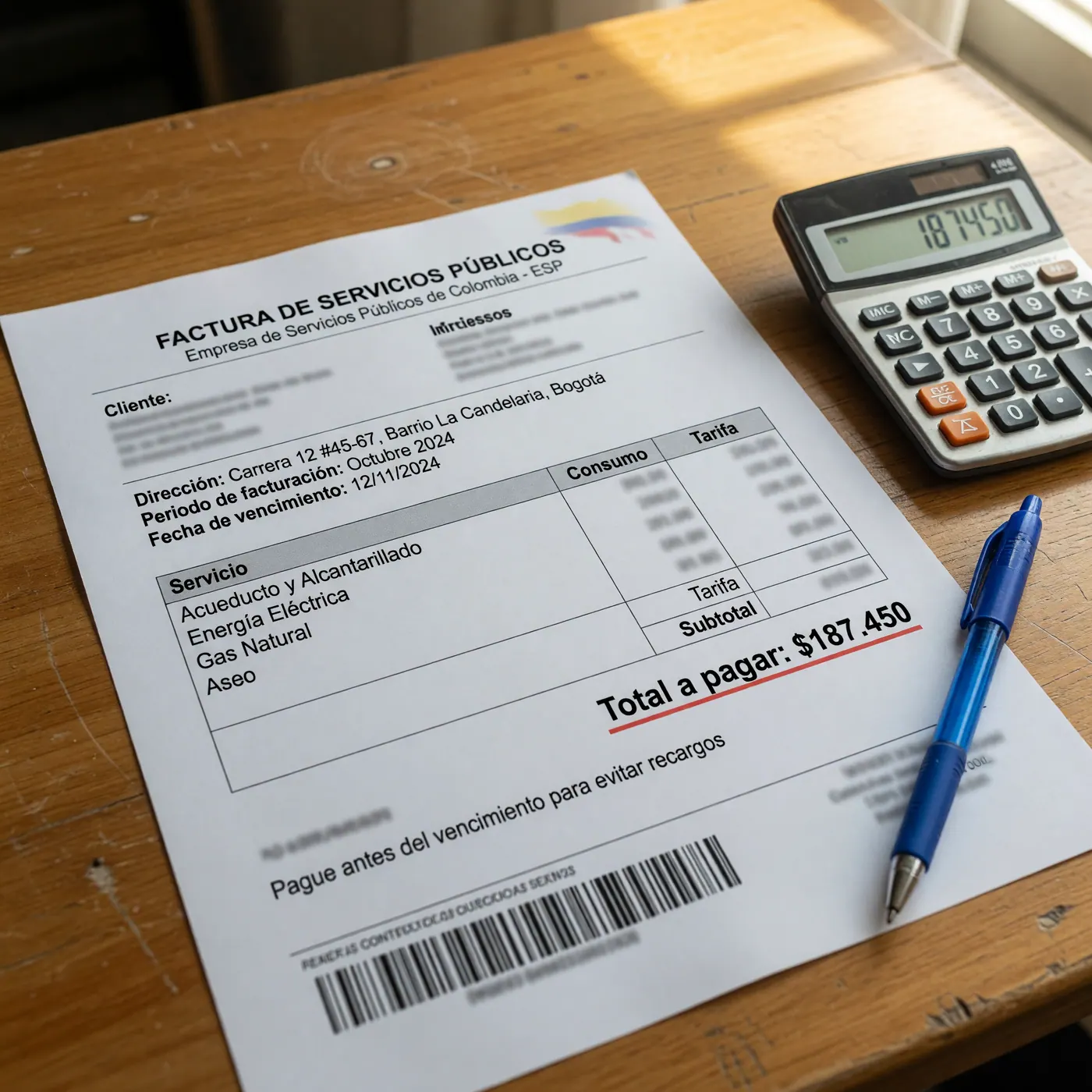
The maximum caps for subsidies and surcharges are set by the regulatory framework of the Energy and Gas Regulatory Commission (CREG) and the Potable Water and Basic Sanitation Regulatory Commission (CRA), supervised by the Superintendence of Public Household Services (Superservicios).
| Socioeconomic Stratum | Maximum Electricity and Gas Subsidy | Maximum Water and Sewerage Subsidy | Solidarity Contribution (Surcharge) |
|---|---|---|---|
| Stratum 1 | CREG: up to 60% of the subsistence CU | CRA: legal cap of 70% of basic coverage | Exempt from surcharge |
| Stratum 2 | CREG: up to 50% of the subsistence CU | CRA: legal cap of 40% of basic coverage | No FSRI surcharge |
| Stratum 3 | CREG: up to 15% of the subsistence CU | CRA: legal cap of 15% of basic coverage | 0% contribution |
| Stratum 4 | Energy at full unit cost | Aqueduct without CRA discount | No surcharge either |
| Stratum 5 | No CREG discount | No CRA discount | +20% solidarity contribution |
| Stratum 6 | No energy discount | No aqueduct discount | 20% FSRI surcharge |
| Commercial and Industrial | No energy discount | No water discount | 20% surcharge on consumption |
Important note: In the case of water and sewerage, the exact subsidy percentages are approved locally by Municipal Councils within the legal caps of Law 1450 of 2011 (art. 125). Therefore, one city may apply 50% in stratum 1 while another reaches the 70% limit.
Key Concept: Basic Consumption vs. Luxury Consumption
The most common mistake when calculating the cost of utilities is thinking that the discount for strata 1, 2, and 3 applies to the household's entire monthly consumption. The law stipulates that subsidies only cover subsistence consumption. Every kWh of energy or cubic meter (m³) of water consumed above that limit is billed at 100% of the standard Unit Cost (CU) without any discount.
Subsistence Energy Consumption Limits
The CREG establishes electricity limits based on the municipality's altitude above sea level:
- Cities over 1,000 meters above sea level (cold/temperate climate like Bogotá or Medellín): The subsistence cap is 130 kWh/month.
- Warm areas (below 1,000 meters above sea level): The subsistence cap rises to 173 kWh/month due to the necessary use of ventilation or air conditioning.
Basic Water Consumption Limits
For the water and sewerage service, the CRA establishes average reference limits of 16 m³ per month per user in cold/temperate climate cities and up to 18 m³ per month in warm climate municipalities.
Step-by-Step Formula to Calculate Your Bill
To project your monthly bill or verify if your provider's charge is correct, follow these steps:
1. Find your provider's Unit Cost (CU)
On the body of the bill you will find the value of the Unit Cost (CU) per kWh or m³. This value includes the costs of generation, transmission, distribution, and commercialization of the service.
2. Apply the formula according to your stratum
Let's assume a hypothetical energy Unit Cost of $800 per kWh in a cold climate city (subsistence cap = 130 kWh) and a total consumption of 180 kWh in the month:
- Subsidized consumption (first 130 kWh): 130 kWh × $800 = $104,000. If you are in Stratum 2 (50% subsidy), you pay $52,000 for this segment.
- Full consumption (the remaining 50 kWh): 50 kWh × $800 = $40,000 (no discount).
- Basic consumption value + surplus: $52,000 + $40,000 = $92,000.
- Fixed charges and lighting: Add the authorized fixed charges and municipal taxes to obtain the final settlement.
On the other hand, if that same consumption of 180 kWh occurs in Estrato 5 or 6, the calculation would be: 180 kWh × $800 = $144,000 + 20% solidarity contribution ($28,800) = $172,800 in consumption, plus fixed charges.
If you manage properties or have a formal lease contract, it is recommended to manage electronic invoicing for rentals to break down the administration payment and fixed fees transparently.
Practical Tips for Tenants and Landlords
When choosing an area to live or invest in real estate in Colombia, keep the following operational recommendations in mind:
- Check the previous tenant's consumption: Ask the owner for the bills from the last three months. In estratos 1, 2, and 3, a large household that significantly exceeds the subsistence limit will pay rates very similar to those in estrato 4.
- Calculate the total cost of the home: A rent in estrato 5 or 6 may seem competitive, but the 20% surcharge on energy, water, and gas will increase the monthly maintenance cost.
- Consider total transaction costs: If you are planning to buy instead of rent, check the guide on expenses when buying used housing to structure your initial budget.
According to active listings on Colombia Move (August 2026), there are 41 apartment ads and 14 house ads; it is advisable to ask for the recent bills for those properties because the property's estrato carries as much weight as the rent.
Frequently Asked Questions
❓ Which estrato pays the real utility rate without subsidies or contributions?
Estrato 4 pays 100% of the Unit Cost. It does not receive a subsidy or pay the 20% contribution, according to CREG and CRA regulations in effect in 2026.
❓ Up to what percentage is electricity subsidized in estrato 1 and 2?
Up to 60% in estrato 1 and 50% in estrato 2. The cap applies only to subsistence consumption, according to CREG in 2026.
❓ What happens if I consume more energy than the subsistence limit in estrato 1, 2, or 3?
The surplus is charged at 100% of the Unit Cost. The 130 kWh (cold climate) or 173 kWh (warm climate) are the CREG caps in effect in 2026.
❓ Why do estrato 5 and 6 pay 20% more on their bill?
They pay an extra 20% solidarity contribution. This is set by Law 142 of 1994 to finance subsidies for estratos 1 to 3 via the FSRI, in effect in 2026.
❓ Can a property's estrato be changed or appealed to the mayor's office?
Yes, the owner or resident can file an appeal with the municipal Planning office. The procedure reviews materials and surroundings, not personal income, according to regulations in effect in 2026.
❓ Where can I view or verify housing offers by area and estrato in Colombia?
Compare residential properties by city and estrato on Colombia Move. Check recent bills for the property; the August 2026 listing helps estimate the maintenance cost.



Comments
Loading comments...
Checking sign-in status...