
How to Rent a Country Recreation Property (Finca de Recreo) in Colombia: Contracts, Deposits and Security (Guide for Owners)
Learn how to protect your recreation property when renting it out. Find out why deposits are indeed legal, how to avoid RNT penalties, and what clauses to include in your contract.
IDIOMA DEL ARTÍCULO
Showing original language
Quick answer: Renting out a country property for more than 30 days is governed by the Civil Code, which makes cash security deposits 100% legal. However, if you rent for fewer than 30 days, the law classifies it as a "lodging contract," which requires you to have an active National Tourism Registry (RNT) and report your guests to the TRA to avoid penalties.
The country property market in Colombia is also a minefield of legal misinformation. Many owners assume that renting out their country house on weekends works the same as renting an apartment in the city. I have personally seen owners lose money by using paperwork contracts that don't protect them or by ignoring the tourism regulations in force in 2026.
If you want to monetize your property without headaches, you need to protect your operation. According to active listing data on Colombia Move (July 2026), there are currently 18 farms on offer on our platform: a concrete sample of the direct supply available today.
1. The Legal Framework: Law 820 or the Civil Code?
The most common and dangerous mistake you can make is trying to regulate the rental of your rural property under Law 820 of 2003. Honestly, skip that law unless your property is strictly urban housing. The scope of Law 820 excludes rural and recreational properties.
If you rent your farm for a period longer than 30 days, the relationship is governed by the Colombian Civil Code (Articles 1973 to 2035). This gives you enormous contractual freedom. Just as when you rent a commercial premises in Colombia, the rules of the game change: you can freely negotiate annual increases, grounds for termination, and guarantees.
2. The 30-Day Threshold and the National Tourism Registry (RNT)
The red line in Colombia is 30 days. If you rent your farm for weekends, long weekends, or short periods, the law (Law 300 of 1996 and Law 2068 of 2020) no longer considers it a lease, but a tourist lodging contract.
To operate legally under this arrangement, having the National Tourism Registry (RNT) is absolutely mandatory. Obtaining it is a free procedure through the Confecámaras portal, but the consequences of not having it are severe. Fines for advertising or renting a farm for tourism purposes without a valid RNT range from 5 to 50 legal monthly minimum wages (SMMLV). With the 2026 minimum wage of COP 1,750,905, we are talking about sanctions that can wipe out a whole year's profitability.
3. Security Deposits: Are They Legal on Country Properties?
Yes, they are 100% legal and valid! There is a huge myth that in Colombia you cannot ask for a cash deposit. This is true for apartment tenants in the city, a topic we cover in depth in our guide on security deposits and guarantees. However, since country properties operate under the Civil Code (or as tourist lodging), the prohibition in Law 820 does not apply.
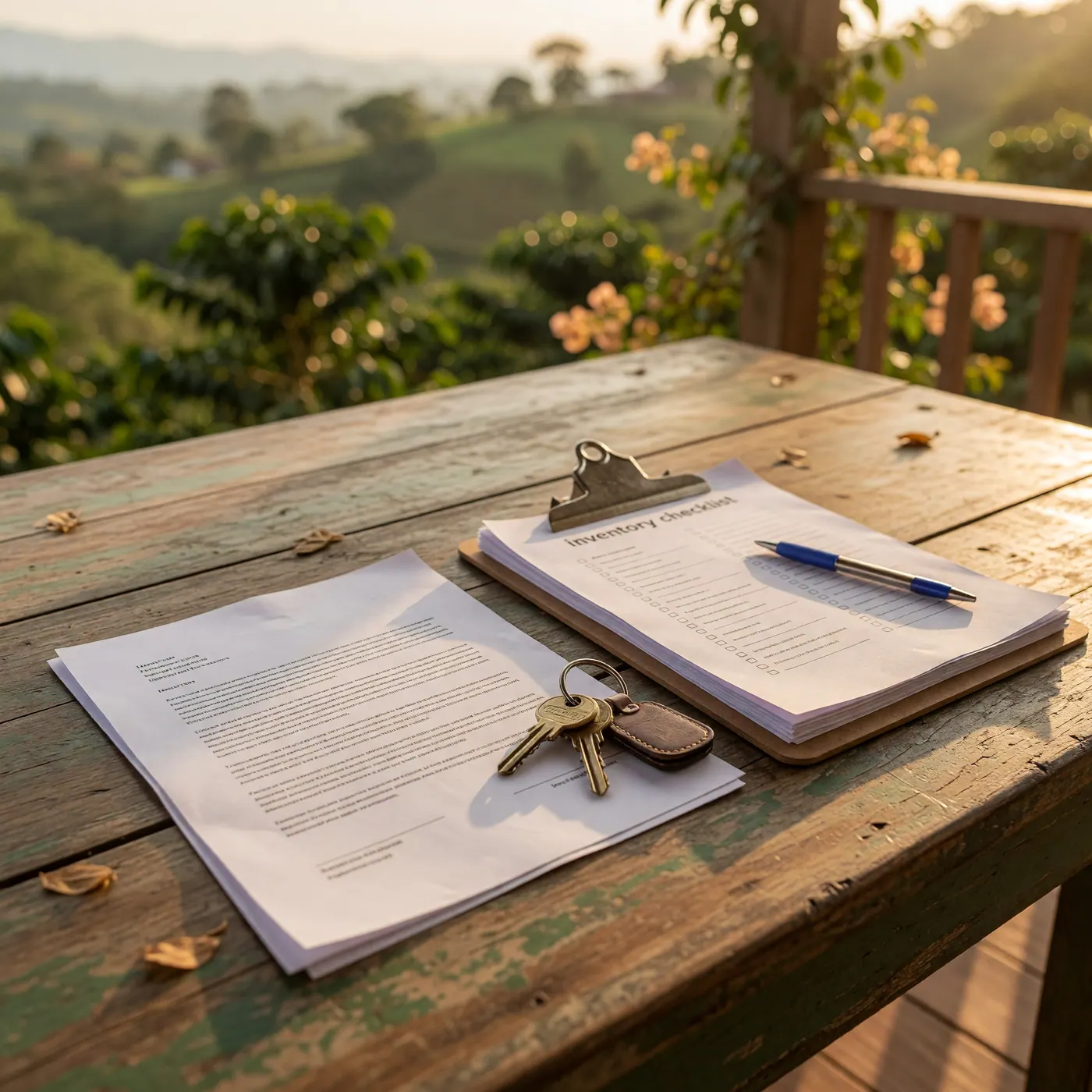
Charging a security deposit is a realistic way to protect yourself against damage to the pool, broken furniture, or runaway utility bills. Put in writing the amount, the return conditions, and the damages that could be deducted, always backed by the inventory.
4. Key Clauses and the Contract Inventory
A good lodging or rural rental contract saves you from endless disputes. Don't rely on good faith; put everything in writing. These are the clauses I consider non-negotiable:
- Guest limit: Define exactly how many people can sleep over and how many can visit for the day (day pass). Overcrowding can overload rural septic systems.
- Pool and common area use: Make the rules clear on access, supervision of minors, hours, and incident management; review with a professional the coverage and responsibilities applicable to your operation.
- Noise and pet rules: Set hours for music and clear conditions for accepting animals.
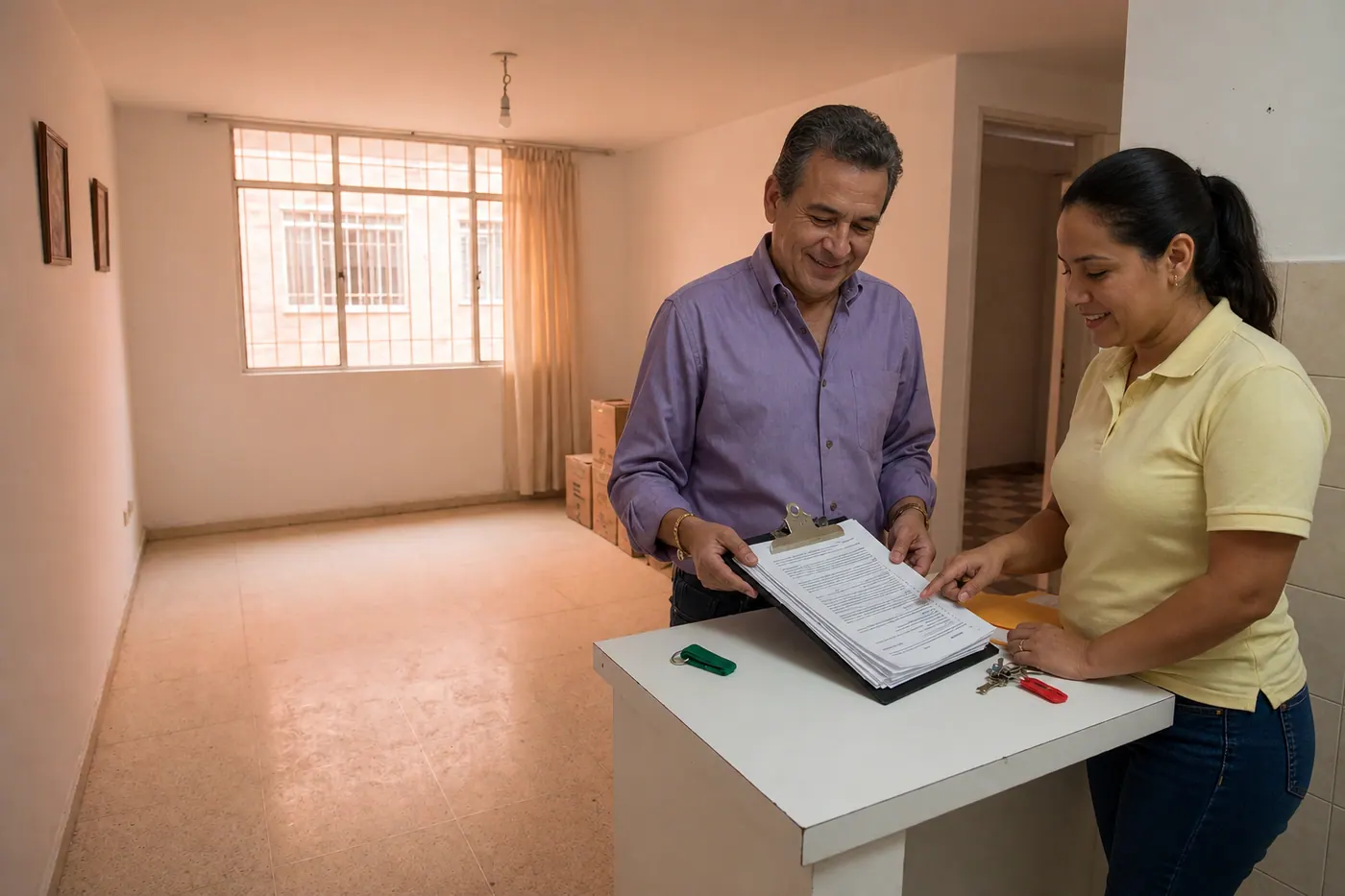
Finally, the inventory. Never hand over the keys without a signed document detailing the condition of the house. If you have doubts about how to document this, review how to handle the inventory and normal wear and tear in furnished properties. Take photos on the same day of handover.
5. Mandatory Reporting: Accommodation Registration Card
If you operate short-stay rentals, you must register all guests—Colombians and foreigners alike—on the Accommodation Registration Card (TRA) of the Ministry of Commerce, Industry and Tourism.
Filling out the TRA records the lodging contract and is part of the obligations of the tourism service provider. Keep the procedure integrated with the handover of keys so that no income goes unregistered.
6. Horizontal Property and Digital Platforms
If your farm is inside a country condominium or closed subdivision under horizontal property regime, you face an additional obstacle. You cannot simply post the property online and start receiving tourists.
For tourist rental to be legal, the Horizontal Property Regulation must expressly authorize it. If the internal rules prohibit it, having an active RNT does not remove that restriction.
Frequently asked questions
❓ Is it legal to charge a security deposit to rent a country property in Colombia?
Yes, it is completely legal. Since they are rural properties or intended for tourist rental, they are governed by the Civil Code, which allows agreeing on guarantee deposits, unlike urban housing regulated by Law 820.
❓ What happens if I rent my farm by the day without the National Tourism Registry (RNT)?
You are operating illegally. According to the tourism regulations in force as consulted in July 2026, you are exposed to fines of 5 to 50 SMMLV, in addition to the sealing of the property.
❓ What is the difference between a rural lease and a lodging contract?
The main difference lies in the time period. If you rent for fewer than 30 days, it is a tourist lodging contract that requires an RNT. If it exceeds 30 days, it is a rural property lease contract governed by the Civil Code.
❓ Can I rent my farm for events or parties if it is in a country condominium?
It depends strictly on the horizontal property regulation of your condominium. If the internal rules prohibit commercial or tourist activity, you will not be able to do so, even if you have an active RNT.
❓ How should I manage the farm's inventory when handing it over to the tenant?
You should create a detailed, signed inventory, accompanied by dated photographs of the furniture, appliances, and pool equipment. This document backs up any deduction from the deposit if damages occur.
Comments
Loading comments...
Checking sign-in status...