
Buying a Used Electric Scooter or E-Bike in Colombia: Legal Rules & Battery Checks
A practical buyer's guide to Colombia's micromobility rules, battery inspection, ownership checks, and safer second-hand handoffs.
IDIOMA DEL ARTÍCULO
Showing original language
Quick Answer: Qualifying low-speed electric scooters and e-bikes in Colombia fall under Ley 2486 de 2025 as light personal urban mobility vehicles. They do not require transit registration (matrícula), compulsory traffic insurance (SOAT), or a driver's license when they fit that statutory category rather than an e-moto or ciclomotor. The national speed limits are 25 km/h on dedicated bike infrastructure and up to 40 km/h on permitted roads, subject to local restrictions. When buying second-hand, your main risks are a depleted lithium battery and unclear ownership. Inspect the battery casing, verify the compatible charger, test performance under load, match the seller's details with available purchase proof, and sign a written bill of sale before handing over money.
Colombia's Legal Framework for E-Scooters and E-Bikes (Ley 2486)
Urban traffic in cities like Bogotá and Medellín makes light electric mobility an attractive choice for daily commutes. However, before purchasing a second-hand electric personal vehicle, you must understand where your vehicle sits under Colombian national law.
Enacted in July 2025, Ley 2486 regulates vehículos eléctricos livianos de movilidad personal urbana (light personal urban electric mobility vehicles). Qualifying devices have distinct rules from gas-powered or heavier electric motorcycles and ciclomotores:
- No SOAT or matrícula: A device that qualifies under the law does not require transit registration or SOAT.
- No driver's license: Operating a qualifying light personal mobility vehicle does not require a driver's license.
- Speed caps: The national cap is 25 km/h in cycle infrastructure and 40 km/h on permitted roads, subject to lower local limits and signage.
- Sidewalks: Do not plan to ride on pedestrian sidewalks; use cycle infrastructure or permitted roads under current local rules.
Regulatory note: As of August 18, 2026, MinTransporte's detailed technical regulation was still a public-comment draft. Proposed items included acoustic signals, speed limiters, braking standards, and technical identification plates. They should not be treated as final requirements without checking for a later resolution.
Crucial Battery and Electrical Health Inspection
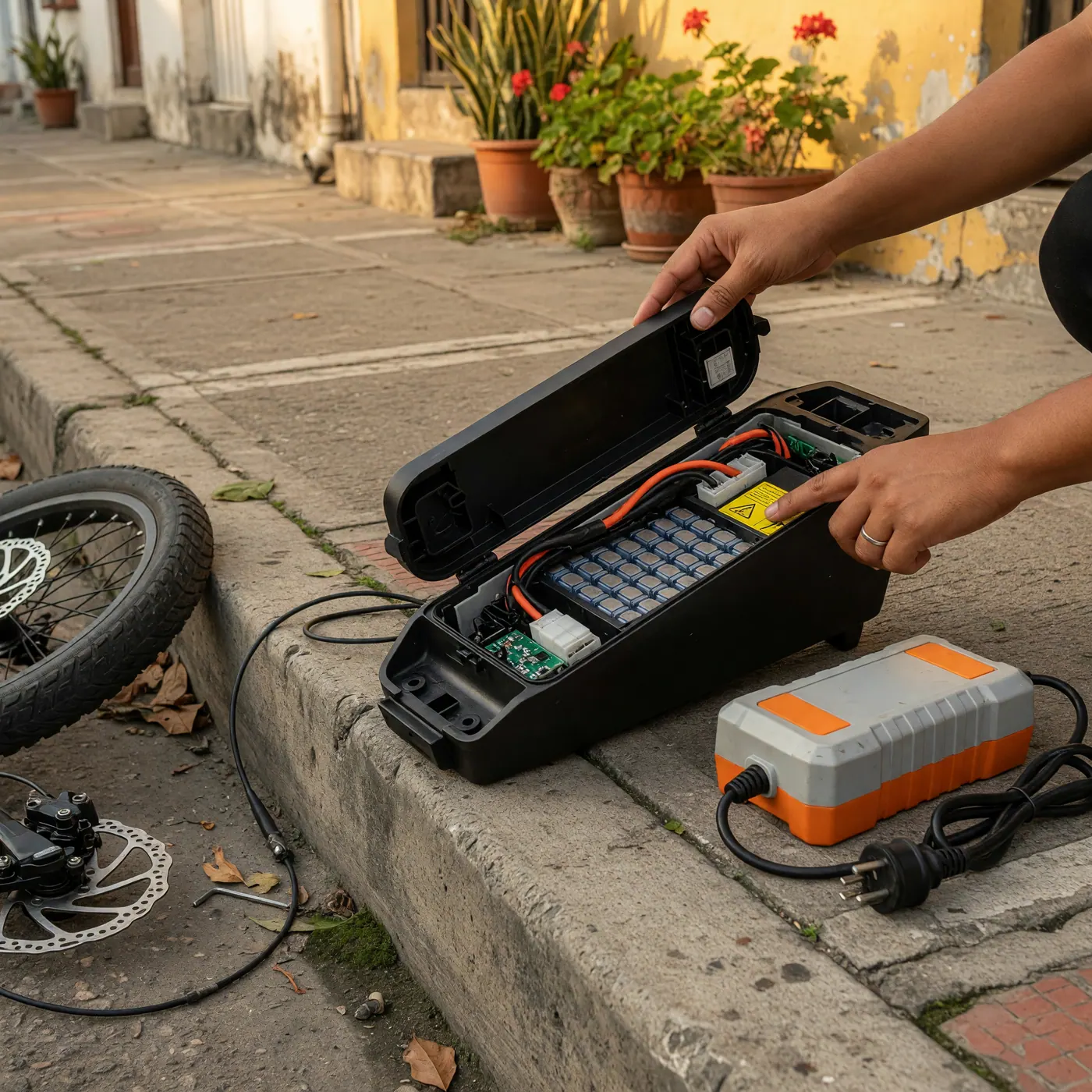
The lithium-ion battery pack is the component most likely to turn a cheap purchase into an expensive mistake. Battery health cannot be judged purely by cosmetic condition, so follow this practical inspection protocol:
| Component | What to Check | Red Flag / Walk Away |
|---|---|---|
| Battery Pack Casing | Inspect for cracks, swelling, dents, water marks, or broken factory seals. | Any bulging, heat warping, corrosion, or unsealed custom wiring. |
| Charger & Ports | Confirm the original or documented compatible charger is present and port pins are clean. | Unknown multi-voltage adapters, sparking, damaged cables, or excessive heat. |
| Load Test | Start with a full indicated charge and watch the display during a short incline test. | Abrupt display drops, power cut-outs, error codes, or inconsistent assistance. |
| Temperature | Check the enclosure immediately after the test ride. | Abnormal heat, a chemical odor, swelling, or smoke. |
UL Solutions emphasizes that certification of a battery, charger, or motor alone is not certification of the complete vehicle. Prefer original or documented compatible components, and avoid counterfeit, damaged, swollen, or modified packs. The same brakes, tires, frame, and test-ride discipline in our used bicycle inspection guide still applies.
Verifying Ownership and Preventing Stolen Property Risks
Buying second-hand goods on open marketplaces carries a stolen-property risk. Bogotá's security authority specifically warns that suspicious informal-market purchases can create receptación complications, so an unusually cheap undocumented unit deserves caution rather than excitement.
To protect yourself and document a safe transaction, insist on these ownership checks:
- Purchase proof: Ask for the original invoice or other purchase proof and compare any recorded serial or frame number.
- Serial number audit: Check the stamped number on the scooter deck or e-bike frame. Walk away if it has been filed down, scratched out, or concealed.
- Seller identification: See the seller's original ID and confirm the name against available documentation; do not keep unnecessary copies.
- Written bill of sale: Record both parties' names and ID numbers, serial number, vehicle description, agreed amount, condition, and date.
Cars require formal RUNT and title checks, as explained in our used-car paperwork guide. Qualifying micromobility is different, which makes purchase proof, serials, and a clear receipt especially useful. Battery documentation and seller checks also overlap with our guide to buying used electronics safely.
City-Specific Etiquette: Bogotá vs. Medellín
While Ley 2486 establishes national rules, local authorities and signage still matter. Bogotá's mobility FAQ, updated July 14, 2026, cites a 40 km/h ceiling for bicycles and electric or gas scooters, alongside lower limits that can apply by zone. Yield at crossings and never assume every corridor permits the same behavior.
Medellín's Secretaría de Movilidad publishes local recommendations for scooters, patinetas, and electric monopatines. Check its current page before riding, especially for protective equipment and route restrictions. On a test ride, use terrain similar to your real commute; hills expose weak batteries, brakes, and thermal cut-outs faster than a flat parking-lot lap.
According to Colombia Move's marketplace supply signals generated August 18, 2026, the broader vehicle section had 14 active listings and 1,023 views. That is not an e-bike-only count, but it is a useful reminder to compare documentation and condition across a still-small pool rather than rushing the first seller.
Buy, Negotiate, or Walk Away?
| Decision | What the evidence looks like |
|---|---|
| Buy | Clear serial and purchase trail, compatible charger, undamaged battery, stable test ride, working brakes and lights, and a seller willing to sign a receipt. |
| Negotiate | Ownership is clear and the battery is physically sound, but ordinary wear, tires, brakes, or missing accessories need attention. |
| Walk away | Missing or altered serial, unclear ownership, swelling, water damage, abnormal heat, improvised wiring, no compatible charger, pressure tactics, or refusal of a test ride. |
Honestly, I would skip any deal that depends on the seller saying “the battery is fine” without letting you charge and test it. A cosmetic scratch is negotiable; a questionable lithium pack or erased serial is not.
Frequently Asked Questions
❓ Do I need SOAT, matrícula, or a license for an electric scooter in Colombia?
Qualifying light, low-speed personal mobility vehicles are exempt under Ley 2486 de 2025. E-motos, ciclomotores, and devices outside that legal category may require different paperwork, so confirm the model's classification before buying.
❓ What speed limit applies to e-scooters and e-bikes in Colombia?
The national caps are 25 km/h in cycle infrastructure and 40 km/h on permitted roads under Ley 2486. Local restrictions and lower posted limits still apply; this legal summary was checked on August 18, 2026.
❓ Can I ride an electric scooter on sidewalks in Bogotá or Medellín?
No—do not plan to ride on sidewalks. Use cycle infrastructure or permitted roads where current local rules and signage allow, and check the relevant city mobility authority before choosing a route.
❓ How do I check a used e-bike battery before buying?
Inspect the casing, ports, charger compatibility, documentation, charge behavior, and performance under load. Stop the test if you notice swelling, water damage, cut-outs, abnormal heat, chemical odor, or improvised wiring.
❓ Is a “UL-certified battery” enough?
No. UL Solutions says certification of a battery, charger, or motor alone is not the same as certification of the complete e-bike or e-scooter. Check what the mark actually covers and whether all components are compatible.
❓ What documents should I ask the seller for?
Ask for purchase proof, original ID for an in-person name check, serial or frame number, charger, manuals, available app screenshots, and a written sale receipt. Avoid retaining more personal data than the transaction requires.
❓ When should I walk away from a used scooter or e-bike?
Walk away from a missing or altered serial, unclear ownership, damaged or swollen battery, incompatible charger, pressure tactics, or refusal of a test ride. An unusually cheap undocumented unit is not worth the legal or safety risk.




Comments
Loading comments...
Checking sign-in status...