
International Schools in Colombia: What Expat Families Need to Know
From IB schools in Medellín to bilingual options in Bogotá, here's what expat families actually need to know — tuition costs, application timelines, and how to choose the right fit.
IDIOMA DEL ARTÍCULO
Showing original language
When we moved our family from Austin to El Poblado, I thought I'd done my homework. Visas? Checked. Apartment? Found. Container? Booked. Schools? I told myself I'd figure that out once we arrived. That was the mistake.
The school year in Colombia starts in February. We landed in early January, and Columbus School — our first choice — had exactly one open seat at my son's grade level, due to a family that pulled out at the last minute. We got it. But if I'd arrived two weeks later, we'd have been scrambling for something far less suitable and waiting for the following year's intake. If you want to see real-world options right now, you can browse apartments and houses on Colombia Move — posting is completely free.
Colombia's international and bilingual schools are genuinely good — better than many families expect, and dramatically cheaper than equivalent options in Europe or North America. But the good ones fill up fast, and the process requires planning from your home country, not after you land.
Quick answer: schools for expat families in Colombia
- 3 main types: international (IB/US/UK curriculum), premium bilingual Colombian, local private
- International tuition: 30–80M COP/year (~$7,500–20,000 USD) — plus enrollment and transport fees
- Premium bilingual: 8–25M COP/year ($2,000–6,250 USD) — strong Spanish immersion
- Best cities for options: Bogotá (widest choice), Medellín (expat-friendly), Cali (solid)
- Apply early: Top schools fill 6–12 months ahead — don't leave this until you arrive
The Three School Tiers — and Which One Is Right for Your Family
Not all 'private schools' in Colombia are the same. A neighborhood colegio privado and a fully accredited international school are completely different animals, and the gap between them matters a lot depending on your kids' ages and your plans.
International schools follow a foreign curriculum — typically American (with AP courses), International Baccalaureate, British, French, or German. They're built for families who may not stay permanently and need qualifications that transfer globally. Teaching language is usually English (or French/German), with Spanish as a compulsory second language.
Premium bilingual schools are Colombian private schools with intense English instruction alongside Spanish. The curriculum follows the Colombian Ministry of Education framework, but with far stronger English immersion than a standard school. Popular with Colombian professional families and with expat parents who want genuine cultural integration.
Local private schools (colegios privados) are the broad middle tier — ranging from solid schools in good neighborhoods to underfunded ones elsewhere. In Bogotá or Medellín, a respectable mid-market colegio runs 3–10M COP per year. Instruction is entirely in Spanish. If your kids arrive without Spanish, it's a steep first semester — but younger children adapt remarkably fast.
My honest take: for teenagers arriving without Spanish, English-medium international schools are almost always the better starting point. For kids under 10, a bilingual Colombian colegio can work beautifully and costs a fraction of the price.
📚 Keep Reading
Planning the full family move to Colombia? Our guide to childcare, nannies, and family life covers the practical details alongside schooling.
Raising Kids in Colombia: Childcare, Schools & Family Life →Schools in Bogotá — The Most Complete Market
Bogotá has by far the widest range of international school options in Colombia. If school access is a priority in your city decision, Bogotá wins on choice alone.
International schools in Bogotá
Colegio Nueva Granada is the flagship US-curriculum school — founded in 1938 originally for US Embassy families and still considered the gold standard for American expats. Located in northern Bogotá near Usaquén. Tuition runs roughly 50–80M COP per year ($12,500–20,000 USD). Apply at minimum a year in advance; many families apply before they've confirmed their move date.
Liceo Francés Louis Pasteur follows the French curriculum with IB authorization — bilingual French-Spanish. Popular with European families and with French-speaking Colombians. The Deutsche Schule Bogotá serves the German-speaking community with a curriculum taught in German. The English School offers the British curriculum K-12 in northern Bogotá.
Premium bilingual schools in Bogotá
Colegio Los Nogales is one of the most prestigious bilingual Colombian schools, IB-authorized. Tuition sits around 25–40M COP per year. If you're living in Chapinero or Usaquén, both neighborhoods have strong bilingual colegio options within reasonable commuting distance.
📖 Keep Reading
Deciding between Bogotá and Medellín for your family? Both have solid international school options — here's what expat life actually looks like in each.
Living in Bogotá: Complete Expat Guide →Schools in Medellín — The Expat Family Favorite
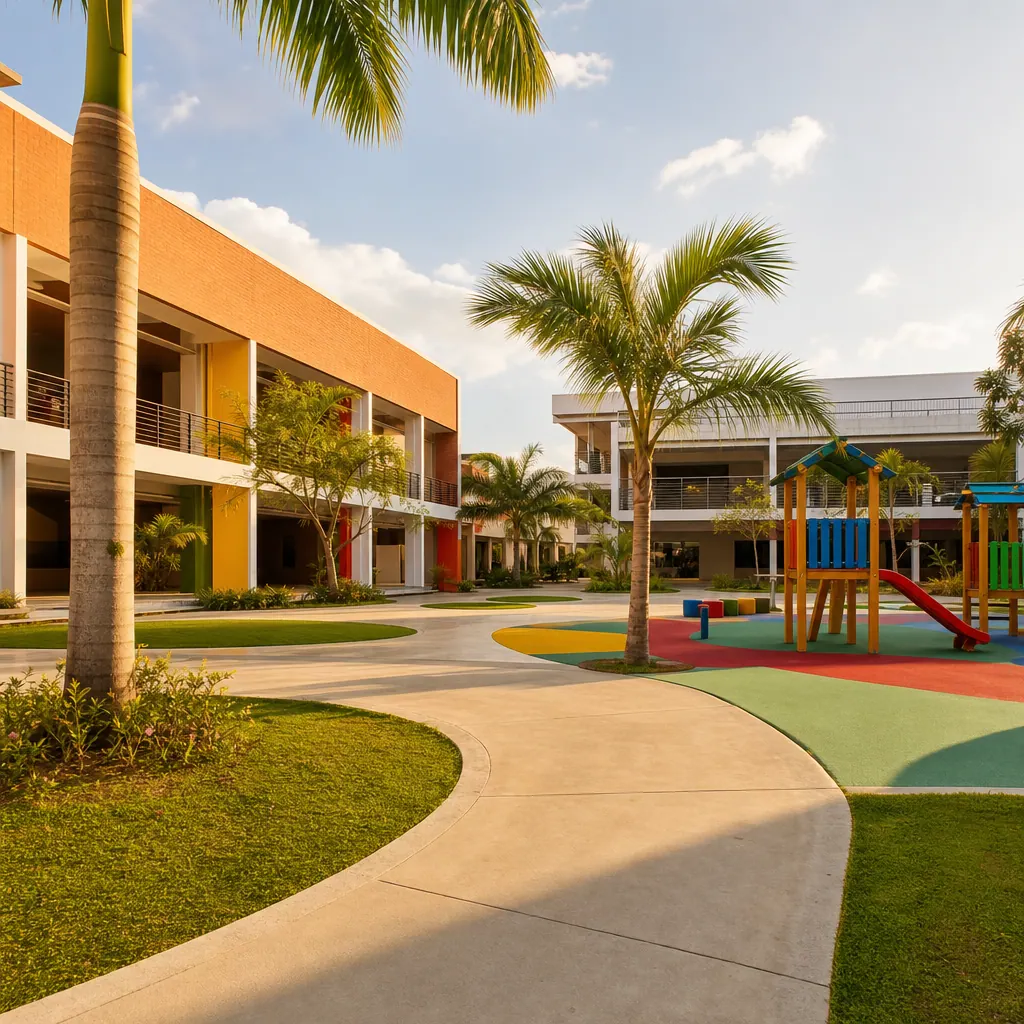
Medellín consistently ranks as the most livable city for expat families in Colombia, and the international school ecosystem reflects that. The concentration of expats in El Poblado and Envigado has built real demand for English-medium education.
International schools in Medellín
Columbus School is the top US-curriculum school in the city. K-12, located in the eastern hills above El Poblado. Tuition runs 40–70M COP per year ($10,000–17,500 USD). Strong sports programs, active parent networks, and a mix of Colombian and international families. The waiting list is real — don't count on a spot if you contact them in December for a February start.
Colegio Alemán de Medellín serves the German-speaking community with a bilingual German-Spanish curriculum. Less expensive than Columbus and well-regarded within its community. For families coming from Germany, Austria, or Switzerland, it's typically the first call.
Bilingual schools in Medellín
Colegio Campestre La Fontaine is a well-regarded bilingual school popular with both Colombian and expat families in Envigado. San Jorge de Inglaterra and Palermo Colegio both have solid bilingual programs at more accessible price points than Columbus.
One practical note: Columbus School runs bus routes (rutas) across most of Medellín, including Laureles and Belén. Don't assume your neighborhood locks you out — confirm transport options directly with admissions.
Cali, Cartagena, and Smaller Cities
Cali's international school options are solid, though the expat community is smaller. Colegio Bolívar has served the international community for decades with a US curriculum — tuition comparable to Bogotá's major schools. Colegio Bennett offers strong bilingual programming. In Cartagena, Colegio Jorge Washington covers the coastal expat community.
The honest reality: if access to a good English-medium school is non-negotiable, Bogotá and Medellín give you the most options. Pereira, Manizales, and Bucaramanga have excellent bilingual colegios but no full international school in the same sense. Worth factoring into your city decision.
What Schooling Actually Costs — Full Budget Breakdown
The figures below are approximate 2025–2026 numbers. Verify directly with each school before committing — annual increases of 8–12% are standard in line with Colombian inflation adjustments.
| School type | Annual tuition (COP) | Annual tuition (USD) | Notes |
|---|---|---|---|
| International (US/IB/UK) | 30M–80M COP | $7,500–$20,000 | Add 2–5M COP enrollment fee |
| Premium bilingual Colombian | 8M–25M COP | $2,000–$6,250 | Often includes more activities |
| Mid-market private | 3M–10M COP | $750–$2,500 | Strong Spanish immersion |
| Public (colegio público) | Free | Free | All instruction in Spanish; no ESL support |
Beyond annual tuition, budget for:
- Registration/enrollment fee: 2–5M COP, usually paid once on first enrollment
- Uniforms: 400K–1M COP — most schools have designated suppliers
- Bus route (ruta): 800K–2M COP/year depending on distance and school
- Lunch: 100K–300K COP/month if not included in tuition
- Extracurriculars: 200K–600K COP/month for sports, music, or arts programs
One thing that surprises families: many Colombian private schools offer sibling discounts of 10–20%. It's standard practice and rarely advertised — ask directly during the admissions conversation, not after you've signed the contract.
🩺 Health coverage while you settle in
Before you're enrolled in EPS, your family needs a backup plan. SafetyWing covers children too — flexible monthly plans that work while you're sorting the permanent solution.
The Application Timeline — Work Backwards From Your Move Date
Most Colombian schools, including international ones, run a February–November school year. Applications for the February intake open in August–October of the prior year. Some schools also accept a January intake for mid-year transfers.
A realistic timeline to work backwards from: 12–18 months before your move, contact target schools, request info packs, and do virtual tours. Find out their intake calendars. 9–12 months before, submit formal applications and gather documents: apostilled birth certificates, prior school records with certified Spanish translations, passports, and visa documentation. Entrance assessments are common at primary and secondary levels. 6 months before, confirm enrollment and pay the deposit. Arrange bus transport. On arrival, complete enrollment with your cédula de extranjería once issued. See our guide on scheduling your cédula extranjería appointment for timing.
The most common mistake: arriving in February thinking you'll sort school in March. The good schools are full. Families often end up in a second-choice school for the first year while waiting for a spot at their preferred option. It's fixable — but avoidable.
How to Choose: The Factors That Actually Matter
Your child's age and current Spanish level matter more than anything else. Kids under 8 are language sponges — a motivated 7-year-old in a good bilingual colegio will be chatting with Colombian classmates within four to six months. A 15-year-old arriving without Spanish faces a genuinely harder academic and social adjustment. For older teenagers, English-medium international schools are almost always the safer starting point.
How long you're staying shapes the curriculum question. Here for two to three years and moving on? An IB school keeps university and transfer options open globally. Staying five-plus years? Bilingual Colombian schools produce better linguistic and cultural integration — your kids will actually become fluent, bicultural people.
Commute matters more than families expect. El Poblado in Medellín and Usaquén in Bogotá have the highest concentration of international schools. Factor transport time into your neighborhood decision, especially in Bogotá traffic. A long daily ruta is a grind for kids.
Curriculum continuity is critical for teenagers. If your kids are mid-stream in US AP or British A-Level, switching curriculum mid-secondary disrupts everything. International schools with Cognia accreditation (US system) or Cambridge accreditation (UK) provide the cleanest continuity for families moving between countries.
Frequently Asked Questions
❓ Can my child attend a Colombian public school?
Yes — Colombian public schools are free and open to children on resident visas. The challenge is that all instruction is in Spanish with no ESL support. Younger kids adapt fast; it's genuinely impressive how quickly a 6-year-old picks it up. For middle and high schoolers arriving without Spanish, the adjustment is much harder. Some families choose it intentionally as full immersion; others use it as a bridge while waiting for an international school spot to open.
❓ Do Colombian international schools accept mid-year applications?
Some do, particularly at the primary level. Contact admissions directly rather than assuming no — many schools maintain informal waiting lists and have occasional openings mid-year when families relocate. Columbus in Medellín and Colegio Nueva Granada in Bogotá both have formal waiting list processes worth joining even before your move is fully confirmed.
❓ What documents do I need for school enrollment?
Typically: apostilled birth certificate with a certified Spanish translation, prior school records (translated), current passport, visa documentation and/or cédula de extranjería, and vaccination records. Some secondary schools also request a letter from the prior institution. Requirements vary — confirm the complete list during your first admissions contact so you have time to get apostilles and translations done before you arrive.
❓ Are there homeschooling options in Colombia?
Colombia doesn't formally recognize homeschooling within its national education framework — the Ministry of Education expects children enrolled in accredited institutions. Some expat families use accredited online US or UK programs while living here. It's a legal gray area worth discussing with an immigration attorney, particularly around how it interacts with visa renewals.
❓ How does the Colombian school calendar affect family travel?
The school year runs roughly February to November, with a June–July midterm break and a longer vacation from November through January. This aligns well for European families. For North Americans, you won't sync with US summer schedules — but most expat families adapt quickly and actually prefer the quieter December flights when Colombian families are taking their own holidays.
💬 Questions from expat parents in Colombia
Moving to Colombia with kids and not sure which city or school makes sense for your situation? The Colombia Move community has expat parents in Bogotá, Medellín, and Cali who've navigated exactly this.
Ask the community at colombiamove.com/comunidad →

Comments
Loading comments...
Checking sign-in status...