
Withholding tax on property sales in Colombia: a guide for sellers
Find out how withholding tax (retención en la fuente) is calculated and paid before you sign the deed for your property. A practical, up-to-date guide for Colombian sellers.
IDIOMA DEL ARTÍCULO
Showing original language
Quick answer: If you are a private individual selling your house, apartment or lot (that qualifies as a fixed asset) in Colombia, the withholding tax (retención en la fuente) is 1% of the total sale value. This payment is made directly at the notary's office before signing the public deed.
Selling a property is exciting. Agreeing on the price, packing boxes and planning the move is the visible part of the process, but the real challenge appears when you sit down at the notary's office and the notary presents you with the tax bill. Many sellers reach this point without having budgeted for the tax hit, which ends in frustration or, even worse, deals falling through at the last minute. If you want to see real options right now, you can view farms and lots available in Colombia Move — publishing is completely free.
Based on active listings on Colombia Move (July 2026), the housing section has more than 20,100 views and almost 100 active properties looking for an owner. Demand exceeds supply and the market moves fast, but before listing your home and receiving offers, you need to be perfectly clear about your tax cost.
The golden rule: the 1% at the notary's office
For the typical case in Colombia—you, as a private individual, selling your apartment to another private individual—the DIAN applies Article 398 of the Estatuto Tributario. The law requires a 1% withholding tax on the transfer value (the sale price stated in the deed).
This 1% is not an invention of the notary, but an advance collection of income tax. The notary acts as a withholding agent of the State: they collect this money from what the buyer pays you and transfer it to the DIAN. If you sell your house for COP 300,000,000, you will need to leave COP 3,000,000 at the notary's office for this concept. Without this prior payment, the notary is legally prevented from authorizing the signing of the public deed.
Regulatory status as of July 2026: the suspension of Decree 572
If you search the internet, you will find old articles or forums that talk about 2.5% rates or strange thresholds for private individuals. Much of this confusion comes from Decree 572 of 2025, which tried to change the rules of the game.
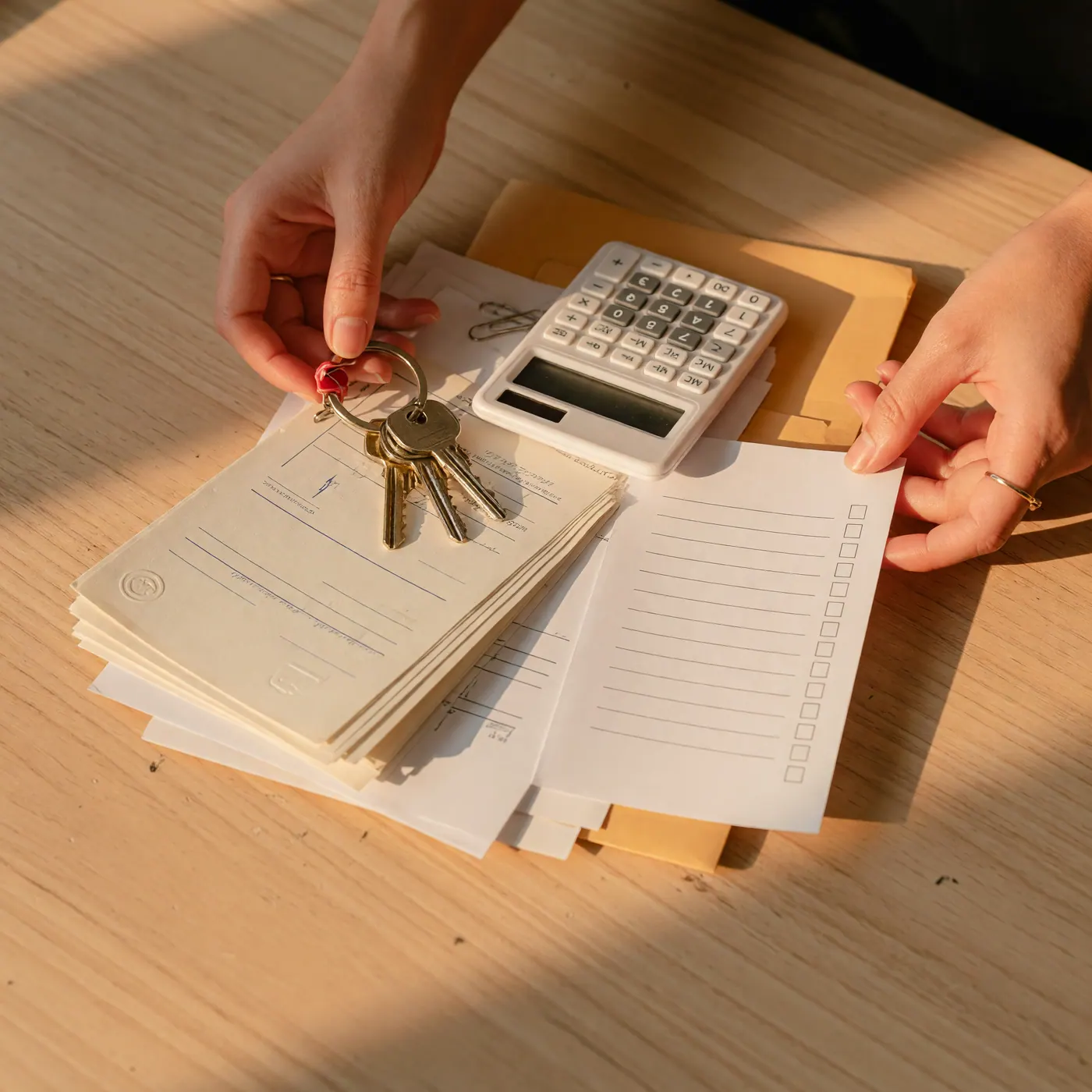
To be clear today: since May 8, 2026, articles 2 to 8 of Decree 572 are provisionally suspended by court order. The DIAN issued Communiqué 070 confirming that, while the measure remains in force, the previous rules and rates must be applied. Therefore, for the private individual selling their fixed asset, the 1% remains the dominant rule. Don't get tangled up in UVT calculations that are currently frozen in the courts.
Document checklist before signing the deed
So that the notary can correctly calculate the withholding and deed-related costs, whose registry and notary fees were updated by the SNR for 2026, you must bring a flawless file:
- Certificate of Land Tradition and Freedom (Certificado de Tradición y Libertad): Ask the notary's office what validity period is required for the procedure. Learn how to download it here.
- Property tax clearance (paz y salvo predial): Shows that you are up to date with the municipality. Includes the cadastral appraisal, a key piece of data for the notary. See how to check your property tax.
- Betterment levy clearance (paz y salvo de valorización): Confirm whether you owe contributions or charges for local public works.
- Administration fee clearance (paz y salvo de administración): Check whether it applies when you sell in a gated community or building (horizontal property).
- Updated RUT: Check whether the notary's office requires it to verify your information. Update your RUT if necessary.
Don't confuse the withholding with the final tax
A very costly mistake is thinking that by paying the 1% at the notary's office you are already settled with the State. The withholding is only an advance payment. The actual tax on the gain you made from the sale is settled the following year in your income tax return.
Frequently asked questions
❓ How much is the withholding tax when selling a property in Colombia?
For the typical case of a private individual selling their home or fixed asset, the withholding is 1% of the total sale value. If companies are involved or the property is commercial inventory, the rates and procedures change.
❓ Does the seller or the buyer pay the withholding?
The money comes out of the seller's pocket, since it is an advance tax on their income. However, depending on who is buying, the physical process of withholding and paying the DIAN is handled by the notary's office or by the corporate buyer.
❓ Is the withholding paid before or after signing the deed?
It must be paid before the transfer and signing of the public deed. The notary will not authorize the transfer of the property without first verifying that this tax has been paid.
❓ Must the seller fill out Form 350?
No, as a general rule the private individual seller does not fill out this form. The Form 350 is the monthly return that withholding agents (such as companies) file with the DIAN to report what they withheld.
❓ What changed with Decree 572 of 2025 in 2026?
Since May 8, 2026, articles 2 to 8 of this decree are provisionally suspended by court order. For now, the DIAN requires applying the bases and rates that existed before this rule while the substantive measure is resolved.
❓ Where can I publish a property before starting the deed process?
You can list your property directly in the housing section of Colombia Move. Make sure to include real photos, a clear price and the negotiation terms to attract serious buyers and filter out casual lookers.
❓ What documents should I have ready before selling?
It is advisable to prepare the Certificate of Land Tradition and Freedom, the property tax clearance, the administration fee clearance when applicable, and a copy of previous deeds. Confirm with the notary's office the validity and documents required for your transaction.



Comments
Loading comments...
Checking sign-in status...