
Fiber Optic Internet Providers in Colombia for Remote Workers: ETB vs Claro vs Movistar Speed & Reliability
A technical and practical comparison of Colombia's major fiber optic providers—ETB, Claro, and Movistar—designed to help remote workers choose reliable, symmetrical internet.
IDIOMA DEL ARTÍCULO
Showing original language
When you relocate to Colombia as a digital nomad or remote professional, finding an apartment with charming brickwork, leafy mountain views, and decent cafes nearby is simple enough. The real challenge starts the moment you fire up an unbuffered 4K Zoom presentation with your team back in North America or Europe: your home broadband connection either holds the line or crumbles under pressure. Symmetrical upload capacity, jitter-free video pipelines, and true infrastructure resilience are what make or break remote work here.
The word “fiber” gets tossed around loosely. Depending on the cable that enters your building riser, you are either on dedicated glass or on legacy coaxial that slows down in the evening. Here is a ground-level breakdown of Movistar, ETB, and Claro.
Planning your apartment logistics? Before picking an ISP, read our field manual on Handling Water & Internet Outages in Colombia: Backup Power, Starlink & Landlord Rights to avoid common lease traps.
The Golden Rule: Pure FTTH vs HFC Coaxial Connections
To understand why two neighbors on the same street might have vastly different experiences during a daily standup, you must recognize the difference between two delivery technologies: FTTH (Fiber to the Home) and HFC (Hybrid Fiber-Coaxial).
Pure FTTH routes a flexible glass strand all the way into your apartment, terminating directly into an Optical Network Terminal (ONT) or a combined fiber gateway. Because data travels as pulses of light over dedicated fiber, FTTH delivers symmetrical speeds: if your plan promises 500 Mbps download, your upload speed is also 500 Mbps. Symmetrical bandwidth is essential for remote engineers pushing code repositories, creators handling multi-gigabyte video renders, or anyone running simultaneous high-definition two-way video streams.
HFC runs fiber to a street node, then finishes the trip on copper coaxial cable. A plan advertising 300 Mbps download might only deliver 20 to 50 Mbps upload, and that last stretch is shared with the building. At 7:00 PM, when neighbors start streaming, calls stutter.
Movistar Fiber: The National Symmetrical Benchmark
Telefónica’s Movistar has rolled out pure FTTH across urban centers. If you need symmetrical upload outside Bogotá, it is frequently the most consistent choice.
- Coverage Footprint: Movistar operates extensive FTTH networks across major hubs, including Bogotá, Medellín, Cali, Barranquilla, and Bucaramanga, spanning over 96 municipalities nationwide.
- Speed Delivery: Movistar’s residential fiber plans are strictly symmetrical (1:1 download-to-upload ratio). Standard consumer tiers range from 250 Mbps and 500 Mbps up to 900+ Mbps.
- Remote Work Strengths: Clean symmetrical throughput on pure FTTH, which is what two-way video and large uploads actually need.
- The Downside: Phone and WhatsApp support can be bureaucratic. A cut drop-cable can still sit for several days before a technician splices it.
ETB Fiber: The Regional Powerhouse in Bogotá
ETB is Bogotá’s municipal operator. Remote workers on the high plain should look at it. Nomads headed to other cities will not find a residential ETB plan.
- Coverage Footprint: Strictly local. ETB’s FTTH footprint covers Bogotá and surrounding Cundinamarca Sabana municipalities—specifically Chía, Funza, Mosquera, Madrid, and Facatativá. It has zero residential presence in Medellín, Cali, or coastal cities.
- Speed Delivery: ETB markets its plans as “velocidad gemela” (twin speed), offering pure symmetrical FTTH tiers scaling from 300 Mbps up to 910 Mbps upload and download.
- Remote Work Strengths: Because ETB built an early urban fiber ring throughout Bogotá, renters in established neighborhoods often find an ETB riser already in the building. Ask the administración which operator’s fiber is already in the duct before you sign.
- The Downside: Plan changes and final bills are clunky. Ending service when a lease ends often means a visit to a Centro de Experiencia, not a clean online cancellation.
Claro: Giant Footprint, But Beware the Coaxial Trap
Claro (América Móvil) has the widest footprint. For remote work, you still have to vet the cable at the address.
- The Delivery Split: Claro delivers home internet over two entirely separate infrastructures. In newer developments and aggressively modernized sectors, Claro deploys excellent pure FTTH with symmetrical upload speeds. However, many residential units in established urban neighborhoods remain connected to legacy HFC coaxial networks.
- The Upload Limit for Remote Work: If you sign up for Claro without verifying the medium at your address, you may end up with a fast download but a meager 30–50 Mbps upload, along with high packet jitter during peak hours.
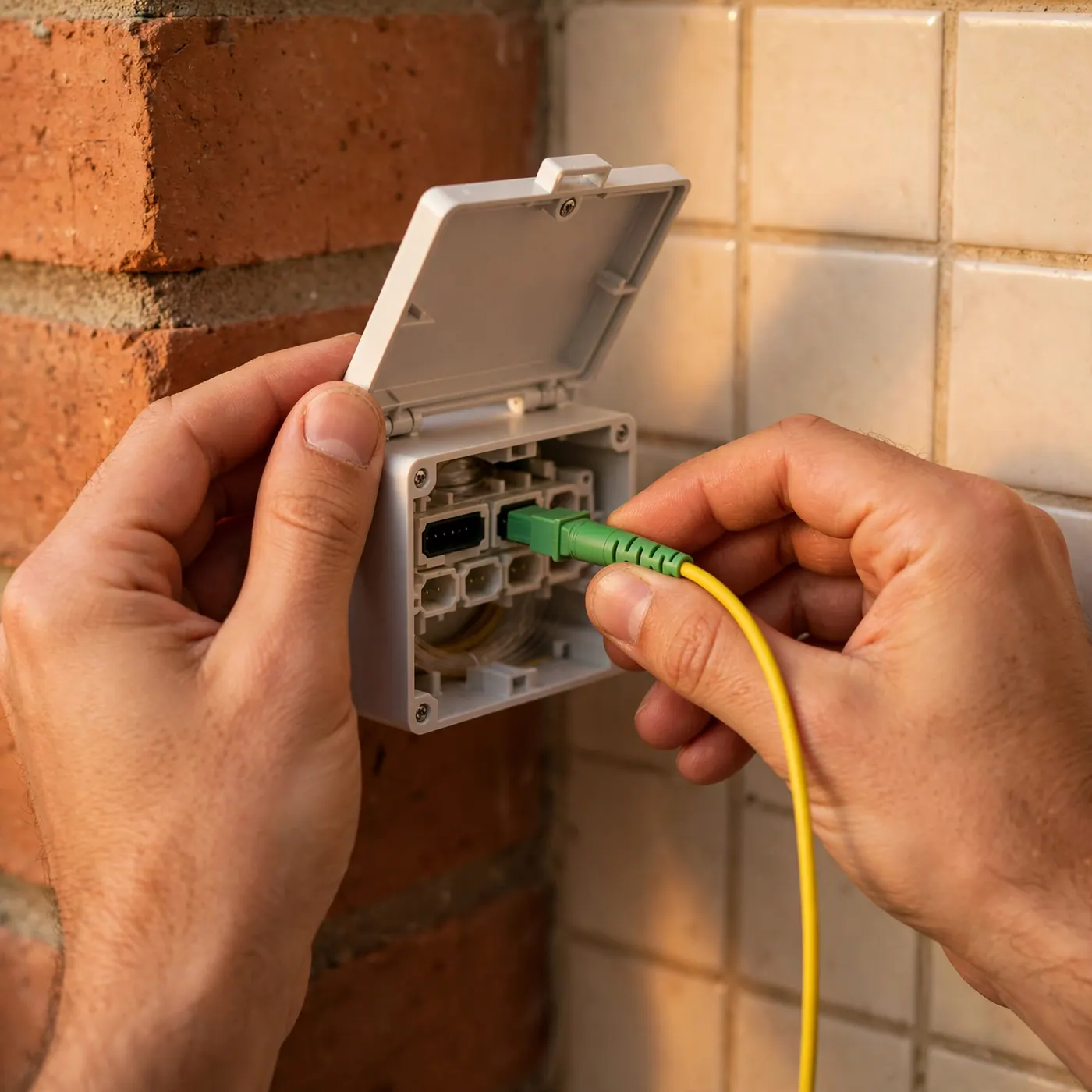
- How to Verify: Never take a telemarketer’s word that an apartment has “fibra.” Inspect the wall terminal inside the unit: a green SC/APC connector click-box with thin yellow cable indicates true FTTH; a threaded metallic screw nut (F-type connector) means you are on asymmetrical coaxial HFC.
Understanding Colombian Internet Pricing & The "Estrato" Factor
Pricing is not one citywide number. Homes sit in a municipal estrato from 1 to 6, and the bill follows that rank. The same neighborhood rank is what we walk through in how the estrato system changes rent and utility bills.
Estrato 5 and 6 homes, where most furnished rentals sit, pay higher baseline rates that cross-subsidize Estrato 1–3. Promotions move, but standalone fiber tiers (300 to 900 Mbps) usually land in these brackets. Confirm the exact quote for your estrato:
- Estrato 3 & 4: Approximately COP 55,000 to COP 85,000 per month.
- Estrato 5 & 6: Approximately COP 80,000 to COP 110,000 per month for identical download and upload tiers.
Always verify the exact estrato printed on your building’s physical utility invoice (factura de servicios públicos) before committing to a contract quote.
Renter Reality Check: HOA Building Rules & Installation Hurdles
The contract is the easy part. Getting the cable into a rental is not. Under Ley 675 de 2001, the building administration (administración) controls the shared ducts and the facade.
Before a technician arrives, you must keep three realities in mind:
- Building Conduit Saturation: Older brick walk-ups frequently have congested central riser conduits (ductos comunales). If the existing internal pipes are packed with old copper cables, building managers may forbid the technician from pulling a fresh fiber line.
- Facade Drilling Restrictions: Many administrations strictly forbid technicians from drilling through external brick walls, window frames, or common-area corridors to run external drop-lines. Technicians who attempt to run exposed black cables down exterior building facades risk being turned away by front-desk security (portería).
- Technician Work Permits: In high-security buildings (particularly in Estrato 5 and 6), technicians cannot simply enter. The building administration often requires proof of the technician’s active ARL occupational insurance before granting roof or riser access. Coordinate with your landlord or building doorman 24 hours prior to your scheduled installation window.
If you are signing a long-term lease directly, check out our guide to Unifianza and El Libertador Rental Guarantees: How Foreign Renters Qualify Without a Codeudor to ensure your tenancy paperwork proceeds smoothly. Before the install date, also confirm the building checklist in Home Internet Installation in Colombia: What Renters Should Confirm.
Regulatory Consumer Protections & Outage Mitigation Protocols
A street cut or a power flicker can still drop the line. The CRC still gives subscribers these protections:
- Updated Broadband Standards: Under CRC Resolución 8307 de 2026, internet providers in Colombia's most developed municipal markets (Category Alto-Moderado) are legally barred from marketing fixed connections as "banda ancha" (broadband) unless they deliver at least 300 Mbps download and 150 Mbps upload speeds, an enforceable standard effective October 1, 2026. Ultra-broadband tiers require 1 Gbps down and 500 Mbps up.
- Mandatory Outage Compensation: Under CRC Resolución 5111 de 2017, if your fixed internet experiences continuous or cumulative downtime exceeding 2.5 hours in a single calendar month, your provider is legally required to credit an automatic proportional discount on your following month's bill.
- The 15-Day PQR Clock: If you file a formal dispute (Petición, Queja o Reclamo - PQR), the operator has exactly 15 business days to resolve it. If they miss that deadline, positive administrative silence (Silencio Administrativo Positivo) legally triggers in your favor. If an operator refuses to rectify chronic dropped service, you can escalate directly via our guide on Cómo Reclamar por Fallas Recurrentes de Internet y Telefonía ante la SIC.
Practical Redundancy: The Remote Worker Toolkit
A bill credit does not save a lost afternoon of calls. Use two backups:
First, pick up a compact DC mini-UPS battery backup and plug your fiber ONT and primary Wi-Fi router into it. When a neighborhood transformer blows or the power blips, the glass fiber line can stay reachable while the battery keeps the modem on. As of late September 2026, that battery-plus-hotspot pair is the practical backup.
Second, establish an out-of-band cellular failover. Keep an unlocked 5G mobile device or dedicated USB LTE dongle powered by an alternate carrier (e.g., if your home fiber is Movistar, maintain a prepaid Tigo or Claro SIM with active mobile data). Pair that SIM choice with Internet & Cell Phone Plans in Colombia: Complete Carrier Comparison. If an accidental backhoe cut disables your street's optical distribution frame, switching over is a short manual step. And if you need to step out to a dedicated workspace, explore our recommendations for Remote Work Cafes & Coworking Day Passes in Envigado and Sabaneta.
Provider Decision Matrix: Which Service Should You Choose?
To summarize your selection strategy across Colombia’s major remote-work destinations:
- Bogotá and the Cundinamarca Sabana: Start with Movistar FTTH or ETB Fiber. Both are symmetrical, up to 900+ Mbps. Pick ETB when the riser is already ETB; pick Movistar if you want mobile and home on one bill. Skip Claro unless you have confirmed pure FTTH.
- Medellín and the Aburrá Valley: I would start with Movistar FTTH in El Poblado, Laureles, and Envigado. Claro is everywhere there, but confirm the ONT before you sign.
- Cali, Barranquilla, and Bucaramanga: Start with Movistar FTTH. Use Claro only after that address shows a dedicated fiber drop, not coaxial.
Frequently Asked Questions
❓ What is the difference between symmetrical and asymmetrical internet in Colombia?
Symmetrical internet provides identical upload and download speeds, which is vital for seamless video calls, large cloud backups, and interactive remote desktops. Asymmetrical internet throttles your upload capacity to a tiny fraction of your download speed, creating severe bottlenecks during live meetings.
❓ Is ETB available outside of Bogotá?
No, ETB’s residential fiber footprint is restricted to Bogotá and neighboring Cundinamarca Sabana municipalities like Chía, Funza, and Mosquera. If you relocate to Medellín, Cali, or Barranquilla, you will need to choose among Movistar, Claro, or regional network providers.
❓ Why does Claro offer high download speeds with poor video call quality?
Many Claro residential installations rely on legacy Hybrid Fiber-Coaxial (HFC) rather than pure FTTH. While HFC delivers fast download speeds, it severely limits upload bandwidth to 30–50 Mbps and suffers from shared neighborhood channel congestion that leads to packet loss and choppy video feeds.
❓ How does the Colombian Estrato system affect my monthly internet bill?
As of September 2026, Colombian residential utility and telecom tariffs are tiered by property Estrato (1 through 6). Apartments located in Estrato 5 and 6 pay higher baseline rates to cross-subsidize utility infrastructure in lower estratos, meaning your monthly plan will cost slightly more in upscale neighborhoods.
❓ What are my legal rights if my home internet goes down in Colombia?
Under CRC Resolución 5111 de 2017, telecommunications providers must issue an automatic billing credit on your following invoice if cumulative downtime exceeds 2.5 hours in a month. Furthermore, operators are legally bound to resolve formal PQR disputes within 15 business days.
❓ Can my landlord or building administration block a fiber optic installation?
Building administrations can refuse facade drilling and riser access under Ley 675 de 2001 because facades and utility ducts are essential common property (bienes comunes esenciales). If the drop needs a new hole through a common hallway or the facade, written permission from the administración is mandatory, and saturated pipes or missing ARL paperwork are common reasons portería turns the technician away.
❓ Do I need a Cédula de Extranjería to sign an internet contract?
As of September 2026, major operators prefer a Cédula de Extranjería for post-paid billing, though several company branches will activate accounts using a foreign passport alongside an upfront deposit or prepaid arrangement. In short-term rentals, having the account maintained under the landlord’s name is usually the simplest route.




Comments
Loading comments...
Checking sign-in status...