
How to price used furniture in Colombia before listing
Practical guide to pricing your used furniture in Colombia before listing: how to compare, account for condition, measure, separate transport costs, and adjust for urgency.
IDIOMA DEL ARTÍCULO
Showing original language
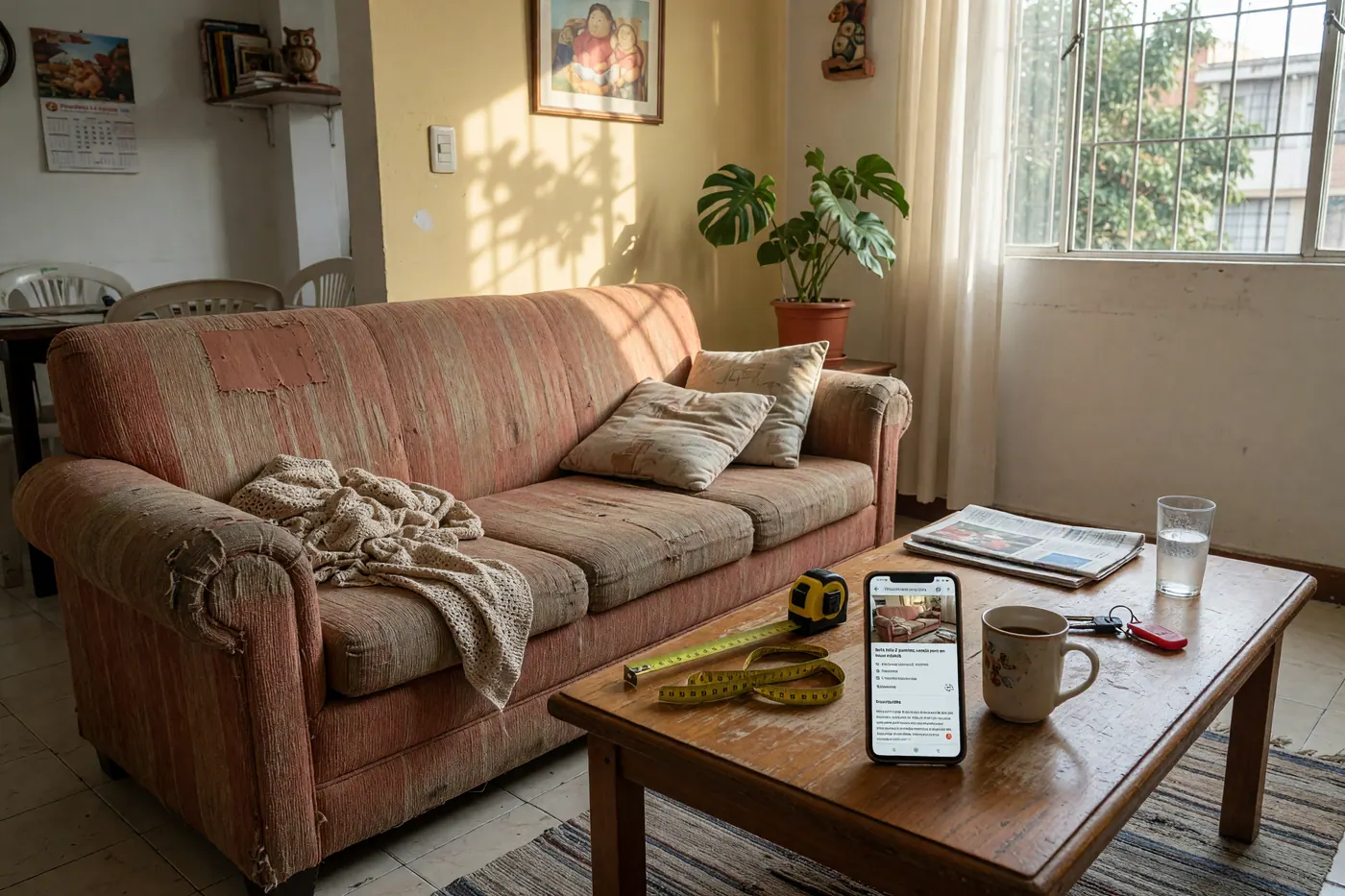
A friend wanted to sell his living room sofa before moving out of his apartment. He set the price at two million “because that’s what it cost me,” uploaded a photo from the other side of the room, and sat down to wait. Three weeks passed with his cell phone in silence. When he finally lowered it to a realistic price and took decent photos, he sold it in four days. The sofa was always fine; the problem was the price and the listing.
Pricing used furniture in Colombia is the part most people improvise, and it’s exactly what decides whether you’re flooded with messages or only get written to by bargain hunters. An inflated price almost never gives you wiggle room: it either scares off the serious buyer or fills your WhatsApp with curious people offering half. And one that’s too low makes you give away something worth more. If you want to see real options right now, you can see apartments and houses on Colombia Move — posting is completely free.
The good news is that you don't guess the price: you build it with data before posting. In this guide, I show you how to compare with what is actually selling, how to discount for condition and dimensions, how to separate the cost of shipping, and how to adjust based on your urgency. It works for sofas, dining sets, beds, desks, closets, and almost any home furniture.
What you should know first
- The price is defined by comparing similar active listings in your city, not by what you paid when you bought it.
- The actual condition rules: stains, scratches, moisture, or loose hardware lower the value, and it is best to show them.
- Measurements (width, height, depth) prevent wasted visits and buyer regret.
- Transportation is agreed upon separately: who disassembles, who loads, and who pays for the move.
- An honest price doesn't prevent scams, but it does reduce doubts and conversations that go nowhere.
What defines the price of a piece of used furniture?
Before writing down a number, it is worth understanding what moves it up or down. It’s not just one thing: it’s the sum of several. The brand or the manufacturer (if the furniture is from a well-known workshop or store), the material—solid wood is not the same as particle board—the years of use, the actual condition, the measurements, and how easy it is to transport.
Something many forget also carries weight: your urgency. It is not the same to sell calmly over two months as it is to need the money by Friday because you have to hand over the apartment. The faster you need to sell it, the more negotiation room you have to leave. Being clear about this from the beginning saves you from feeling frustrated later.
If you are going to sell several pieces of furniture at the same time due to a move, logistics change the calculation. In what to do with furniture and appliances before moving I explain how to organize the complete inventory when you are selling everything against the clock.
Step 1: Compare with active listings in your city
Price is researched, not invented. Open a classifieds platform and search for your own furniture by filtering for “used” and your city. On Mercado Libre, for example, there are pages for used living room furniture and sofas by city that give you a quick idea of the range people are operating in today. Compare apples to apples: similar furniture type, similar material, equivalent condition, and the same city.
Watch out for a common trap: the prices you see posted are what people are asking for, not necessarily what they get. Many listings have been up for weeks without selling precisely because they are too high. Use them as a ceiling reference, not as absolute truth, and remember that the final value is adjusted for wear and tear, shipping, and speed of sale. Don't marry yourself to a fixed price chart: the used market changes by city and by season.
Step 2: Evaluate the condition honestly
Stand in front of the furniture and look at it as if you were a skeptical buyer. Does it have stains on the fabric, scratches on the wood, a wobbly leg, rust on the frame, a musty smell, sunken foam? None of that is necessarily a problem for selling; the problem is hiding it. A defect that the buyer discovers during the visit kills the sale; one that was already in the photos and the description builds trust.
The rule of thumb: for every defect, lower the price a little compared to similar furniture in better condition and state it clearly. There is no universal discount percentage, so don't make one up; describe the detail (“10 cm scratch on the surface,” “right cushion a bit sunken”) and let the price reflect it. It is easier to sell a piece of furniture “with a well-explained detail” than an “impeccable” one that no one believes.
Step 3: Measure everything before posting
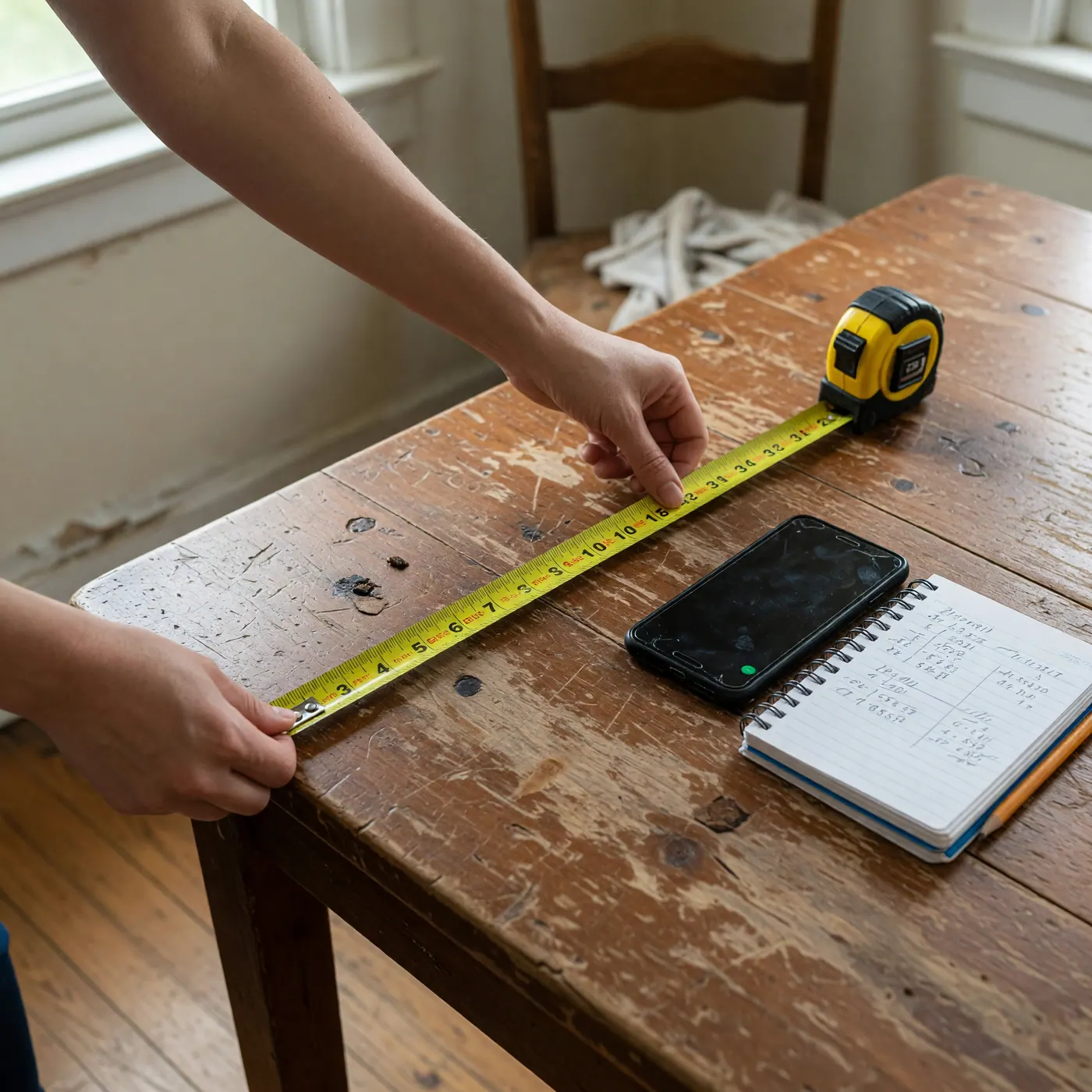
Measurements are the data point that saves the most wasted visits, and almost no one includes them. Take out your tape measure and note the basics of each piece of furniture:
- Width, height, and depth in centimeters.
- If it is modular or can be disassembled (a closet or bed that comes apart is valued and transported differently).
- If it fits through a standard door, elevator, or staircase.
- Approximate weight if it is very heavy, so the buyer knows what transportation they need.
A photo with a tape measure on top of the furniture is worth a thousand messages. It avoids the classic “I thought it was smaller” once the buyer has already made the trip. That wasted visit is both of your time.
Step 4: Separate the price of the furniture and the transport
This is where many sales of large furniture fall through. A three-seat sofa or a dining set for six doesn't fit in just any car, and getting them down a narrow staircase can cost as much as the profit. That's why it is better to separate three things and make them clear before closing: the price of the furniture, the cost of transport, and who disassembles and loads.
Decide right away if the buyer picks it up, if you deliver, or if the shipping cost is split, and say so in the listing. Don't hide the transport within the price to make it look “all-inclusive”; that generates misunderstandings at delivery. If the piece of furniture needs someone to carry it down and load it, mention it: the typical “I thought you would bring it down” kills sales at the last minute.
Step 5: Adjust for urgency, bundles, and negotiation
With the base price clear, adjust it to your situation. A practical trick: set it a little above your acceptable minimum, but within the real market range. That leaves the buyer room to “win” something in the negotiation without you ending up giving it away. And avoid suspicious round numbers: “one million exactly” sounds made up, $920,000 sounds well-thought-out.
If you are in a rush, decide on three prices in your head: the normal one, the quick-sale one, and the bundle one. Selling the dining table with the chairs, or the entire living room set in one deal, usually happens faster even if you lower the price a bit, because you save the buyer the hunt for individual pieces. You sometimes get more money for separate pieces, but you have to wait longer. There is no single answer: it depends on your urgency.
When you already have the price and the photos, you still need the listing. In how to write a listing that actually gets messages you will see how the title, description, and photos work together, and how to share it afterward on WhatsApp without sounding like spam.
Where to post your used furniture
Not all channels work the same way, and being honest about that saves you time. Facebook Marketplace has a lot of traffic and direct contact, but also many messages that lead nowhere. Mercado Libre gives you reach and buyers used to buying online; however, for sellers, the conditions change depending on the case (for example, used items can be sold for free up to a certain number of sales per year, with exceptions for professional profiles), so it is worth checking the rules before setting the price. Neighborhood or building WhatsApp groups work surprisingly well for large furniture because the buyer is nearby and transport is short.
Colombia Move is the free, bilingual option designed for Colombia: you post in the furniture section with no commission, direct contact, and space to include all the photos, measurements, and details we covered above. As I explain in why posting is and will be free, it is just one more option alongside Facebook Marketplace, Mercado Libre, and local groups, not a promise to sell in one day — that always depends on the price and the condition.
Mistakes that lower your price
Avoid this:
- Setting a price “because that's what it cost me” without looking at what is selling today.
- A single photo, dark and taken from far away, that hides the true condition.
- Not including measurements and letting the buyer arrive only to discover it doesn't fit.
- Hiding a defect to sell for more — it almost always backfires on you during the viewing.
- Including transport in the price without clarifying it and then arguing about it during delivery.
Do this:
- Price researched against similar active ads in your city.
- Four to six clear photos, with good light, including close-ups of any defects.
- Complete measurements and, if applicable, whether the furniture can be disassembled.
- Condition described honestly with a small margin for negotiation.
- Transport agreed upon separately, clear from the ad.
Pricing used furniture correctly isn't luck: it's about comparing, being honest about the condition, and having the delivery logistics sorted. Do that homework before posting, and you will receive messages from people who actually want to buy, not those who haggle for sport.
Frequently Asked Questions
❓ How do I calculate the price of a used piece of furniture in Colombia?
Compare active ads for the same type of furniture, material, and city on platforms like Mercado Libre or Facebook Marketplace, filtering by “used”. Adjust based on the actual condition, measurements, how easy it is to transport, and how urgent your need to sell is. Forget what you paid when you bought it: the buyer only looks at today's price.
❓ How much should I discount if the furniture has stains or scratches?
There is no universal percentage. The right thing to do is to describe the defect clearly and set the price below similar furniture in better condition. Showing the detail in the photos generates more trust than hiding it, and it usually closes the sale faster.
❓ Is it better to sell a dining set or a living room set by pieces or as a combo?
It depends on your urgency and transport convenience. Combos help to move things quickly even if you lower the price a bit, because you save the buyer from having to look for separate pieces. Selling separately sometimes gets you more money, but you have to wait longer.
❓ Who should pay for the transport of used furniture?
This should be clear before closing the deal. Seller and buyer can agree on it in several ways, but do not hide it within the price. Also, clarify who will disassemble and load, especially with large furniture.
❓ Where can I post used furniture in Colombia?
You can use Colombia Move, Facebook Marketplace, Mercado Libre, or local WhatsApp groups. Each channel has different rules and costs, so check the conditions for each; the ideal is to use the same well-made ad in more than one place.
❓ How do I avoid scams and ensure a safe delivery when selling furniture?
No method completely eliminates the risk, but you can greatly reduce problems. Agree on the delivery in a specific place and time, let the buyer inspect the furniture, and for high amounts, prefer a confirmed transfer before handing over the product. An honest ad with real photos and full measurements reduces doubts and filters out curiosity seekers.
❓ Should I put “negotiable price”?
Only if you truly have margin. If you put it but don't plan on lowering anything, you will frustrate buyers. If the price is fixed, state it clearly; if you are open to negotiation, clarify more or less to what extent.





Comments
Loading comments...
Checking sign-in status...