
Health Permit for Restaurants, Cafés and Bakeries: What Resolution 2674 Requires
What the health permit for the premises is, which four programs the sanitation plan includes, and how the inspection report scores the visit to restaurants, cafés and bakeries.
IDIOMA DEL ARTÍCULO
Showing original language
Quick answer: the health concept belongs to the establishment, not the dish. It is issued by the territorial health authority after inspecting the premises, and it can be favorable or unfavorable depending on what the inspector finds. What INVIMA does issue is the authorization for the food (NSA, PSA or RSA), and that is a different matter.
I have seen café owners spend weeks on the menu and decoration, and learn the word "acta" on the day the inspector arrives. This guide is so that day is not a surprise. It applies to restaurants, cafés and bakeries; meat outlets fall outside Resolution 2674 because they are governed by the official system of Decree 1500 of 2007 (paragraph of article 2, consulted in October 2026).
What the health concept is and who issues it
Resolution 2674 of July 22, 2013, from the Ministry of Health, regulates anyone who manufactures, processes, prepares, packages, stores, transports, distributes or sells food, and food handling personnel. It defines the health concept as the one issued by the health authority after inspecting the establishment, and it can be favorable or unfavorable. The competent health authorities are INVIMA and the territorial health entities.
In practice, for a restaurant, café or bakery, the one who comes to your premises is the territorial health entity. Each city has its own procedure; if you don't know yours, ask your local health secretariat before assuming steps from another city.
First, registration
Article 50 requires registering the operating establishment with the competent health authority, through the procedure it sets. It also requires immediately reporting a change of ownership, business name, location, or a temporary or permanent closure. If you bought an already set-up business, that notice is your responsibility, not the previous owner's.
A concrete example: the path in Bogotá
Just to illustrate, and as a district procedure, not a national one: the Bogotá District Health Secretariat publishes a clear sequence in its Negocios Saludables program. You register the business, complete the checklist, request the visit when the premises are already operating, and receive the concept according to what the inspector sees. The visit is carried out by the integrated health service subnetworks according to the locality (pages consulted on October 25, 2026).
Watch out for a common misunderstanding: the SDS asks you to complete 100% of the checklist criteria before requesting the visit. That is a self-assessment goal. It is not the scale used to grade the acta, which we will see below. Also, the site where you write to ask for information is not where you "get" the concept: the visit takes place at your establishment.
I did not find in the official sources consulted a national fee for registration or for the visit, so I will not give you an invented figure. If someone charges you something "for the concept", ask exactly what they are charging you and confirm with your secretariat.

The sanitation plan: four programs in writing
This is the block that trips people up most. Article 26 requires a written sanitation plan, available to the authority, with procedures, schedules, records, checklists and responsible persons for four programs:
- Cleaning and disinfection: what is cleaned, with what product, how often, and who signs off.
- Solid waste: how it is separated, where it is stored, and when it leaves.
- Pest control: preventive measures and a record of each intervention.
- Drinking water supply: where the water comes from and how its quality is ensured.
A useful clarification: the SDS Bogotá summary shows three programs within the plan (cleaning and disinfection, solid waste, and integrated pest control) and treats potable water as a condition of the premises. Even so, article 26 requires a documented drinking water program. My advice: write it down, even if your district checklist lists it separately.
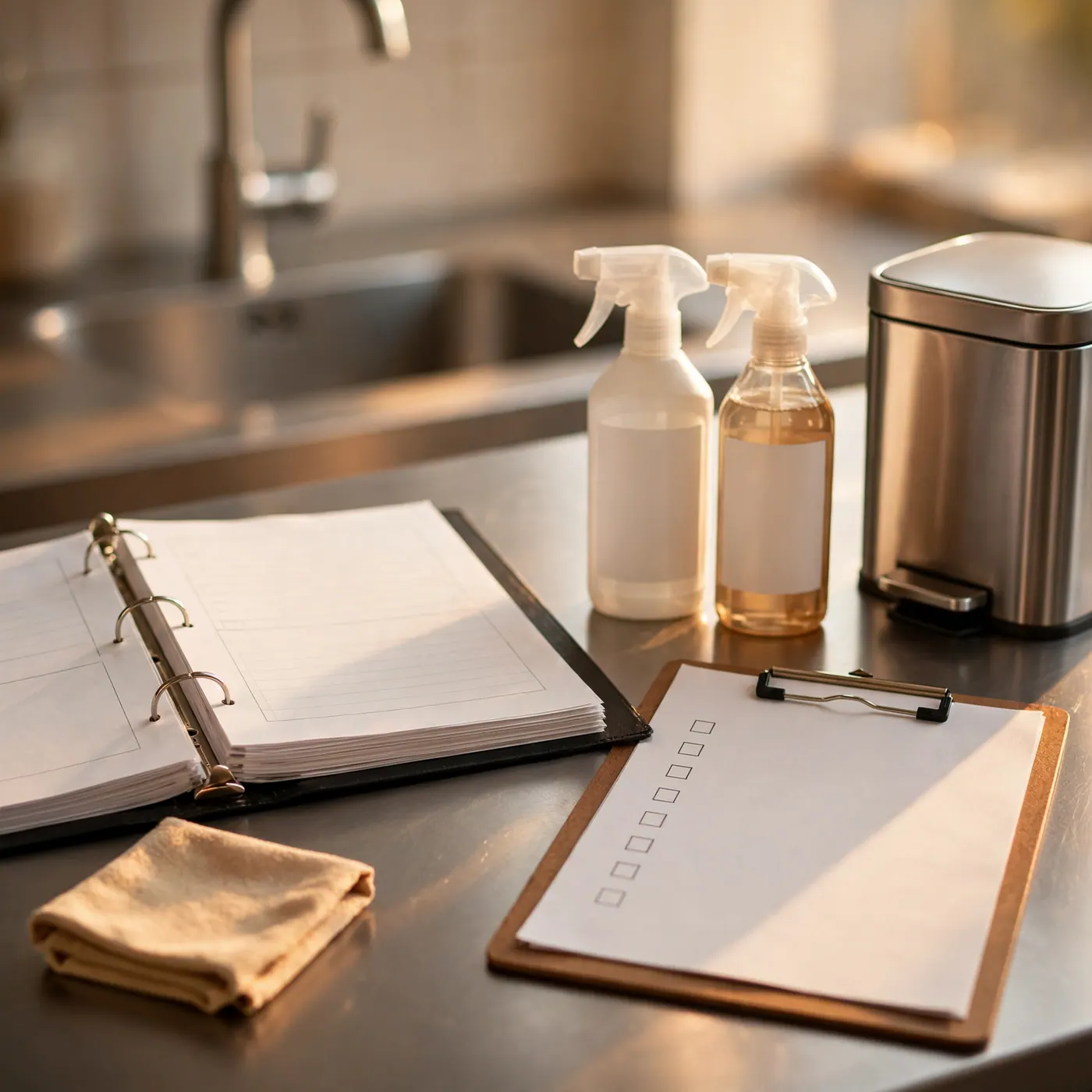
What annoys inspectors most is empty paperwork. An inspector prefers to see records with real dates and signatures, even if they are simple, rather than a nice manual without a single mark of use.
How the inspector reads the acta
The INVIMA sanitary inspection record with a risk focus names, among the types of premises, restaurants, cafés, bakeries, fruit shops, fast food and canteens, and the territorial health entity carries out the inspection. The bands for the concept are these (acta consulted on October 25, 2026):
| Compliance | Concept |
|---|---|
| 90–100 % | Favorable |
| 60–89.9 % | Favorable with requirements |
| Below 59.9 % | Unfavorable |
If a critical aspect is rated unacceptable, the concept is unfavorable even if the percentage is higher, and a sanitary safety measure is applied. The sanitation block weighs 33% of the total, meaning a third of your score depends on that plan existing and being followed. The acta must be notified within no more than five days of the visit, and a copy is left with the person who attended.
People: medical certificate and training
The food handler needs a medical certificate of fitness to handle food, and the company must arrange a medical examination at least once a year, plus an additional one if there is a clinical or epidemiological reason. In addition, the training plan is continuous and permanent, of at least 10 hours per year, with methodology, duration, instructors, schedule and topics.
Note: a course certificate is not the premises' concept or anyone's permit. For the course and the card, see this guide on food handling. And remember that the owner, management and staff are responsible for the safety of what is prepared and sold.
The premises itself
Article 32 requires, among other conditions, that the restaurant area be independent of any dwelling and not be used as a bedroom, that there be sufficient supply of drinking water, and that staff toilets be separated from the preparation area. Article 33 sets, for wet processing areas, a minimum slope of 2% and at least one drain of 10 cm diameter for every 40 m2 of served area. I am quoting the text of the regulation; for a specific construction project, consult the person who designs it.
If the concept comes out unfavorable
A critical finding can lead to a safety measure. Article 576 of Law 9 of 1979 allows total or partial temporary closure, suspension of works or services, seizure, destruction or denaturing, and freezing or temporary suspension of sales. They are of immediate execution, preventive and temporary, without prejudice to sanctions.
On sanctions, article 577 (modified text published by the Senate) includes a warning, successive fines, seizure, suspension or cancellation of the registration or license, and temporary or permanent closure. The cap on fines is 10,000 current monthly legal minimum wages. That is the legal ceiling of the catalog, not what an ordinary visit costs.
A favorable concept does not by itself authorize deliveries, alcohol, land use or human safety. The fire department technical concept is a separate procedure.
Premises versus product: don't mix the two
The concept belongs to the establishment. The NSA, PSA or RSA belong to the food and are issued by INVIMA. According to article 37 (modified by Resolution 3168 of 2015), all food sold directly to the consumer requires one of those authorizations depending on its risk, with four exceptions, among them foods and raw materials for exclusive use by industry and the gastronomic sector in preparing meals. A dish served at your premises and a branded packaged product for the public follow different rules; confirm your case with the health secretariat and with INVIMA.
If you sell roasted or ground packaged coffee, you have its own sanitary notification guide. And if you cook to order from home, see baking and pastry to order; this guide is about the physical premises.
What you can say in your listing
According to the active listings on Colombia Move (October 25, 2026), prepared food has 2 active listings, and coffee y bakery have 0. The food section is well below its goal, so whoever publishes with clear details will stand out.
A buyer distrusts vagueness. State what you sell, from what price, in which area, real photos of your kitchen or counter, and the status of the concept if you already have it (favorable, favorable with requirements, or in process). Do not promise health effects. For ingredients, storage and listing text, use the guide to food, desserts and coffee.
Frequently asked questions
❓ Does INVIMA issue the health concept?
It is issued by the territorial health authority for the establishment, after inspecting it. INVIMA issues the NSA, PSA or RSA, which belong to the food. Resolution 2674 considers both to be health authorities, each in its own role. (verify with the official source)
❓ How much does the health concept cost?
In the official sources consulted there is no national fee in pesos for registration or for the visit. Ask your health secretariat what it charges, if anything, and be wary of anyone who charges you "for the concept" without explaining what it includes. (verify with the official source)
❓ Does every restaurant dish need INVIMA registration?
The registration, permit or notification belongs to the food sold to the consumer, with the exceptions in article 37, among them exclusive use by the gastronomic sector. Confirm your case with the health secretariat and INVIMA, especially if you sell packaged product. (verify with the official source)
❓ What programs does the sanitation plan include?
Four, in writing: cleaning and disinfection, solid waste, pest control, and drinking water supply. Each with procedures, schedules, records, checklists and responsible persons, according to article 26 of Resolution 2674. (verify with the official source)
❓ What percentage is needed for a favorable concept?
In the INVIMA acta for food preparation, favorable is 90–100 %, favorable with requirements 60–89.9 %, and unfavorable below 59.9 %. An unacceptable critical finding makes it unfavorable. The 100 % of the Bogotá list is prior self-assessment, not this scale. (verify with the official source)
❓ Where can I publish my food, coffee or bread from my premises?
You can publish them in the prepared food category of Colombia Move, or in coffee and bakery depending on what you sell. Include product, price, area and real photos of the site. The listing does not replace the health visit. (verify with the official source)
❓ How do I sell safely and avoid scams?
Show your real premises, clarify what you sell and the status of your concept, and do not promise health effects. As a buyer, be wary of listings without photos of the site or a defined area, and ask to see the establishment. (verify with the official source)
Sources
- Ministry of Health, Resolution 2674 of 2013
- Bogotá Mayor's Office, SISJUR, Resolution 2674 of 2013
- INVIMA, Resolution 3168 of 2015 (article 37)
- INVIMA, Sanitary inspection record for food preparation establishments
- Bogotá District Health Secretariat, Negocios Saludables: restaurants
- Senate, Law 9 of 1979, articles 575 to 588

Comments
Loading comments...
Checking sign-in status...