
How to Sell Used Trucks and Dump Trucks in Colombia: Cupo, Scrapping, and Transfer in the RUNT
A registered truck is transferred; the cupo cannot be sold separately. What to check in the RUNT, what the buyer signs if there is an omission, and when to scrap.
IDIOMA DEL ARTÍCULO
Showing original language
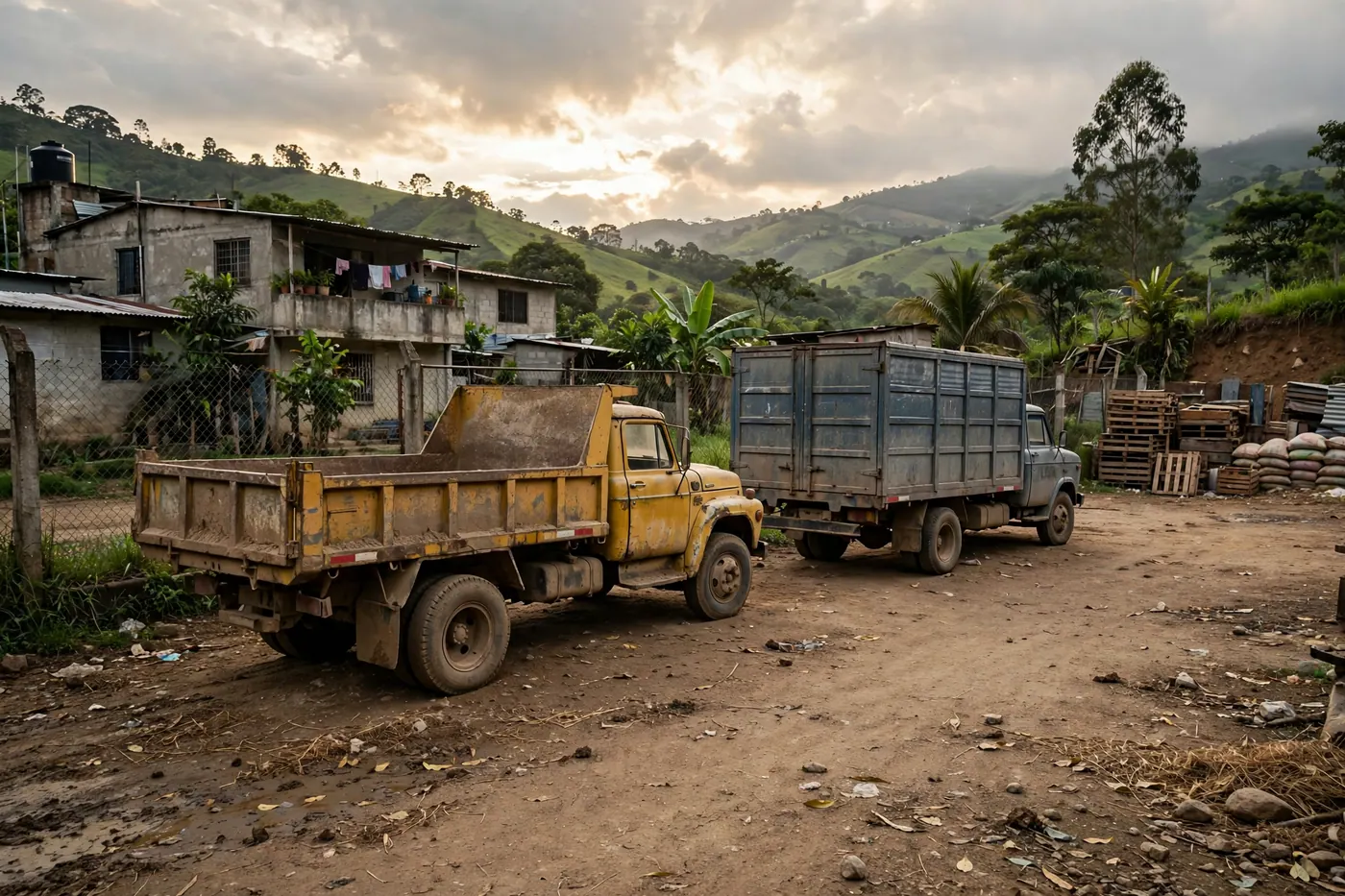
A truck owner would summarize it like this: "Twenty curious people call me, and none of them asks about the papers." And the serious buyer does exactly the opposite: the first thing they check is whether the registration is clean. This article is for anyone who wants to sell a truck, a dump truck, or a tractor-trailer that is already registered, without getting tangled up in the word "cupo."
Short answer: selling an already registered cargo vehicle is a transfer of that registration. The cupo is not a separate asset you sell loose, and scrapping is not selling.
A used truck is transferred; a new cupo cannot be sold loose
According to Decree 1017 of 2025 (dated September 21, 2025, which amends Decree 1079 of 2015), the initial registration of a new cargo vehicle, public or private, with a PBV equal to or greater than 3.5 tons, is done before any transit authority in only two ways: by replacing a cargo vehicle of the same service that was disintegrated, reached total loss, or was stolen, or by paying 25% of the commercial value before VAT to the FOPAT.
That 25% and the replacement both belong to the entry of a new vehicle. Your used truck entered the system a long time ago: selling it is a transfer and, by itself, does not oblige you to pay that 25%. One exception: if the procedure combines a transfer with a change from official to private cargo service, the acquirer must prove the initial registration conditions of article 2.2.1.7.7.2.
Beware of chat messages offering to "sell the cupo," "unfreeze a stalled truck," or "put it into the scrapping payment" in exchange for an advance. That is not a Ministry channel. In its statement of March 2, 2026 on the FOPAT table for light cargo and dump trucks, MinTransporte said that no official or third party is authorized to charge for this procedure.
A note on territory: cargo vehicles of 3.5 t or more registered in San Andrés, Providencia and Santa Catalina are excluded from the modernization program, cannot provide service outside the archipelago, and cannot transfer the account to another transit authority. It is not the place to register a mainland work truck.
What to check in the RUNT before publishing the plate
Before putting the plate in an ad, review the same things the buyer will check. The citizen RUNT query by plate requires the plate and the owner's document, and shows what the actors have reported. If something is wrong, the correction is requested from the transit authority where the vehicle is registered, not from the RUNT. If you do not have the owner's document, the vehicle history can be requested with the plate alone, but it is a paid document and does not include the owner's location data (check the current fee in the RUNT). For a query with an ID number, see the RUNT query guide by ID number, and for liens and seizures, the history and certificate of title.
Confirm these points:
- Active status, service (public or private) and PBV.
- Current SOAT and technical-mechanical inspection (RTM): they are checked in the plate query, not in a PDF circulating on WhatsApp.
- Liens or restrictions: if there is a pledge, authorization is needed from the holder.
- Omissions from the initial registration. If the vehicle weighs more than 10,500 kg, the transit authority validates in the RUNT that an initial registration authorization from the Ministry of Transport exists.
For the mechanical part and the appraisal, see the truck papers and appraisal guide; I will not repeat it here.
How the transfer works and what the buyer signs if there is an omission
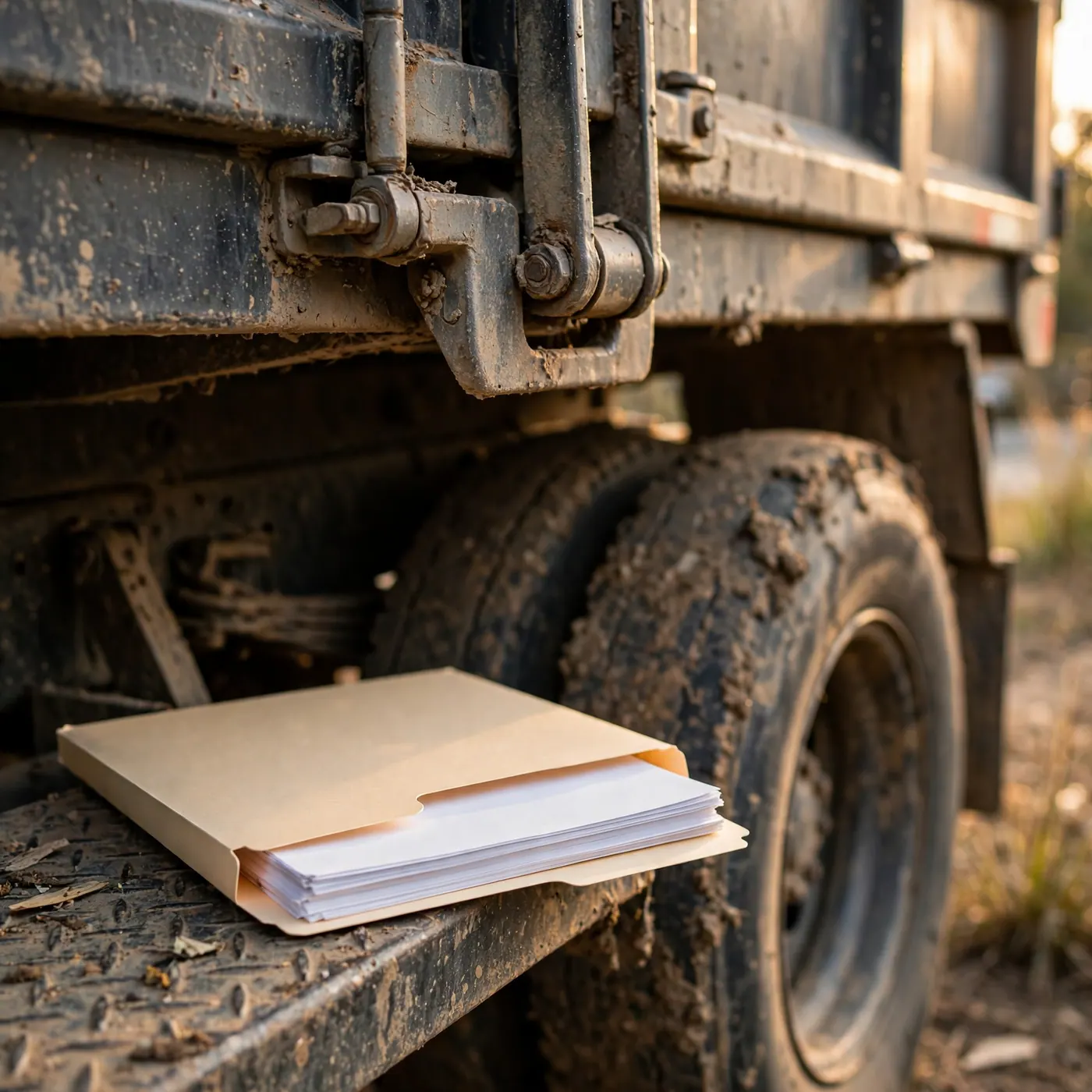
The transfer is filed with the transit authority where the vehicle is registered; the RUNT headquarters in Bogotá is not that counter. The standard sequence is in the step-by-step transfer guide; for trucks and dump trucks the extra step is the initial registration authorization.
According to the compiled Resolution 20223040045295 of 2022 (art. 5.3.2.1), the transfer requires:
- Seller and buyer registered in the RUNT.
- Transfer document with QR code.
- Certification of engine and chassis numbers (guarismos o improntas).
- No restrictions, or authorization from the lien holder.
- Current SOAT and RTM in the RUNT.
- Proof of no outstanding fines through the SIMIT–RUNT interoperability.
- Validation of the withholding tax payment and the vehicle tax.
I will not give you fee or withholding figures: request the calculation from the transit authority and, for the withholding, from the DIAN or that authority.
And if there is an unresolved omission? According to Resolution 20233040017145 of 2023, the owner may transfer with a written authorization from the buyer who accepts proceeding despite the omission. Note: that signature does not exempt you from regularizing and does not stop the authorities' actions. The RUNT instructions (November 2024 version), citing Resolution 3913 of August 27, 2019, describe three regularization routes for registration omissions between May 2, 2005 and the validity of that resolution: disintegrate another cargo vehicle of the same service with the equivalences, pay the indexed bond, or use a certificate of compliance with requirements.
Once the requirements are met, the authority registers the new owner and issues the new title. Until that registration, the registered owner is still you. That is why you should not hand over the vehicle title before filing the transfer.
Scrapping is not selling
Disintegrating the vehicle cancels it. It works as an exit when no one buys it or as support for a replacement. How the registration is canceled afterwards is in the registration cancellation and scrapping guide.
Two equivalence rules from Decree 1017 that help you understand the business:
- More than 10,500 kg: if the new vehicle is of the same configuration or lower and the disintegrated one also exceeds 10,500 kg, the equivalence is one to one, regardless of cargo capacity.
- Between 3,500 and 10,500 kg: the PBV, or the sum of PBVs, of what is disintegrated must be 100% of the PBV of the new vehicle according to the homologation sheet. Leftover amounts are not saved for another replacement.
For the higher configuration, the count is in the decree (art. 2.2.1.7.7.3, as amended); I will not copy it incompletely.
On the economic recognition: Resolution 20243040001165 of 2024 refers to 60% or 90% of the recognition for total physical disintegration for replacement purposes. The owner applies for the vehicle in the RUNT, and the payment depends on available funds and chronological order. It requires, among other things, an active public service, SOAT and RTM for at least two years within the previous nine, being free of liens, and a PBV above 10,500 kg. It excludes certain cases, such as having changed a dump truck, mixer, compactor or armored-car body to a cargo vehicle since January 1, 2008. This is not a price list; review the full conditions in the resolution.
Disintegrate only at an entity with a Ministry registration resolution and a valid environmental certification. If it does not appear on the official MinTransporte list, do not present it as authorized.
Dump trucks and cargo of 3.5 to 10.5 tons
Resolution 20263040015655, issued April 27, 2026, regulates the initial registration of new vehicles of 3,500 to 10,500 kg and of dump trucks. The 25% is calculated on the complete vehicle, or on the chassis with engine plus body, without VAT. These rules apply from July 1, 2026 if the RUNT already has the functionality, or earlier if an external circular from the Directorate of Transport and Transit announces it is enabled. There are special bodies exempt from the 25% (the article names, for example, ambulances and motorhomes); the list remains in the resolution.
Dates not to mix up: on March 2, 2026 the Ministry said the incentive program for light cargo and dump trucks was still being structured, with no open call. On July 17, 2026 the RUNT summoned only transit authorities to a session on July 22 about replacement and initial registration of 3,500–10,500 kg, which does not prove the citizen module was open that day. Before writing in your ad that there is a call, confirm the current module in the RUNT.
And a used dump truck already registered is still a transfer. What changes is the history of its body: a registered body change can close the door on the incentive, so state it honestly.
What to write in the ad so that a transporter contacts you, not a curious onlooker
According to the active ads on Colombia Move (October 26, 2026), the trucks category has only one active ad, and it is a rental: there is almost no offer of trucks for sale. A clear ad stands out quickly.
- Plate, configuration and PBV.
- Service: public or private, and registration year.
- Photos of the vehicle at work, of the cab, of the flatbed or body, and of the papers with personal data covered.
- Pledge, seizure or initial registration omission, stated upfront.
- Who pays pending fines and tax.
- Whether a mechanical inspection is allowed before closing.
- Price: your asking price. Who pays the vehicle's freight is negotiated; there is no official rate.
Regarding commission: there are no surprises, you do not pay an intermediary to contact the buyer. You can also explore the vehicles section.
Frequently asked questions
❓ Does selling my used truck force me to pay the 25% FOPAT?
No. That 25% is for the initial registration of a new cargo vehicle, not for transferring one already registered. If the procedure combines a transfer with a change to official-to-private service, the acquirer does have to prove the initial registration conditions (verify with the official source).
❓ Does the cupo travel with the dump truck?
The buyer receives the existing registration, not a separable cupo. If the initial registration authorization is missing, that omission can travel with the vehicle, and the buyer's signature does not erase the obligation to regularize (verify with the official source).
❓ Can I transfer if the RUNT shows an omission?
Yes, if the buyer authorizes in writing to proceed despite the omission and the other requirements are met. Afterwards, the new owner must regularize: disintegrate an equivalent, pay the indexed bond, or use a certificate of compliance, according to Resolution 3913 of 2019 (verify with the official source).
❓ Is scrapping a way of selling?
No. Disintegrating cancels the vehicle and can support a replacement or an economic recognition. The verified percentages for replacement are 60% or 90% of the recognition, and payment depends on available funds and chronological order (verify with the official source).
❓ How much does it cost to transfer a truck?
There is no single national figure I can give you with certainty. The transit authority where the vehicle is registered calculates the fees, and the payment of the withholding and the vehicle tax is validated during the procedure. Request the calculation before agreeing on who pays what (verify with the official source).
❓ How do I sell safely and avoid scams?
Verify everything in the RUNT, do not hand over the vehicle title before filing the transfer, and distrust anyone asking for advances to "sell the cupo" or to enter scrapping. The Ministry said in March 2026 that no one may charge for this procedure (verify with the official source).
❓ Where do I publish my used truck or dump truck to sell it?
You can publish it in the trucks category of Colombia Move, with plate, PBV, service, photos and RUNT status, alongside other vehicle ads. Transporter groups and general sites also work, but it is harder to filter out the curious there.



Comments
Loading comments...
Checking sign-in status...