
Moving and Relocation Permits in Colombia: When They Are Needed and How to Process Them with the Police or Mayor's Office
Debunk the myth of the moving safe-conduct in Colombia. Learn which local permits apply in Bogotá and Medellín, and what documents the police require on the road.
IDIOMA DEL ARTÍCULO
Showing original language
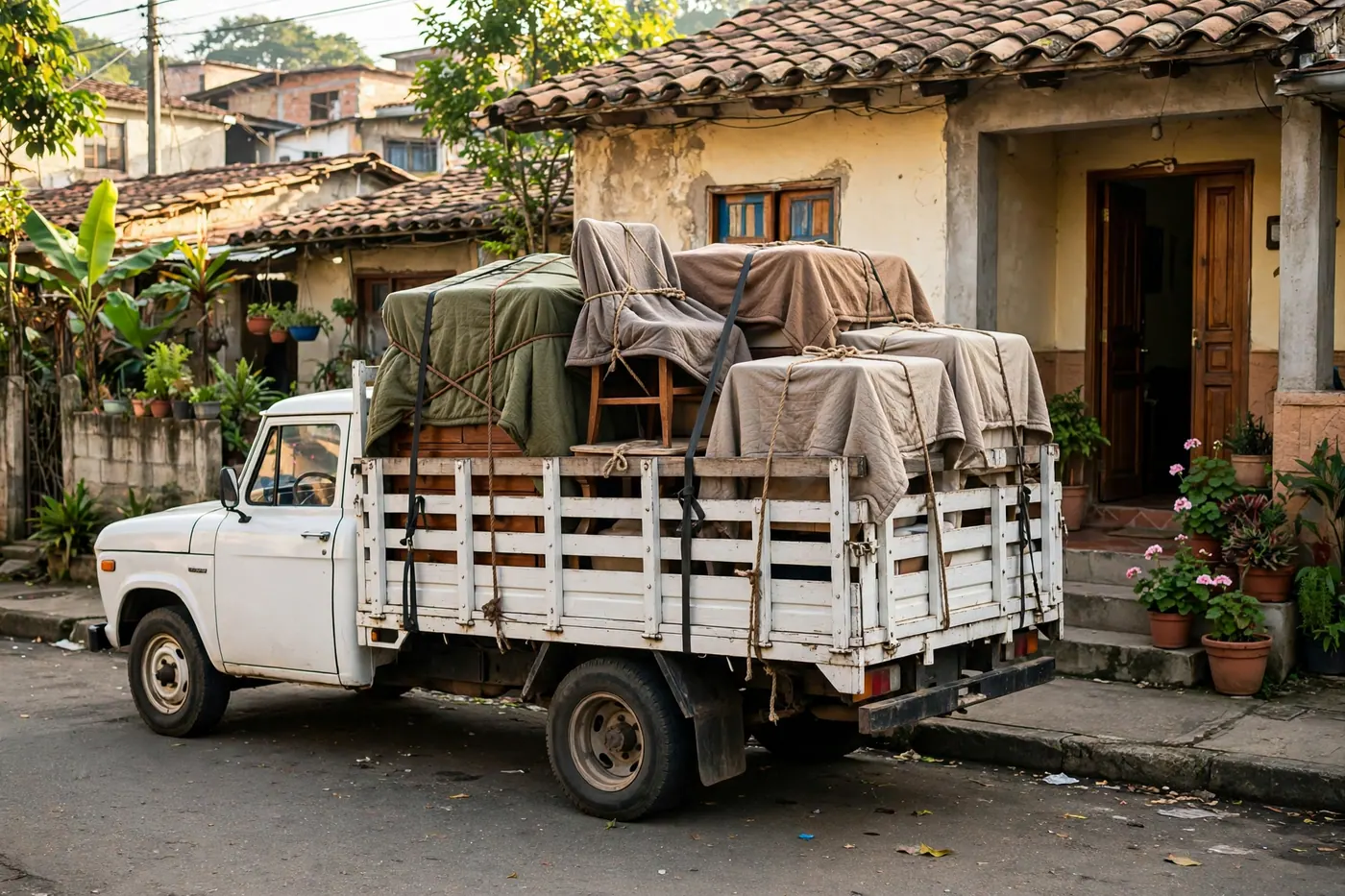
Organizing a move in Colombia often sparks a recurring concern among tenants, property owners, and transporters: can the National Police impound the truck or seize furniture for not carrying a moving permit? Myths circulate on social media and community forums about supposed notarial authorizations or mandatory police inspection stamps that end up causing delays and unnecessary payments to fake intermediaries.
The legal reality in the country is different and much simpler. Although national legislation has eliminated most prior requirements for moving personal belongings, there are district regulations on nighttime hours, highway protocols before the Directorate of Traffic and Transportation (DITRA), and internal building regulations that you must coordinate precisely before loading the first piece of furniture onto the truck.
Does a moving permit exist in Colombia? The legal truth behind the Anti-Red Tape Law
At a national level in Colombia there is no general mandatory police moving permit for moving during the day. The figure of a mandatory notarial permit applies in foreign legislations (such as in Chile), but in Colombia, administrative simplification regulations changed this landscape.
Under Law 962 of 2005 and Decree Law 019 of 2012 (known as the Anti-Red Tape Law), administrative and police authorities are prohibited from requiring permits, neighborhood letters, or prior authorizations not expressly contemplated by a national law for the daytime transport of furniture, appliances, and household goods.
In practical terms: if you pack your belongings and move them from one neighborhood to another at ten in the morning within the national territory, no police quadrant can demand a permit issued by a police station. However, this freedom of daytime transit does not exempt you from complying with two fundamental exceptions: municipal time restrictions for security and property road controls against residential theft.
Moves in Bogotá and Medellín: Time restrictions and nighttime permits
Although the national government eliminated the daytime permit, municipal and district mayors retain constitutional public order powers. This means that in the country's two main cities, specific local rules apply to the nighttime transport of goods:
1. Bogotá D.C. and District Decree 495 of 2002
In Bogotá, Article 2 of District Decree 495 of 2002 establishes a strict circulation restriction: the transport of moves and gas cylinders is prohibited between 6:00 p.m. and 6:00 a.m. the following day, seven days a week.
If you schedule your move within the daytime window between 6:00 a.m. and 6:00 p.m., you do not need any type of permit issued by the Mayor's Office or the Bogotá Metropolitan Police. The nighttime prohibition seeks to prevent clandestine moves associated with home theft during low-visibility hours.
2. Medellín and the procedure before Police Inspections
In Medellín, the Mayor's Office regulates the procedure called Permit for the transport of household goods during nighttime hours, managed by the Secretariat of Security and Coexistence through the Single System of Procedure Information (SUIT).
If for operational reasons you need to carry out the move during the night, you must file an in-person request at least one business day in advance at the Police Inspections (for example, at the central headquarters of the La Alpujarra Administrative Center on Calle 44 # 52 - 165, or at Police Inspection 1 Santo Domingo on Carrera 32 # 101 - 283). The usual requirements include:
- Formal letter addressed to the inspection explaining the reasons for the nighttime move.
- Exact address of the origin property and the destination place.
- License plate, model, and characteristics of the cargo or transport vehicle.
- Name, ID number, and phone number of the driver and the owner of the household goods.
- Detailed inventory of the goods that will be transported.
This procedure in Medellín is free at the district level, allowing for logistics coordination without incurring police fines.

Inter-municipal highway moving: Mandatory documents for Police (DITRA) checkpoints
When you move between different municipalities or departments, the truck passes through Traffic and Transportation Police (DITRA) checkpoints. At these points, highway agents are not looking for a non-existent national permit, but verifying that the goods do not come from theft or smuggling.
To avoid delays or preventive impoundments, the driver and the owner of the move must carry a folder with the following supporting documents:
| Document | Issued by | Purpose before the authority |
|---|---|---|
| Detailed inventory of household goods | Owner of the move | List of appliances, furniture, and boxes, signed with ID and contact phone number. |
| Identity document | National Registry (Registraduría) | Citizenship or alien ID card of the holder who is traveling or authorizing the freight. |
| Proof of origin and destination | Landlord / Notary / Building Administration | Copy of the terminated lease contract, payment release certificate, or contract for the new property. |
| Land cargo shipment | Authorized transport company | Cargo manifest that covers the legal inter-municipal freight of goods. |
| Vehicle documentation | RUNT / Insurers / CDA | Valid SOAT, certificate of mechanical technical inspection, and vehicle registration card. |
If you are traveling in a private van or a truck belonging to an acquaintance, an authorization letter from the owner with a handwritten signature is crucial to prove that it is not unauthorized commercial freight or irregular theft.
Moves in residential complexes: Law 675 of 2001 and payment release certificate
Beyond police regulations, the most common friction when moving occurs at the security gates of buildings and gated communities subject to Law 675 of 2001 (Horizontal Property Regime). Co-ownerships have the power to regulate the use of common areas, which includes setting coexistence manuals.
In practice, almost all administrations require:
- Prior written notice: filed days in advance to coordinate the arrival of the truck and reserve the freight or service elevator.
- Specific hours: most regulations restrict moves to business days and Saturdays (typically from 8:00 a.m. to 5:00 p.m.), prohibiting truck entry on Sundays or holidays.
- Guarantee deposit: a sum of money temporarily consigned to the co-ownership to respond for possible scratches on walls, damage to elevator mirrors, or misalignment of vehicle gates.
A critical legal point: can the administration or the private security company physically retain the furniture if the tenant or owner owes administration fees? The Constitutional Court's response has been emphatic: no. Withholding property through self-help measures violates fundamental rights such as freedom of movement and due process. Debts for common expenses must be collected through standard legal channels (executive proceedings before civil courts), without building management being allowed to prevent your belongings from leaving.
To leave the property without contractual trauma, review the recommendations for creating a delivery and clear-to-leave record when ending your lease.
Practical checklist before loading the moving truck
Planning your move in advance avoids road surprises and misunderstandings with building administrations. Follow this checklist before starting the loading process:
- Check the district schedule: if you are moving in Bogotá, schedule the departure and arrival to take place between 6:00 a.m. and 6:00 p.m. If you are in Medellín and need to do it at night, obtain the permit from the Police Inspection.
- Draft a signed inventory: print two copies detailing home appliances (brand and color if possible), number of bundles or boxes, and main furniture pieces.
- Request a clear-to-leave document from the building/complex management: coordinate with administration regarding the use of elevators, wall protectors, and the required security deposit.
- Check the vehicle's paperwork: confirm that the driver has an up-to-date SOAT (compulsory insurance), a valid technical-mechanical inspection in the RUNT, and a license suitable for the truck's category.
- Hire services with verified coverage: agree upon clear conditions for packing, loading personnel, and estimated delivery time.
How to hire or offer direct moving services in Colombia
In the local transport market, users often face intermediaries who inflate freight prices or informal carriers who lack basic tying and protection equipment. On the other hand, drivers with stake-sided vans and small trucks look for direct trips without losing commission percentages to third-party apps.
If you have a freight vehicle and wish to make your local or inter-municipal routes profitable, it is best to put coverage, loading personnel, and what is included in the freight rate in writing.
According to active ads on Colombia Move (September 2026), the moving category has 0 active listings and a supply gap, with demand for direct searches.
Frequently asked questions
❓ Is it mandatory to ask for a Police permit to carry out a move in Colombia?
No, for moves carried out during daytime hours (6:00 a.m. to 6:00 p.m.) no safe-conduct or general police permit is required nationwide. Anti-red tape laws (Law 962 of 2005 and Decree 019 of 2012) eliminated prior authorizations to move personal effects, and that rule remains in force as of September 2026.
❓ During what hours is it prohibited to carry out moves in Bogotá?
In Bogotá, District Decree 495 of 2002 is in effect, which prohibits moving transport between 6:00 p.m. and 6:00 a.m. the next day. Daytime transfers, from 6:00 a.m. to 6:00 p.m., do not require a district permit. That nighttime restriction remained in effect when checking the regulation in September 2026.
❓ How is a nighttime moving permit processed in Medellín?
You must file an in-person request with the Police Inspections of the Secretariat of Security and Coexistence one business day in advance. Attach an explanatory letter, inventory of goods, driver's information, and the truck's license plate. The Medellín Mayor's Office file, consulted in September 2026, indicates a response within one business day and at no official cost.
❓ What documents can the Highway Police demand for a safe move?
The Traffic Police usually ask for the signed inventory, the owner's ID, and the vehicle's paperwork. They also check for origin or destination support, such as the lease agreement or the clear-to-leave document, plus the current SOAT and technical-mechanical inspection. That package shows the origin of the belongings at a checkpoint, according to the practice described as of September 2026.
❓ Can the building management prohibit me from moving my belongings out if I owe administration fees?
No, the administration cannot physically withhold your belongings or prevent the truck from leaving due to administration debts. The Constitutional Court prohibits self-help measures and requires the collection to be carried out through judicial executive proceedings. That line, from Ruling T-424 of 1992 and Law 675 of 2001, remained in effect as of September 2026.
❓ How much does it cost to get an authorization or moving permit at the mayor's office?
In major districts like Medellín, the procedure for nighttime transport is free. In some small municipalities that manage local inter-municipal exit authorizations, minor municipal stamps may apply according to the current fiscal agreement. There is no single national rate; confirm the cost at your mayor's office, as of September 2026.
❓ Where can I offer my moving truck services or find haulers without intermediaries?
You can publish your vehicle or find carriers directly in the moving category and the services section on Colombia Move, agreeing on direct freight rates with clients without charging commissions. As of September 2026, that category had 0 active ads.

Comments
Loading comments...
Checking sign-in status...