
How to start a lunch box (corrientazo) business in Colombia: costs, permits, and dish pricing in 2026
Everything you need to open a corrientazo business in Colombia in 2026: step-by-step permits, real payroll and ingredient costs, dish pricing, and how to sell your menu directly without intermediaries.
IDIOMA DEL ARTÍCULO
Showing original language
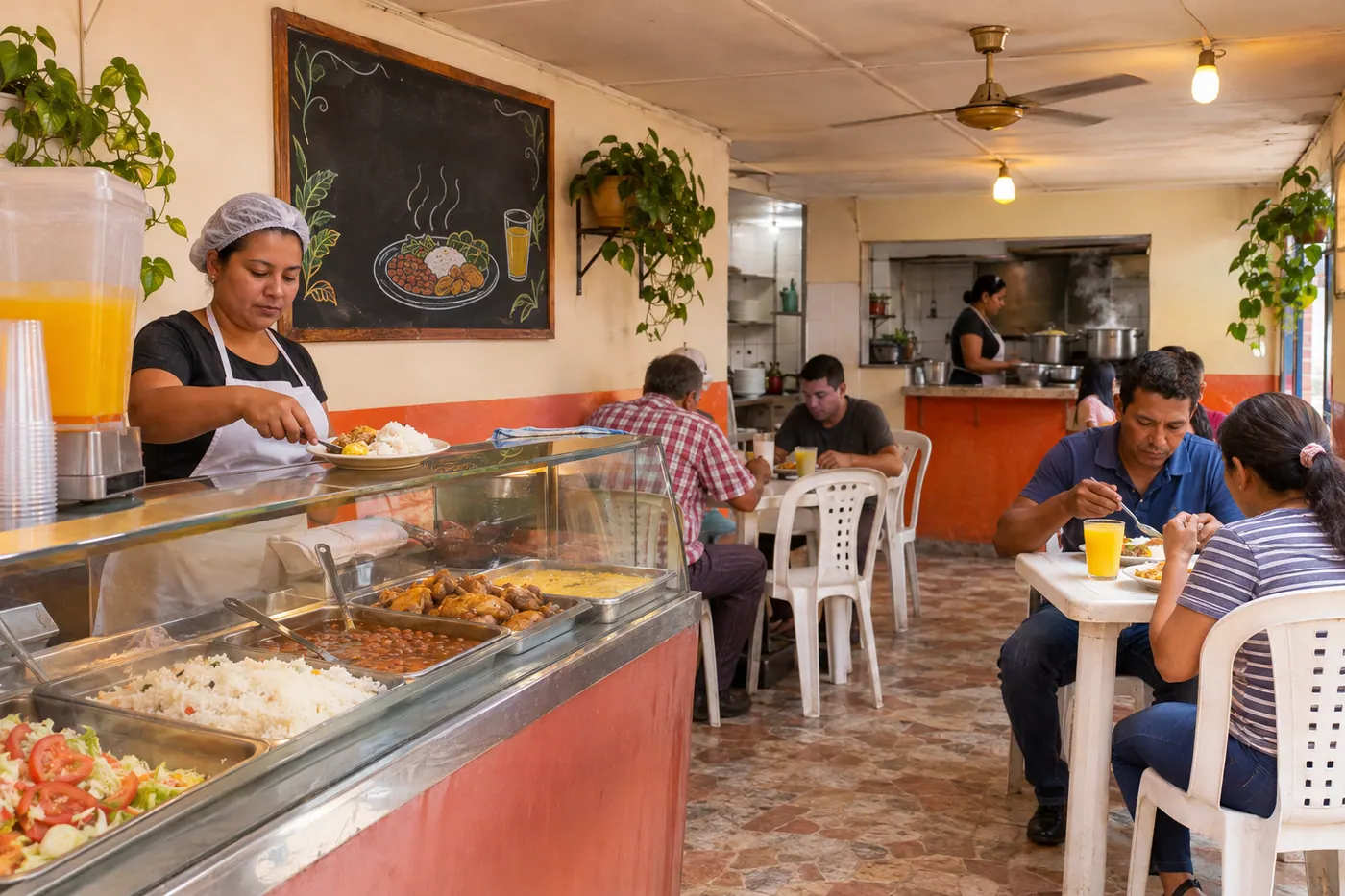
Starting a business selling executive lunches or affordable daily meals (corrientazo) remains one of the most direct ways to generate daily cash flow in Colombia, but opening your doors without clear accounting can eat up your capital in just a few months. In October 2026, the annual inflation rate for restaurants and hotels reached 9.39% according to DANE, and restaurant meals increased by 9.47% compared to the previous year. Against this backdrop, improvising dish prices or skipping permits comes at a high cost.
Quick answer to open legally
- Mandatory prior permits: compatible land use, valid commercial registration, and notice of opening to the National Police.
- Sanitary operation: sanitary concept from your local health secretary (not from INVIMA), annual medical certificate, and 10 hours of annual training for each food handler.
- 2026 Payroll: the minimum wage is $1,750,905, but an employee costs the employer (exempt from parafiscal contributions) approx. $2,715,573 per month.
- Reference price: an affordable daily meal (corrientazo) ranges between $14,000 and $22,000 depending on the zone and portion size.
The 5 permits you need before and during operation
Many people believe it is enough to rent a space, turn on the stove, and wait for customers. In Colombia, Article 87 of Law 1801 of 2016 (National Police Code) sets three prior requirements that must be met before opening to the public, in addition to sanitary and fire prevention requirements during operation.
First, check the land use of the property. The land use concept issued by the planning office or curatorship is merely informative and does not authorize you to operate on its own. If the space has residential use and you want to change it to commercial for a restaurant, you need a construction license under the adaptation modality; regarding the expenses of this process, ask the curator for the exact settlement. You can review the details in our guide on changing residential land use to commercial.
Second, you need the commercial registration for both you as a merchant and for the business establishment at the Chamber of Commerce, and you must renew it every year before March 31. Third, file the notice of opening with the commander of the police station or substation in your sector; it is a free procedure and is done only once.
Fourth, process the sanitary concept under Resolution 2674 of 2013 from the Ministry of Health. Pay attention to this detail because it is a common mistake: the sanitary permit for a restaurant is issued by the municipal or district health secretary, not INVIMA. Additionally, each food handler must have a medical fitness certificate at least once a year and complete 10 hours of annual training; there is no single national ID card. We explain how to prepare for that visit in what the health secretary checks for the sanitary concept.
Fifth, address the conditions for firefighters and fire prevention. According to Law 1575 of 2012 (Article 42), the firefighter certificate is not a national prior requirement to open according to Article 87 of Law 1801, but they do require prevention measures (valid extinguishers, signage, and clear exits) throughout the operation.
Step-by-step to formalize your space without wasting time
To avoid going in circles or paying fines, follow this logical order before signing the definitive lease agreement:
- Verify land use: confirm that restaurant activity is permitted at that address before handing over a deposit or adapting the kitchen.
- Register in the RUT and Chamber of Commerce: obtain your Single Tax Registry (RUT) with the DIAN for the food sales economic activity and register the business. According to Decree 045 of 2024, the minimum registration fee for a commercial establishment in 2026 is $48,400 (same jurisdiction and assets up to $78,715,000). For a microenterprise with $50 million in assets, the merchant registration costs approx. $448,070. Check the complete step-by-step in how to register commercial registration.
- File the opening letter with the Police: submit the official letter with the address and activity of the space and keep the receipt.
- Organize the sanitation plan and request a visit: keep up to date the cleaning programs, pest control, waste management, and the medical and training certificates of your team.
How much it costs to set up a corrientazo: initial investment and fixed expenses
There is no single universal figure because the setup changes radically between a small space in a white shell and one that already had a kitchen installed. Instead of guessing a fixed amount, divide your budget into three blocks: adaptation and installations (grease trap, exhaust hood, and countertops), kitchen equipment, and working capital for the first two months while you build your customer base.
In the monthly fixed expense, payroll is usually the heaviest item. For 2026, Decree 1469 of 2025 set the monthly minimum wage (SMMLV) at $1,750,905 and the transport subsidy at $249,095, for a total received of $2,000,000. However, for you as an employer exempt from parafiscal contributions, hiring someone at the minimum wage costs approx. $2,715,573 per month when adding pension (12%), ARL, compensation fund (4%), severance pay, interest, bonus, and vacation (and approx. $2,951,944 without exemption). Review the detailed calculation in how much an employee with minimum wage costs in 2026.
Worked example: how to cost a dish and set the price
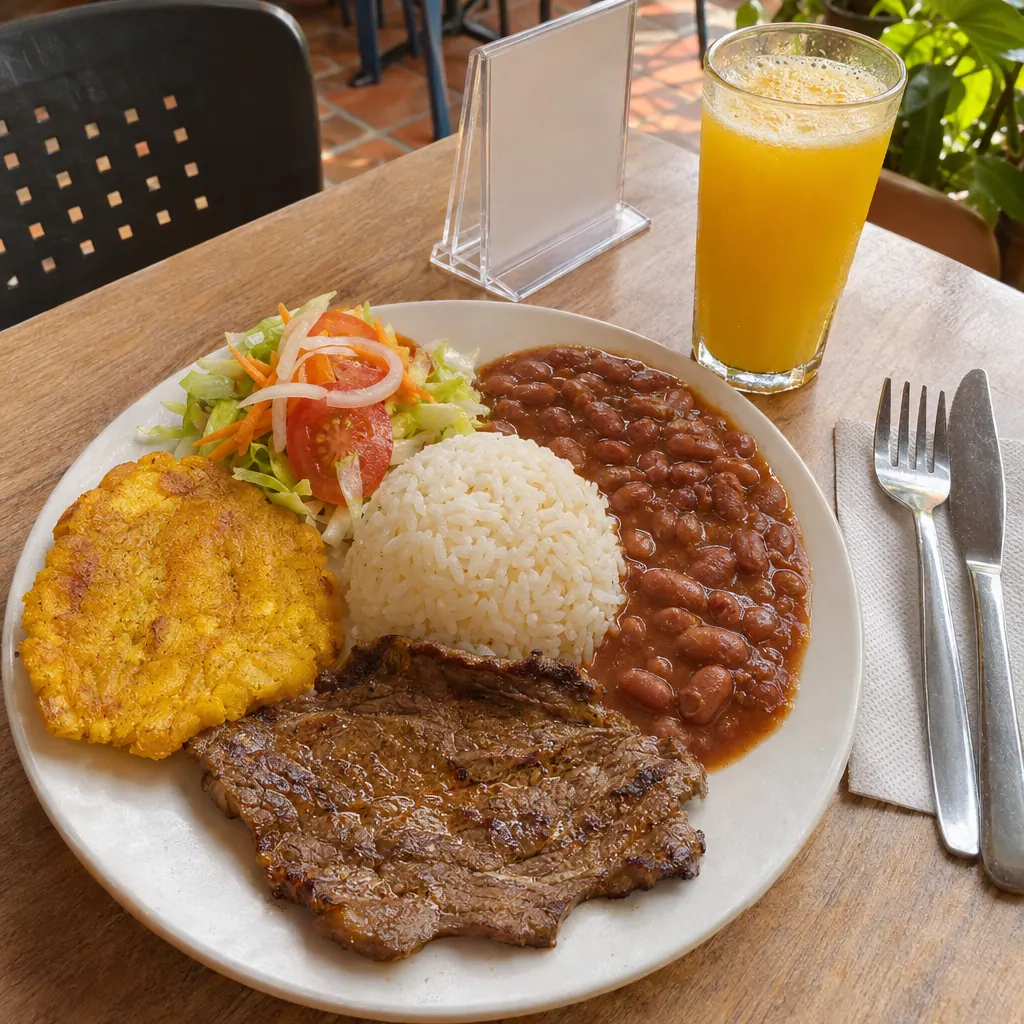
The most common mistake when setting up a corrientazo is calculating the cost by looking only at the meat or chicken. An analysis by La República with data from SIPSA/DANE showed that in October 2026, the estimated cost of ingredients for a complete individual portion (rice, meat, potato, plantain, salad, beans or egg, and juice) rose from $15,505 to $18,984 in one year (+22.44%). Although this figure reflects a broad basket of supplies and not your final sales price, it demonstrates why you must weigh and cost every gram according to your actual menu.
For a practical exercise of a standard popular lunch (soup, dry dish with moderate protein, and juice), set up your cost sheet like this:
| Dish component | What you must include in the calculation |
|---|---|
| Direct inputs | Portioned protein, rice, starch, salad, fried plantain or potato, soup, and fruit from the juice, adding shrinkage and oil. |
| Energy and disposables | Daily proration of gas, water, electricity, and packaging if you offer delivery. |
| Labor | Total monthly cost of the cook and waiter divided by the projected dishes per month. |
| Fixed expenses (overhead) | Rent, internet, and maintenance divided by the monthly volume of lunches. |
Suppose that between optimized raw materials, gas, labor, and prorated rent, your total cost per dish is around $11,500. If you want to leave a healthy margin of 30% to 35% for contingencies and real profit, you need to sell that lunch between $16,500 and $17,700. If you sell below your actual cost just to match the neighbor, you will work at a loss.
Corrientazo price in 2026 and what happens with taxes
In 2026, an affordable daily meal (corrientazo) in the country is sold in a reference range of $14,000 to $22,000 depending on the zone and portion size. If you are reviewing how the local market has moved, look at our analysis on the rise in lunch prices according to DANE.
In terms of taxation, keep in mind the National Consumption Tax (INC) of 8% regulated in articles 512-1 and 512-9 of the Tax Statute: it applies to all consumption in restaurants and must be itemized on the bill or invoice, although voluntary tips are not part of the taxable base. If you have doubts about whether your annual income volume meets the thresholds to be non-liable (such as the 3,500 UVT threshold of article 512-13 of the Tax Statute) and what type of electronic billing corresponds to you, confirm this with your accountant before you start charging.
Kitchen equipment: how to save by buying used without risking
Buying a new industrial stove, commercial refrigerator, stainless steel countertops, and high-power blender can double your initial investment. A smart strategy to start with less financial pressure is to get used equipment in good condition and check the available options in the category of machinery and gastronomy equipment on Colombia Move, where you can compare models and speak directly with the seller.
Before closing any deal, ask for startup tests, check refrigeration seals, avoid advance transfers without seeing the equipment working, and arrange for in-person delivery. If later you renew your kitchen or decide to sell a refrigerator you no longer use, you can also read our guide on how to sell used gastronomy equipment in Colombia. And if you want to see how the local supply of dishes and drinks moves, explore the food section or the prepared food.
Designed to sell in Colombia with more clarity.
Frequently asked questions
❓ How much does it cost to open a lunch business in Colombia?
There is no single figure because it depends on the zone, rent, and whether the space already has a kitchen. In Chamber of Commerce procedures, the minimum establishment registration in 2026 starts from $48,400 for assets up to $78,715,000, and for a microenterprise with $50 million in assets, the merchant registration is around $448,070 (check the official source).
❓ Does INVIMA give me the sanitary permit for the restaurant?
No, INVIMA does not issue the sanitary concept for restaurants or cafeterias in Colombia. This procedure corresponds to the municipal or district health secretary of your jurisdiction under Resolution 2674 of 2013, prior to a technical inspection visit to the establishment (check the official source).
❓ How much does it cost to hire a cook with minimum wage in 2026?
The 2026 minimum wage is $1,750,905 plus $249,095 for transport subsidy, for a total of $2,000,000 received by the worker. When adding social benefits, pension, ARL, and compensation fund, the total monthly cost for an exempt employer is approx. $2,715,573 (check the official source).
❓ Should I charge VAT or consumption tax on my corrientazo?
Restaurant service is taxed with the National Consumption Tax (INC) of 8% on the sale value, excluding voluntary tips according to article 512-9 of the Tax Statute. You must itemize it on the bill or invoice, and validate with your accountant if you apply to the non-liable regime (check the official source).
❓ How do I sell my equipment or menu with confidence and avoid fraud?
The best practice is to deal directly with each interested buyer or seller, confirm their identity, and arrange in-person deliveries for machinery or cash-on-delivery payments for lunches. Keeping the conversation clear on WhatsApp and never delivering advances without verifying the product reduces risk in any negotiation.
❓ Where can I publish the daily menu or kitchen equipment to sell more?



Comments
Loading comments...
Checking sign-in status...