
Footwear and Work Uniform Allowance in Colombia: Dates, Requirements, and Penalties for Employers (2026 Guide)
Everything an employer in Colombia needs to know about footwear and work uniform allowances: mandatory delivery dates, the 2 SMLMV salary limit, the validity of vouchers, and legal penalties.
IDIOMA DEL ARTÍCULO
Showing original language
Complying with labor obligations in Colombia goes beyond paying the payroll and registering employees for social security on time. One of the points that generates the most operational doubts and frequently results in fines from the Ministry of Labor is the provision of footwear and work uniforms. Far from being a gift or a business courtesy, this is a social benefit in kind, expressly regulated by the Substantive Labor Code (CST).
For anyone with staff in their charge—from a micro-enterprise with three operators to someone hiring support for general services—making the mistake of paying this benefit in cash or missing legal deadlines can be quite costly. Below, we review how the calendar works, which employees are eligible, the differences compared to safety equipment, and how to manage the delivery without administrative hurdles.
Quick answer: when and how is the legal uniform delivered?
General rule: Every employer who permanently employs one or more workers is obligated to provide, free of charge, every four months, one (1) pair of shoes and one (1) work uniform to those who earn up to two (2) Legal Monthly Minimum Wages (SMLMV) and have completed at least three (3) months of continuous service by the date of each cutoff.
Fixed and non-extendable delivery dates (Art. 232 CST):
- April 30
- August 31
- December 20
Absolute prohibition: Article 234 of the CST prohibits paying for the uniform in money via payroll. It is only permitted to deliver the items physically or through corporate uniform vouchers or cards that are not exchangeable for cash.
Eligibility requirements: who has the right to the uniform?
The mandatory supply of footwear and clothing does not cover the entire workforce of a company. Law 11 of 1984 and Article 230 of the CST establish three joint and indispensable conditions for the right to arise:
- Salary ceiling: The worker must earn an ordinary monthly remuneration of up to two (2) SMLMV. For 2026, with a minimum wage set at COP 1,750,905, the maximum threshold for accrual is set at COP 3,501,810. If you have questions about how payroll costs are structured, you can check our guide on how much an employee with a minimum wage costs in 2026.
- Minimum length of service: The employee must have accumulated more than three (3) months of continuous service for the employer on the date set for delivery. Those who have been employed for less time on that specific date must wait until the next four-month cutoff.
- Subordinate labor contract: This applies to any type of employment contract (fixed-term, indefinite term, or for a specific work or task). This obligation fully covers daily workers and domestic employees, as we explained when reviewing how to hire a domestic worker by the day with social security. It does not apply to independent contractors linked through civil or commercial service provision contracts. In fact, providing uniforms with identifying marks to a contractor can constitute strong evidence of a reality-based employment contract.
Mandatory calendar and frequency of deliveries
Article 232 of the Substantive Labor Code sets three unchangeable dates during the calendar year. It is not legal to accumulate deliveries to make a single purchase at the end of the year, nor to reschedule them due to liquidity or cash flow issues:
- First delivery: No later than April 30.
- Second delivery: No later than August 31.
- Third delivery: No later than December 20.
What happens with an employee who started, for example, on February 15? By April 30, they will have completed only two and a half months of service, so they legally do not meet the three-month requirement for that cutoff. Their first regulatory uniform must be delivered at the following cutoff, that is, on August 31.
For micro-entrepreneurs managing small teams, a lack of planning in textile purchases often causes trouble. According to the active ads on Colombia Move (September 2026), the clothing and footwear section shows an active supply of fewer than 5 listings in key work categories, which demonstrates that most employers purchase their items in a scattered manner and pay unnecessary intermediaries instead of contacting vendors and direct manufacturing workshops.

Package content and the prohibition of paying in money
The minimum package required by law for each four-month delivery consists of:
- One (1) pair of shoes suitable for the work performed.
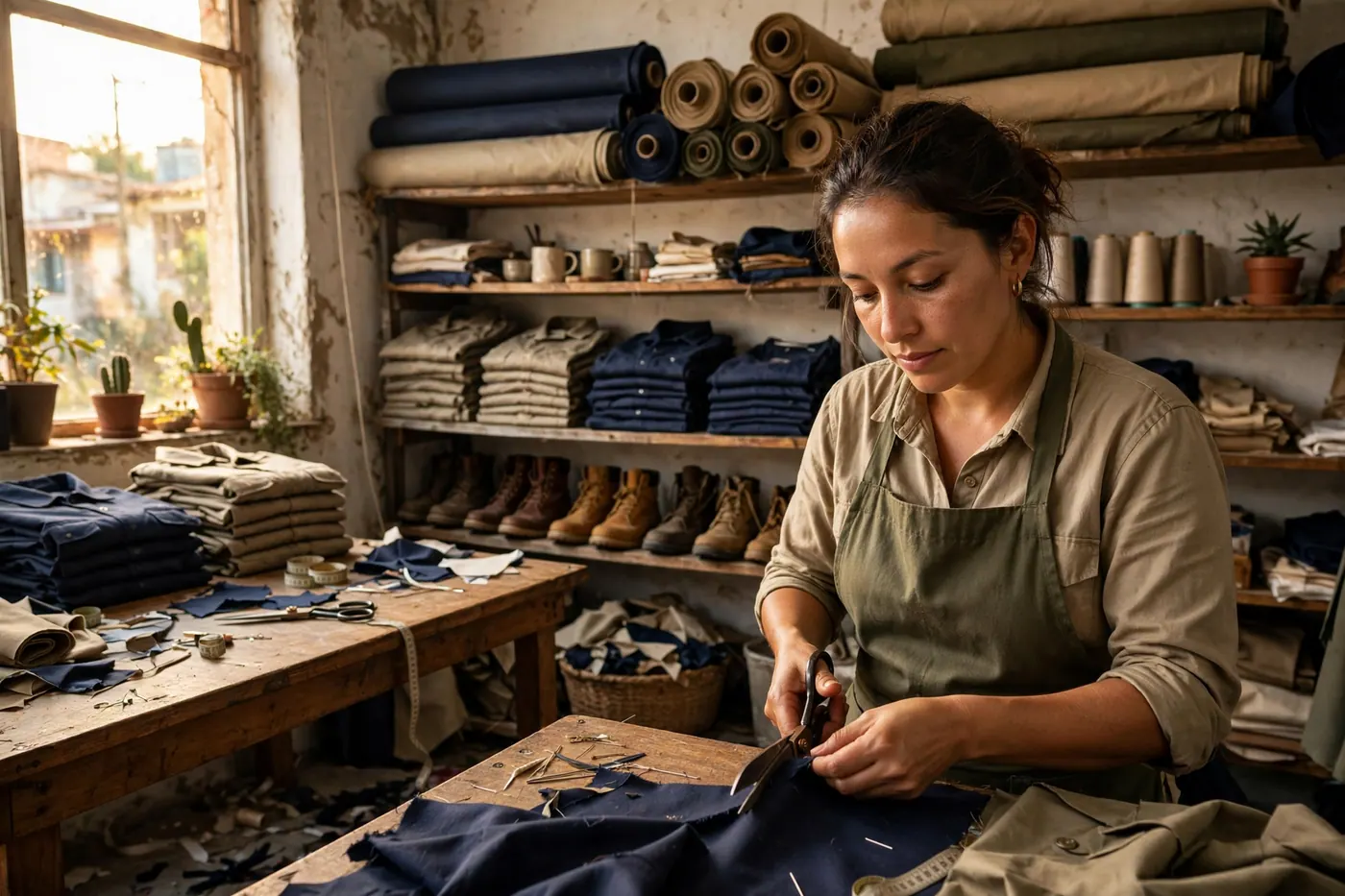
- One (1) work uniform suitable for the conditions of the activity and the climate where the service is provided (generally pants and shirt/blouse, coveralls, or resistant apron).
The most delicate aspect and where novice employers fail the most is the prohibition of compensation in money. Article 234 of the Substantive Labor Code strictly points out that it is forbidden for employers to pay the uniform provision in cash.
If an employer includes an cash amount for the uniform in a biweekly or monthly payroll, they are committing a serious offense. That money will be considered ordinary salary in the face of any judicial claim, and the employer will still owe the physical uniform in kind.
Are store vouchers or uniform cards valid?
Yes. The Ministry of Labor, through reiterated doctrine (including recent concepts such as File 23920 of 2025), has endorsed the use of physical vouchers or corporate prepaid cards, provided they meet strict conditions:
- They must be nominative, personal, and non-transferable.
- They cannot be exchangeable, either in whole or in part, for cash.
- Their use must be restricted exclusively to authorized merchants for the acquisition of clothing and footwear compatible with the company's tasks.
- They cannot be used to buy food, liquor, appliances, or other general consumer goods.
Legal uniform vs. Personal Protective Equipment (PPE)
It is very common that in sectors such as construction, gastronomy, cleaning, or mechanical workshops, the Substantive Labor Code uniform is confused with Personal Protective Equipment (PPE). However, their legal framework and purpose are completely different:
| Criterion | Legal uniform (CST Art. 230) | Personal Protective Equipment (PPE) |
|---|---|---|
| Purpose | Clothing and footwear to perform the job while protecting the worker's personal garments. | Shielding physical integrity against specific risks in health and safety at work. |
| Base regulation | Substantive Labor Code (Decree Law 3743/1950 and Law 11/1984). | Resolution 2400 of 1979, Law 9 of 1979, and Decree 1072 of 2015 (SG-SST). |
| Salary ceiling | Only for workers who earn up to two (2) SMLMV. | No salary limit: mandatory for every worker exposed to the risk. |
| Waiting period | Requires more than 3 months of service prior to the cut-off date. | From the first minute of the first day of work. |
| Frequency | Every 4 months (April, August, December). | Immediate, based on technical wear and tear or the manufacturer's expiration date. |
| Examples | Drill pants, polo shirt, comfortable leather shoes. | Steel-toe or dielectric boots, helmets, safety goggles, nitrile gloves, harnesses. |
Mandatory use and delivery records: how to protect your company
Supplying uniforms is not a one-way process. Article 233 of the Labor Code (CST) establishes a fundamental rule for a company's internal discipline: the worker is required to use the uniforms received.
If the employee chooses to wear their own street clothes and refuses to use the garments provided for the workday, the employer is legally authorized to not provide them with the uniform for the following four-month period. To make this measure effective without legal risks, it is essential to:
- Deliver the clothing using a formal uniform delivery record, which includes the date, the exact description of the garments, the size supplied, and the employee's legible signature.
- If non-use is detected, issue a written warning, keeping a formal record and allowing for a response before the date of the next cut-off.
- Notify the employee in writing that, in accordance with Article 233 of the CST, they have lost the right to the supply for the next four-month period for failing to use the garments from the previous period.
Ministry of Labor sanctions and indemnifications
Ignoring the four-month deliveries or not keeping properly signed receipts entails significant financial risks:
- Administrative fines from the Ministry of Labor: In the exercise of its inspection and oversight powers (Law 1610 of 2013), the Ministry of Labor may impose sanctions ranging between 1 and 5,000 SMLMV, graduated based on the size of the business and recidivism. As is the case with other employer obligations (as we reviewed in the analysis of electronic payroll sanctions with the DIAN), the lack of supporting documentation is the main cause of sanctions.
- Indemnification for contract termination: The Labor Cassation Chamber of the Supreme Court of Justice (Sentence 17094) has reiterated that, once the employment contract has ended, the employer cannot deliver overdue clothing in kind. If the former employee sues for the omission, a claim for damages may proceed, provided that the employee demonstrates to the judge that they had to purchase and spend money on their own clothing to perform the contracted functions.
Frequently asked questions
❓ Can I pay the uniform allowance in the biweekly paycheck so the worker can buy what they like?
No, Article 234 of the Labor Code expressly prohibits compensating or paying the uniform allowance in cash while the employment contract is in effect. Payment in money does not extinguish the employer's obligation; it is calculated as current salary and leaves you exposed to having to provide the physical garments again or face fines from the Ministry of Labor.
❓ What happens if the worker quits or is fired and the uniform was never delivered?
Upon termination of the employment relationship, the employer can no longer deliver uniforms or footwear in kind to compensate for past periods. The worker can claim damages in labor court, but according to the Supreme Court of Justice jurisprudence, consulted in 2026, it is up to them to demonstrate the material damage suffered by having to pay out of their own pocket for the clothing required to work.
❓ Is it safe to use prepaid cards or store vouchers to provide the uniform?
Yes, they are fully valid according to the reiterated doctrine of the Ministry of Labor, provided they are personal, non-transferable, and not exchangeable for cash. Additionally, they must be technically restricted so that they can only be redeemed for work clothing and footwear at authorized stores or clothing suppliers.
❓ If an employee earns more than two minimum wages, can the company require them to buy their own corporate uniform?
No, if the company requires the mandatory use of an institutional uniform or garments with branding for employees who earn more than 2 SMLMV, the cost must be fully assumed by the employer. The two-minimum-wage threshold defines the legal social benefit of the current CST in 2026, but no rule authorizes transferring corporate image operating costs to the worker's salary.
❓ Can I deduct the cost of the uniform from the final settlement if the employee does not return the uniforms?
It is not permitted to deduct ordinary uniforms already worn out from use from the settlement. There is only one exception if there is an express prior clause regarding high-value technical equipment with a signed inventory. Any deduction not expressly authorized by the law in force in 2026 or by the worker in writing may be qualified as illegal withholding of wages.
❓ Where can companies and workshops publish or quote work clothing and footwear in Colombia without commissions?
Textile workshops, independent manufacturers, and footwear distributors can publish their catalogs directly in the clothing and footwear section of Colombia Move without paying commission percentages. This allows small and medium-sized enterprises to quote directly with local producers via WhatsApp to supply their April, August, and December deliveries.



Comments
Loading comments...
Checking sign-in status...