
How to Identify Counterfeit Banknotes in Colombia and Avoid Fraud When Receiving Cash in Sales
A practical guide for private sellers in Colombia: learn the official methodology of the Banco de la República to verify cash and avoid scams during in-person deliveries.
IDIOMA DEL ARTÍCULO
Showing original language
Selling second-hand items in person remains one of the fastest ways to get liquidity in Colombia. Whether you are handing over a cell phone, a laptop, a furniture set, or a motorcycle, cash-on-delivery is usually the preferred method to avoid banking delays. According to active listings on Colombia Move (September 2026), there are 11 cell phone ads, 9 for computers, and 6 for motorcycles—exactly the categories where cash-on-delivery is most common. However, closing a face-to-face deal with strangers carries a silent risk: receiving counterfeit or adulterated paper money.
Scammers know that during an in-person delivery, the seller is focused on the conversation, the condition of the product, and their surroundings, which creates the ideal moment to slip in fraudulent bills in high denominations like $50,000 or $100,000 pesos. If you know exactly what to look for before handing over the item, you can verify any stack in a matter of seconds without having awkward moments.
The official method of the Bank of the Republic: five foolproof steps
The Bank of the Republic of Colombia (BanRep) designs the current family of banknotes with multilayer security technology. To verify the authenticity of any piece on the street or at your home, the entity recommends applying the five-action rule: Look, Touch, Lift, Tilt, and Check.
| BanRep Step | What to look for in an authentic bill | Red flag in an imitation |
|---|---|---|
| 1. Look | Intense colors, sharp lines, clean contrasts, and legible text without smudges. | Running ink, dull colors, or blurry details on the edges and faces. |
| 2. Touch | 100% cotton fiber paper, rough to the touch, resistant, and with marked high relief on text and figures. | Smooth or satin bond-style commercial paper, with no texture on the main inscriptions. |
| 3. Lift | Against the light, you can see the three-dimensional watermark of the historical figure and the matching "BRC" text. | Watermark printed with flat white ink or elements that are misaligned when looking against the light. |
| 4. Tilt | Drastic color change (green to blue) and optical effect of circular movement in magnetic inks. | Fixed shiny ink with glitter or static metallic prints that do not change tone. |
| 5. Check | Sharp microtext visible with a magnifying glass and fluorescent fibers under ultraviolet light. | Bills that do not react to UV light or have generalized fluorescence across the entire paper surface. |
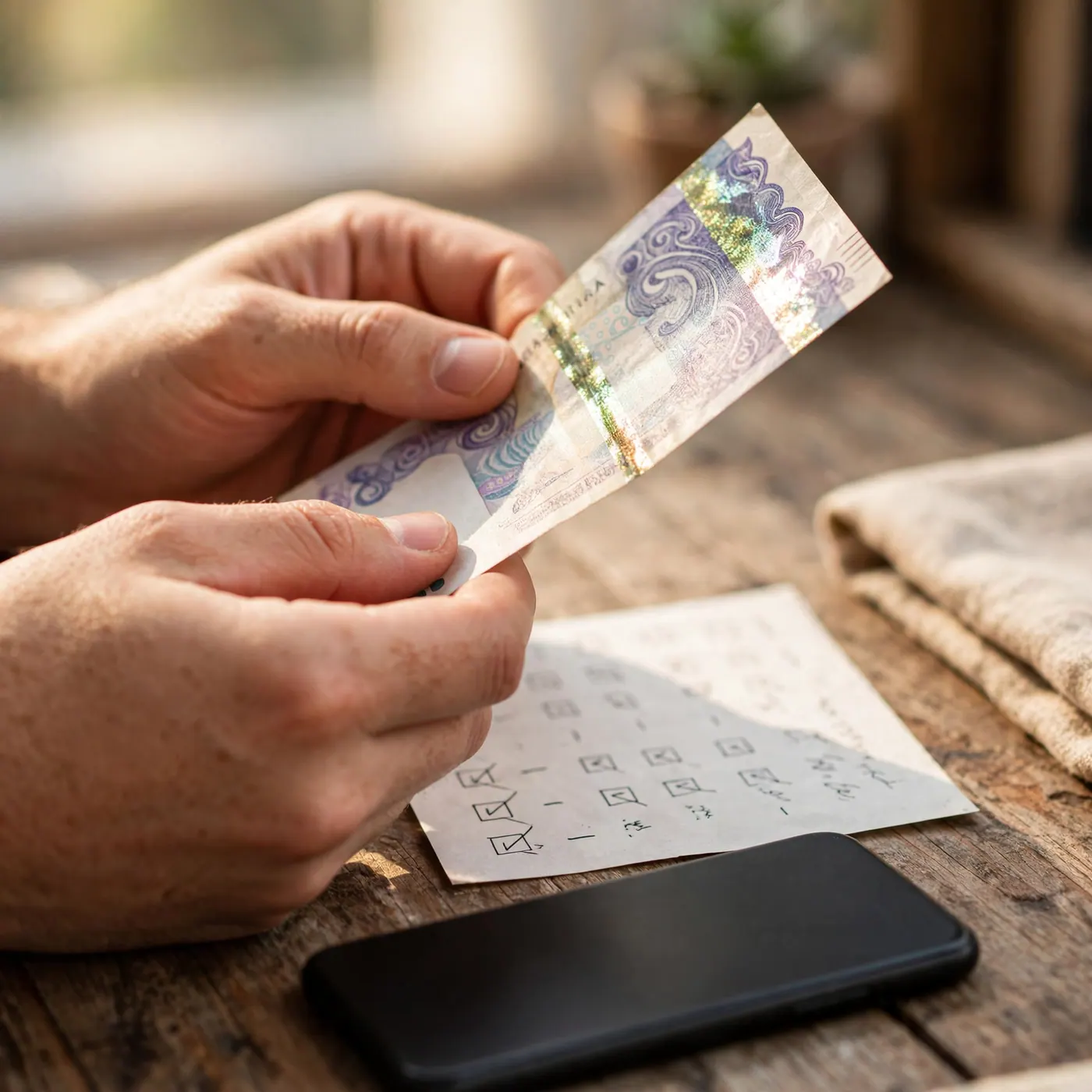
In fast second-hand transactions, you don't always have an ultraviolet lamp or a magnifying glass. Therefore, the fastest and most effective filter for any seller is to combine Touch + Tilt: the embossed texture of the cotton fiber and the dynamic color change in the central figure are almost impossible to replicate with quality in clandestine printing shops.
How to check $100,000, $50,000, and $20,000 bills in seconds
High-denomination bills are the most common targets for counterfeiting rings due to the profit margin they get from each fraudulent transaction. Knowing the distinctive features of each will allow you to validate them instantly:
$100,000 bill (predominantly green)
Dedicated to President Carlos Lleras Restrepo and the Cocora Valley with the wax palm. When receiving it, focus on two key elements:
- Sietecueros flower (when tilting): Located on the obverse to the left of the figure. When tilting the bill in front of your eyes, the color changes cleanly from green to intense blue, while an inner circle shifts with the movement.
- Security thread: When moving the bill, the integrated security strip changes from fuchsia to a greenish-yellow tone.
- High relief: Run your fingertips over the text "100 MIL PESOS" and over the suit of Dr. Lleras Restrepo; you will notice a rough and unmistakable relief.
$50,000 bill (predominantly violet)
Pays tribute to Nobel laureate Gabriel García Márquez and Ciudad Perdida. It is one of the denominations with the highest circulation volume in local trade:
- Hummingbird feeding on a flower (when tilting): When moving and tilting the piece, the bird changes from green to blue, revealing a bright green circle that appears to float inside it.
- Watermark and burgao snail: When lifting the bill against natural light, you can see the face of Gabo with soft three-dimensional shadows, accompanied by the figure of the burgao snail that fits perfectly with the print on the reverse.
- Relief text: The words "BANCO DE LA REPÚBLICA" and the silhouette of the standing Nobel laureate have a pronounced texture.
$20,000 bill (predominantly orange)
A tribute to President Alfonso López Michelsen and the pre-Hispanic channels of La Mojana:
- Custard apple (anón) fruit (when tilting): The fruit stamped on the obverse changes from green to blue when moving the surface.
- Vueltiao hat: When lifting the bill, the texture and graphic details of the typical hat complement each other against the light with millimeter precision.
The 4 most common deception methods in classified deliveries
Identifying counterfeit bills isn't just about looking at the paper; it also implies anticipating the behavior of malicious buyers. According to recurring security reports in private trade, these are the most repeated tactics:
- The sandwich bill: The buyer gives you a stack of money where the outer bills (the first and the last) are authentic, but the inside is composed of crude copies or smaller denomination bills folded strategically. Golden rule: count and feel every bill one by one, regardless of the apparent rush.
- Induced haste and distraction: They arrive in a running vehicle, constantly looking at their watch, talking loudly on the phone, or asking you to pack quickly because they are poorly parked. The intentional hurry is meant to make you put the money in your pocket without checking it.
- The immediate switch: This happens when the scammer pretends to regret the purchase after giving you the money, asks for the cash back to check it, and then, in a quick sleight of hand, returns fake bills to you while canceling the transaction or insisting on negotiating a discount.
- Mixed payment with adulterated receipt: They show you a fake screenshot of a financial app claiming they only missed transferring a part, and they complete the remaining balance with suspicious stacks of bills so that the confusion prevents verifying both amounts with rigor. If you post on open platforms, check where to sell used items in Colombia with best practices to safeguard your deals.
Do fake banknote detector markers work?
Many merchants resort to pens or iodine-based chemical marker pens that mark amber on authentic bills and black or purple on ordinary paper. Although they can serve as a first superficial filter for printouts on office bond paper, they are not an infallible method.
Criminal organizations often use bleached paper or chemically 'washed' low-denomination genuine bills to print $50,000 or $100,000 values on them. In these cases, the marker will mistakenly detect genuine cotton fiber. The definitive test will always be to verify the tactile relief, the watermark against the light, and the color change when rotating the piece.
Security protocol for closing cash sales without setbacks
If you are going to close an in-person sale for a significant amount, follow these preventive steps to protect both your finances and your personal safety:
- Choose a monitored meeting point: Avoid lonely alleys, desolate bus stops, or nighttime appointments. Arrange the delivery in the food court of a shopping mall with security cameras or in the vicinity of a National Police CAI.
- For sums exceeding one million pesos, use a teller or ATM: Agree to meet directly inside a bank branch. Ask the buyer to deposit the money into your account using an automatic multifunctional ATM before handing over the product. The ATM electronically validates the authenticity of each bill before crediting it.
- Verify first, deliver later: Keep the product in your possession while you count and carefully check every bill. Do not release the item until you are absolutely certain of the full payment.
- Stay calm in the face of a doubtful bill: If you detect a suspicious piece, do not enter into violent confrontations. With a neutral and firm tone, say: "This bill does not pass the security test; please exchange it for another or we can perform the transfer via a verified digital channel". If the person becomes aggressive or evasive, cancel the deal immediately and move to a safe area.
Frequently asked questions
❓ What is the fastest way to know if a 50 thousand or 100 thousand bill is fake?
Touch the relief and rotate the bill: the hummingbird or the flower must change from green to blue. Do it in less than five seconds, in full light, before handing over the item.
❓ Does the chemical marker work to detect fake bills in Colombia?
The chemical marker detects common cellulose paper but can fail against washed or adulterated genuine bills; therefore, it should always be complemented with the tactile and visual review from the Banco de la República.
❓ What should I do if a buyer hands me a fake bill during a sale?
Reject the bill calmly by requesting another payment method or an authentic bill, and if you perceive evasive or intimidating attitudes, suspend the delivery immediately without exposing yourself to physical confrontations.
❓ Can I go to a bank to exchange a fake bill that I received by mistake?
No, banking entities in Colombia retain and seize counterfeit bills under an official record without refunding their value, sending them to the Banco de la República for their definitive destruction.
❓ Is it a crime to pay again with a fake bill if I was a victim of a scam?
Yes: knowingly recirculating a fake bill is a crime in Colombia. According to the Penal Code (Law 599 of 2000, consult 2026), hand it over to a bank or destroy it; do not use it to recover the loss.
❓ Where is it safer to collect cash for large sales in cities like Bogotá or Medellín?
The safest place is inside monitored shopping malls or directly in the ATM area of a bank to make the immediate deposit of the cash before handing over the item.


Comments
Loading comments...
Checking sign-in status...