
Charging for Visitor and Private Parking in Horizontal Property: Law 675 Rules
We analyze the regulation of charging for visitor parking in horizontal property in Colombia, the assembly quorums, and the implications with the DIAN.

IDIOMA DEL ARTÍCULO
Showing original language
Charging for the use of visitor parking is one of the topics that generates the most discussion in homeowners' assemblies and administrative councils in residential complexes in Colombia. Doubts frequently arise about whether the administration has the power to set rates unilaterally, whether a resident can occupy these bays continuously, or what the tax obligations are to the National Directorate of Taxes and Customs (DIAN) when this common space is commercially exploited.
To avoid coexistence conflicts and legal sanctions, it is essential to understand what is established in Law 675 of 2001 (Horizontal Property Regime), as well as the tax regulations of the Tax Statute. Below, we detail the clear rules of the game for owners, tenants, and administrators.
The 3 types of parking spaces in horizontal property
Before analyzing fees and restrictions, it is essential to differentiate the legal nature of each parking space within a complex or building under the horizontal property regime:
- Private parking spaces: These are goods of private domain. They have an independent real estate registration folio or are linked to the apartment's deed. The owner has full control over this space to use or lease it.
- Common parking spaces for exclusive use: These are non-essential common goods assigned by the assembly or the regulations to one or several specific co-owners for their use, enjoyment, and benefit, although ownership remains with the legal entity of the complex.
- Visitor parking spaces: These are common goods for general use intended for the temporary parking of vehicles of people visiting the building or residential complex.
Article 22 of Law 675 of 2001 clearly establishes that visitor parking spaces cannot be assigned as goods for exclusive use under any circumstances. Therefore, no resident or the administration can appropriate these spaces permanently.
Is it legal to charge for visitor parking?
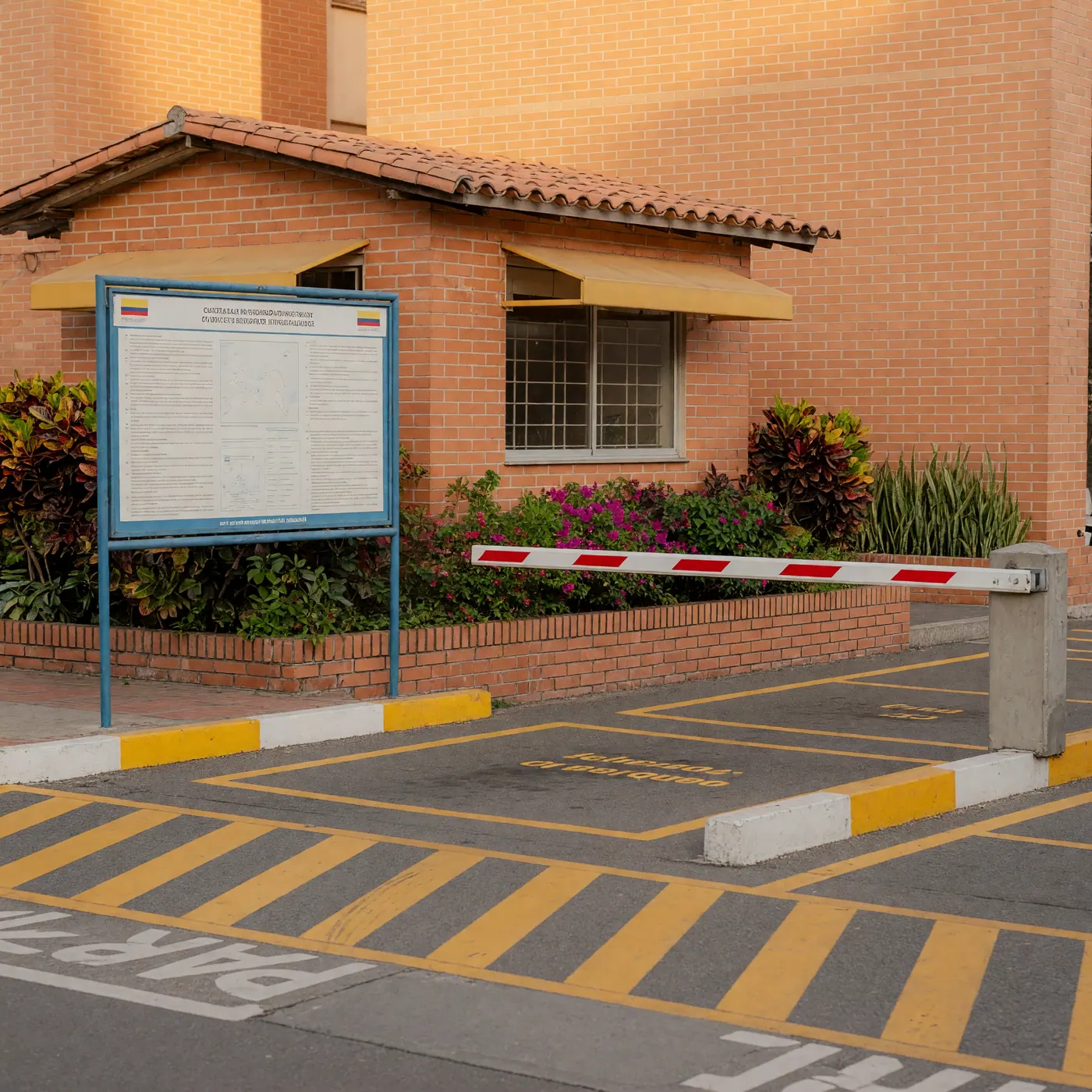
The short answer is yes, it is completely legal, but it requires strict compliance with an institutional procedure within the co-ownership.
Articles 19 and 72 of Law 675 of 2001 authorize the legal entity of the horizontal property to commercially exploit common goods for general use, provided that such a decision is aligned with the collective well-being and does not affect the main destination of the property. However, the administration or the administrative council cannot start charging arbitrarily without the express authorization of the general assembly of co-owners.
Quorum and majorities in the assembly
To approve charging for visitor parking, set the fee structure (by hour, fraction, or night), and determine grace periods (for example, the first 30 or 60 minutes free), the approval of the simple majority of coefficients present at the ordinary or extraordinary assembly meeting is sufficient. A qualified majority of 70% would only be required if the measure implies a formal modification to the horizontal property regulations or a de-affectation of non-essential common goods (according to Article 20 of the law).
Tax obligations to the DIAN: The 19% VAT
An aspect that catches many administrative councils by surprise is the tax impact derived from charging visitors for parking. Although commercial or mixed co-ownerships carry out this activity routinely, residential complexes often omit compliance with current tax regulations.
According to Article 462-2 of the Tax Statute and the official doctrine of the DIAN (reiterated in 2025 concepts), when a horizontal property legal entity provides a parking service by charging visitors or third parties, this activity is subject to the general 19% VAT rate..
You may be interested in: If you want to know how the direct handover or leasing of spaces between co-owners works, check our guide on how to rent a parking space in horizontal property in Colombia.
Legal requirements demanded of the administration
When starting to charge visitors for parking, the residential complex acquires the following responsibilities before the DIAN:
- Update the RUT: Must register the responsibility as a provider of parking services subject to VAT.
- Electronic invoicing: It is obligated to issue an electronic sales invoice or an equivalent document authorized by the DIAN to users who pay the fee.
- Declaration and payment: Must file periodic VAT declarations and pay the tax collected.
It is important to highlight that the assignment of common parking spaces to residents themselves when the cost is covered solely within the ordinary administration fee is not considered a commercial exploitation and, therefore, does not generate VAT in accordance with Decree 1625 of 2016.
Misuse of bays by residents and sanctions
One of the most common reasons for sanctions in internal regulations is the prolonged or permanent parking of resident vehicles in visitor zones. Since these bays are for the flow of external people, parking the family's second or third car there without authorization violates the collective rights of the other co-owners.
To address this situation, the assembly can establish progressive deterrent rates after exceeding a certain number of hours or apply monetary sanctions contemplated in the regulations. However, to apply any fine, the administration must strictly respect the due process enshrined in Article 59 of Law 675 and supported by Constitutional Court jurisprudence (Sentences C-318 and C-738 of 2002), allowing the resident's right to defense.
Renting private parking spaces: What limits exist?
If you are the owner of a private parking space (with its respective real estate registration), the law grants you the power to use, enjoy, and dispose of it. This includes the right to rent it to another resident of the building or complex.
However, a frequent concern arises: can a private parking space be rented to an external third party who does not live in the complex?
Although the law protects private property, the assembly of co-owners has the authority to regulate vehicular access control for security reasons. If the complex's regulations prohibit the entry of non-resident pedestrians or vehicles without authorization, the parking owner must comply with these community security rules. However, the administration can never arbitrarily or unilaterally block access to the private parking of an owner who is up to date or in arrears with administration fees without prior legal process.
According to active offer signals on Colombia Move (August 2026), the housing section gathers 100 active listings and 19,190 views. That activity makes it especially useful to review the complex's rules before signing an agreement for housing or parking.
Ways to solve arbitrary or unfair charges
If your complex's administration starts charging for visitor parking without the proper approval of the assembly, or imposes disproportionate amounts not contemplated in the regulations, residents have the following legal mechanisms:
- Right of Petition: Request in writing from the administrator a copy of the general assembly minutes where the parking rate and charging scheme were formally approved.
- Coexistence Committee: Go to the complex's internal body to present the disagreement and seek a concerted solution between the parties.
- Conciliation Center or Civil Judge: If the internal path does not work, one can file a request for extrajudicial conciliation or sue for the nullity of the administration or assembly decisions before municipal civil judges within the timeframe established in Law 675.
Recommended reading: To avoid administrative issues during a move, check our guide on permits, schedules, and policies in residential complexes in Colombia.
Frequently asked questions
❓ Can a complex's administration start charging for visitor parking without consulting the assembly?
No, the administration does not have the legal authority to impose parking rates unilaterally. The charge for the economic exploitation of common areas must be approved by the General Assembly of Co-owners according to Articles 19 and 72 of Law 675 of 2001.
❓ Why must a residential complex charge VAT if it is a non-profit entity?
Although the co-ownership is non-profit, Article 462-2 of the Tax Statute establishes that providing parking services to visitors or third parties is a commercial activity taxed at the general VAT rate of 19%.
❓ Can a resident park their vehicle in visitor bays continuously?
No, Article 22 of Law 675 of 2001 prohibits designating visitor parking spaces as exclusive or permanent use property for residents of the complex, and sanctions contemplated in the coexistence manual may be applied.
❓ Can I rent my private parking space to someone who does not live in the building?
The owner has autonomy over their private property but must comply with the complex's security and access control regulations, which may limit the entry of individuals outside the community.
❓ What quorum is needed in the assembly to approve charging for visitor parking?
It is usually approved by a simple majority of the co-ownership coefficients present at the assembly, unless the measure expressly requires modifying the horizontal property regulation deed.
❓ What legal resources exist if I am imposed an unfair fine for using parking?
You can file a right of petition requesting evidence and the respective minutes, go to the coexistence committee, request a formal conciliation, or sue for the nullity of the sanction before the civil jurisdiction.





Comments
Loading comments...
Checking sign-in status...