
INVIMA sanitary notification to sell roasted and ground coffee in Colombia
If you roast or grind coffee and want to sell the package, this guide tells you which authorization to request from INVIMA, how to process it in InvimÁgil, who is exempt from payment, and how to publish your notice with the visible code.
IDIOMA DEL ARTÍCULO
Showing original language
Quick answer: if you sell roasted or ground coffee, packaged for the customer to prepare at home and without a sucrose base, what you need is a sanitary notification (NSA), not a sanitary registration (RSA). It is processed in InvimÁgil and is valid for ten years.
Friend, before you send your bags with the logo to print, let's clarify something that confuses half of Colombia: not all coffee requires the same paperwork. We will separate four cases here, because mixing them up is the most expensive mistake I see among micro-roasters.
Four types of coffee, four different answers
- Natural coffee beans, unprocessed (green): is excepted from NSA, PSA, and RSA when sold as a natural food product.
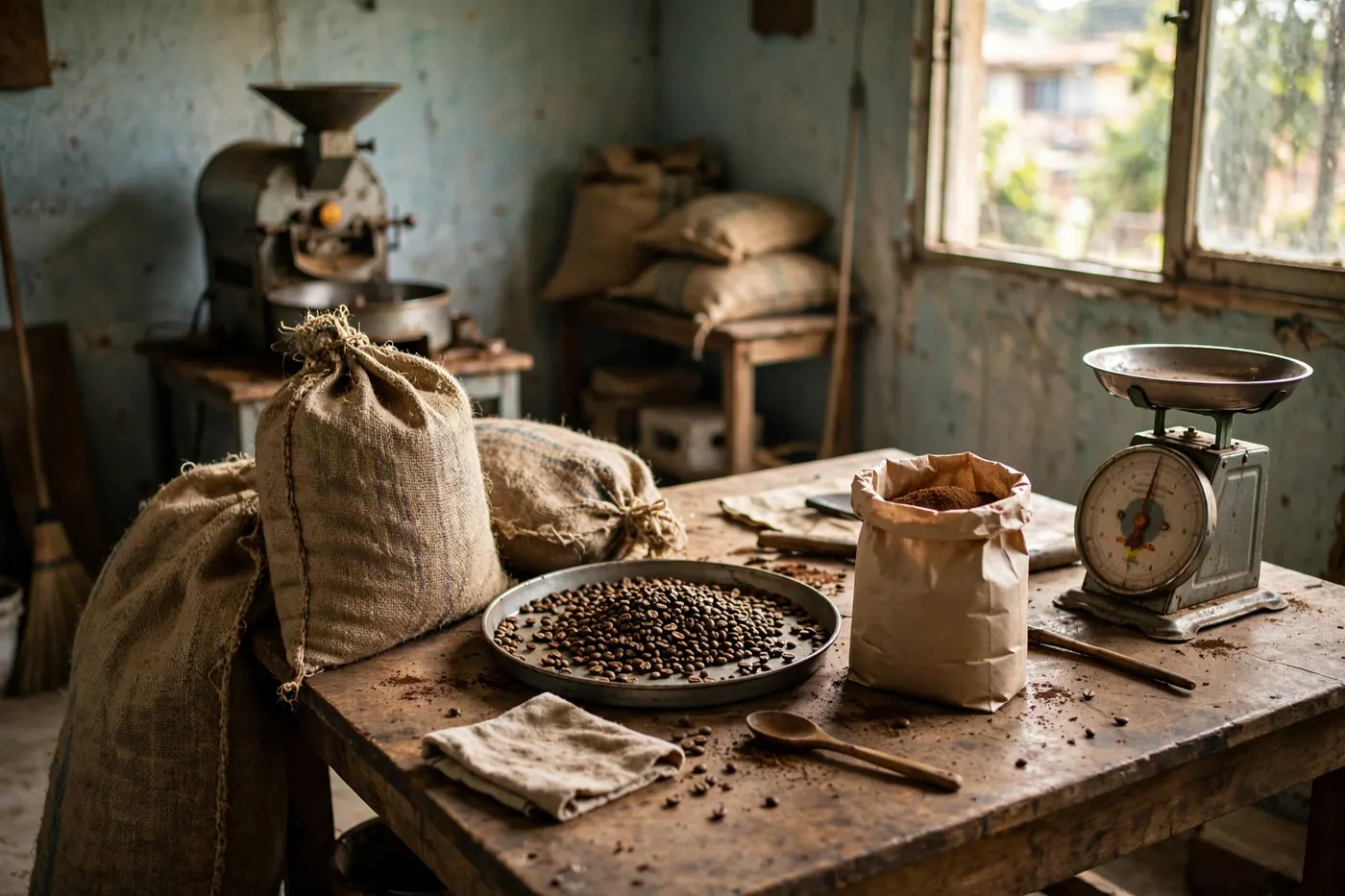
- Roasted or ground coffee, packaged for preparation: this is your likely case. It goes through the NSA.
- Ready-to-drink beverage (for example, canned coffee): this is a different procedure, a sanitary permit (PSA).
- Coffee that you only sell as raw material to industry or gastronomy, without direct sale to the consumer: it does not require NSA, PSA, or RSA.
Watch out for this: roasting is a transformation. Do not use the raw bean exception to justify selling roasted coffee without authorization. And don't say that "all coffee needs an NSA": it depends on which of these four cases is yours.
Why roasted and ground is an NSA and not an RSA
Resolution 719 of 2015 classifies food by risk. Coffee concentrates and beans treated to prepare beverages are in subcategory 3.4.2, marked as lower risk, and sucrose-based products are excluded there. Ready-to-consume coffee is in 3.4.1, medium risk, which is why it requires a PSA.
The practical consequence is that your authorization is an NSA. According to Resolution 2674 of 2013, the NSA is valid for ten years and renewal must be requested by the holder three months before expiration. For reference, the RSA lasts five years and the PSA seven. A warning: if you see public procurement documents that put roasted coffee in 3.4.1, do not use them as a guide; the regulation is what governs.
Another thing not to be confused: the NSA covers the product. It does not replace establishment registration or the inspection, surveillance, and control of the competent sanitary authority. And the food handling card is a separate process; we already explained it in this guide for the food handling course and card.
Step-by-step in InvimÁgil
As of July 22, 2025, new applications for NSAs, PSAs, and RSAs for food and non-alcoholic beverages are made in InvimÁgil. The Virtual Office stopped receiving new applications from that sector. The route is this:
- Create your user on the platform.
- Register the company (natural or legal person). If you are not yet formalized, look first at how to register your business with the Chamber of Commerce.
- Register the activities you are going to carry out.
- Request the commercialization authorization for the product, with the INVIMA format and the coffee technical sheet.
Choose the modality well: manufacture and sell, manufacture, package and sell, or package and sell. If you roast yourself and pack, the first or second fit; if you buy already roasted coffee and only pack it, that is another. And good news: a single authorization can cover several presentations or varieties in the cases of article 42 of Resolution 2674, so you don't have to get an NSA for every 250 g or 500 g bag without checking if it applies first.
Regarding times, no stories: the process is automatic with subsequent review. That means the document comes out fast, but later INVIMA can ask for corrections and, if you do not fix them, suspend the authorization. Do not promise anyone a code "in 24 hours" as a guaranteed deadline.
If you already had a valid NSA from before InvimÁgil, you can systematize it voluntarily and at no cost for future management. Expired ones are not systematized.
The payment exemption for micro-enterprises
Here many people get overly excited. Law 2069 of 2020 and Resolution 2128 of 2023 exempt micro-entrepreneurs, small producers, and agricultural, ethnic, or peasant cooperatives or associations that qualify as a micro-enterprise from paying for issuance, modification, and renewal. It is not for "every entrepreneur" or "every coffee grower."
How to know if you qualify: according to Decree 957 of 2019, in manufacturing, you are a micro-enterprise if your annual ordinary income is less than or equal to 23,563 UVT. Check the current UVT value at the DIAN; we do not convert to pesos here to avoid giving you an incorrect figure.
Three honest warnings:
- The exemption does not apply if your micro-enterprise is subordinate to a large company or belongs to a business group.
- If you transfer the authorization, whoever receives it pays.
- Do not guess the current rate: InvimÁgil liquidates according to your size, income, varieties, and the Law 2069 exemption. For the detail of values, verify the current figure on the official INVIMA rates page.
The label: what your bag should and should not have
Consumer packaging follows Resolution 5109 of 2005: food name, net content in metric units, name and address preceded by "manufactured or packaged by," and visible batch identification.
Regarding the nutritional table: ground coffee, instant or soluble coffee, and coffee extract, without added ingredients, are excepted. If your mixture contains sugar, flavorings, powdered milk, or any other added ingredient, that exception is dropped. And the front label ("Excess in" or "Contains sweeteners") applies when salt or sodium, sugars, fats, or sweeteners are added and the table in the regulation is met. For whole unground coffee beans, do not assume the exception names it; confirm it with the authority before printing.
The brand is another story: protecting your name before the SIC has nothing to do with the sanitary code. If you want to shield the name, review how to register a trademark before the SIC, but understand that neither thing replaces the other.
How to publish your now-authorized coffee
With the NSA in hand, your ad goes from "just another package" to something the buyer can verify. In the ad, put:
- NSA number and expiration date.
- Bag weight, origin, roast level, and grind type.
- Photos of the actual packaging, with the label and batch visible.
- Delivery method; shipping is agreed upon by buyer and seller.
According to the active ad registry on Colombia Move (September 29, 2026), the coffee category has zero active ads and the bakery one too, while prepared food has 5. That is, today whoever publishes packaged coffee with their code visible has the showcase almost all to themselves. Publishing here does not replace the INVIMA authorization; the code is a piece of trust data that the buyer can verify in the official registry consultation of sanitary records. For more ideas on how to build the ad, look at the guide on how to publish local food, desserts, and coffee. If you also sell bread or cookies, the food section is your place.
Mistakes that could cost you a suspension
- Selling roasted coffee "as natural grain". The exception applies to unprocessed grain, not to roasted coffee.
- Mixing coffee with panela or sugar and using the same NSA. A product based on sucrose changes its classification and labeling; do not cover it with the authorization for pure coffee.
- Claiming "with INVIMA registration" when you only have a Chamber of Commerce, RUT, or trademark. That is misleading advertising. If you do not have the NSA number, do not claim it.
- Failing to renew on time. The application must be submitted three months before the expiration date.
This guide is informative and regulations change; if you have doubts about your specific case, confirm with INVIMA or your regional health secretariat.
Frequently asked questions
❓ Does roasted and ground coffee need to be registered or notified with INVIMA?
If it is for preparing a beverage and does not contain a sucrose base, it is notified: it is a lower-risk NSA, not an RSA. It falls under subcategory 3.4.2 of Resolution 719 of 2015. Review your specific case before processing (verify with the official source).
❓ Does green coffee bean also need notification?
No, natural unprocessed grain is exempt when sold as a natural food product. But roasting is a transformation, so roasted coffee cannot use that exception and needs its own authorization (verify with the official source).
❓ How much does the notification cost and is it worth it for a micro-enterprise?
You may be exempt from payment if you qualify as a micro-enterprise under Law 2069 and Resolution 2128 of 2023. The InvimÁgil assessment will confirm if this applies to you. It does not apply if there is subordination or a business group. Verify the current figure on the fee page (verify with the official source).
❓ How long is the notification valid and when should it be renewed?
The NSA is valid for ten years. The holder must request renewal three months before the expiration date, so set a reminder well in advance so you don't run out of authorization while continuing to sell (verify with the official source).
❓ Is it safe to sell packaged coffee online and what builds buyer trust?
RUT, Chamber of Commerce, or trademark are not enough: product authorization is different. Publishing on a marketplace does not substitute it. Display your NSA number so the buyer can trust it and verify it in the official database (verify with the official source).
❓ Does ground coffee without sugar need a nutritional label and a front-of-pack warning label?
Ground or soluble coffee without added ingredients is exempt from the nutritional table. A front-of-pack label appears if salt, sugars, fats, or sweeteners are added and thresholds from the standard are reached. With sugar or flavorings, the exception does not apply (verify with the official source).
❓ Where do I file a new application and where do I post my coffee to sell it?
The application goes through InvimÁgil, starting July 22, 2025, after creating a user account, registering the company, and registering the activities. With the NSA in hand, publish your ad in the coffee category of the marketplace with the number visible (verify with the official source).
Comments
Loading comments...
Checking sign-in status...