
How to Open a Bank Account in Colombia as a Foreigner
Opening a local account takes more than a passport. Bring the right cédula and income documents, then register the 4x1000 exemption.

IDIOMA DEL ARTÍCULO
Showing original language
- Quick Answer: To open a fully functional retail savings account (cuenta de ahorros) in Colombia, you cannot just use a tourist passport. You generally need a valid physical Cédula de Extranjería (CE), proof of income, and proof of a local address. US citizens must also sign a FATCA W-9 form. Once opened, you can designate an account as exempt from the 4x1000 tax up to $18,330,900 COP per month in 2026.
You have finally secured your Colombian visa, picked up your ID, and signed a lease. Now comes the moment you realize paying for everything via international wire transfers or cash is exhausting. Getting a local retail bank account is the ultimate milestone for settling in. It unlocks the ability to use PSE for online payments (a lifesaver when you need to pay utilities in Colombia) and lets you transfer funds to locals.
But if you think you can just walk into a branch with your foreign passport and walk out with a debit card, you are in for a frustrating afternoon. Here is exactly how to navigate the system in 2026.
The Cédula Barrier (Why Your Passport Isn’t Enough)
For a standard, fully functional savings account, banks generally ask foreign residents for an approved M or R visa and a physical Cédula de Extranjería (CE). Honestly, skip trying to bypass this with a tourist passport. Specialized brokerage or investment accounts can follow a different onboarding track, but they are not a substitute for daily retail banking.
Also, do not bother showing up with the temporary paper receipt (contraseña) you get while waiting for your card to print. Because of strict identity and anti-money-laundering checks, branches generally require the physical card to verify your identity.
Your Rights vs. Bank Autonomy
Sometimes, even with a CE in hand, an account manager might tell you “we don’t bank foreigners.” Under Superintendencia Financiera Concept No. 2017121469-001, a bank cannot deny access solely because of your nationality or immigration status.
However, institutions retain autonomy to refuse service based on objective SARLAFT anti-money-laundering risk policies. If your funds lack traceability or your income documents do not clearly explain their origin, the application can still be declined. Keep your cool, present clean income documents, and ask the advisor which missing document would resolve the compliance concern.
Bancolombia vs. Davivienda: What to Compare
Most long-term residents compare these two familiar retail options. The useful question is not which logo is “best,” but which branch can document your foreign income cleanly and which account package fits how you will receive and spend pesos.
| Feature | Bancolombia | Davivienda |
|---|---|---|
| Digital wallet relationship | Nequi operates in the same broader financial group. | DaviPlata is Davivienda’s digital wallet. |
| What to confirm | Account fees, transfer enrollment, PSE access, and international-transfer documentation. | Account fees, transfer enrollment, PSE access, and international-transfer documentation. |
| Best practical test | Ask a branch advisor to review your CE and income evidence before starting the application. | Ask a branch advisor to review your CE and income evidence before starting the application. |
Required Document Checklist for a Branch Visit
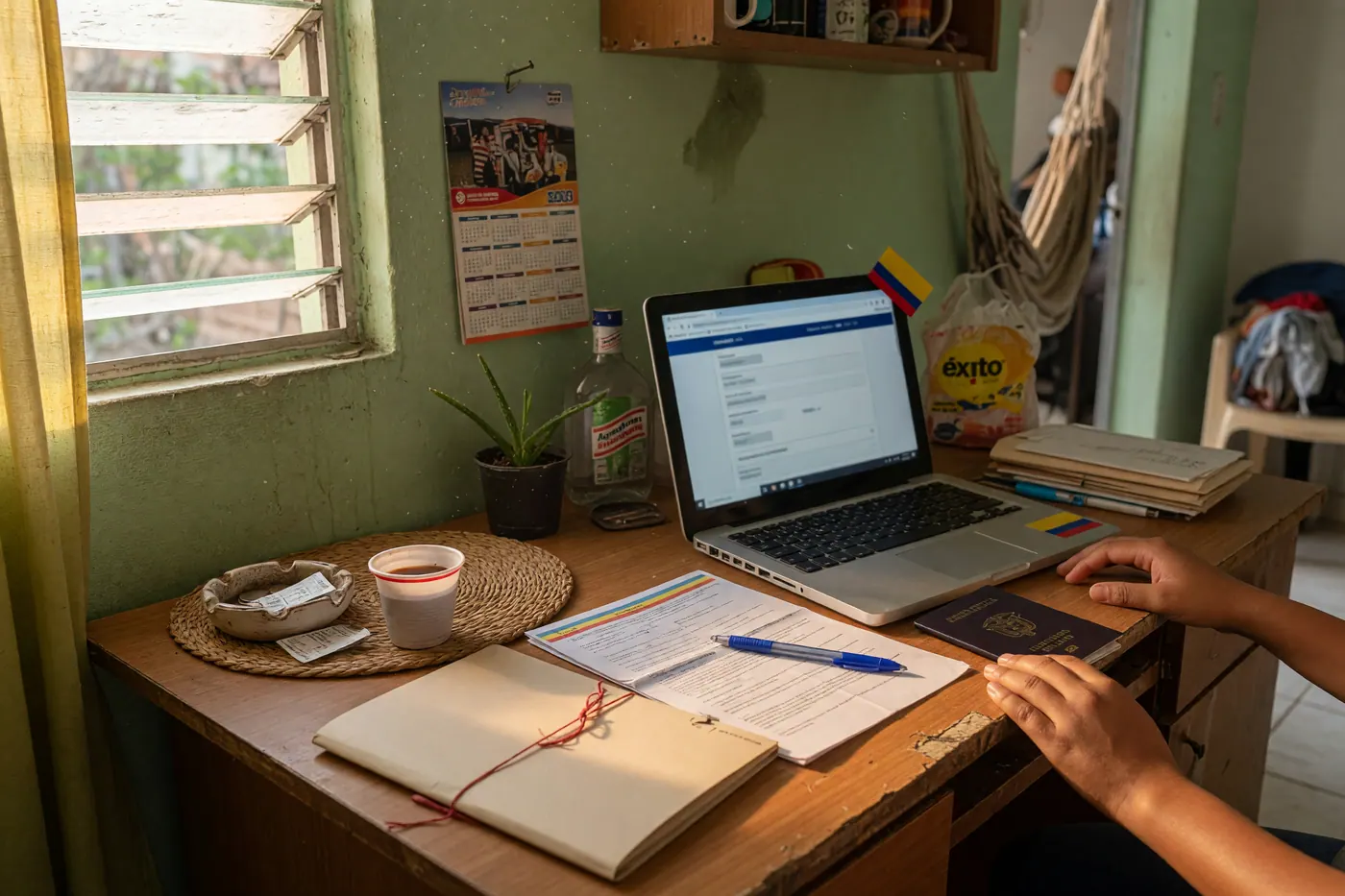
Do not show up empty-handed. Print these out and carry them in a folder:
- Physical Cédula de Extranjería: Do not rely on the temporary paper receipt.
- Passport and valid visa: Bring the passport data page and a copy of the electronic visa.
- Proof of Colombian address: Usually a recent utility bill or a formal lease agreement. Read our guide on proof of address in Colombia if your lease is not in your name.
- Proof of funds: Work contracts, tax declarations, pension evidence, or recent international bank statements showing where your money comes from.
- RUT (Registro Único Tributario): This depends on your tax situation and the bank’s file requirements. It is normally relevant if you are locally employed, self-employed, operating a business, or filing taxes; retirees should ask the branch whether it is necessary for their case.
- FATCA Form W-9: US citizens should expect to complete FATCA self-certification and Form W-9.
Colombian Banking Taxes (The 4x1000 Reality)
Colombia levies a financial transaction tax known as the 4x1000 (Gravamen a los Movimientos Financieros, or GMF). It charges 4 pesos for every 1,000 pesos withdrawn or transferred from a covered account.
You can claim the exemption up to a monthly limit of 350 UVT. DIAN Resolution 000238 set the 2026 UVT at exactly $52,374 COP, so 350 UVT equals exactly $18,330,900 COP in monthly transactions.
Pilas con the operational detail: Law 2277 of 2022 provides for the exemption across a user’s accounts, but implementation has not been seamless across every bank. In practice during 2026, ask your bank to register one primary account as exempt and confirm that designation before moving money. Do not assume the exemption is automatic merely because the law changed.
Step-by-Step Branch Onboarding and Alternative Paths
- Choose the account type you actually need: usually a cuenta de ahorros for daily payments and transfers.
- Ask for an asesor comercial and present the complete document folder before filling out forms.
- Explain your income source plainly and consistently across the application, bank statements, contracts, and tax forms.
- Complete the SARLAFT declarations and, if you are a US citizen, the FATCA/W-9 paperwork.
- Before leaving, confirm account fees, PSE activation, transfer limits, international-transfer procedures, and the 4x1000-exempt designation.
If you are purely investing and not living here, you might not need a retail bank at all; you can invest in the Colombian stock market through a specialized brokerage account with a different onboarding process. But for daily life, rent, utilities, and local transfers, a retail savings account is usually the practical choice.
According to active Colombia Move marketplace signals from July 2026, the mudanzas category had 0 active listings against a target supply of 5. That is a useful warning to line up relocation help early rather than assuming providers will be visible on demand.
Frequently Asked Questions
❓ Can I open a bank account in Colombia with just a passport?
No, not a standard full-service personal savings or checking account at the traditional retail banks covered here. Foreign residents generally need a physical Cédula de Extranjería; specialized brokerage accounts can use a different process.
❓ What is the 4x1000 tax and how can I avoid it?
The 4x1000 is a government levy of $4 COP for every $1,000 COP withdrawn or transferred from a covered account. Ask your bank to designate a primary account as exempt; the 2026 monthly ceiling is 350 UVT, exactly $18,330,900 COP.
❓ Why do banks reject my temporary Cédula receipt (“contraseña”)?
Most branches require the physical identity card for their verification and SARLAFT checks. The paper receipt is not treated as an equivalent high-security identity document for standard branch onboarding.
❓ Do I need a RUT tax ID to set up a personal bank account?
It depends on the bank and your tax situation. A RUT is normally relevant for local workers, independent contractors, business owners, and tax filers; retirees receiving foreign pensions should confirm the requirement with the branch.
❓ Are there extra requirements for US citizens banking in Colombia?
Yes. US citizens should expect FATCA self-certification and IRS Form W-9 so the Colombian bank can meet its US tax-reporting obligations.


Comments
Loading comments...
Checking sign-in status...