
How to sell specialty coffee of direct origin from the farm in Colombia: channels, packaging, and shipping
How to get a batch of single-origin coffee from the farm to a specific buyer: channels, short-form sanitary authorization, packaging, labeling, shipping, and secure payment.
IDIOMA DEL ARTÍCULO
Showing original language
A specialty coffee buyer almost never asks only "how much is it?". They ask which farm it comes from, what variety it is, how it was processed, what harvest it is from, how much the bag weighs, and whether it is shipped or picked up. If your ad doesn't answer that, they move on to the next one. And today there is a curious gap: on October 4, 2026, the Coffee and Beverages category of Colombia Move showed 0 ads. Whoever publishes first doesn't compete with a long list.
This guide is for those who grow, process, or roast and want to sell directly, without treating the coffee as if it were a real estate listing. If you want to sell or lease property, that goes elsewhere, in farms. Here we are talking about the bean.
Quick answer: the shortest path
- Define what you sell: parchment or green to a roaster, or roasted/ground to the consumer. The rules change.
- Check the sanitary authorization before publishing packaged roasted coffee.
- Pack it sealed, with net weight, batch, and date.
- Get paid before shipping and write in the ad who pays for the freight.
- Publish a complete spec sheet with price per weight, shipping city, and real photos.
Channels: where it actually makes sense to sell
I would rank them like this, from the most direct to the farthest from your pocket.
1. Cafeterias and clients you already know. This is the sale with the best margin because there is no intermediary. Bring them a sample with batch data: farm, variety, process, harvest, and weight. A neighborhood roaster buys faster when they can repeat the same batch they tasted.
2. A permanent ad in the coffee category. Unlike a post in a Facebook group, which gets buried in hours and leaves no spec sheet with price and weight, an ad remains as its own page that Google can index. It is the same logic of direct sale without commission that we explained in where to sell used goods in Colombia, applied now to coffee.
3. Cooperatives and the Federation's reference price. If what you are producing is unroasted parchment, this is the natural channel. The National Federation of Coffee Growers publishes an internal reference price for dry parchment per 125 kg load, and it varies depending on the distance to the purchase point. Careful: that number is not useful for quoting a bag of roasted coffee. They are different products.
4. The official FNC store on Mercado Libre. It exists as a showcase for national brands. It is useful for getting to know the channel, but it does not replace your own ad or your relationship with the client.
Which sanitary authorization to check (in short)
There is real confusion here, and I prefer to tell it to you without fluff. Every food sold to the consumer needs notification, permit, or sanitary registration depending on its risk, except for four exceptions in Article 37 of Resolution 2674 of 2013, amended by Resolution 3168 of 2015. One of them is natural food without any transformation; roasted or ground coffee does not fit there.
Now the clash of sources. The annex to Resolution 719 of 2015 includes in subcategory 3.4.2 coffee beans treated to prepare coffee products, which falls into the low-risk column; Resolution 2128 of 2023 associates that risk with notification. But the ADR public procurement spec sheet (June 2026) classifies "roasted and ground coffee - soluble coffee" as a sanitary permit, copying the text for ready-to-consume coffees (3.4.1, medium risk). That document is not the norm for the retail seller, but the disagreement exists. My advice: don't tie yourself to either one and let the INVIMA classifier decide your case. If they send you back to get a permit, submit the form, not what a blog says.
If you only sell parchment or green coffee to a roaster or a food business, you could fall under the raw material exception for exclusive industrial or gastronomic use. If you also sell to the public, do not use it.
Regarding the fee: the exemption for payment of issuance, modification, and renewal is not for every coffee grower. Resolution 2128 of 2023 limits it to micro-entrepreneurs, small producers, and cooperatives or associations that qualify as micro-enterprises, and according to INVIMA, it does not apply if the micro-enterprise is subordinate to a large company or belongs to a business group. Verify the current figure of the ceiling in the regulation.
The step-by-step procedure is in the guide for INVIMA registration for roasted and ground coffee; I will not repeat it here.
Packaging and labeling that won't make you look bad
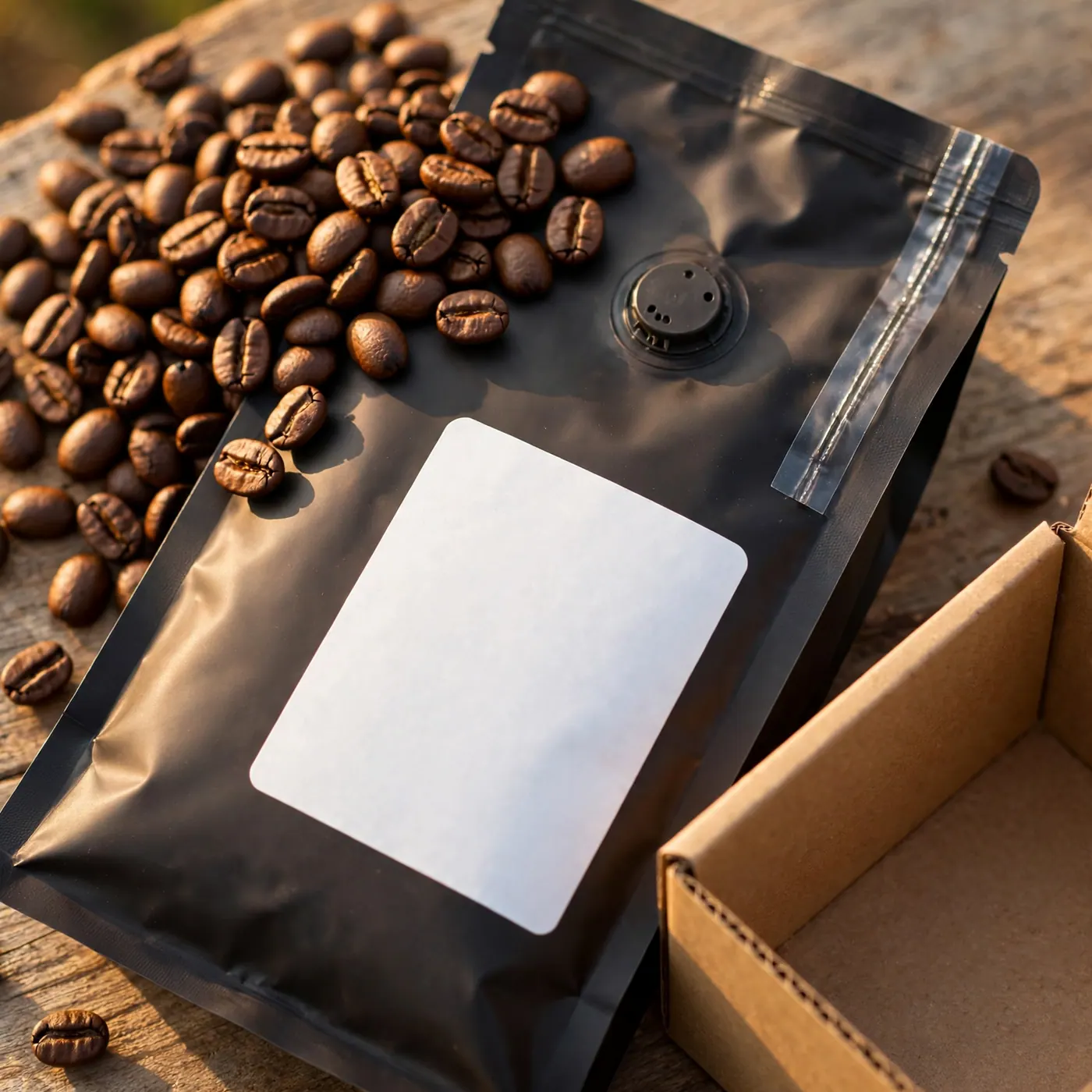
Use a food-grade bag and seal it well. The material in contact with the coffee must comply with Resolution 683 of 2012 and the standard for its material type. The one-way degassing valve is a best practice, because fresh roast releases gas and can inflate the bag, but none of the sources reviewed make it mandatory. You also don't need to buy the most expensive packaging in the catalog to get started.
The label follows Resolution 5109 of 2005, as applicable: name of the product without deception, net content, batch, and expiration date or minimum shelf life. With a single ingredient (coffee), you don't need an ingredient list. Also include the manufacturer or packager and the authorization number when it exists.
Farm, municipality, variety, process, and harvest are commercial data that you can print, provided they are true. What you cannot do is use "Café de Colombia" on your own: that designation of origin, protected by the SIC, is only used by those who have authorization from the Federation. Saying the neighborhood or the municipality is not the same as using the designation.
Warning seals only apply if the product has an excess of sugars, sodium, fats, or sweeteners. A roasted coffee without additives doesn't carry invented labels, although the nutritional table is requested by the spec sheet for packaged processed goods, with its exceptions.
Storage: ambient, in a cool and dry place. No fridge or weird promises.
Shipping and payment: this is where money is lost
To send coffee to another city by national parcel service, the bag must be closed, inside a sealed box, and identified with the sender, recipient, and tracking guide. Servientrega does not accept perishables that depend on refrigeration or freezing; dry roasted coffee is not one of those, but don't promise cold or anything like that. Also, don't invent rates in the ad: agree on the freight separately.
The most important thing: cash on delivery from the courier is not a protected payment for the coffee. In the modalities described by Servientrega, the recipient pays the freight, and an unclaimed or returned shipment can generate double freight or the freight plus 50 percent charged to the sender. That is, if you ship an entire batch expecting them to "pay upon receipt," you could end up owing money.
My rule: get paid before shipping, or deliver in person by weighing the coffee in front of the buyer. And don't release a batch against a check; read first about the bounced check scam in sales.
How to structure the ad to filter out the curious
A good coffee ad answers before they write to you. Put in:
- Price of the weight you sell: 250 g, 500 g, 1 kg, or sack, each one clear.
- Real origin: farm, municipality, variety, process, and harvest.
- Shipping city and if you ship to the whole country.
- Who pays for shipping and when to collect payment.
- Photos of the bean and the packaging, in natural light and without filters.
- WhatsApp with scheduled hours. You control the contact; you don't have to be available at 11 p.m.
Post in the coffee category, within the foodsection. An honest warning: with the category empty, there is no accumulated traffic yet; being one of the first helps, but your photo, your product details, and your quick response matter more than any platform.
Frequently asked questions
❓ Does my farm's roasted coffee need sanitary notification, or can I sell it without paperwork?
If you package it for the customer to prepare, it is not covered by the exception for unprocessed grain and requires the authorization corresponding to its risk level. Subcategory 3.4.2 points to notification, but the ADR public procurement form points to a permit; the INVIMA classifier decides your case (verify with the official source).
❓ Are microenterprises or farming associations exempt from the INVIMA fee?
The exemption exists, but only if they qualify as a microenterprise and are not subordinated to a large company or part of a business group. Not every coffee grower has it automatically, so confirm your classification and the current threshold before assuming you don't pay (verify with the official source).
❓ Can I print "Café de Colombia" or the municipality on the bag?
The municipality and the farm, yes, provided they are accurate. "Café de Colombia" and regional denominations require authorization from the National Federation of Coffee Growers, delegated by the SIC. Mentioning the district (vereda) is not the same as using the designation of origin (verify with the official source).
❓ Does the bag need to have a degassing valve?
According to the sources reviewed, no regulation requires it. What is necessary is food-grade packaging, sealed, with net weight, lot number, and date. The valve is a quality practice useful for fresh roasting, not a legal requirement (verify with the official source).
❓ How do I send the coffee to another city?
In a closed bag inside a sealed and identified box, via national courier, without promising refrigeration. Agree on the shipping cost separately and collect payment for the coffee before shipping. Cash-on-delivery services from transport companies cover the shipping fee, they do not hold the value of your coffee (verify with the official source).
❓ How much does it cost to post a lot on Colombia Move?
On October 4, 2026, the Coffee and Beverages category stated that posting is free and commission-free, and there were zero ads. You define the sale price of your coffee based on the weight and the lot you provide (verify with the official source).
❓ How do I sell safely and avoid scams?
Collect payment before shipping or deliver in person by weighing the coffee in front of the buyer. Do not release the lot against a check, and do not trust cash-on-delivery that only covers the shipping cost. State in the ad who pays for shipping and keep the conversation on your WhatsApp (verify with the official source).
Comments
Loading comments...
Checking sign-in status...