
How to send money to Colombia from the United States in 2026: options, costs, and timelines
Sending money to Colombia doesn't have to break the bank. We explain how to compare fees and exchange rates so your family receives more pesos.
IDIOMA DEL ARTÍCULO
Showing original language
Sending money to family or to pay for responsibilities in Colombia is a monthly task for many, but I'll be honest with you: most people lose money without realizing it. You stare at your phone screen, see that the exchange rate has dropped, get hit with an unexpected fee, and in the end, fewer pesos arrive than you calculated.
In 2026, the options for sending money from the United States have improved significantly. You no longer depend solely on waiting in line at an agency with cash; now you can send directly to a bank account, a mobile wallet, or use the country's new interoperable system. Here, I explain exactly how to compare your options without the hassle.
Quick summary of the best options:
| Reception method | Typical speed | Ideal for... |
|---|---|---|
| Wallet (Nequi/DaviPlata) | Minutes | Fast transfers of low or medium amounts for daily expenses. |
| Bank deposit | 1 to 2 business days | Large amounts, rent or installment payments, higher security. |
| Cash pickup | Minutes to hours | Family members who are unbanked or for emergencies. |
1. The 4 main ways to receive money in Colombia
Before choosing which app to use in the United States, ask your family member or contact in Colombia how they prefer to receive the money. This completely changes the cost and delivery time.
To a bank account: Almost all major providers allow direct deposits to banks like Bancolombia or Davivienda. It is the safest option for large amounts, although if you send on a Friday afternoon, the money may not reflect until Monday or Tuesday. If your recipient is a foreigner, check out our guide on the best banks in Colombia for foreigners.
To mobile wallets (Nequi and DaviPlata): This is the favorite option today due to its immediacy. Nequi receives remittances from international partners and does not charge to receive them. However, keep in mind the current limits: Nequi allows receiving up to USD 2,000 per month for low-amount deposits, and up to USD 5,000 for savings accounts, with a maximum cap of USD 2,000 per transaction.
Cash pickup: Useful if the person does not have a bank account. Traditional companies allow collection at counters in supermarkets (Éxito, Carulla) or currency exchange offices. The disadvantage is that the person must go out with the cash, which is always a security risk.
Bre-B (The Banco de la República system): Bre-B is Colombia's interoperable instant payment system. It works with "keys" (such as your cell phone number, ID, email, or an alphanumeric code). Some international providers are already integrating deliveries through this system so that the money arrives in seconds to any Colombian financial institution.
2. Remitly vs. Wise vs. Western Union: which one is better?
Honestly, there is no absolute winner. For small amounts, it is usually best to compare two or three apps with the same amount to see which one gives you more pesos. In many cases, the difference lies in the delivery method.
Remitly: It is very strong in the corridor to Colombia. It offers transfers from the U.S. with delivery via mobile wallet, bank deposit, cash pickup, and options for the Bre-B system. It often has aggressive promotions for the first transfer, but check the exchange rate on subsequent transfers.
Wise: It is usually very competitive for bank deposits and stands out for showing its fees transparently before you pay. They lock the exchange rate for a few hours so you know exactly how much will arrive, which is ideal for higher amounts where a variation in the rate makes you lose a lot of money.
Western Union: The traditional giant. It allows you to send online, via app, or in person, and reception in Colombia can be done via bank, cash, mobile wallet, and debit card, depending on availability. It is the most robust option if the recipient is in a small town and needs physical cash immediately.
ARQ: The modern option with digital dollars. ARQ (formerly DolarApp) receives USDC—a regulated digital dollar—and converts it to pesos to send it directly to a bank account in Colombia. Combined with apps that send USDC without commission, it usually cuts a large part of the cost of a traditional remittance, and the recipient can also keep the balance in digital dollars to protect themselves from the devaluation of the peso. Mind you: it has a steeper learning curve than a classic remittance app.
Transparency: the links to Remitly and ARQ in this article are referral links. If you use them, Colombia Move may receive a commission at no additional cost to you.
3. The "zero commission" trap and how to calculate the real cost
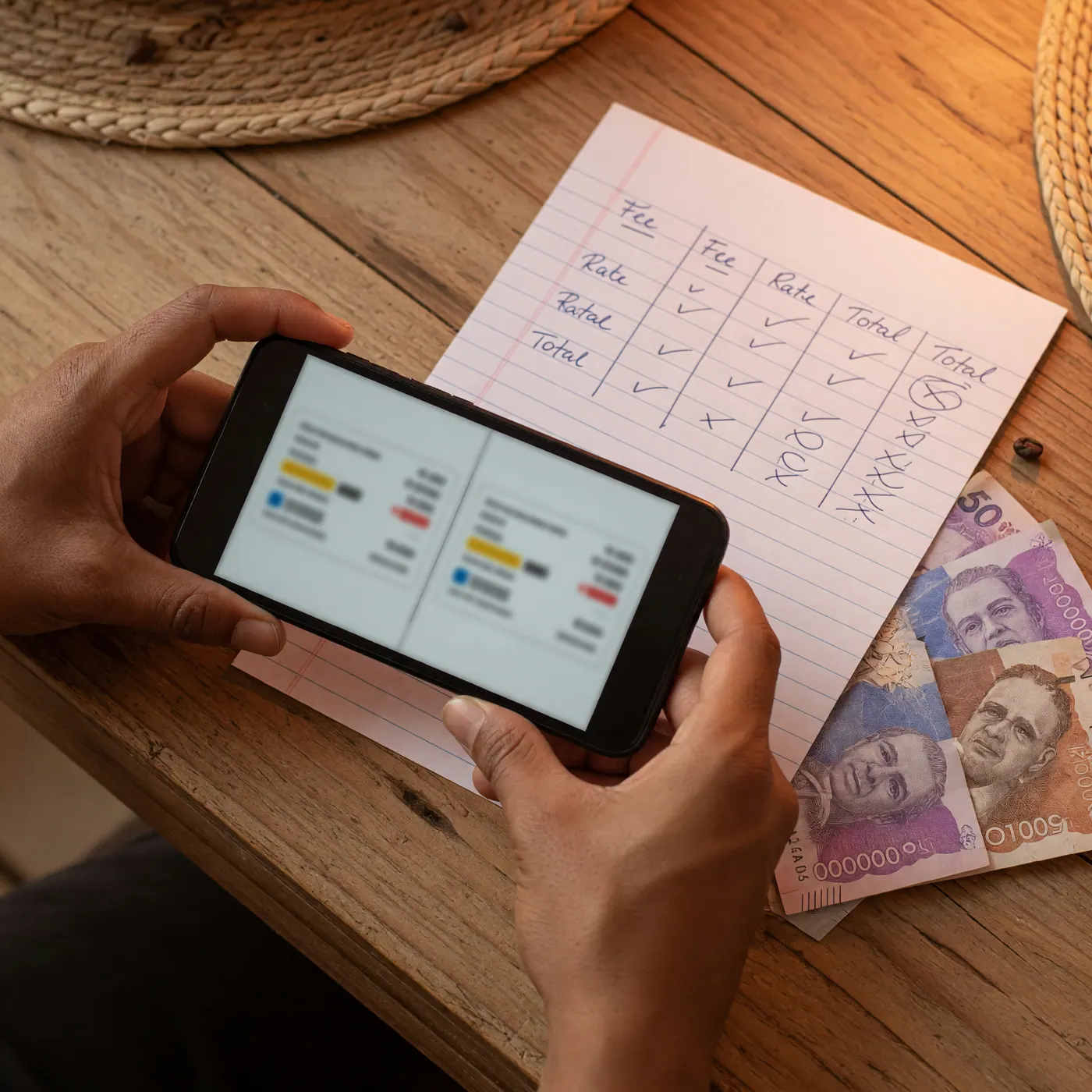
Watch out for this: many apps tell you "Zero shipping cost," but they punish you on the exchange rate. The real cost of your remittance is the combination of the commission you pay upfront plus the margin the company earns on the currency.
The official Market Representative Rate (TRM) of the Banco de la República should be used only as a reference (you can check it in our dollar today tool), but be clear that the user will receive the provider's rate, not necessarily the exact TRM.
By law, if you send from the United States, the Consumer Financial Protection Bureau (CFPB) requires that before you pay, the provider must clearly show you the total cost, the applied exchange rate, the exact amount expected in Colombian pesos, and the availability date. Use that confirmation screen to compare, not the advertising on the home page.
4. Requirements and security to avoid blocks
So that the money doesn't get stuck in limbo, you need the person's full name (exactly as it appears on their ID), their ID number, their cell phone number, and the exact bank or wallet details.
Regarding security, if the person in Colombia is going to receive money through the new Bre-B system, remind them that they only need to provide their "key" (their cell phone or ID). They should never open links, download files, or give out passwords to receive a payment via Bre-B. The money simply arrives in the account.
And here is a practical fact: according to the active ads on Colombia Move (June 2026), we see very high demand in the housing section (with more than 12,800 recent views and 79 active ads). If the money you are sending from the United States is to pay for temporary rent, a deposit, or to hire a local service, coordinating directly via WhatsApp with the owner or provider through our marketplace saves you from triangulating payments with agencies that charge you extra commissions.
Another way to send: pay the Bre-B key from dollars
If the person receiving in Colombia doesn't have a bank account, Nequi, or Daviplata yet—because they don't have a cédula—you can still get the money to them: WanderWallet lets you pay directly to any Bre-B key (mobile number, email, or document) from dollars. You fund the account via ACH, SEPA, Revolut Pay, or USDC on Polygon, the balance is non-custodial Circle USDC (you control the funds), and no Colombian bank or cédula is required. For now, it works for transfers to keys (QR payments are not yet available).
Open WanderWallet and pay via Bre-B without a Colombian account →
Notice: personal affiliate link — Colombia Move may receive a referral reward at no additional cost to you, and is not affiliated with, endorsed, or sponsored by WanderWallet. This is not financial advice; fees and availability are defined by the provider and may change.
Frequently Asked Questions
❓ What is the cheapest way to send money to Colombia from the United States?
It depends on the amount, the payment method, and how it is received; you should always compare the total Colombian pesos (COP) that arrive at the end. There is no app that is universally the cheapest, as fees and exchange rates change every day; compare the current quote in each app with the same amount.
❓ Where is it better to receive money: bank, Nequi, or cash pickup?
For daily expenses and speed, Nequi or DaviPlata are ideal. For large amounts or rent payments, a bank deposit is safer. Cash pickup is only recommended if the recipient is unbanked or it is an emergency; check your wallet's updated limit in the app before deciding.
❓ How long does a transfer to Colombia take?
It can take from a couple of minutes to several business days, depending on the provider (checked in June 2026). Mobile wallets and cash pickups are usually almost instantaneous, while bank deposits depend on security reviews and banking hours.
❓ How much money can I receive in Nequi from abroad?
According to the official Nequi website (checked in June 2026), it handles monthly limits of USD 2,000 for low-amount deposits and USD 5,000 if you have a traditional savings account. In both cases, the maximum cap is USD 2,000 per individual transaction.
❓ What information does the person sending from the United States need?
They need the recipient's full name, their ID document number, their Colombian mobile number, and, depending on the method, the bank account number, Nequi number, or the registered key.
❓ How do I know if I am getting a good exchange rate?
Compare the quote the app gives you with the official TRM from the Banco de la República for that day. Although you will never receive the exact TRM, it helps you know which provider is charging you a hidden margin that is too high.
❓ What do I do if the money doesn't arrive or I suspect a scam?
Contact the provider immediately and save the receipt. If you are sending from the United States, you have rights under the CFPB; the provider is obligated to investigate errors and respond to you if the money was not delivered according to the agreed-upon terms.


Comments
Loading comments...
Checking sign-in status...