
Colombian Social Etiquette: Handshakes, Greetings & Cultural Norms for Expats
Navigating social norms in Colombia requires balancing genuine warmth with traditional respect. Learn the exact rules for handshakes, cheek greetings, and formal address.
IDIOMA DEL ARTÍCULO
Showing original language
When you walk into a meeting room in Bogotá or step into a coworking café in Medellín, the first thing that strikes you is the interpersonal warmth. But beneath that immediate friendliness lies a structured social architecture built around respeto (respect) and personal connection. Foreigners frequently trip over the subtle boundaries between casual camaraderie and formal professional decorum.
Whether you are closing a commercial deal, meeting your partner's family, or just saying hello to the concierge in your building, understanding Colombian social customs will save you from awkward misunderstandings and open doors far faster than fluent grammar ever could. Here is your practical field guide to the handshakes, cheek kisses, speech codes, and host etiquette that govern daily life in Colombia.
Quick Answer: Colombian Greeting Protocol
- First encounters & business: Always offer a firm, warm handshake accompanied by direct eye contact and a smile. This applies equally to men and women.
- Social greetings among acquaintances: Women greet other women and men with a single light touch of the right cheek paired with a gentle kiss sound. Men greet other male friends with a handshake plus a quick back-pat or embrace (abrazo).
- Public decorum: Always greet everyone when entering an elevator, small shop, or waiting room with "Buenos días" or "Buenas tardes".
- Default address: Start with "Usted" and use professional honorifics ("Doctor/a", "Don/Doña") until explicitly invited to transition to "Tú" or "Vos".
The Mechanics of Colombian Greetings: Handshakes, Besos & Abrazos
The Colombian greeting is not a hurried transaction; it is a vital relational ritual. In the United States or northern Europe, a vague wave and a collective "Hey everyone" often suffices when joining a group. In Colombia, doing so makes you look aloof or rude. You are expected to acknowledge each individual in the room.
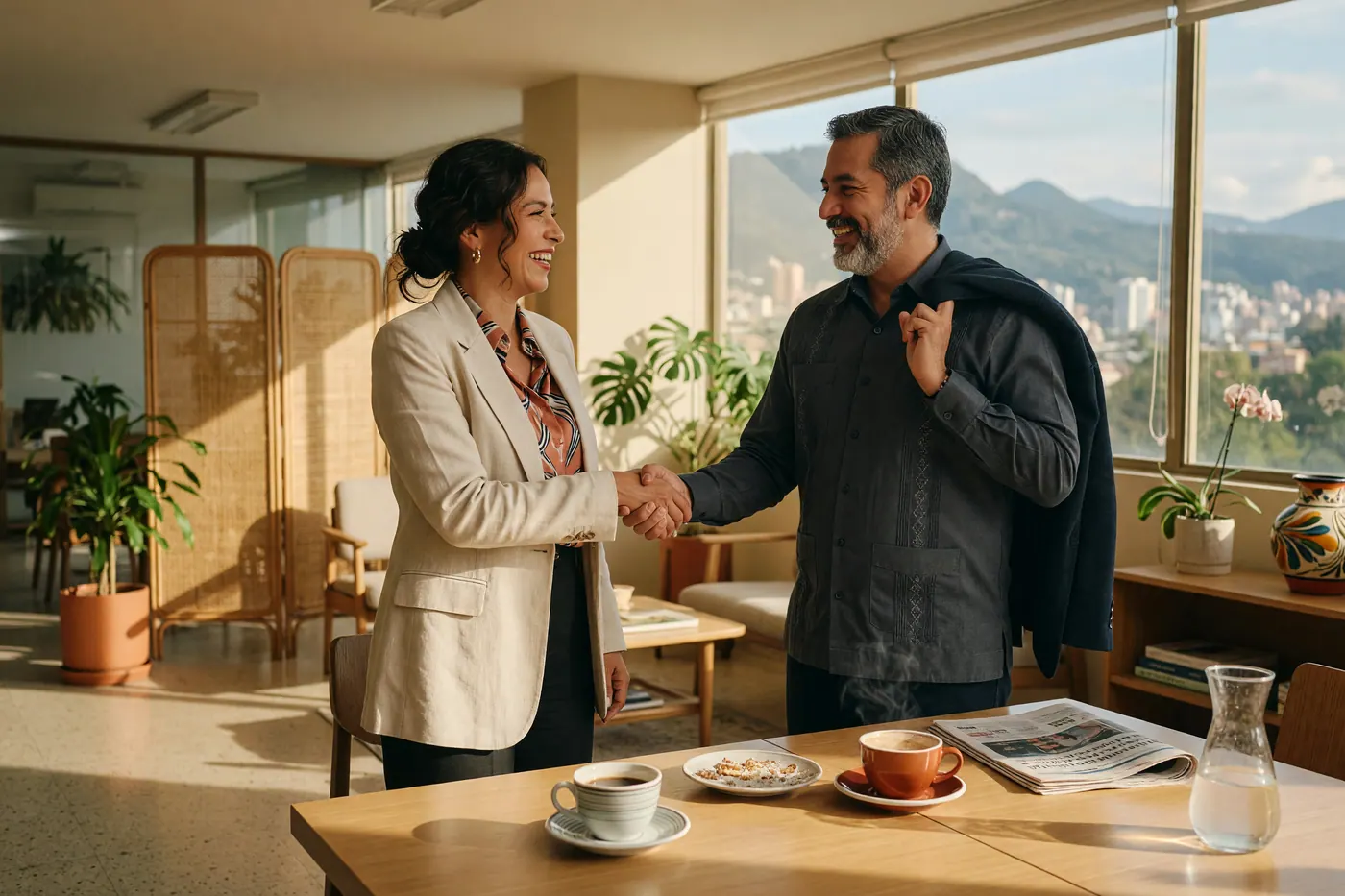
For first introductions and formal professional contexts, the Colombian handshake is the universal standard. It should be firm, steady, and held slightly longer than a standard Western business shake, paired with steady eye contact and a genuine greeting such as "Mucho gusto, ¿cómo está?". Both men and women exchange handshakes in professional environments upon arriving and before departing. When leaving a gathering, walking out with an Irish goodbye will be noticed—make your rounds and say a separate farewell to each person.
In social settings among acquaintances, physical warmth increases quickly:
- Cheek Kisses (El Beso en la Mejilla): This is a single, gentle touch of right cheek to right cheek accompanied by a light kiss sound in the air. It occurs between women, and between men and women once an acquaintance has been established. It is almost never practiced between two men, unless they are very close family members. Never plant wet lips on someone’s skin; it is a soft cheek-touch gesture.
- The Men’s Embrace (El Abrazo): As male friendships develop, handshakes evolve into a brief two-part greeting: a clasp of hands sliding into a quick half-hug with one or two rhythmic pats on the back, followed by another release handshake.
- Public Shared Spaces: When you enter an elevator, a local bakery, or a bank branch waiting area, announce "Buenos días" (morning) or "Buenas tardes" (afternoon). When you step out, offer a polite "Hasta luego" or "Que esté bien". Staying silent in an elevator full of neighbors is perceived as standoffish.
If you are exploring deeper cultural integration, check out our guide to Colombian customs and etiquette for wider context on daily social rhythms.
Navigating "Usted", "Tú", and Professional Titles
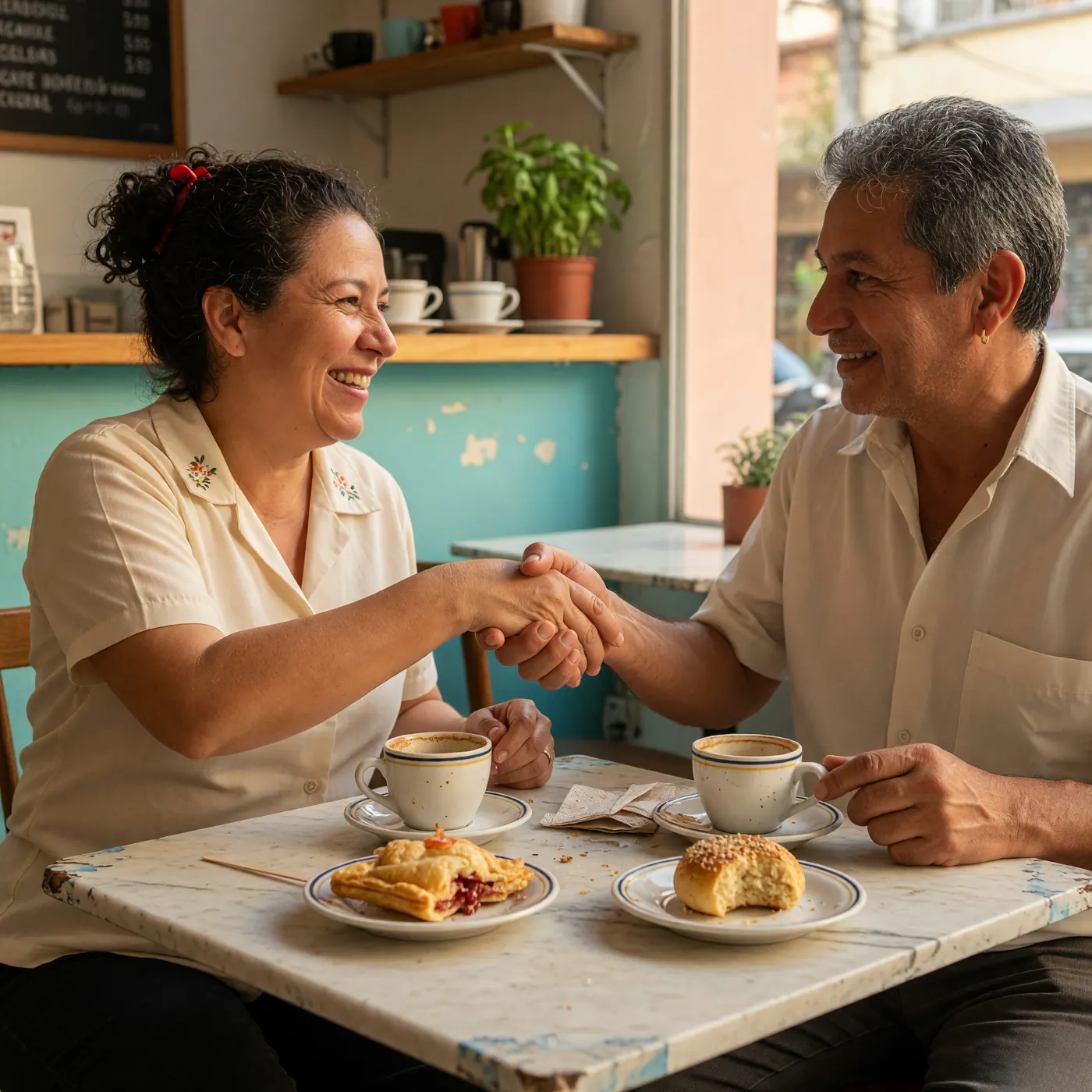
The Spanish language offers layers of formality, and Colombia preserves these distinctions far more actively than many other Latin American nations. Knowing when to elevate formality shows high social intelligence.
As a golden rule for newcomers: default to "Usted". You should always use "Usted" when speaking to elders, service staff (waiters, drivers, building security guards), government officials, and business partners during initial discussions. Moving to "Tú" too fast can feel presumptuous. Allow the other person to invite you into informal address by saying "Puedes tutearme" or simply leading with informal phrasing.
Regional variations add nuance to these rules across the country:
- Bogotá and the Andean Highlands: Formality runs deep. Even long-time friends, spouses, or parents and children frequently address each other as "Usted". You will also hear "Sumercé" in the Bogotá highlands, an affectionate, respectful historical form of address.
- Medellín and the Coffee Axis (Paisa Region): Locals frequently employ voseo (using "Vos" instead of "Tú") among peers and friends, while keeping "Usted" for strangers and seniors.
- The Caribbean Coast: Coastal culture (Costeño) is naturally informal and breezy; "Tú" is standard even in early conversations, though professional deference is still preserved when speaking to superiors.
In the workplace, titles matter. You will quickly notice colleagues referring to managers, attorneys, consultants, and public figures as "Doctor" or "Doctora", even if they hold only a bachelor's degree. This is a conventional cultural honorific indicating status, leadership, and professional respect. Similarly, "Don" and "Doña" are used respectfully before first names for older individuals or property owners (e.g., "Don Hernán"), signifying personal dignity.
Host Etiquette & Dinner Table Norms
Being invited into a Colombian home is a genuine sign of friendship. Hospitality here is generous and attentive, and reciprocating that warmth requires a few foundational manners.
Never arrive completely empty-handed. A bottle of quality wine, a box of fine chocolates, or a box of fresh pastries from a reputable neighborhood bakery (panadería) makes an ideal host gift. If you decide to bring flowers, avoid marigolds or lilies (often associated with funerals), and leave dramatic red roses for romantic partners.
| Social Situation | Standard Protocol | What to Avoid |
|---|---|---|
| Arriving at a Host's House | Hand over a small gift (wine/pastries), greet everyone individually. | Arriving empty-handed or ignoring family members present. |
| At the Dining Table | Keep hands visible on the table (wrists resting on the edge); wait for "Buen provecho". | Placing hands in your lap or starting to eat before the host begins. |
| Offered Food / Drink | Accept graciously; decline only with polite explanation ("Muchas gracias, estoy satisfecho"). | Bluntly saying "No quiero" without a courteous buffer phrase. |
| Splitting the Check | The person who extends the dinner invitation typically pays; offer to split politely. | Arguing aggressively over the bill or nickel-and-diming pennies. |
At the table, continental dining rules apply: hold the fork in your left hand and the knife in your right. Rest your wrists on the edge of the table rather than dropping your hands below the table into your lap. When someone sits down to eat near you or servers deliver plates, it is customary to exchange a pleasant "Buen provecho" (bon appétit), to which you reply "Muchas gracias, igualmente" if you are dining as well.
Looking to broaden your social circle outside of expat bubbles? Read our practical guide on making friends in Colombia as a foreigner.
Understanding Time, "Hora Colombiana" & Indirect Communication
One of the most confusing dichotomies for foreigners is the dual standard applied to time. In the corporate, government, and medical worlds, punctuality is strictly expected. Arriving late to a formal client meeting, notary appointment, or job interview reflects poorly on your professionalism.
Social gatherings, however, operate on what locals call "la hora colombiana". If a friend invites you to a house party, barbecue, or informal birthday celebration starting at 8:00 PM, arriving at 8:00 sharp will likely find your hosts still in the shower or setting out furniture. For large home gatherings, arriving 30 to 45 minutes after the stated invitation time is culturally expected. For intimate one-on-one dinners at a restaurant, aim to be on time or message ahead if traffic delays you.
Equally critical is understanding Colombian conversational indirectness. Culturally, preserving harmony and avoiding confrontation takes precedence over blunt efficiency. Colombians rarely say a flat, harsh "No". Instead, you will hear softened deflections:
- "De pronto" (Literally "maybe/perhaps", frequently meaning unlikely or no).
- "Vamos a ver" ("Let's see"—often a gentle way to table an idea without refusing outright).
- "Qué pena con usted" (An expression of deep empathy, regret, or a polite preamble before delivering bad news or correcting a mistake).
Learn to listen for the tone behind these phrases. If a contractor or acquaintance repeatedly responds with "de pronto la otra semana", it is their polite way of letting you know the schedule is strained rather than making a direct refusal.
Professional Decorum When Setting Up an Office or Business
When you transition from casual nomad life to setting up a local entity, renting commercial space, or hiring staff, etiquette directly impacts your bottom line. Business deals in Colombia are relationship-driven. Contracts, paperwork checks, and spreadsheets are mandatory, but they are rarely signed without a preliminary coffee and personal conversation.
Before launching into technical agenda items, spend the first 5 to 10 minutes asking about your colleague's family, their health, or how their week is going. Skipping personal pleasantries to dive immediately into quarterly metrics can cause local partners to view you as cold or untrustworthy. Cultivate the relationship first; the contract will follow naturally.
For independent professionals and founders looking for dedicated commercial hubs, finding the right space is the first hurdle. If you are currently outfitting an operation, take a look at our walkthrough on setting up a productive home office in Colombia to source local furnishings without overpaying.
According to active listings on Colombia Move (September 2026), there are 6 office listings and 6 commercial-space listings live on the platform, a thin nationwide pool. Colombia Move listings are fee-free and peer-to-peer. If you are planning a full relocation, exploring options across our broader housing and commercial property section shows current inventory by city.
Frequently Asked Questions
❓ How do men greet each other in Colombia?
Men meeting for the first time or in business settings exchange a firm handshake with direct eye contact. Once a friendship is established, they transition to a handshake paired with a brief shoulder pat or full back-slap embrace (abrazo).
❓ Do you kiss on the cheek when meeting someone for the first time in Colombia?
No, you should always default to a handshake during a first meeting, especially in business or professional environments. Cheek kisses are reserved for social introductions between women, or between a man and a woman who are introduced socially by mutual friends.
❓ Is "Usted" or "Tú" more common in Colombia?
"Usted" is the safest and most respectful default across Colombia, especially with elders, service workers, and new professional contacts. "Tú" and "Vos" are common in informal peer settings depending on the region, such as "Vos" in Medellín and Cali, or "Tú" along the Caribbean coast.
❓ Why does everyone call executives "Doctor" in Colombia?
In Colombia, "Doctor" or "Doctora" is a traditional honorific used to show deference and professional respect to managers, lawyers, engineers, and public figures. It does not imply that the person holds a medical doctorate or a Ph.D.
❓ What should I bring when invited to a Colombian home for dinner?
Bringing a small host gift such as high-quality wine, chocolates, or fresh pastries from a reputable bakery is standard etiquette. Avoid bringing yellow or red flowers unless you know the host intimately, as certain florals carry specific ceremonial or romantic connotations.
❓ How should I respond when someone says "Buen provecho"?
You should reply with "Muchas gracias, igualmente" (Thank you, same to you) if you are both dining, or simply "Muchas gracias" if they are passing by your table. Acknowledging the greeting is an essential courtesy in Colombian dining culture.



Comments
Loading comments...
Checking sign-in status...