
How to Hire a Property Manager in Colombia as a Foreign Owner
Managing a Colombian rental property from abroad requires a trusted local partner. Here is what foreign owners need to know about fees, taxes, contracts, and rental insurance.

IDIOMA DEL ARTÍCULO
Showing original language
Buying an apartment in Colombia is thrilling. Trying to fix a leaking pipe from a timezone three hours away? Not so much. If you've invested in Colombian real estate, you quickly realize that managing a property from abroad requires more than just WhatsApp and good intentions. You need eyes on the ground.
Whether you're targeting digital nomads with a short-term rental or looking for a stable, long-term Colombian tenant, hiring a local property manager is often the best investment you can make to protect your asset. Here is exactly how it works, what it costs, and how to avoid getting overcharged. If you want to see real-world options right now, you can browse apartments and houses on Colombia Move — posting is completely free.
Quick Answer: Colombian Property Management at a Glance
- Long-Term Fees: 8% to 12% of the monthly rent (10% is the market standard).
- Short-Term Fees: 20% to 25% of gross revenue for vacation rentals (Airbnb).
- Taxes: You will pay a 19% IVA (VAT) calculated on the management commission itself, not the total rent.
- Tenant Protection: A seguro de arrendamiento (rental insurance) is the gold standard for securing payments, typically costing about 50% of one month's rent annually.
Why You Need a Local Property Manager in Colombia (The Expat Reality)
Managing a property remotely is a logistical headache anywhere, but in Colombia, the challenges are highly localized. Beyond the obvious hurdles of language barriers and timezone differences, you have to navigate strict building administrations and local bureaucracy.
In Colombia, most modern apartment buildings operate under a propiedad horizontal regime. The building administrators hold significant power, and if your tenant violates noise ordinances, throws unauthorized parties, or damages common areas, the administration will come after you, the owner. A good property manager acts as a buffer, ensuring your tenants comply with local rules and handling disputes before they escalate to fines.
Long-Term vs. Short-Term Property Management: Understanding the Split
Before you hire anyone, you need to decide your rental strategy, as the management styles and the companies that handle them are completely different.
Long-term (traditional) management focuses on tenant placement, rent collection, and legal compliance. The manager finds a tenant who will sign a one-year lease, screens them rigorously, and handles the monthly accounting. It's a hands-off, passive income approach.
Short-term (vacation) management is essentially running a hospitality business. These managers handle dynamic pricing on platforms like Airbnb, coordinate daily cleanings, restock supplies, and communicate with guests at all hours.
If you are leaning toward short-term or mid-term rentals, the market can be favorable for owners. According to active listings on Colombia Move (July 2026), there is a stark supply gap in temporal/short-term rentals: we saw only 1 active listing in the "temporal" housing category compared to steady buyer demand. A well-managed, furnished rental has a clear market advantage when supply is that thin.
The Cost of Property Management in Colombia (Fees & Taxes Explained)
Understanding the fee structure is crucial so you don't get hit with surprise deductions on your monthly statement. Always consult a local Colombian accountant regarding your specific tax liabilities, but here are the baseline costs you should expect.
For long-term rentals, standard property management fees range from 8% to 12% of the monthly rent, with 10% being the widely accepted market rate (often recognized as a costumbre mercantil by local chambers of commerce). For short-term rentals, expect to pay between 20% and 25% of your gross rental income due to the heavy operational workload.
The IVA (VAT) Factor: Property management commissions are subject to Colombia's 19% Value Added Tax (IVA). Importantly, this tax is calculated on the commission fee, not the total rent. For example, if your apartment rents for 2,000,000 COP a month and your manager charges a 10% fee (200,000 COP), the 19% IVA is applied to that 200,000 COP, adding 38,000 COP. Your total monthly management cost would be 238,000 COP.
Source note: The fee and insurance ranges above were checked against Metrocuadrado, Vitrina Raíz, Arrendamientos Villacruz, and Casacol property-management guidance accessed on July 8, 2026. Tax and contract details can vary by owner profile, so treat this as practical guidance and confirm your situation with a Colombian accountant or lawyer.
Key Terms to Negotiate in Your Contrato de Administración
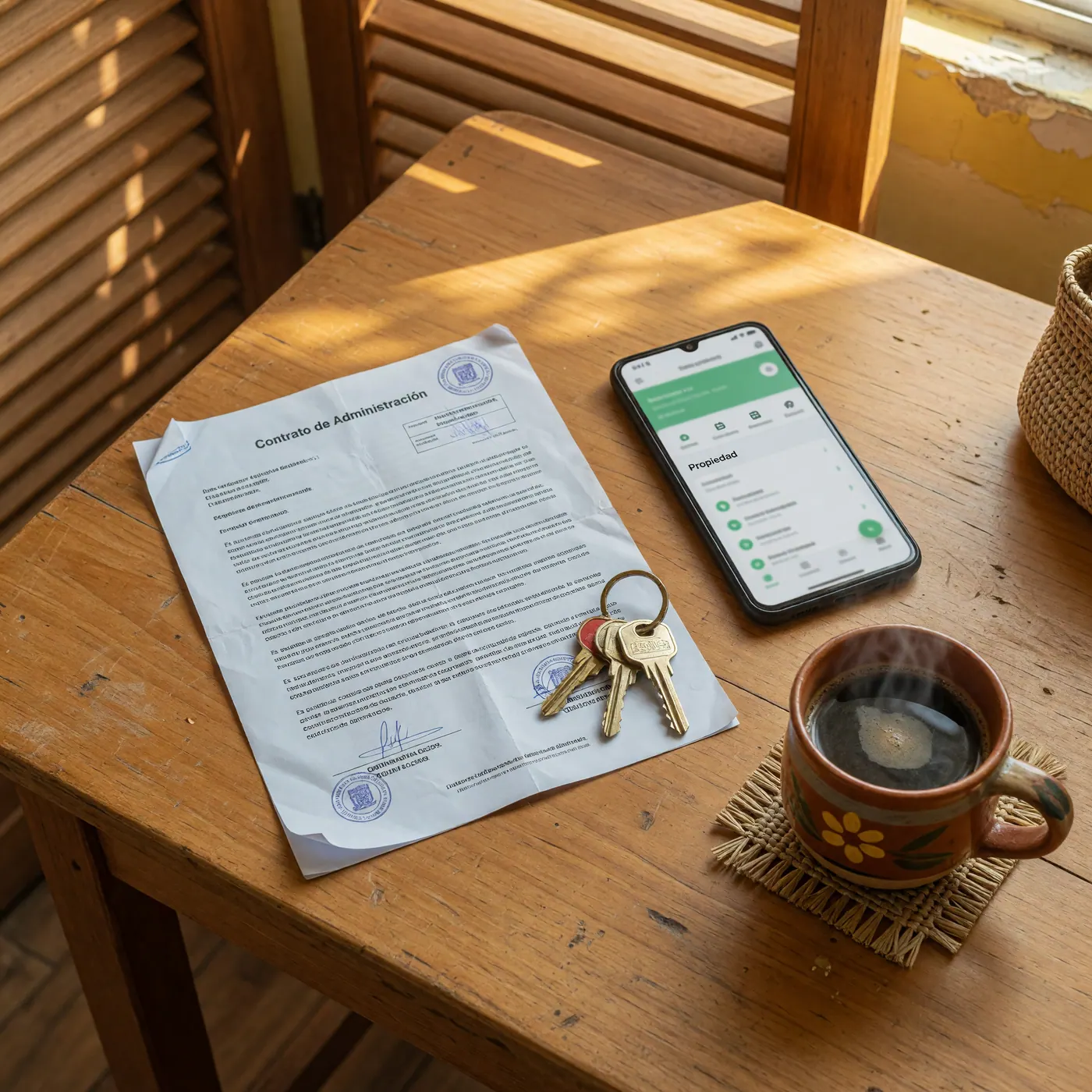
When you hire a manager, you will sign a contrato de administración de inmueble. Do not just sign the boilerplate template; make sure it explicitly covers your boundaries.
Pay close attention to the maintenance limit. Standard contracts include a clause allowing the manager to execute urgent repairs without your prior approval, typically capped between 300,000 COP and 500,000 COP. This is practical: you don't want to be woken up at 3:00 AM to approve a plumber for a burst pipe, but anything above that limit must require your explicit written consent.
You should also define the reporting and payout schedules. Clarify exactly when you will receive your monthly statements and how the funds will be transferred (e.g., local transfer to your Colombian bank account or an international wire, and who eats the transfer fees).
Tenant Screening and the Role of Rental Insurance (Seguro de Arrendamiento)
In Colombia, the traditional way to secure a rental is by requiring a fiador (a co-signer with debt-free real estate in the same city). As a foreign owner, verifying a local fiador's property deed is nearly impossible. This is where rental insurance comes in.
A seguro de arrendamiento (or fianza) from companies like Sura, El Libertador, or Mapfre is the industry standard. This policy guarantees your rent and utility payments if the tenant defaults. It typically costs about 50% of one month's rent as an annual premium, or a monthly fee of 2% to 6% of the rent. Your property manager will require the tenant to apply directly with the insurance company, outsourcing the financial background check to the insurer.
Understanding local tenant rights is also vital. Under Colombian law (Ley 820 de 2003), annual rent increases for residential properties are legally capped at the previous year's Consumer Price Index (IPC) inflation rate. Furthermore, early termination of a residential lease by either the landlord or the tenant without a legally justified cause typically requires a 3-month written notice and a penalty equivalent to 3 months' rent. If you are buying property in Colombia as a foreigner with the intent to live in it part of the year, a standard one-year lease might not fit your lifestyle.
How Colombia Move Fits Your Rental Strategy
While having a property manager is highly recommended for the day-to-day operations, you don't necessarily have to rely on traditional, expensive real estate agencies just to find a tenant. Many foreign owners hire independent property managers for the logistics but handle the marketing themselves to widen their tenant pool.
You can list your property directly on platforms designed to connect owners with both locals and expats. If you are ready to find a tenant, you can use our free housing classifieds to get eyes on your property without paying an agency's placement commission.
Frequently Asked Questions
❓ How much is the typical property management fee in Colombia?
As checked on July 8, 2026, long-term property management usually costs 8% to 12% of monthly rent. The common market reference is 10%, while short-term vacation-rental management often costs 20% to 25% of gross revenue.
❓ Do I have to pay VAT (IVA) on property management fees in Colombia?
Yes, as checked on July 8, 2026, property management commissions are subject to Colombia's 19% IVA. The tax is calculated only on the management company's fee, not on the total rent collected.
❓ Is a seguro de arrendamiento a safe way to screen tenants?
A seguro de arrendamiento guarantees rent and utility payments if a tenant defaults. As checked on July 8, 2026, it often costs about 50% of one month's rent annually and is usually paid by the tenant or split during onboarding.
❓ Can a property manager handle maintenance without my approval?
Yes, as checked on July 8, 2026, but only up to a pre-approved limit specified in your contract. Many contracts use urgent-repair limits around 300,000 COP to 500,000 COP, while larger expenses should require your explicit written consent.
❓ How do property managers in Colombia screen tenants?
As checked on July 8, 2026, managers commonly screen tenants through local credit bureaus and rental-insurance approval. They may also request a co-signer (fiador) with real estate property, but insurance approval is easier for many foreign owners to verify.
❓ Where does self-managing a Colombian rental from abroad usually break down?
As checked on July 8, 2026, self-management usually breaks down around emergencies, key handovers, inspections, and disputes. Digital platforms help with listing and communication, but a local partner is hard to replace when something must be handled in person.



Comments
Loading comments...
Checking sign-in status...