
Vehicle Transfer in Colombia: A Step-by-Step Guide
The transfer is what turns a vehicle sale into a real sale. Here is the complete process—RUNT, SIMIT, 1% withholding tax, and costs by city—straight to the point.
IDIOMA DEL ARTÍCULO
Showing original language
A buddy from the office got a ticket from Itagüí in March... for a motorcycle he sold in 2023. He handed over the bike, got the cash, shook hands, and the “we’ll do the title transfer later” stayed as a later. Today the bike is still registered in his name, the traffic tickets go to him, and the buyer doesn't answer his WhatsApp.
That is what is at stake with the title transfer. It is not optional paperwork: it is the only thing that turns “I sold you the bike” into a real sale before the State. And although the process is honestly annoying—lines, forms, fees that change depending on the city—it is much cheaper to do it right once than to fix the mess years later.
The short answer: the transfer is done before the transit authority where the vehicle is registered. You need a purchase agreement, the vehicle to be free of fines and taxes, the 1% withholding tax paid if the seller is a natural person, and the appointment for the process. The rest of this guide is that process, step-by-step and without frills.
What the transfer is and why handing over the keys is not selling
The transfer is the change of owner in the official vehicle registry. As long as it is not done, to the system the owner is still the one who appears on the ownership card: that person receives the fines, camera tickets, and the vehicle tax bill, regardless of who has the keys.
If you are selling, you want your name off the registry as soon as possible. If you are buying, you want to be able to prove that the vehicle is yours. The transfer solves both things; nothing else does.
Before negotiating: checking in RUNT, SIMIT, and paperwork
This stage costs zero pesos and avoids big scares. Before seriously talking about price, buyer and seller should have this verified (if you are planning to buy, our guide to buying a used car or motorcycle goes deeper into the vehicle inspection itself):
- RUNT citizen inquiry: on the official RUNT portal verify by license plate that the owner, characteristics, SOAT, and technical-mechanical inspection match what is shown to you. If the engine number does not match, the conversation ends right there.
- Fines and tickets in SIMIT: the SIMIT inquiry shows what is pending by license plate or ID number. Debts can stall the process, so be up to date or agree in writing who will cover them.
- Vehicle tax up to date: delays become a headache for the buyer after the transfer. Ask for receipts from the last few years.
- SOAT and technical-mechanical inspection: check the dates on the RUNT inquiry, not on the paper they show you. In our SOAT and insurance guide we explain what each one covers.
- Pledge or limitations: with a lien in favor of a bank, there is no transfer until it is lifted. It appears on the ownership card and in the RUNT.
The step-by-step process
The exact order varies a bit by city, but the skeleton of the process is the same nationwide. This is what it looks like from beginning to end:
- Close the deal in writing. Purchase agreement with full details of both parties, vehicle identification, price, payment method, and who pays for the process. Without this, there is nothing to rely on if something goes wrong.
- Get up to date. Fines in SIMIT and vehicle tax paid. It is the first thing checked and what ruins the most appointments.
- Pay the 1% withholding tax. When the seller is a natural person, the sale of a fixed asset like a vehicle triggers a 1% withholding tax on the sale value, and it must be paid before the transfer (Tax Statute, art. 398). It is paid at authorized banks or online depending on the city.
- Schedule the appointment at the transit authority. The process is done where the vehicle is registered. In Bogotá, it is scheduled through the Ventanilla Única de Servicios; in other cities, directly with the transit secretariat or its local operator.
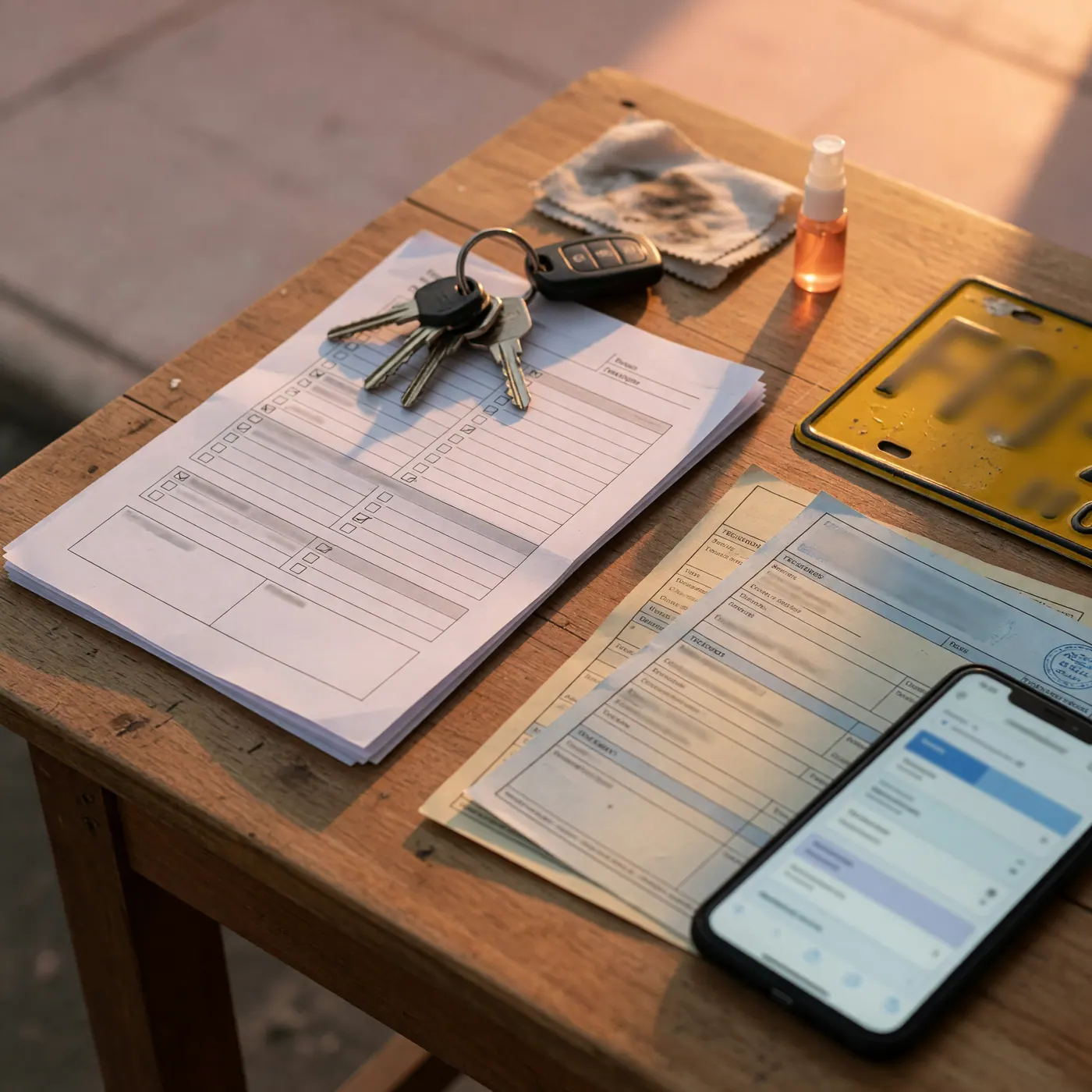
- Bring the documents. IDs, contract, ownership card, clearance certificates, proof of withholding, and the forms requested by your transit authority (some require engine imprints).
- Pay the fees and confirm the registration. Each agency charges its own fee. At the end, the buyer receives a new ownership card and the change is recorded in the RUNT. Until that appears, the transfer is not done.
Be careful with one detail: many transit authorities require the seller to sign or be present for the process. If you sold, don't leave it to the buyer's good faith—accompany the process until the end.
How much it costs: the components, not a magic number
Here is the uncomfortable truth: any article that gives you a single figure for the transfer in Colombia is misleading you, because the processing fees are set by each transit authority and change over time and by the type of vehicle. The serious thing is to understand what makes up the cost and verify the current rate in your city before closing the deal:
| Component | Who defines it | How to verify it |
|---|---|---|
| Transfer fees | The transit authority where the vehicle is registered | Current fee published by your transit secretariat or its operator (in Bogotá, the Ventanilla Única de Servicios) |
| Withholding tax (1%) | National — Tax Statute art. 398 | 1% of the sale value when the seller is a natural person; paid before the procedure |
| Pending fines and taxes | SIMIT and the departmental treasury secretariat | Inquiry by license plate before negotiating; paid to get clearance |
| Expired SOAT or technical-mechanical | Insurers / CDA | If they are expired, renewing them is usually a practical requirement to move the vehicle and close the deal |
| Local extras (imprints, forms) | Each transit authority | Ask when scheduling the appointment what your city requires |
Who pays? It is negotiable. In practice, it is common for the buyer to assume it, but it is not a fixed rule: the only thing that matters is that it be in writing in the contract, along with who is responsible for old fines or taxes.
Motorcycles vs cars: what changes in practice
The legal basis is the same: same registry, same withholding, same clearance. The differences are practical. With motorcycles, the procedural fees weigh more against the value of the vehicle, and it is the market where you see the “I'll leave it to you with the transfer pending” excuse most often—the amounts seem small until the tickets from someone else arrive. With cars, the big risk lies in unlifted liens and delinquent departmental taxes from several years ago. In both cases, the same applies: the vehicle is delivered when the payment is confirmed and the process is underway, not before.
Common mistakes when selling (and how to post an ad that generates trust)
- Handing over the vehicle with the payment “on the way”. Transfer confirmed in your account, not a screenshot. The typical marketplace scams almost always start by rushing the delivery.
- Leaving the transfer “for next week”. It is the vehicle version of lending money without a promissory note. If the buyer cannot schedule the appointment, they are not yet the buyer.
- Not agreeing in writing who pays for what. Paperwork, old fines, current year's taxes: everything is negotiable, nothing verbal.
- Publishing a weak ad. Real photos, city license plate, mileage, honest vehicle condition, and the phrase "papers up to date, immediate transfer" filter out curious people better than any discounted price. We explain this in depth in the guide for selling your car without intermediaries.
A fact that puts it in perspective: according to internal Colombia Move data (June 2026), the platform registered more than 15,500 ad views in the last 30 days, but the vehicle section is empty — zero active car and motorcycle ads. Anyone who publishes a vehicle today with clear papers competes with no one.
Frequently asked questions
❓ How much does it cost to transfer a vehicle in Colombia?
There is no single national rate: the cost depends on the city, the type of vehicle, and the model. To that, you add the 1% withholding tax if the seller is an individual, and any pending taxes or fines. Verify the current rate at the transit authority where the vehicle is registered (checked in June 2026).
❓ Who pays for the transfer, the buyer or the seller?
It is negotiable and should be in writing before the appointment. In practice, it is common for the buyer to assume it, but it is not a fixed rule in 2026 or in any city: agree in the contract who pays for the procedure and who is responsible for pending fines or taxes, and avoid last-minute surprises.
❓ Can I sell a motorcycle with pending fines?
You can negotiate it, but the process becomes complicated: for the transfer, it is best to be debt-free. Consult SIMIT by license plate or ID (official source) before receiving any payment and put in writing who assumes the pending debt. An unresolved debt is the easiest way for the deal to fall through at the appointment.
❓ What should I check on the RUNT before buying?
That the license plate, the owner, and the registered characteristics match the physical vehicle, and that the SOAT and technical-mechanical inspection appear up to date. The citizen consultation is free on the RUNT portal (official source, checked in June 2026). If the engine number does not match the papers, walk away from the deal without shame.
❓ Is it safe to hand over the keys and the registration card before the transfer?
It is not recommended. Hand over the vehicle when the payment is confirmed, the contract is signed, and the process is underway at the transit authority. No check eliminates all risk, but that order reduces it significantly: a "word-of-mouth" transfer leaves your name tied to fines and taxes that are not yours (recommendation in effect as of June 2026).
❓ What happens if I never do the transfer?
The vehicle continues to be registered in the name of the previous owner: citations, photo-fines, and vehicle taxes go to that person, and the new owner cannot prove full ownership. Regularizing it later is usually more expensive and slower. If you sold, do not consider the deal closed until you see the registration updated in the RUNT (checked in June 2026).




Comments
Loading comments...
Checking sign-in status...