
Price per square meter of an apartment in Colombia: how to calculate it and compare neighborhoods
A step-by-step method to calculate the price per m² of an apartment in Colombia, tell private area apart from built area, and avoid confusing an official index with the price in your neighborhood.
IDIOMA DEL ARTÍCULO
Showing original language
Quick answer: the price per square meter of an apartment is the asking price divided by the area stated in the listing. The number is only useful if all the comparables use the same area and the same treatment of the parking space.
Almost every discussion about whether an apartment is overpriced starts with a listing that says «80 m²» and ends with nobody knowing which meters were meant. Here is the method so your comparison doesn't fall apart at the seller's first question.
What price per m² is and how it's calculated
The formula is simple: asking price ÷ declared area. DANE defines the sale price per square meter in a similar way: the commercial value of the unit divided by its square meters (conceptos.dane.gov.co).
A hypothetical example, just to see the math and not as market data: an apartment priced at $400,000,000 with 80 m² comes to $5,000,000 per m². If that same apartment has 72 m² of private area, the result rises to about $5,555,556 per m². Same apartment, two numbers. That's why the first thing to ask is which area was used.
The reason to use price per m² rather than the total price is simple: a 90 m² apartment looks expensive next to a 50 m² one, even if they cost the same per meter. The m² puts both on the same scale.
Private built area, built area and open area
This is where most people get lost. These are three different measures:
- Private built area: according to article 3 of Law 675 of 2001, it is the covered extent of the private property, excluding common property within its boundaries. It is used to calculate the co-ownership coefficient (article 26).
- Private open area: the semi-open or open private extent, with the same exclusion. Think of a private terrace.
- Built area: the SIC housing guide (labeled «Advertencias 2012» on its page) says it includes dividing and façade walls, ducts and structure, and that a shared wall is measured from its midline. That's why it is larger than the private area.
The practical consequence: using private area, the price per m² comes out higher, and using built area it comes out lower. Neither is «the correct one»; what matters is not mixing them. If the listing only says «80 m²», ask which one it is and ask them to show you in the deed or the horizontal property regulations.
The parking space also changes the math. According to the SIC, it can be individual, communal, for exclusive use or under an easement, depending on the regulations. Ask whether it's included in the price and whether it counts toward the meters.
Why the same m² doesn't cost the same everywhere
Two apartments with identical price per m² can be very different deals. Before concluding that something is «high» or «cheap», check this list:
- Stratum and neighborhood: a city's median mixes areas that aren't alike.
- Floor, view and orientation.
- Age and condition: renovated or needing renovation.
- Parking and storage: included in the price or not.
- Building administration fees: they weigh on the monthly cost even if the m² doesn't change.
There is no official percentage premium per floor or discount per year of age, so be wary of anyone who offers you one as a fixed rule. What official data does show is that the stratum groups don't move the same way. In the DANE IPVN bulletin for Q2 2026 (August 24, 2026), the quarterly change in Bogotá was 2.40% overall: 2.67% in low strata (1 to 3), 1.76% in the middle (stratum 4) and 2.76% in the high (strata 5 and 6). In Medellín it was 2.73% overall: −1.65% in low, 4.11% in middle and 3.03% in high. Same quarter, opposite behavior depending on the stratum.
What DANE measures and what the Banco de la República measures
Official indices provide context, but none of them tells you how many pesos per m² your neighborhood costs.
IPVN (DANE): measures the change in new housing prices. In Q2 2026 it rose 2.37% for apartments compared with the previous quarter and 8.88% compared with the same quarter of 2025. Overall it was 2.41% and 8.80%, with base Q4 2020 = 100 (DANE bulletin). According to the methodology, its m² is the average sale price without parking, and includes land, urban development, direct and indirect costs, financial costs, sales costs and profit. It is not the seller's net price nor the m² of a resale property (IPVN methodology).
IPVU (Banco de la República): tracks resale housing based on credit appraisals from several banks. As of June 30, 2026, the nominal index stood at 3,086.36 with base 1990=100 (Banco de la República). It is an index level, not pesos per square meter.
How to read the asking-price median on Colombia Move
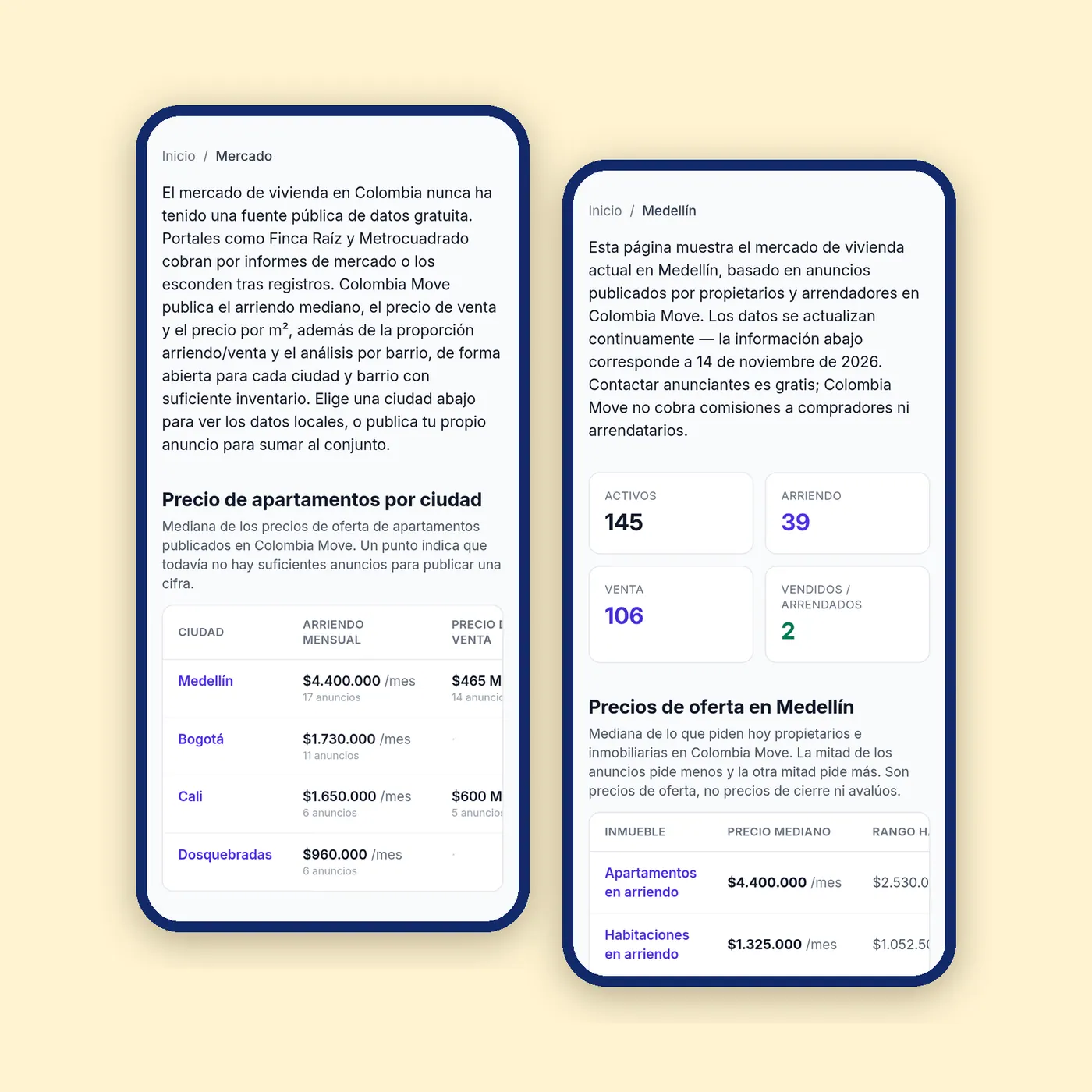
Our own data is in Real estate market: medians of asking prices for active listings, with the number of listings next to them. They are what sellers ask, not appraisals or closing prices. When a cell shows a dash, there isn't enough sample and it is not filled in.
According to the query of November 14, 2026:
| Query | Median asking price | Listings |
|---|---|---|
| Apartments for sale, Colombia Move total | $460 million (usual range $370 to $720 million) | 31 |
| Sale per m², total | $5,974,026 | 31 |
| Apartments for rent, total | $1,800,000 per month ($38,889 per m²) | 56 |
| Medellín, sale per m² | $6,121,341 | 14 |
| Medellín, rent | $4,400,000 per month | 17 |
| Bogotá, rent | $1,730,000 per month | 11 |
Notice what doesn't appear: Bogotá had no published sale per m² because the sample wasn't large enough, and neither did Cali. With few listings, a median misleads. I prefer an honest dash to an invented number.
As supply context, that same day the property portal showed 196 apartments for sale and 63 for rent, and the Vivienda section listed 262 in the Apartment category. You can filter the apartment for sale category and calculate the m² yourself for five or six listings in the same neighborhood.
Mistakes when comparing
- Mixing areas. A listing with private area compared with one with built area gives a false difference.
- Including or leaving out the parking space. If one includes it in the price and the other charges it separately, they are not comparable.
- Forgetting administration fees in rentals. Add the fee before dividing, and see how to compare rents in the guide to rental prices.
- Comparing a neighborhood with the city or national average. The national median is an order of magnitude, not your yardstick.
- Taking an index as a closing price. The IPVN and IPVU measure changes; the asking-price median measures what is requested. None of that is what gets signed at the notary's office.
- Comparing with land. The m² of a lot or a farm can't be compared with the built m² of an apartment.
And a warning I'll repeat: calculating the m² does not replace reading the certificate of title and does not justify paying a deposit before verifying who the owner is.
How to use the calculation when listing your apartment
If you're selling, the m² is your defense when someone says «it's overpriced». A clear listing says, at a minimum:
- which area you used (private built or built) and how many meters it is;
- stratum, floor and age;
- whether the parking space and administration fees are separate;
- how many similar listings in the neighborhood you looked at to set the price.
With that, the buyer compares using the same rules, and you save repeated questions. Once you have the price, the next steps are in the guide to selling your apartment without an intermediary.
Short closing: the m² orders the comparison, but it is not an appraisal. If you need one, start with the guide to commercial housing appraisal.
Frequently asked questions
❓ How is the price per square meter of an apartment calculated?
Divide the asking price by the area stated in the listing. For the comparison to be valid, all comparables must use the same area (private built or built) and treat the parking space and administration fees the same way. (verify with the official source)
❓ Are private area and built area the same number?
No. Private built area excludes common property within the boundaries (Law 675 of 2001, article 3), so it is smaller. The SIC explains that built area includes walls, façade, ducts and structure. (verify with the official source)
❓ Does the DANE index tell me how much a square meter costs in my neighborhood?
No. The IPVN measures how much new housing prices changed, not the peso price in a neighborhood. In Q2 2026 apartments rose 2.37% compared with the previous quarter, and their m² does not include parking. (verify with the official source)
❓ Can I compare the price per square meter in Medellín with Bogotá?
Only as an order of magnitude. On Colombia Move, on November 14, 2026, Medellín showed sale per m² with 14 listings and Bogotá did not, because the sample wasn't large enough. Stratum and neighborhood weigh more than the city average. (verify with the official source)
❓ Is the Colombia Move median an appraisal or the price at which a sale closes?
No. It is the median of what active listings ask, and it is shown with the number of listings. The appraisal is a separate procedure, and the closing price is negotiated between the parties. (verify with the official source)
❓ How do I avoid a scam if an apartment's price per m² seems like a bargain?
Be wary of a price well below comparables in the same neighborhood. Request the certificate of title and freedom from encumbrances, verify that the person offering is the owner, and don't make advance payments before reviewing the documents. No m² calculation replaces that verification. (verify with the official source)
❓ Where can I list my apartment for sale or rent?
You can list it in the Vivienda section of Colombia Move, Apartment category, indicating the area, stratum, floor and age. Interested people contact you directly, without an intermediary.



Comments
Loading comments...
Checking sign-in status...