
How to Bring Your Car to Colombia as a Returnee: 2026 Guide
Practical guide for returnees who want to bring their car to Colombia: documents, DIAN process, RUNT homologation and real costs.
IDIOMA DEL ARTÍCULO
Showing original language
If you've been abroad for years and have a car overseas, at some point you'll ask yourself the same question every returnee does: should I bring the car or sell it here? The answer isn't as obvious as it seems, and most people get it wrong — either because they don't understand the real costs of the process or because they assume "the Return Law covers everything" and it turns out it doesn't work exactly that way.
The good news is that Colombia does have a legal framework to import your vehicle with benefits under Law 2136 of 2021 (Return Statute). The bad news is that the process has steps nobody anticipates, requires a customs agent that is absolutely essential, and a RUNT homologation that can take weeks. This guide explains it to you straight. If you want to see real options right now, you can see cars and motorcycles available on Colombia Move — posting is completely free.
If you're in the first few weeks back and still putting together your list of procedures, I also recommend reading the Returnee's Guide: the first 30 days back in Colombia — it covers everything else, from your ID to your bank account.
Is it worth bringing the car or selling it abroad?
Before thinking about procedures, there's a more basic question to answer: does it make financial sense to bring your car to Colombia?
The answer depends on three things. First, the vehicle's value: if you have a car worth less than $10,000 USD, the costs of the process — transportation, customs, homologation — probably don't justify the effort. For cars worth $20,000+ the balance can be positive. Second, the Colombian market: a car that costs $20,000 USD in the US might have local equivalents for $80 to $100 million pesos. Make the comparison before deciding. Third, the brand: if you bring a Toyota, Chevrolet or Renault there are easy spare parts and shops that know them. If you bring something uncommon in Colombia, you're going to struggle.
Practical rule: if the car is worth more than $15,000 USD, is in good condition and there's a spare parts market in Colombia, it's worth evaluating the process. If it's worth less or has mechanical problems, sell it abroad and buy here. The only time the equation clearly favors importing is when the vehicle has high sentimental or technical value (high-end 4x4 trucks, high-end electric vehicles, etc.).
What the Return Law says about vehicles
Law 2136 of 2021 (Colombian Return Statute) establishes benefits for Colombians who return after having resided abroad for a minimum of 5 consecutive years. The most well-known benefits are for household goods — personal effects and household items without tariffs — but vehicles have special and separate treatment.
For motor vehicles, the benefits are not a "blanket exemption". What the law allows is to include ONE vehicle for personal use within the return process, with reduced tariff rates compared to a standard commercial import. The vehicle always has its own customs declaration and goes through formal DIAN review — it doesn't go "packed" with the furniture.
The basic requirements to access the benefit are:
- Minimum 5 years of continuous residence abroad, accredited with passport, visas or consular certificate
- The vehicle must be registered in the name of the returnee in the country of origin
- It must be a vehicle for personal use, not commercial or work-related
- Only one vehicle per family unit that has returned
- The vehicle must have been acquired before making the decision to return
Important: if you return before completing 5 years, you no longer have the right to the returnee benefit for the vehicle. Some customs agents manage special cases with less time, but that's the exception, not the rule. And if you bring the car without the benefit, you pay regular import tariffs, which can be 15% to 35% of the customs value.
The documents you need to gather
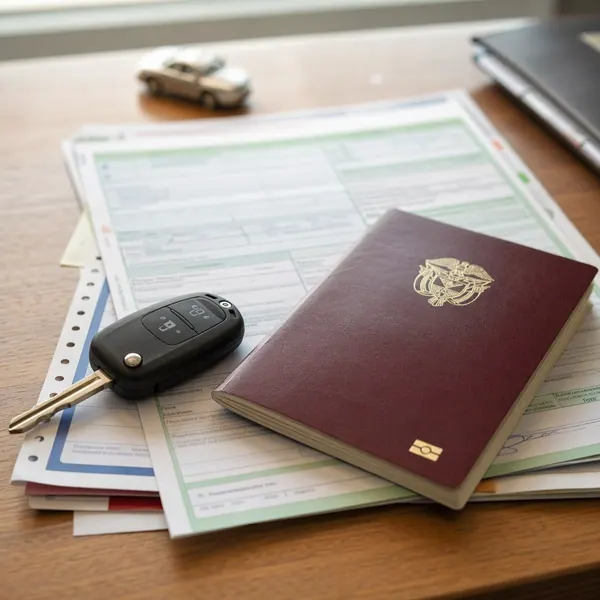
The customs process requires papers that take time to obtain. Start gathering them at least two months before shipping the vehicle.
From the country where you lived
- Vehicle title (proof of ownership in your name, current)
- Insurance letter current until the export date
- Consular residence certificate — issued by the Colombian consulate in your country of residence
- Passport with entry/exit stamps proving the 5 years
- BL (Bill of Lading) — generated by the shipping company when you ship the vehicle
Procedures in Colombia
- Returnee Certificate from the Ministry of Foreign Affairs — this document activates the benefits of Law 2136. Without it, you import the car like anyone else, without discounts
- Notarized power of attorney if a customs agency will act on your behalf before the DIAN
The returnee certificate is processed at the Ministry of Foreign Affairs in Bogotá or at one of the regional offices (Medellín, Cali, Barranquilla, Cartagena). If you're still abroad, you can also start it at the Colombian consulate in your country. The process takes between 2 and 4 weeks.
The DIAN process step by step
Once the vehicle is ready to leave the country of origin, here's what happens:
1. Hire a customs agent in Colombia
It's not optional and don't try to do it alone. The DIAN process requires an authorized customs agent (also called a customs agency or SIA — Customs Intermediation Company). The service cost varies between $1,500,000 and $3,000,000 COP. Get quotes from several agencies and verify that they are authorized by the DIAN — you can check it on the muisca.dian.gov.co portal.
2. Transport the vehicle
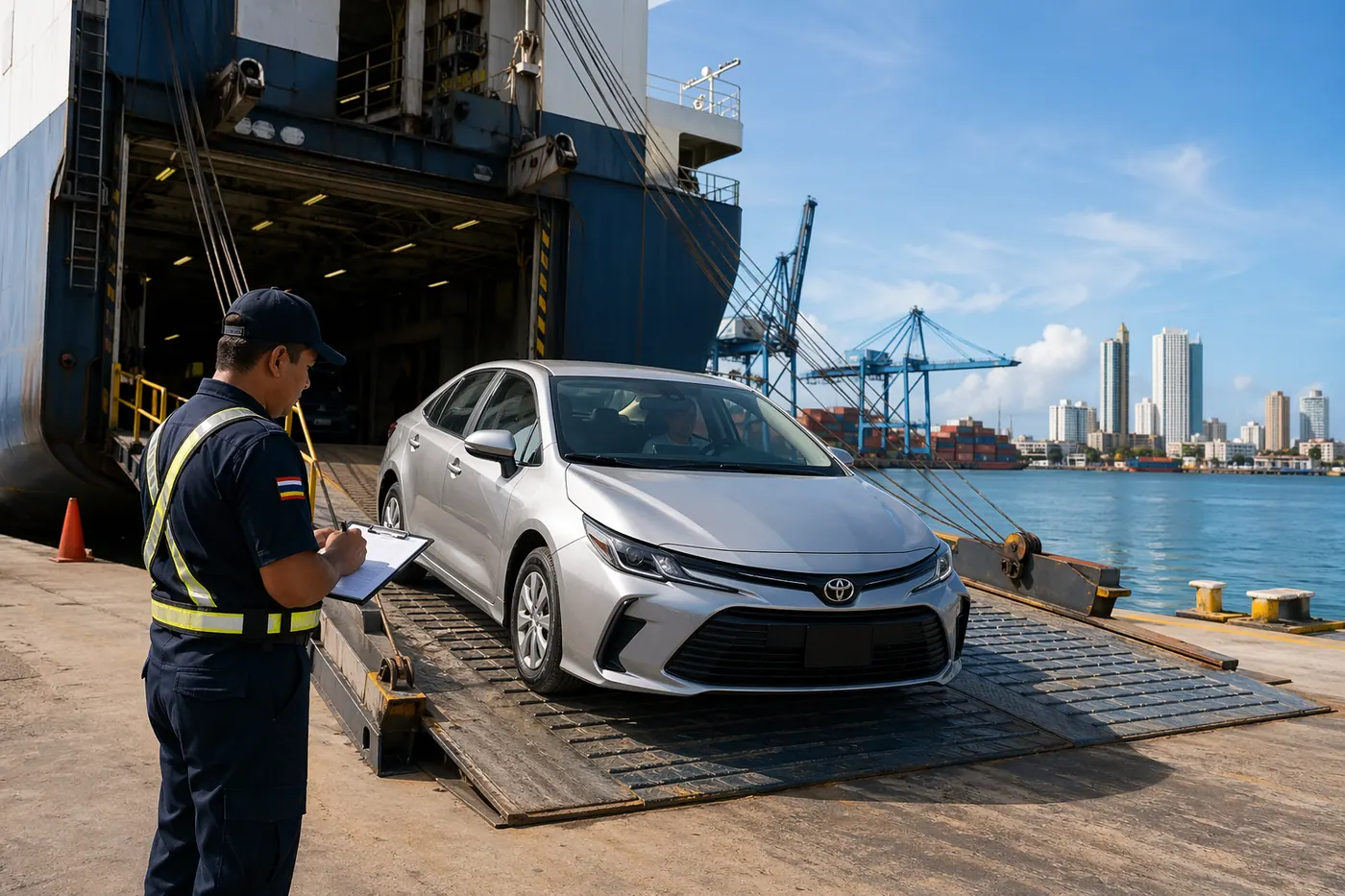
Most returnees coming from the US or Europe use maritime transport. There are two options: Roll-on/Roll-off (RoRo, the car drives onto the ship, cheaper) or container (more expensive but greater protection). The most common entry ports are Buenaventura on the Pacific, and Cartagena or Barranquilla on the Atlantic. Transit time from the US is 2 to 4 weeks, and transportation costs range between $1,500 and $3,000 USD depending on origin and vehicle type.
3. Import declaration and settlement
Your customs agent submits the declaration with all documents. The DIAN settles the applicable tariffs and taxes. Under the returnee benefit, the tariff is significantly lower than the standard — which can reach 35% for vehicles in regular import — but the 19% VAT on the customs value always applies, benefit or not.
4. Physical inspection
The DIAN may request physical inspection of the vehicle at port before releasing the merchandise. They don't always do it, but when they request it, it can take an additional 3 to 10 business days. It's normal, don't worry.
5. Payment and withdrawal
Once the declaration is approved and taxes are paid, the vehicle is free to be withdrawn. Your agent coordinates logistics with the port warehouse. Port storage has daily costs, so it's best to coordinate quick withdrawal once DIAN gives the green light.
Homologation in the RUNT: the step nobody mentions
Importing the vehicle doesn't mean you can already drive it in Colombia. Before circulating legally, you need to homologate it and register it in the RUNT (Registro Único Nacional de Tránsito). This is the step that surprises returnees the most.
Homologation is the technical process by which a certifying entity verifies that your vehicle complies with Colombian safety standards, emissions, and technical characteristics. Not all vehicles pass easily:
- Vehicles with the steering wheel on the right side (as in Japan, Australia, or the United Kingdom) are generally NOT homologable in Colombia
- Cars with airbag systems or seatbelts different from Colombian standards may need adaptations
- Vehicles older than 10 years sometimes have problems with current emissions standards
The homologation process is done before ICONTEC or a certifying entity authorized by the Ministry of Transport. The process can take between 4 and 8 weeks and the cost ranges between $800,000 and $2,500,000 COP. Once approved, the vehicle is registered in the RUNT with Colombian plates and you can drive it legally.
The only time you can drive without homologating is if you have a temporary transit permit issued by the RUNT while the process is underway. Ask your customs agent about this permit from the start.
How much does it all cost in total
Budgeting this is difficult because costs vary depending on origin, vehicle type, and commercial value. For a returnee coming from the U.S. with a standard sedan of $15,000–$20,000 USD, here are the realistic ranges:
| Concept | Approximate cost |
|---|---|
| Maritime transport (U.S. → Colombia) | $1,500 – $3,000 USD |
| Tariff (with returnee benefit) | Variable (reduced) |
| VAT (19% on customs value) | Variable |
| Customs agent (SIA) | $500 – $1,000 USD |
| RUNT homologation | $200 – $600 USD |
| Registration, plates, and RUNT procedures | $400,000 – $800,000 COP |
The sum of fixed costs (excluding tariffs and VAT on the car's value) is around $2,500 to $5,000 USD minimum. For a car of $8,000 USD, that represents between 31% and 62% additional value in logistics alone. For a car of $25,000 USD, the same expense is a much more reasonable percentage.
The only expense many underestimate is port storage: if procedures are delayed, customs warehousing can cost $50,000 – $150,000 COP per day. Your customs agent should coordinate it to minimize days.
If you decide not to bring it: buying in Colombia
If the numbers don't work out or the process seems too cumbersome, the most sensible alternative is to sell the car abroad and buy one in Colombia. The Colombian used car market is broad and there are good options in all price ranges.
📖 Keep reading
Buying a used car or motorcycle in Colombia: where to look and what to check before paying
Once in Colombia, you can check options on portals like TuCarro.com, MercadoLibre Autos, and Colombia Move Vehículos — which is free to post and has both private cars and small sellers. If you arrive before selling yours, you can also post it there from abroad to close the deal as soon as you arrive.
🇨🇴 Looking for a car or motorcycle in Colombia?
On Colombia Move you can see cars and motorcycles from individuals throughout the country. Free to post, no commissions, and with listings from Bogotá, Medellín, Cali, and more.
View available vehicles →Frequently asked questions
❓ Can I bring the car if I've been abroad for only 3 years?
No. The benefits of the Return Law for vehicles require a minimum of 5 years of continuous residence abroad. If you've been away for less time, you can import the vehicle but under regular import conditions, with higher tariffs and without the benefits of the Returnee Status.
❓ What happens if the car doesn't pass homologation?
If the certifying entity determines that the vehicle does not comply with Colombian standards, you cannot register it or drive it legally. The options are: make the necessary technical adaptations (if they are viable and economically justified) or re-export it. That's why it's crucial to check the homologability of the model before shipping it — your customs agent can guide you.
❓ Can I drive with my foreign license while I do the procedure?
Technically yes, with licenses from countries that have an agreement with Colombia. But in practice many traffic authorities don't recognize them well. The recommendation is to process the Colombian license as soon as possible once you have a current ID.
❓ Is the process different if I come from Venezuela or Ecuador by land?
Yes. If you enter through the Cúcuta border (Venezuela) or Ipiales (Ecuador), the vehicle goes through the corresponding land customs. The documents are the same, but the transport logistics are different and customs agents specialized in border traffic are different from those at sea ports.
❓ How long does the entire process take from start to finish?
From when you ship the vehicle until you have Colombian plates, count between 2 and 5 months. Transport takes 2–4 weeks, customs procedures another 2–6 weeks, homologation 4–8 additional weeks, and RUNT registration 1–2 more weeks. Plan ahead and coordinate with your agent from the beginning.
Have you already gone through this process?
Bringing a car to Colombia as a returnee is one of the most complex procedures there is, and each case has its own particularities. If you've already done it and have concrete experience — good or bad — share it in the comments. Real cases help more than any written guide.
You can also ask your questions in the Colombia Move community at colombiamove.com/comunidad — there are returnees and procedure experts who can guide you with specific situations.



Comments
Loading comments...
Checking sign-in status...