
Learning Spanish in Colombia: Schools, Cities, and What Actually Works
Colombia has one of the clearest Spanish accents in Latin America — and far fewer expat bubbles than you'd expect. Here's how to make the most of it.

IDIOMA DEL ARTÍCULO
Showing original language
When I first arrived in Medellín, my Spanish was just good enough to order coffee and avoid major embarrassments. Three months later, I was navigating a dispute with my landlord about the administración fee — in Spanish, over WhatsApp voice notes, because he'd never once messaged in writing. The gap wasn't a formal school. It was the right city, a few hours a week of tutoring, and forcing myself through situations where Spanish was the only option.
Colombia has a legitimate reputation as one of the best countries in Latin America to learn Spanish. The accent — particularly in the interior cities of Medellín and Bogotá — is widely considered among the clearest on the continent. Words don't get swallowed. Consonants actually land. And Colombians tend to be patient with learners in a way that isn't universal.
That said, not every city works equally well, not every approach produces results, and the classic move of "just showing up and absorbing it" works slower than most people expect. Here's what I'd tell a friend who just booked a flight.
📚 Quick answer: what to know first
- Colombia — especially Medellín and Bogotá — is widely considered one of the best countries in Latin America to learn Spanish: clear accent, patient locals, low cost
- Best cities for learners: Medellín (lifestyle + accent), Bogotá (business Spanish), Coffee Region (quiet, affordable immersion)
- Private lessons: ~80,000–200,000 COP/hour · group school programs: ~500,000–1.5M COP/week
- Avoid hiding in the expat bubble — progress comes from daily Spanish use, not just class hours
- For a real language shift, plan at least 3–6 months of consistent effort
Why Colombia Is Actually Good for Learning Spanish
The accent is the starting point. Colombian Spanish — especially the paisa dialect spoken in Medellín and the surrounding Antioquia region, and the rolo accent of Bogotá — is slower, more clearly enunciated, and closer to the standard textbook Spanish you learned in a classroom than most Latin American varieties. Argentinian porteño speakers clip and swallow syllables. Cuban Spanish drops consonants. Caribbean coastal dialects run fast. Interior Colombian Spanish is forgiving.
Beyond accent, there's a social warmth that matters. If you fumble an explanation in a shop, the shopkeeper will usually slow down, repeat key words, or try again differently — rather than reaching for their phone to find Google Translate. There's a cultural pride in how Colombians speak, and most people respond positively to a foreigner who's genuinely trying. You're not going to be made to feel ridiculous for speaking imperfect Spanish here.
The cost works in your favor too. Private tutors run 80,000–150,000 COP per hour in most cities. Even a formal group class week costs less than an equivalent program in Spain or many parts of Latin America. You can spend three months here, take consistent lessons, and spend less than a four-week program in Barcelona.
Best Cities for Spanish Immersion in Colombia
Not all Colombian cities are equal for this, and it's worth thinking carefully before committing to a location.
Medellín is my top pick for most people. The paisa accent is among the most neutral in the country. There's a substantial expat community, which is useful when you first arrive and disorienting if you spend too long in it — you can live in El Poblado and speak English nine-tenths of your day without trying. Move to Laureles, Envigado, or a less expat-saturated barrio and the language pressure increases fast. The lifestyle also makes staying three to six months feel easy.
Bogotá is the alternative for people focused on professional Spanish. The rolo accent is exceptionally clear — some linguists consider it even closer to standard Castilian than paisa. The city is enormous, expensive by Colombian standards, and gray for much of the year. But for business vocabulary, formal Spanish, and access to the largest selection of language schools, it's the better choice.
The Coffee Region — specifically Pereira, Armenia, and Manizales — is underrated for serious learners. The accent is clear, the pace of life is slower, and there's almost no expat bubble to retreat into. Armenia in particular is compact and affordable. If you want quiet immersion, don't care about nightlife, and want to stretch your money further than in Medellín, this region can be excellent. The Eje Cafetero also makes it easy to tie language learning to extended coffee farm visits and rural Colombia.
Cartagena is gorgeous and a bad choice for language learning. The tourist economy means locals default to English constantly, and the Caribbean coast accent is among the harder varieties for beginners to parse. Cali is worth visiting but the faster, more musical caleño accent is easier to handle once you're already at intermediate level.
Spanish Language Schools in Colombia: What's Available
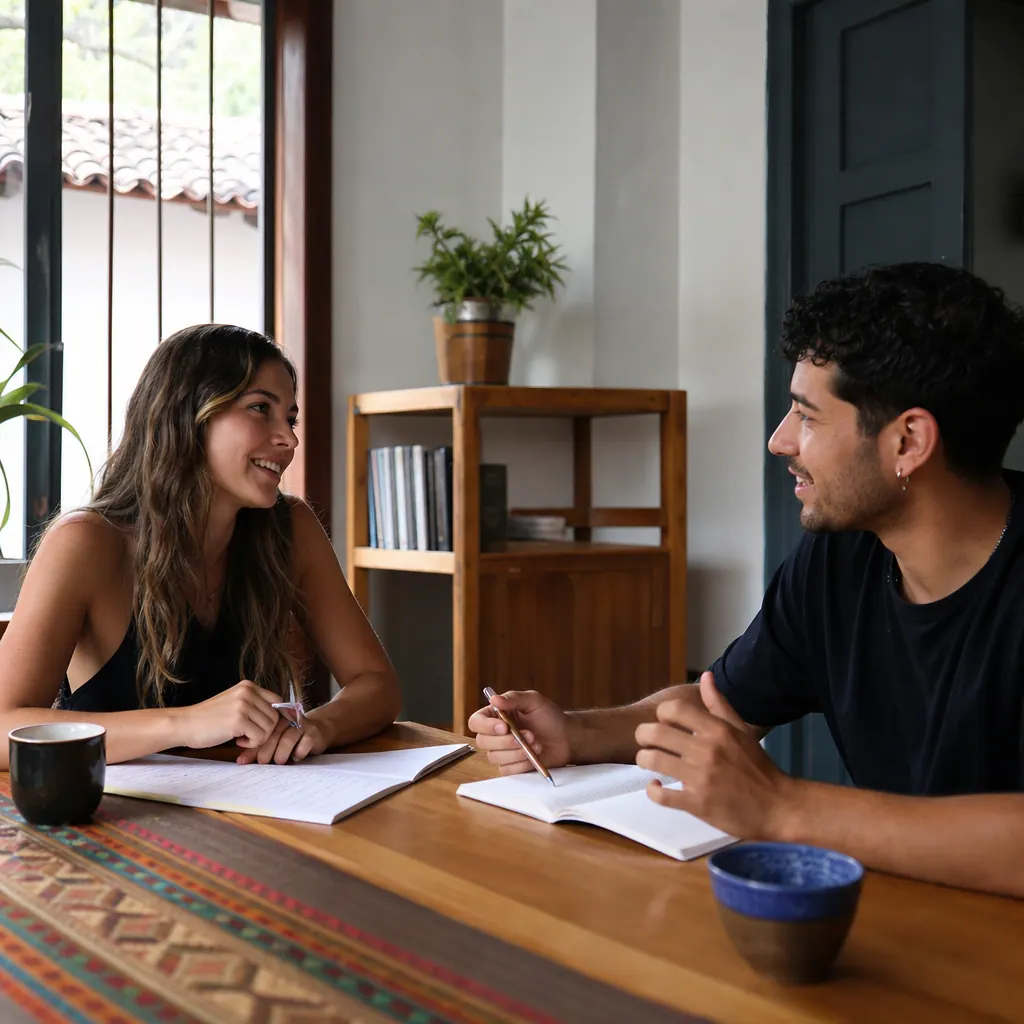
Formal schools aren't strictly necessary, but they're the fastest on-ramp if you're starting below intermediate. The structure forces actual grammar study rather than collecting survival phrases — and most people underestimate how much grammar they need until they're stuck in a real conversation.
Group Classes
Typically two to four hours per day, five days a week, with four to eight other students. Good for building habits and meeting other learners. Costs run roughly 500,000–1.5M COP per week depending on intensity and school quality. Most schools in Medellín and Bogotá offer short tourist packages (one to two weeks) as well as longer enrollment. Don't expect the same linguistic intensity as one-on-one work, but the social environment keeps you showing up.
Private Lessons (Clases Particulares)
One-on-one instruction at your pace and schedule. This is where most people make their fastest progress — the teacher can address exactly where you're stuck, not what the curriculum prescribes. Private tutors are easy to find through university bulletin boards (UPB and EAFIT in Medellín, Universidad Nacional in Bogotá and Medellín), language exchange apps, or locally posted ads. Expect 80,000–200,000 COP per hour for in-person sessions. Online platforms like italki connect you with Colombian or Latin American tutors at $10–20 USD per hour — worth considering if your schedule is irregular or you want to supplement in-person classes.
Intensive Immersion Programs
Full-package programs that combine four to five hours of class per day with a homestay — you live with a Colombian family, eat with them, deal with Spanish at breakfast and dinner. These run 300–600+ USD per week all-in, which is expensive by Colombian standards, but the immersion effect is real. You're speaking Spanish at meals and during cultural activities, not just in class. Best suited for people who want rapid results and won't self-motivate without external structure.
Schools that come up frequently in Medellín expat circles: New Tongue Language School, Toucan Spanish, and the foreign-student language programs at UPB and EAFIT. Quality varies among smaller schools — read recent reviews, and ask to meet the teacher before committing to a full week.
💡 Tip: Long-term stays need insurance
If you're staying 3–6 months for a language immersion program, sort health coverage before you arrive. SafetyWing Nomad Insurance is popular with expats who aren't yet enrolled in Colombian EPS — low cost, covers you across borders, and pays for emergency care at private clinics.
The No-School Approach: Exchanges and Self-Study
Plenty of expats reach functional fluency without ever enrolling in a formal program. It requires more discipline but costs significantly less and suits certain learning styles better.
The self-study stack that actually works: Anki for vocabulary retention (find or build a Colombian Spanish deck — prioritize words you actually hear, not textbook lists); italki or Preply for weekly one-on-one conversation sessions with a native tutor (even one hour a week provides accountability that pure self-study lacks); language exchange (intercambio) sessions with a local who wants English practice — you each get thirty minutes per language. Tandem and HelloTalk work for finding partners; so does simply asking at your gym or coworking space. Colombian media rounds it out: TV series like Café con Aroma de Mujer or La Reina del Flow work better for immersion than neutral content.
The honest caveat: language exchange arrangements fall apart easily when both people get busy. Schools win for people who need external accountability. If you consistently reschedule intercambio sessions, that's your sign to pay for structure instead.
📖 Keep Reading
Language practice is also a fast track to actual friendships. Read: How to Make Friends in Colombia as a Foreigner →
What Actually Makes You Fluent
There's a clear pattern between expats who get genuinely conversational within six months and those who spend a year in Colombia and still struggle with anything beyond the basics. It's rarely about natural aptitude.
⚡ Fast vs. slow language progress in Colombia
| Fast progressors do this | Slow progressors do this |
|---|---|
| Speak Spanish even when it's embarrassing | Wait until they feel "ready" to speak |
| Live outside the expat bubble (Laureles, not Poblado) | Live in El Poblado and default to English |
| Handle bureaucracy in Spanish — lease, bank, utilities | Use Duolingo as their only "study" tool |
| Do grammar study to lock in patterns | Rely entirely on "absorbing it" passively |
Colombia's specific advantage as a language environment is the social friction, or rather the lack of it. Locals genuinely don't make you feel bad for trying. That lowers the fear of embarrassment enough that if you push yourself to engage — sign the lease, call the utility company, argue about the restaurant bill — real progress follows. The country does its part. You have to do yours.
One thing that genuinely helps that people underestimate: dealing with Colombian bureaucracy in Spanish. Signing a lease requires reading a contract and asking questions. Getting your cédula de extranjería sorted requires navigating an appointment system. Even a dispute with your internet provider forces you to listen carefully. These aren't language classes, but they teach you the Spanish you actually need — and fast.
📖 Keep Reading
Planning to work remotely while you learn? See: Colombia Digital Nomad Visa: How to Apply → and Best Coworking Spaces in Medellín and Bogotá →
Frequently Asked Questions
❓ Is Colombian Spanish the easiest Spanish to learn as a beginner?
Many language learners say yes — specifically the interior accents of Bogotá and Medellín. Words are clearly enunciated, the pace is slower than Caribbean Spanish, and the grammar stays close to standard textbook Spanish. If you learned Spanish in a classroom, Colombian speech patterns will sound the most familiar.
❓ How long does it take to become conversational in Spanish in Colombia?
With three to four hours of daily input (classes plus real-world use), most motivated beginners reach functional conversational level in three to six months. Part-time learners with a couple of hours per week should budget twelve months or more. The biggest variable isn't class time — it's how much Spanish you actually use outside of sessions.
❓ Do I need Spanish before arriving in Colombia?
Not strictly — Medellín and Bogotá both have enough English speakers that you can function for a few weeks without it. But you'll hit a ceiling fast without Spanish, especially for housing, services, and anything outside the tourist zone. Even a month of Duolingo or a few italki sessions before you fly in noticeably smooths the first few weeks.
❓ Are language schools in Colombia cheaper than in Guatemala or Spain?
Generally yes. Colombian programs typically cost 30–50% less than equivalent schools in Spain. Quality at the better schools is solid, and the lifestyle infrastructure in Medellín and Bogotá is considerably more comfortable than many Guatemala-based immersion destinations. Guatemala (especially Antigua) is still popular, but Colombia competes well on both value and quality of life.
❓ Where can I find a free language exchange partner in Colombia?
Check expat Facebook groups for Medellín and Bogotá — intercambio posts are common. Tandem and HelloTalk both work for finding partners online. Colombians studying English at university are especially motivated partners, since they need conversation practice for their own studies. Coworking spaces and gyms are also underused sources — it's a normal thing to ask about, not a strange request.
🗣️ Have questions about learning Spanish in Colombia?
Ask the community — there are plenty of expats at every stage of the language journey at colombiamove.com/comunidad




Comments
Loading comments...
Checking sign-in status...